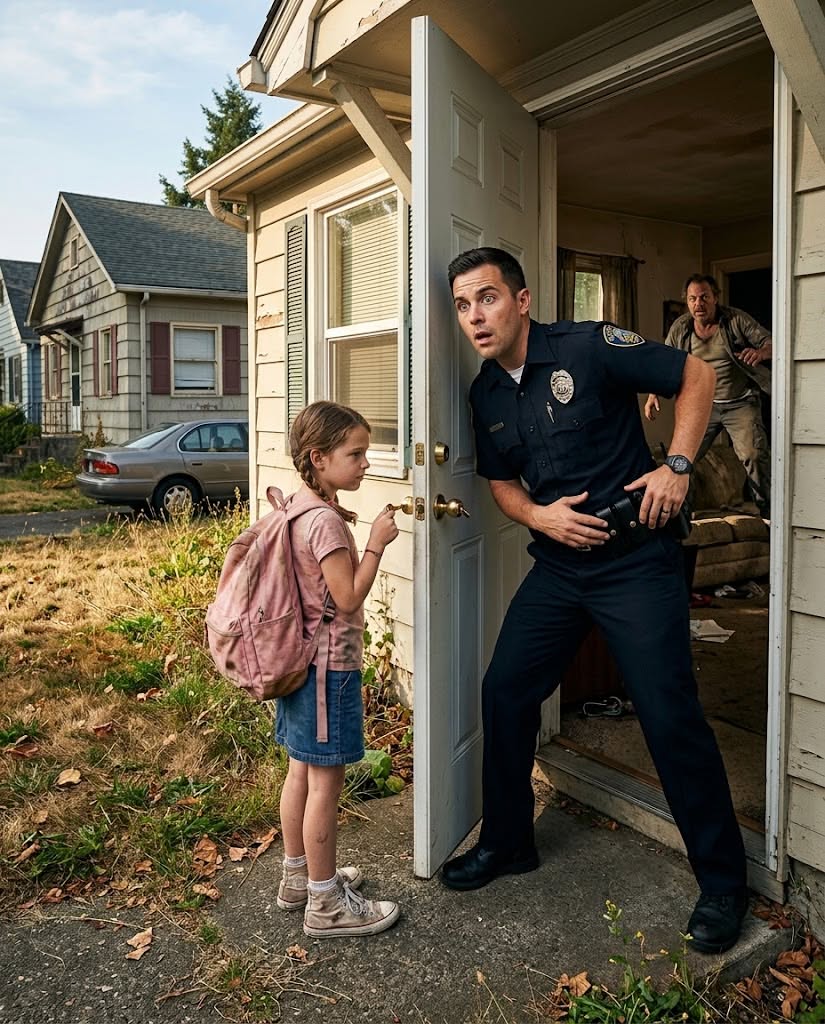
The brass key trembled between Brenna’s tiny fingers.
For a moment, she just stood there in front of the old wooden door, staring at it as if she was gathering every bit of courage she had left.
I gently placed my hand near her shoulder.
“Brenna, you don’t have to be afraid.
We’ll figure this out together.”
She looked up at me, her eyes filled with a mixture of fear and hope.
“I’m not afraid of the house,” she whispered.
“Then what are you afraid of?”
She swallowed hard.
“I’m afraid you’ll see it… and then leave like everyone else did.”
Those words stayed with me.
Because children rarely fear the truth itself.
They fear being alone after they tell it.
Brenna slowly unlocked the front door.
The moment it opened, a strange silence surrounded us.
Not the peaceful silence of a quiet home.
It was the kind of silence that felt like something had been hidden for a very long time.
The inside of the house was dark despite the afternoon light outside.
The curtains were closed tightly, the furniture looked old and untouched, and the air smelled like a place that had not welcomed visitors in years.
“Mr. Radley?” I called out.
No answer.
Brenna stepped inside and motioned for me to follow.
She walked down a narrow hallway and stopped in front of a closed door.
“My room is here,” she said.
She opened it.
At first, I expected to see something terrible.
Something that explained why this child had carried such a heavy secret on her shoulders.
But what I saw confused me.
The room was almost completely empty.
There was only a small mattress on the floor, a few folded blankets, and a tiny stuffed rabbit with one missing ear.
No toys.
No books.
No pictures.
Nothing that belonged to a seven-year-old child.
I looked at Brenna.
“Where are your things?”
She lowered her head.
“I don’t have many.”
“Why not?”
She hesitated.
Then she walked across the room and pulled away a loose wooden panel near the wall.
Behind it was a small hidden space.
Inside were dozens of neatly organized items.
School drawings.
Certificates.
Birthday cards.
A collection of library books.
A small box filled with photographs.
I picked up one picture.
It showed Brenna smiling beside a woman who looked like her mother.
“Who is she?” I asked quietly.
Brenna’s face changed.
“That’s my mom.”
I looked at her.
“Where is she now?”
“She passed away three years ago.”
My heart sank.
Brenna continued.
“After that, Dad changed.”
She sat on the edge of the mattress.
“He stopped talking to people.
He stopped letting anyone visit.
He told everyone I was difficult and that I made things up.”
I stayed silent and listened.
“He said nobody would believe a little girl over him.”
That sentence made everything clearer.
Not because it revealed something about what happened inside the house.