
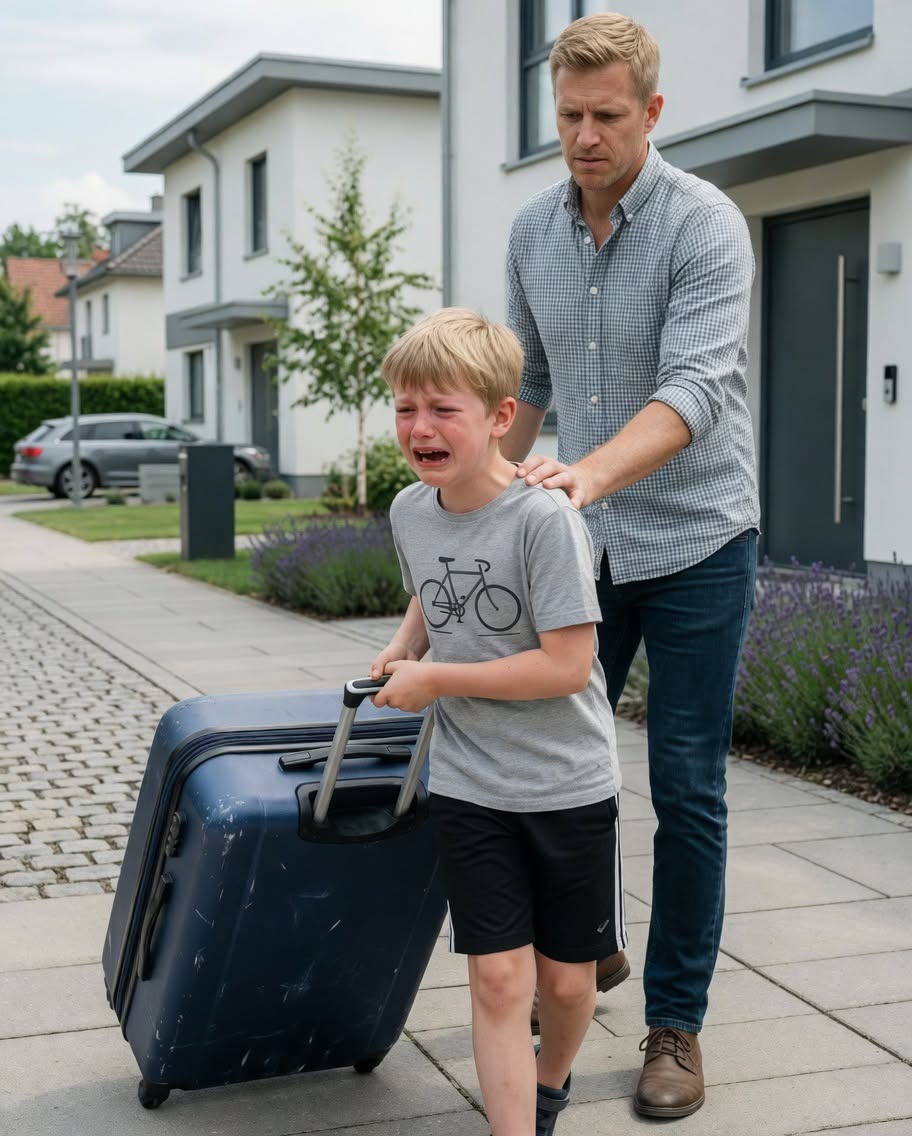
“Pack your things, Lukas. You aren’t my son. Your mother is dead, and I’m no longer responsible for you.”
He didn’t argue.
He didn’t cry.
The twelve-year-old simply bent down, picked up his worn-out backpack from the floor, and walked out into the cold night.
And the most shocking part?
No guilt. No hesitation. Just a strange sense of relief, as if a heavy burden had finally been lifted from my shoulders.
My name is Adrian Kohl, and I was thirty-six when my wife, Marina, suddenly died of a stroke. Her death tore our home apart overnight. But she didn’t just leave me behind.
She left behind her son.
Lukas.
A quiet, observant boy with deep brown eyes who had just turned twelve.
When I married Marina, Lukas was already part of her life. His biological father had long since vanished, leaving her to raise him alone. I often told others how generous I was to marry a woman with a child.
But the truth was far less honorable. That generosity was merely a facade.
I provided for Lukas. I paid for his schooling, bought his supplies, and ensured he had food and clothing.
Yet, in my heart, I never truly embraced him. To me, he was an obligation… not a son.
When Marina died, the fragile bond between us shattered completely.
He never complained. He never caused trouble. He remained quiet at dinner and was polite in every conversation.
Strangely, that silence only made it easier for me to push him away.
A month after the funeral, I told him to leave.
And he left. I never tried to stop him.
Shortly thereafter, I sold the house and moved to another city, determined to start over. My business flourished, and I built a comfortable, successful life for myself. Eventually, I remarried—a woman with no children and no complicated past.
For years, I told myself that Lukas was nothing more than a fading memory. Occasionally, a thought would surface: Had he survived out there?
But even those questions faded with time.
In my darkest moments, I told myself something cruel:
If he was gone… perhaps it was for the best.
I buried that part of my life in silence.
Or at least, I thought I had.
Ten years later, at forty-six, I had everything I had once desired—prosperity, stability, respect.
“Mr. Kohl,” a calm voice said, “we would like to invite you to the grand opening of the L.K. Art Gallery this Saturday. Someone has specifically requested your presence.”
“I’m not interested,” I replied quickly, ready to hang up.
But the voice continued.
“Don’t you want to know what became of Lukas?”
My hand froze.
The phone nearly slipped from my grasp.
His name echoed in my mind like something returning from the grave.
“What… did you say?” I asked, my throat suddenly tight.
“Lukas Kohl asked that you appear in person,” the voice said. “He mentioned that the exhibition wouldn’t be complete without you.”
I couldn’t answer.
I simply hung up.
I didn’t sleep that night.
Memories I had buried for a decade came flooding back all at once: the sound of the door closing behind him… the worn-out backpack… the look in his eyes that night.
I didn’t know if he wanted forgiveness… or revenge.
When Saturday arrived, the city felt alien to me, even though I had lived there for years.
Or perhaps the truth was simpler.
I was the one who had changed.
The new gallery stood in the heart of the artists’ district; its towering glass walls gleamed in the sunlight like a monument to perseverance. The initials were emblazoned on the façade:
L.K.
Lukas Kohl.
My heart raced as I stepped inside. The lobby was filled with journalists, collectors, and artists. Paintings and portraits hung on the white walls.
But one piece in the center made me stop dead in my tracks.
It depicted the blurred figure of an adult standing in a doorway… while a small boy with a worn-out backpack ran off into the darkness.
I didn’t need to read the title.
Yet my eyes drifted to the plaque.
“The Night I Lost My Father.”
“I had a feeling you would come.”
The voice behind me sent a shiver down my spine.
I turned around slowly.
And there he stood.
No longer the frightened child I remembered—but a grown man.
Tall, composed, with Marina’s gentle eyes and a quiet strength I had never seen in him before.
“Lukas…” I whispered.
He nodded slightly.
“Hello, Mr. Kohl.”
That form of address hit me harder than any insult.
I had never truly been his father.
“I thought you were dead,” I said, before I could stop myself.
“In a way, I was,” he replied calmly. “But sometimes, you only learn how to rebuild yourself after you’ve lost everything.”
He led me into a private room behind the gallery.
Sketches, photographs, and newspaper clippings lay on a table.
They told a story I had never known.