
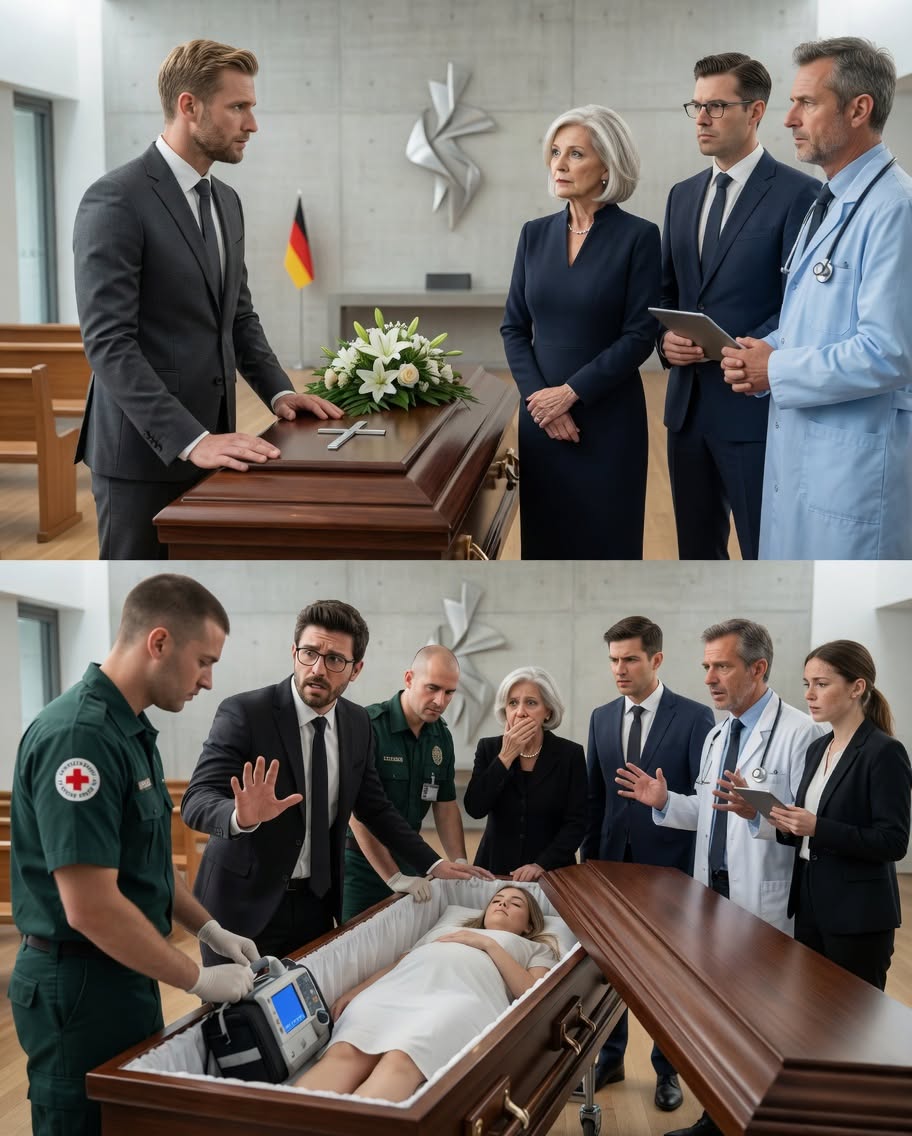
They were mere moments away from cremating my pregnant wife when something suddenly moved beneath the white burial shroud inside the coffin. And the people standing closest to the flames weren’t mourning.
They were waiting.
The crematorium smelled of incense, rainwater, and secrets. My mother-in-law, Helene von Walde, gently pressed a black lace handkerchief against eyes that were completely dry. Beside her, my brother-in-law Markus glanced impatiently at his watch, as if my wife’s funeral were interfering with his evening plans. Standing against the chapel wall was Dr. Kranich, the family physician, looking pale in the dim light.
“She’s gone, Daniel,” Helene said smoothly. “Please don’t make today any harder than it already is.” I stared at the coffin.
Inside lay my wife, Klara, dressed in the same white gown she had chosen for our baby shower. Seven months pregnant. According to them, she had suddenly died of heart failure before I could even reach the private clinic. Before I could touch her hand. Before I could say goodbye. It had all happened too fast. No transfer to a hospital. No police investigation. No autopsy. Just a signed death certificate, a sealed coffin, and the relentless pressure from the von Walde family to have her cremated before sunset.
Markus stepped so close to me that I could smell the expensive whiskey on his breath. “You married into this family, Daniel,” he muttered. “You don’t control it.” I was a mechanic’s son. The quiet husband they considered lucky to have married Klara. A nobody in borrowed black clothes. Or so they thought. I stepped toward the coffin. Helene immediately stepped in my path. “That’s enough.” “I want to see her one last time.” “No.” The answer came too quickly. Silence fell over the room. I slowly turned to Dr. Kranich. “If she really died of natural causes,” I said calmly, “then opening the coffin shouldn’t alarm anyone.” The doctor swallowed hard. Markus gave a soft laugh. “You’re making a fool of yourself.” “Then let me make a fool of myself properly.”
Near the cremation chamber, two attendants hesitated beside the furnace doors. Beyond them, flames glowed like a living creature waiting for sustenance. I looked straight at them. “Open it.” Helene suddenly snapped at me, “He has absolutely no authority here!” Without a word, I reached into my coat and unfolded a document. “Actually,” I said quietly, “I do.” Months earlier, following complications during Klara’s pregnancy, she had signed emergency medical directives appointing me as her legal representative in any disputed medical situation—including death. Helene’s face darkened instantly. The attendants slowly opened the coffin.
Klara’s skin was as pale as wax. Her lips had a faint bluish tinge. Her hands rested on her stomach beneath the white cloth. Then, her stomach moved. A tiny movement. Slight. Impossible. Someone audibly gasped. I didn’t move. Then it happened again. I stepped forward. “Stop everything—right now!”
Panic erupted in the crematorium. One attendant stumbled back in shock. Dr. Kranich whispered under his breath, “That’s impossible…” I grabbed him by the collar and pulled him down toward me. “Then explain it!”
For the first time, Helene’s voice faltered. “Those are just post-mortem muscle spasms,” she said quickly. “No,” I replied coldly. “Not like that.” Markus stepped toward the coffin. “Close it!” I turned slowly to face him. “Touch that coffin,” I said calmly, “and you’ll regret it.” He froze. Not because I raised my voice. But because I didn’t.
I called emergency services myself. Then I made another call. Detective Chief Inspector Mara Kühn answered immediately. “You were right,” I told her. “They rushed the cremation.” Her voice instantly sharpened. “Is the body still there?” “Yes,” I replied. “And the baby moved.” Silence. Then: “Don’t let anyone leave.”
Markus overheard enough to panic. “Who are you calling?” “The person I should have trusted before your family.” Helene narrowed her eyes. “You ungrateful little parasite.” I offered a smile devoid of warmth. “There she is.”
For years, Klara had warned me about her family. They owned clinics, influenced officials, controlled companies, and buried scandals beneath polished smiles. But Klara was smarter than all of them. Two weeks before her alleged death, she discovered tampered inheritance documents. If she and the baby were to die before the birth, the family fortune would pass directly to Helene and Markus. Then Klara uncovered pharmaceutical records linked to Dr. Kranich. Sedatives. Muscle relaxants. Drugs that slow the body down enough to mimic death. She secretly sent copies to me. And to Detective Kühn. Then Klara suddenly stopped answering her phone. When I arrived at the clinic, there were tears, police tape, and a doctor who calmly explained to me that my wife had “passed away peacefully in her sleep.”
Suddenly, the ambulance burst through the crematorium entrance. Paramedics rushed over and lifted Klara from the coffin. One of them shouted, “We have a pulse!” The chapel froze. A monitor picked up the baby’s heartbeat first. Rapid. Strong. Alive. Then Klara’s. Weak. Slow. But alive.
Markus tried to slip away immediately. Detective Kühn arrived before he could reach the elevator. “Markus von Walde,” she said calmly, showing her badge, “have a seat.” He scoffed nervously. “Do you even know who my family is?” Kühn nodded. “Yes. The white-collar crime unit has been investigating them for nearly a year.” The confidence drained from his face. Helene stared at me as if she had never truly seen me before. I stepped closer. “You thought Klara had married beneath her station,” I said quietly. Her mouth trembled. “But she married someone who listens.”
Klara woke up three days later. Her first words were not about herself. “The baby?” I held her hand tightly. “She’s alive.” Tears rolled silently down Klara’s face before slowly giving way to anger. “They did this,” she whispered. “I know.” “Dr. Kranich gave me the injection. Markus held me down. My mother watched.” I closed my eyes for a moment. Klara squeezed my hand. “Don’t lose your temper.” “I won’t.”
That is why we won. Not because we shouted the loudest. But because we documented everything. From her hospital bed, Klara gave detailed statements to detectives, prosecutors, and investigators. Toxicology reports confirmed the presence of drugs in her system. Security footage from the clinic—footage Markus believed had been destroyed—had already been copied to external servers. Klara was prepared for everything. They underestimated her.