“You don’t get to make my children stand on the porch of a house I helped you keep.”
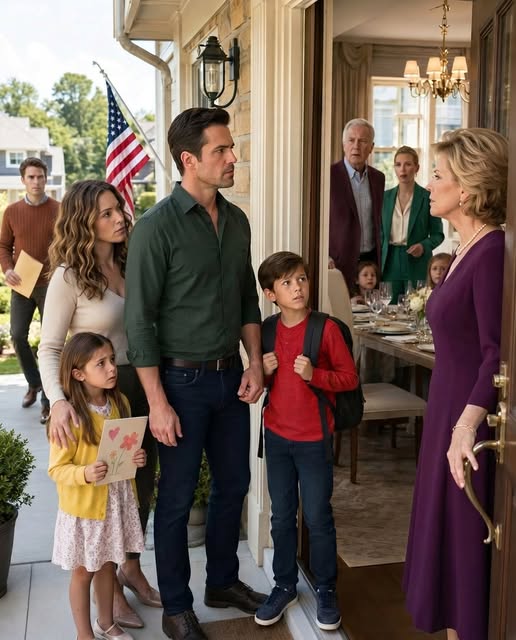
The words left my mouth so calmly that, for one strange second, no one moved. My mother stood halfway inside the open front door, one hand still wrapped around the brass knob, her church dress neatly smoothed, her smile locked in that careful expression she used when neighbors might be looking. Behind her, through the slim space between her shoulder and the doorframe, I could see the dining room table already prepared. White plates. Folded napkins. Crystal glasses they only brought out when guests were expected. My father sat at the head. My sister Melissa sat close to him, her three children already settled in their seats.
My two kids stood behind me on the porch with a chocolate cheesecake, a handmade card, and the kind of hopeful innocence children carry when they still believe grandparents are supposed to feel safe.
Tyler was nine, tall and lanky, all elbows and quiet attention. He had held the bakery box on his knees for the entire drive like it was something precious. Emma was seven and had covered a construction-paper card with foam hearts, crooked stars, and a purple marker message that said, “I love you Grandma,” with the G written backward. She had shown it to me at breakfast like she was presenting treasure.
Now the card dangled at her side.
My mother looked down at it, then looked away.
“Jack,” she whispered, leaning close enough for her perfume to slice through the spring air. “There just isn’t enough room.”
Some sentences do not sound loud when spoken, but they echo for years. That was one of them. Not enough room. Not for my children. Not at the table where I had eaten Thanksgiving turkey, birthday cake, dry pot roast, and every quiet family judgment of my childhood. Not inside the house whose mortgage I had silently helped pay for almost ten years.
I looked beyond my mother at my father. Richard Thompson had always known how to dominate a room without standing up. At sixty-seven, he was grayer and thicker around the waist, but he still carried that old foreman posture, heavy arms folded over his chest, chin raised like the whole world was a work crew waiting for orders. His fork hovered above his plate. Melissa glanced at me and rolled her eyes before turning back to her youngest, as if my children’s shame were only another inconvenience I had decided to exaggerate.
“Dad?” Tyler asked behind me.
That single word settled something inside me.
For thirty-eight years, I had been taught to explain, smooth things over, rescue people, apologize, pay, and act as if the responsibility had always belonged to me. I knew how to swallow discomfort so completely that people called me easygoing. I knew how to laugh off remarks that left invisible bruises. I knew how to send money with one hand while typing, “No problem, Mom,” with the other.
But I did not know how to look at my son’s confused face and call that family.
I shifted slightly, placing myself between my children and the doorway. “We’re leaving.”
My mother blinked. “Don’t be ridiculous.”
“I’m not.”
“Jack, it’s a seating issue.”
No,” I said. “It’s a pattern.”
Her eyes narrowed. She had always hated when I used calm words she could not easily dismiss.
Emma slid her little hand into mine. Tyler tightened his grip around the bakery box. Behind my mother, Melissa gave a small laugh, the same one she had used since high school whenever she wanted everyone to decide I was too sensitive before I had even finished talking.
“Over chairs?” Melissa called from the dining room.
I looked at her, then at the table, where her children had full plates waiting while mine had not even been counted.
“This was never about chairs.”
My father shoved his chair back. The legs scraped across the hardwood, a sound that once would have made my shoulders tense. I felt the old instinct rise in me, the one that told me to lower my voice and make the moment easier before his anger filled the room. But my son was watching. My daughter was holding a card nobody wanted. And for the first time, I understood that if I softened this moment, I would be teaching them to do the same someday.
My father stepped into the hall. “What did you just say to your mother?”
I looked at him and felt something almost peaceful pass through me.
“I said we’re leaving,” I answered. “And starting today, I’m not sending another mortgage payment.”