
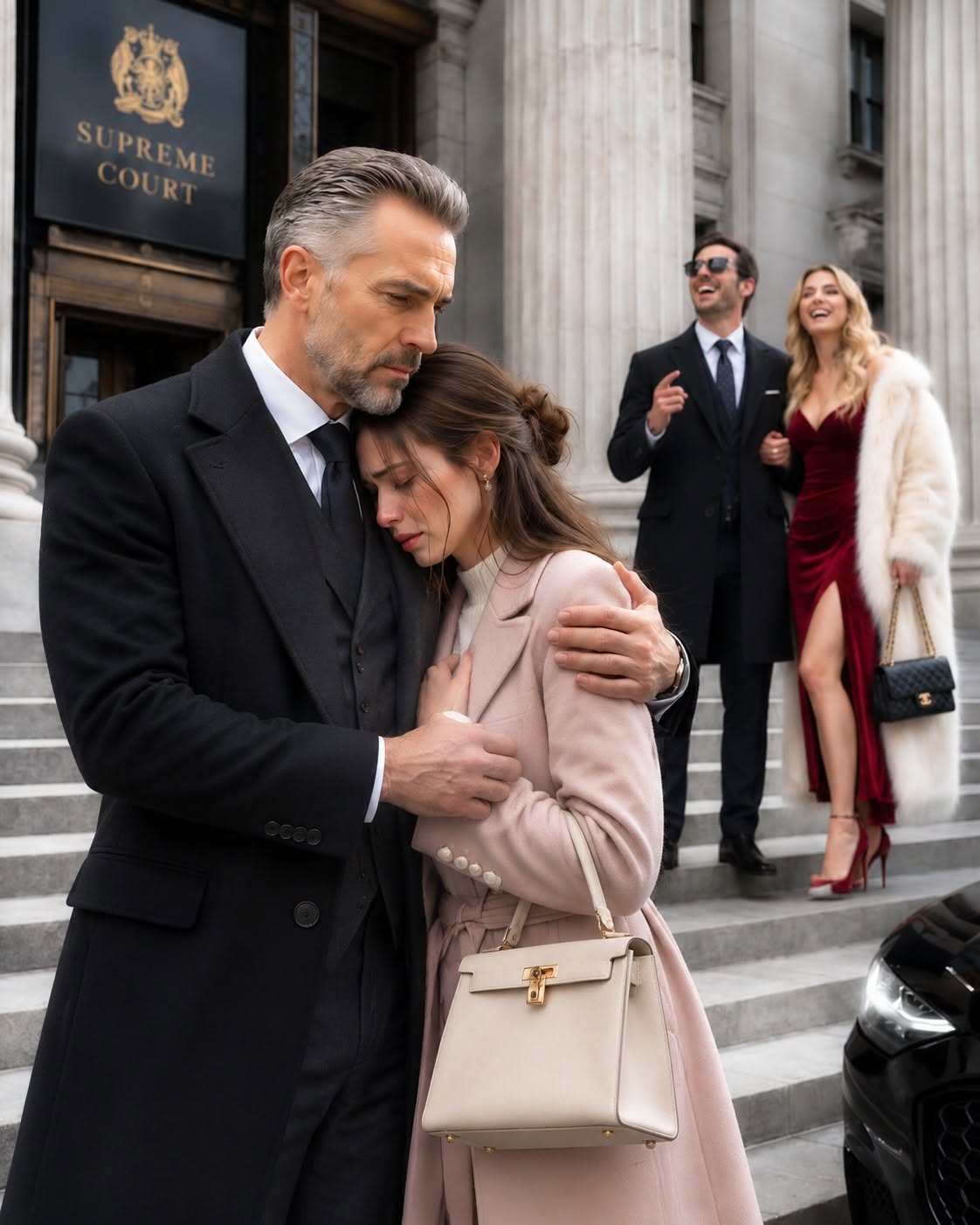
PART 2
For one full minute, neither my father nor I spoke.
The fraud alerts kept appearing on my phone, each one lighting the screen with a sharp little buzz against the wooden kitchen table.
Aurum House — $12,400.00 — declined.
Aurum House — $86,700.00 — declined.
Aurum House Jewelry Salon — $640,000.00 — declined.
Aurum House Private Dining — $258,900.00 — declined.
Then, finally, the number that made my stomach fold in on itself.
Aurum House — $998,000.00 — declined.
I stared at it until the glowing letters blurred.
A million dollars.
Not a careless dinner. Not a spiteful night out. Not a man trying to make his ex-wife jealous with champagne and oysters.
A million dollars.
My father sat across from me with his hands wrapped around a white coffee mug, the same one he had used every morning since I was sixteen. It had a small chip near the rim and the faded logo of a fraud investigators’ conference from twenty years ago. He looked calm, but not relaxed. There was a difference. Calm was the face he wore when he knew exactly how bad things were.
“Dad,” I said slowly, “what did you know?”
He took a breath.
Not a dramatic one. Not the kind people take before revealing some cinematic betrayal. It was tired. Heavy. The breath of a man who had been carrying something unpleasant and had hoped his daughter would never have to see it.
“I didn’t know for certain,” he said. “Not until today.”
“Today?”
He nodded once. “During the proceedings.”
I pushed back from the table slightly. The chair legs scraped against the tile. “You were sitting behind me the whole time.”
“I was.”
“You didn’t say anything.”
“I couldn’t.”
My first instinct was anger. Not at Daniel. That anger had already become familiar, like a bruise I pressed without thinking. This was different. This was aimed at my father, and it startled me because my father had been the one steady thing all day. The hand on my shoulder. The ride to the courthouse. The quiet presence beside me while Daniel’s attorney picked through five years of marriage like it was an estate sale.
“You couldn’t tell me my ex-husband might try to drain my accounts?” I asked.
Dad looked down at his coffee.
“I didn’t want to give you a suspicion I couldn’t prove. Not in the middle of a hearing. Not when your emotions were already being used against you.”
I knew exactly what he meant.
Daniel’s attorney had spent the morning painting me as fragile, resentful, overly sensitive. A grieving wife who had turned business success into bitterness. A woman who misunderstood Daniel’s “entrepreneurial risks.” A woman who had become “cold” after the miscarriage two years earlier. A woman who had, according to Daniel, “emotionally abandoned the marriage long before he ever found comfort elsewhere.”
Comfort.
That was the word they used for Vanessa.
Comfort with perfect hair, a cream silk blouse, and my husband’s hand resting on her lower back outside the courthouse.
I swallowed hard.
“What happened during the proceedings?” I asked.
My father reached into the inner pocket of his cardigan and pulled out a folded piece of paper. He placed it on the table but kept two fingers on top of it, as though he didn’t want it to slide too close to me yet.
“Daniel’s financial disclosure had a missing page.”
I frowned. “My attorney didn’t mention that.”
“Because it wasn’t missing from the official packet. It was missing from the copy his attorney handed your side during the recess.”
My heart began to beat differently.
Not faster exactly. Deeper.
“What page?”
“Authorized users and associated account privileges.”
I stared at him. “He was removed from everything.”
“From what your lawyer knew about,” Dad said. “From the joint accounts, yes. From the household card, yes. From the investment account, yes. But your business membership at Aurum House was never part of the divorce filing.”
“That’s not a bank account.”
“No,” he said. “It’s worse in some ways. It was a private club account backed by several payment methods, including old corporate cards and emergency credit lines you probably forgot were connected.”
I felt my face go cold.
Aurum House.
I had joined three years earlier because my company had hosted two client dinners there. It was never meant to be personal. I had put Daniel on the membership as a spouse because it seemed simpler at the time.
At the time.
So many disasters began with those three words.
“I thought that membership was dormant,” I said.
“It should have been.”
“But he used it tonight.”
“He tried.”
The alerts kept quiet for several seconds. Then another appeared.
Aurum House Gratuity Adjustment — $89,820.00 — declined.
I let out a small, humorless laugh before I could stop myself. “He tipped almost ninety thousand dollars?”
My father’s mouth tightened. “A man who thinks someone else is paying often becomes generous.”
The sentence should have been funny. It wasn’t.
Because beneath the ridiculousness of the number, I could see Daniel. I could picture him leaning back in a velvet chair, one ankle resting casually over his knee, speaking loudly enough for staff to hear. I could see Vanessa admiring the necklace against her throat while he told her not to look at the price. I could see him performing wealth he had not earned, confidence he did not deserve, certainty he had not checked.
I put both hands over my face.
“I was married to him,” I whispered. “I slept next to him. I planned a life with him.”
Dad’s voice softened. “You loved the version he let you see.”
“That doesn’t make me feel better.”
“No,” he said. “But it may help you stop blaming yourself.”
The phone rang before I could answer.
A number I didn’t recognize flashed on the screen with a Manhattan area code. My father glanced at it and reached for a small yellow notepad he kept beside the salt shaker. Even at home, even after retirement, Richard Hayes prepared for conversations like evidence.
“Put it on speaker,” he said.
I answered.
“Ms. Hayes?” a polished male voice asked.
“This is Emily Hayes.”
“My name is Adrian Voss. I’m the evening director at Aurum House. I apologize for calling at this hour.”
His tone was careful. Too careful. I could hear muted voices behind him, the low hum of music, and something that sounded like a door closing firmly.
“How can I help you, Mr. Voss?”
There was a pause.
“We have an active membership matter involving your account. A party is currently dining under your membership privileges, and multiple payment methods on file have been declined.”
“My ex-husband is not authorized to use my membership.”
“Yes, ma’am. We are now aware of that.”
Now aware.
My father wrote the words on his notepad and underlined them twice.
“I revoked his access months ago,” I said.
Another pause.
“I see a request in our system dated March fourteenth,” Adrian said slowly. “However, it appears the revocation was never finalized.”
My father’s eyes sharpened.
“Why not?” I asked.
“I am reviewing that with our membership office.”
“Mr. Voss, my divorce was finalized today. Daniel Whitmore is not my spouse. He is not my employee. He is not an officer of my company. He has no authority to charge anything to my cards, my accounts, or my business.”
“I understand.”
“Do you?”
My voice surprised me. It was not loud. It was not shaking. It sounded like someone I had not yet met but might someday become.
On the other end, the director lowered his voice. “Ms. Hayes, I do understand the seriousness of the situation. The charges have not been approved. No payment has been collected from your accounts.”
“What about the necklace?”
“The item has not left the premises.”
My father wrote: Get written confirmation.
“I need written confirmation of that immediately,” I said.
“Yes, of course.”
“And I want all account access frozen.”
“Already done.”
“All recordings, receipts, authorization attempts, employee notes, and membership logs preserved.”
The silence on the line changed. It became less polished.
“Ms. Hayes—”
“My father is a retired financial fraud investigator,” I said. “He is sitting beside me. I am asking politely right now.”
Dad looked at me, and for the first time that night, pride softened the edges of his face.
Adrian Voss exhaled. “I will preserve all relevant records.”
“Thank you.”
“There is one more matter,” he said.
I waited.
“Mr. Whitmore is insisting he has written authorization from you.”
My body went still.
My father stopped writing.
“What kind of written authorization?” I asked.
“He claims to have a document granting him continued use of your corporate hospitality privileges for a period of six months after the divorce.”
I looked at my father. He looked back at me with an expression I had only seen a few times in my life. It was the face he wore when a simple problem had become a trail.
“I signed no such document,” I said.
“I understand.”
“No,” I said carefully. “Listen to me. I signed no such document.”
This time Adrian did not answer right away.
In the background, I heard a woman’s voice, sharp and rising. Vanessa. Then Daniel, lower but unmistakably angry.
“Ms. Hayes,” Adrian said, “would you be willing to provide a statement to that effect by email?”
“Yes.”
“I’ll send a secure link within five minutes.”
“Do that.”
I ended the call and stared at the phone.
My father leaned back in his chair.
There were nights when a house seemed to understand before the people inside it did. The kitchen had gone very quiet. The refrigerator hummed. Rain tapped gently against the window over the sink. Somewhere down the hall, the old grandfather clock my mother had loved marked the hour with a soft, patient tick.
“A document,” I said.
Dad nodded.
“Could he have forged my signature?”
“Possibly.”
“That’s a crime.”
“Yes.”
“And he did it before the divorce was final.”
“Maybe.”
“Dad.”
He looked at me.
“Tell me what you’re thinking.”
He folded his hands on the table.
“I’m thinking Daniel may not have gone to Aurum House tonight just to celebrate.”
I frowned. “What else would he be doing?”
“Testing access.”
The words moved through the room like a draft.
“Testing access to what?”
My father’s gaze shifted to my laptop bag sitting near the entryway. “Your business.”
I wanted to reject it immediately. Daniel had never cared about the actual business, only what it gave him. The dinners, the contacts, the vacations disguised as networking trips. My company, Hayes & Bloom, created boutique event strategies for museums, foundations, and private cultural institutions. We were not a giant corporation. We were twelve employees, two consultants, and a small office with too many plants because my cofounder, Natalie, believed greenery improved invoice collection.
There was nothing there for Daniel to take.
Except there was.
Client lists. Vendor agreements. Payment portals. Membership accounts. Insurance policies. Lines of credit. Reputation.
And Daniel knew just enough about all of it to cause damage.
My phone buzzed with the secure email from Aurum House. Before I opened it, another message appeared.
This one was from Natalie.
Are you awake?
I almost laughed again.
Awake. As though sleep was still a country I had permission to enter.
I typed back.
Yes.
Her reply came instantly.
Did Daniel just try to use the company’s Aurum membership?
I stared at the screen.
Dad leaned forward. “Who is that?”
“Natalie.”
“What did she say?”
I turned the phone toward him.
His expression hardened.
“Call her,” he said.
Natalie answered on the first ring.
“Oh, thank God,” she said. “Tell me you’re okay.”
“I’m at my dad’s. What happened?”
“I got an alert from the corporate card administrator.”
“I changed all the PINs.”
“I know. That’s why it flagged. Emily, he tried every card on file. Every single one.”
“I saw.”
“No, you don’t understand. He didn’t just try the cards. Someone logged into the old vendor portal from Daniel’s email address at seven fifty-two tonight.”
I stood up so abruptly the chair nearly tipped behind me.
“What vendor portal?”
“The legacy one. The account we used before we switched platforms last year.”
“That account was closed.”
“It was supposed to be archived. Not closed.”
My father was already reaching for his notebook again.
“What did he access?” I asked.
“I’m still checking. The login was brief. Seven minutes, maybe eight. But he downloaded something.”
My skin prickled.
“What?”
Natalie’s breath trembled. “A client deposit schedule.”
I closed my eyes.
The client deposit schedule showed upcoming payments from three major accounts. It also showed banking references, project codes, and contact names. Not enough for a clean theft by itself, but enough for someone clever or desperate to create confusion.
“When?” I asked.
“About an hour before the Aurum charges.”
Dad wrote: Timeline.
“Why would he download that?” I asked.
Natalie went quiet.
“Natalie?”
“I didn’t want to tell you this today.”
My stomach tightened. “Tell me what?”
“Daniel called me yesterday.”
Of all the things she could have said, that one landed strangely. Not with shock, but with a tired, familiar ache.
“What did he want?”
“He said the divorce was going to be harder on you than you realized. He said you might make emotional decisions that could damage the company. He suggested I speak to our bank about requiring dual approval on large transfers.”
My mouth went dry.
“That sounds almost responsible,” I said.
“I know.”
“But it wasn’t.”
“No.” Natalie’s voice lowered. “Because then he said if I ever needed someone who understood both you and the business, he would be willing to advise us through the transition.”
I opened my eyes.
The kitchen window reflected my face back at me, pale and tense beneath the warm overhead light.
“He wanted into the company,” I said.
“He wanted me to invite him in,” Natalie replied.
My father’s expression did not change, but his pencil snapped in his hand.
Natalie heard the silence. “Emily?”
“I’m here.”
“I told him no,” she said quickly. “Obviously. I told him that if he contacted me again about company matters, I would forward it to counsel.”
“What did he say?”
“He laughed.”
Of course he did.
Daniel laughed when he wanted people to feel small. He laughed when a waiter mispronounced a wine. He laughed when I cried in the laundry room because another pregnancy test had been negative. He laughed the night I asked whether Vanessa was just a colleague, and he kissed my forehead like I was a nervous child.
“What kind of laugh?” I asked, though I already knew.
Natalie hesitated.
“The kind he uses when he thinks he knows more than you do.”
Rain whispered against the glass.
My father rose from the table and walked to the counter. He took an old file folder from a drawer, the kind he used for tax receipts and appliance warranties, and placed it beside me.
“Print everything,” he said.
Natalie heard him. “Is that Richard?”
“Yes.”
“Thank God. Richard, what do we do?”
My father leaned toward the phone. “First, nobody panics. Second, nobody deletes anything. Third, you lock every account that Daniel ever touched, saw, guessed, borrowed, or bragged about understanding.”
“I’m already on it.”
“Good. Send Emily screenshots of the login history. Send them to her personal email and company counsel. Do you have cyber liability coverage?”
“Yes.”
“Notify them.”
“At ten o’clock at night?”
“At ten o’clock at night,” Dad said. “And use the word unauthorized.”
Natalie took a breath. “Okay.”
“Also,” he added, “do not call Daniel. Do not text Daniel. Do not answer Daniel.”
“I wasn’t planning to.”
“Plans change when someone tries to scare you.”
There was a pause, then Natalie said softly, “He already did.”
I gripped the edge of the table.
“What do you mean?”
“He sent me a message five minutes ago.”
“Read it.”
Natalie was quiet for a few seconds. Then she read, her voice tight.
“Tell Emily she shouldn’t embarrass herself tonight. I can still make this simple for everyone.”
My father’s eyes narrowed.
I laughed once, very softly.
Not because it was funny.
Because there it was. Daniel’s favorite trick. Offer the injury, then call mercy a favor. Break the glass, then present himself as the only person who knew where the broom was kept.
“What did you say?” I asked.
“Nothing.”
“Good.”
The secure link from Aurum House waited in my inbox. I opened it on my laptop with my father beside me and Natalie still on the phone. The form was simple, almost too simple for the size of what had happened.
I, Emily Hayes, confirm that Daniel Whitmore has no authorization to use, access, charge against, or represent himself under any personal, corporate, or hospitality accounts belonging to Emily Hayes or Hayes & Bloom LLC.
I read it twice before signing.
My hand hovered over the trackpad.
For years, my signature had given Daniel things. A shared lease. A joint account. A vacation upgrade. Permission to pick up a car from valet. A spousal membership. Forgiveness written into birthday cards and holiday letters and the backs of envelopes after arguments.
This signature took something back.
I clicked submit.
Almost immediately, my phone rang again.
Daniel.
His name on the screen did not hurt the way I expected it to. Earlier that morning, it might have felt like a door opening in my chest. Now it looked like what it was: a problem.
“Don’t answer,” my father said.
“I won’t.”
The call ended. Then came another. Then another.
A text appeared.
Emily. There’s been a misunderstanding.
Then:
Call me. Now.
Then:
You’re making this worse.
Then:
Do you have any idea what you’ve done?
I read the last one twice.
Then I typed one message, careful and clean, while my father watched.
All future communication should go through counsel.
I sent it.
Daniel responded almost immediately.
Don’t hide behind lawyers. This is between us.
I did not reply.
Natalie let out a low whistle over the phone. “He hates losing direct access.”
“He always did,” I said.
The words came out before I could decide whether they were true. But once they were there, I realized they were.
Daniel had loved access more than intimacy. Access to my calendar, my contacts, my father’s advice, my company’s prestige, my patience. He had confused being let in with being owed a key forever.
My father placed a hand briefly on my shoulder.
“You’re doing well,” he said.
I shook my head. “I don’t feel like I am.”
“That’s not the same thing.”
At Aurum House, the scene must have been unraveling carefully, politely, behind heavy doors and discreet staff expressions. No public spectacle. No shouting in the lobby, if Adrian Voss was good at his job. Just the quiet humiliation of wealth refusing to materialize.
Part of me wanted to imagine Vanessa’s face when the necklace was removed from the velvet tray. Part of me wanted to imagine Daniel forced to explain himself, his polished confidence shrinking under the weight of declined cards.
But that feeling did not last long.
Underneath it was something sadder.
I had not wanted to win like this. I had wanted not to need a victory at all.
I had wanted a marriage where my father did not have to tell me to change ten PINs outside a courtroom. I had wanted a husband who came home when he said he would. I had wanted the child we lost. I had wanted the little blue nursery we painted too early and closed the door on too late. I had wanted Daniel to grieve with me instead of drifting toward someone who admired the version of him untouched by sorrow.
For a while, the kitchen blurred.
Natalie seemed to sense it. Her voice gentled.
“Em?”
“I’m okay.”
“No, you’re functioning. That’s different.”
I wiped my cheeks quickly, irritated by the tears.
My father did not tell me not to cry. He never had. After my mother died, when I was twenty-four, he had sat beside me on the back steps and said, “Grief is not a leak, Emily. You don’t fix it by tightening something.” Then he had cried too, silently, looking out at the yard where she used to plant basil.
Now he passed me a paper towel without a word.
“I hate that he can still make me feel stupid,” I said.
Natalie replied immediately. “You are not stupid.”
“I let him use everything. My accounts. My name. My company. My life.”
“You were married,” she said. “Trust is not stupidity.”
My father nodded. “And fraud depends on trust. That’s why it wounds twice.”
I looked at him.
He had spent three decades saying things like that about strangers. People in reports. Victims in case files. Elderly couples, small business owners, widows, young professionals who thought love and paperwork lived in separate rooms.
Now he was saying it about me.
Another call came in, but this time it was not Daniel.
It was my attorney, Marisol Grant.
I answered immediately.
“Emily,” she said, “I just received a message from Daniel’s attorney claiming you are interfering with his ability to settle a legitimate marital expense.”
My jaw tightened. “At Aurum House?”
“So you know.”
“He tried to charge almost a million dollars to my business account.”
Marisol was quiet for half a second. “I’m sorry. Did you say almost a million?”
“Yes.”
My father leaned closer and said clearly, “$998,000 in attempted charges, including jewelry.”
Marisol heard him. “Richard, is that you?”
“It is.”
“Good. Tell me everything.”
We did.
Not dramatically. Not emotionally. My father guided it like an interview. Times. Dates. Names. Messages. Alerts. The March fourteenth membership revocation request. Daniel’s claim of written authorization. The vendor portal login. Natalie’s message. The timing.
By the end, Marisol’s voice had changed.
Earlier that day in court, she had been composed and precise, a woman with navy suits and quiet eyes who knew how to wait out bluster. Now there was a new edge beneath her calm.
“Emily,” she said, “do not engage with him directly. Richard, make sure she preserves all texts and call logs.”
“Already started.”
“Natalie should send the vendor access information to our office tonight. I’m going to notify Daniel’s counsel that any claim of post-divorce authorization must be produced immediately.”
“What happens if the document is fake?” I asked.
“Then Daniel has much larger problems than an unpaid dinner.”
I looked at my father. He did not smile.
Marisol continued. “There’s something else. During negotiations, Daniel pushed very hard to keep personal responsibility for his business debts out of the final language.”
“I know,” I said. “I thought he was just being difficult.”
“He may have been more than difficult.”
“What does that mean?”
“It means I want to review whether he anticipated a liquidity issue.”
“A what?”
“A cash problem,” my father said quietly.
Marisol sighed. “Daniel presented himself as financially stable. If that was untrue, and if he concealed debts or obligations during the divorce, that matters.”
My mind went back to the courthouse. Daniel standing straight in his tailored charcoal suit. Daniel’s watch glinting when he signed. Daniel smiling like a man who had walked away clean.
“What kind of debts?” I asked.
“I don’t know yet,” Marisol said. “But his attorney sounded nervous.”
That sentence settled over the kitchen.
“His attorney is always unpleasant,” I said. “Nervous is different.”
“Exactly.”
After we ended the call, Natalie promised to send everything and lock down the old portal. My father made a fresh pot of coffee no one needed. I opened my laptop and began forwarding emails into folders: Aurum, Daniel Texts, Vendor Portal, Divorce Follow-Up.
The practical tasks helped. They gave my hands a purpose.
At 11:17 p.m., Adrian Voss sent written confirmation that all charges had been declined, no goods had left the premises, Daniel Whitmore had been removed from all membership privileges pending review, and Aurum House would preserve records connected to the incident.
At 11:26 p.m., Marisol forwarded a message from Daniel’s attorney.
My client maintains that Ms. Hayes verbally permitted use of the Aurum House membership for celebratory purposes previously planned during the marriage.
I read the sentence aloud.
My father stared at the email.
“Celebratory purposes,” he repeated.
“Apparently my divorce was very festive.”
He gave me a look, and for a second, we almost laughed. Almost.
Then another email arrived from Marisol.
Daniel’s counsel says he will provide supporting documentation tomorrow morning.
Tomorrow morning.
Daniel had bought himself time.
My father saw the thought cross my face.
“Forgery isn’t always a signature,” he said.
“What else could it be?”
“An email. A text taken out of context. An old message altered. A PDF created from pieces of something real.”
I thought of every message I had ever sent Daniel. Every logistical note. Every “that’s fine.” Every “use the card.” Every “we’ll sort it out later.”
Marriage was full of informal permissions. Love made people careless with records.
“What if he has something that looks real?” I asked.
“Then we show what is true.”
I wanted to ask if truth always mattered.
But my father had spent too long in fraud work for me to insult him with that question. He knew better than anyone that truth mattered most when someone tried to bury it.
Near midnight, he made toast. It was such an ordinary thing that it nearly undid me. He buttered two slices, cut mine diagonally the way he had when I was little, and set it beside my coffee.
“You need food,” he said.
“I need my life to stop turning into paperwork.”
“One slice first.”
I took a bite because arguing with Richard Hayes over toast was pointless.
For a while, we sat quietly. The rain softened. The fraud alerts stopped. Daniel stopped calling.
That should have made me feel safer.
It didn’t.
The absence of noise felt like a man stepping out of view.
I slept in my childhood bedroom that night, or tried to. My father had never turned it into an office, though he had replaced the bedspread and boxed up most of my old things. A few traces remained: a chipped ceramic horse on the bookshelf, a college debate trophy, the pale square on the wall where a poster had hung.
At 2:04 a.m., I woke from a dream in which Daniel stood in our old apartment holding a stack of blank checks and asking why I had made him do this.
My phone sat facedown on the nightstand.
For a moment, I did not turn it over.
I lay there listening to the house. Pipes settling. Rainwater dripping from the gutter. My father’s faint cough from down the hall.
Then I reached for the phone.
One new email.
From an address I did not recognize.
Subject: You should know what he kept.
No message body.
One attachment.
I sat up slowly.
Every sensible part of me knew not to open it. My father’s voice might as well have been in the room: Unknown attachment, unknown sender, no.
So I did not open it.
I took a screenshot and forwarded the email to Marisol with the subject line: Received at 2:04 a.m. — not opened.
Then I carried the phone down the hall.
My father’s door was open. His bedside lamp was on. He was awake, wearing reading glasses, a file open on his lap.
“Dad?”
He looked up immediately.
I held out the phone.
He read the email, then removed his glasses.
“You didn’t open it?”
“No.”
“Good.”
“Who would send that?”
“Someone who knows Daniel.”
“That narrows it down and somehow doesn’t help.”
He handed the phone back. “Forward it to Natalie’s cyber contact too.”
“I already sent it to Marisol.”
“Good. Now send it to cyber.”
I leaned against the doorframe.
“You were awake,” I said.
“So were you.”
“What are you reading?”
He glanced down at the file on his lap.
For one brief second, he looked older than he had that morning. Not frail. Never that. But worn at the edges, like the day had taken more from him than he wanted me to see.
“Dad?”
He closed the file.
“Something I should have told you sooner.”
The air between us changed.
“What?”
He gestured toward the chair near his dresser. “Sit down.”
“I don’t want to sit down.”
“Emily.”
I sat.
My father rested one hand on the file.
“Three months ago, Daniel came to see me.”
I stared at him.
“What?”
“He came here.”
“To this house?”
“Yes.”
“When?”
“Late March. You were in Boston for the museum conference.”
My mind scrambled to place the date. Late March. I had been exhausted, living on hotel coffee and panel discussions, texting Daniel only when necessary through lawyers. He had seemed distant, impatient, eager to finish the divorce.
“What did he want?”
“At first, advice.”
“From you?”
“He said he was worried about you.”
I laughed before I could help it. “Of course he did.”
“He said you were unstable. Angry. That you were making irrational financial decisions. He asked whether I would speak to you about being reasonable in the settlement.”
I felt heat rise in my face. “And you didn’t tell me?”
“I told him to leave.”
“That’s not the same thing.”
“No,” he said quietly. “It isn’t.”
The anger returned, complicated and sharp.
“Why wouldn’t you tell me?”
“Because you were holding yourself together by threads, and I didn’t want to add another one for him to pull.”
“I’m not a child.”
“I know.”
“Do you?”
His eyes lifted to mine.
The hurt in them stopped me.
“I know you’re not a child,” he said. “But I am still your father. Sometimes those two truths fight each other.”
The room went quiet.
On the dresser, a framed photograph of my mother watched us with her familiar half smile. She had loved Daniel at first. Everyone had. He was charming in rooms where charm was useful. He helped carry dishes. He remembered birthdays. He brought my mother yellow tulips the first time he came for dinner because I had mentioned, once, that she hated roses.
After she died, Daniel had been wonderful for exactly six weeks.
Then grief became inconvenient.
“What happened after you told him to leave?” I asked.
“He got angry.”
“Daniel always gets polite when he’s angry.”
Dad nodded. “He did. Very polite. He said I would regret choosing sides.”
My throat tightened. “He threatened you?”
“He implied.”
“With what?”
My father looked down at the file.
“He asked whether you knew everything about your mother’s estate.”
For a moment, the sentence made no sense.
“My mother’s estate?”
“Yes.”
“She didn’t have some secret fortune. She had life insurance, savings, the house interest, and that small investment account from her parents.”
“I know.”
“So what was he talking about?”
Dad did not answer quickly enough.
I stood. “Dad.”
He opened the file and removed a photocopy of an old bank statement. The paper had been handled many times. I recognized my mother’s name at the top.
Margaret Hayes.
Seeing it unexpectedly made my chest ache.
“What is this?”
“A trust account your mother set up before she died.”
I blinked. “What trust account?”
“She intended it for you.”
The room tilted slightly.
“For me?”
“Yes.”
“How much?”
“That isn’t the important part right now.”
“Dad.”
He rubbed a hand over his face. “At the time of her death, a little over four hundred thousand dollars.”
I sank back into the chair.
Four hundred thousand dollars.
My mother had been a school librarian. Careful, generous, practical. She wore sweaters with wooden buttons and saved wrapping paper if it was still nice. Four hundred thousand dollars sounded impossible until I remembered her parents’ old house in Queens, the one sold quietly after my grandfather died.
“Why didn’t I know?” I asked.
“Because she left instructions.”
“What instructions?”
“That you receive it when you turned thirty-five or at the end of your first marriage.”
My heart stopped on the last phrase.
At the end of your first marriage.
“My first marriage,” I repeated.
Dad looked away.
“She was cautious,” he said. “Her own sister went through a painful divorce. Your mother worried about inherited money becoming marital property or being used by someone else.”
I almost smiled at the bitter tenderness of it. My mother, who had seemed so gentle, had planned like a woman who understood storms.
“I’m thirty-four,” I said.
“Yes.”
“And my divorce finalized today.”
“Yes.”
“So the trust activates now.”
My father nodded.
The silence rang.
“Does Daniel know?”
“I don’t know how much he knows. But he knows something.”
I looked at the bank statement again. “How?”
“That’s what I’ve been trying to find out.”
I thought of Daniel visiting my father in March. Daniel asking about my mother’s estate. Daniel testing financial access tonight. Daniel claiming authorization. Daniel wanting Natalie to bring him into the business.
The pieces did not form a picture yet, but they no longer looked random.
“What does the trust have to do with Aurum House?” I asked.
“Maybe nothing,” Dad said. “Maybe he needed access to your accounts to locate where new funds would land. Maybe he thought tonight’s charges would go through before anyone noticed. Maybe he was trying to create leverage.”
“Leverage?”
“If he could make a large charge appear tied to you, or to your business, or to some supposed agreement between you, it could complicate things.”
I stared at him. “He’d create a financial mess so I’d negotiate?”
“He might.”
“That’s insane.”
“It’s not rational,” Dad said. “That doesn’t mean it’s uncommon.”
My phone buzzed in my hand.
A new message from Marisol.
Do not open the attachment. Forwarded to forensic review. Also, Daniel’s attorney just sent a document. I need you to look at it, but only after you sleep.
I almost laughed. Sleep had become everyone’s most unrealistic suggestion.
Then a second message arrived.
Emily, brace yourself. It appears to include your signature.
My father read it over my shoulder.
Neither of us spoke.
A forged signature was frightening enough. But the word appears was worse. It meant there was something familiar about it. Something close enough to require caution.
At 2:31 a.m., Marisol sent a secure preview.
The document opened in a protected viewer.
It was titled:
Spousal Hospitality and Transitional Access Agreement
My eyes moved down the page, catching phrases like continued courtesy access, reasonable personal charges, corporate hospitality privileges, post-separation transition, mutual understanding.
It was absurd. It was formal. It was written in the slippery language of people trying to make nonsense look administrative.
And at the bottom was my signature.
Emily Hayes.
For several seconds, I could not breathe.
Because it was mine.
Not a childish imitation. Not a shaky tracing.
Mine.
The curve of the E. The narrow loop of the y. The way I crossed nothing because my signature had always been more suggestion than spelling.
“That’s my signature,” I whispered.
My father leaned closer, his face grim.
“Maybe copied,” he said.
“From what?”
He did not answer.
But I knew.
There were thousands of places Daniel could have taken it from. Tax forms. Holiday cards. Closing documents. Company approvals. Love notes. The old anniversary letter where I had written that I trusted him more than anyone.
My stomach turned.
Then I noticed the date.
March fifteenth.
The day after my request to remove Daniel from the Aurum House membership.
I looked at my father.
“He made this because I tried to remove him.”
“Likely.”
“And Aurum never finalized the removal because this document appeared.”
“Maybe.”
“Who sent it to them?”
Dad pointed to the upper corner of the document. There was a small routing note embedded in the file preview.
Submitted by: V. Cole
For a long moment, I simply stared at the name.
Vanessa Cole.
Not Daniel.
Vanessa.
My mind replayed her outside the courthouse, her cream blouse, her satisfied smile, the way she laughed when Daniel said some women didn’t know how to keep a man.
I had thought she was an accessory to his arrogance.
But she had submitted the document.
“She was involved,” I said.
My father’s jaw tightened. “It appears so.”
The hallway seemed suddenly colder.
I had spent months imagining Vanessa as the woman who stepped into the life I lost. The mistress. The replacement. The person Daniel chose when marriage became hard.
But this was not perfume on a collar or a late-night text.
This was paperwork.
This was planning.
This was someone reaching into my life with both hands and moving pieces.
I stood and walked to the window. The rain had stopped, leaving the street shiny under the amber lamps. My father’s neighborhood looked peaceful in that way old neighborhoods do after midnight, every house holding its secrets politely behind curtains.
“Emily,” Dad said.
I turned.
He was looking at his phone now.
“What is it?”
“Marisol forwarded one more thing.”
“What?”
He handed me the phone.
It was a still image from Aurum House security footage, time-stamped 8:12 p.m.
Daniel sat at a private table in the Sapphire Room, one hand around a glass of red wine.
Vanessa sat beside him wearing the sapphire necklace.
Across from them was a third person.
A woman with silver hair cut neatly at her chin, wearing a dark green coat.
Her face was turned slightly toward the camera.
For a heartbeat, I did not understand what I was seeing.
Then my knees weakened.
Because the woman at Daniel’s table—the woman sitting calmly across from my ex-husband and his mistress less than an hour before they tried to charge nearly a million dollars to my account—was my mother’s younger sister.
My aunt Claire.
The woman who had stopped speaking to my father after my mother died.
The woman I had not seen in seven years.
And on the table in front of her, beside Daniel’s wineglass, was a folder stamped with the name of my mother’s trust.
Yes. The full story will be in the comments below.👇👇
END OF PART 2 – LIKE, SHARE AND COMMENT “THE ENTIRE STORY” IF YOU WANT TO READ THE FULL STORY