
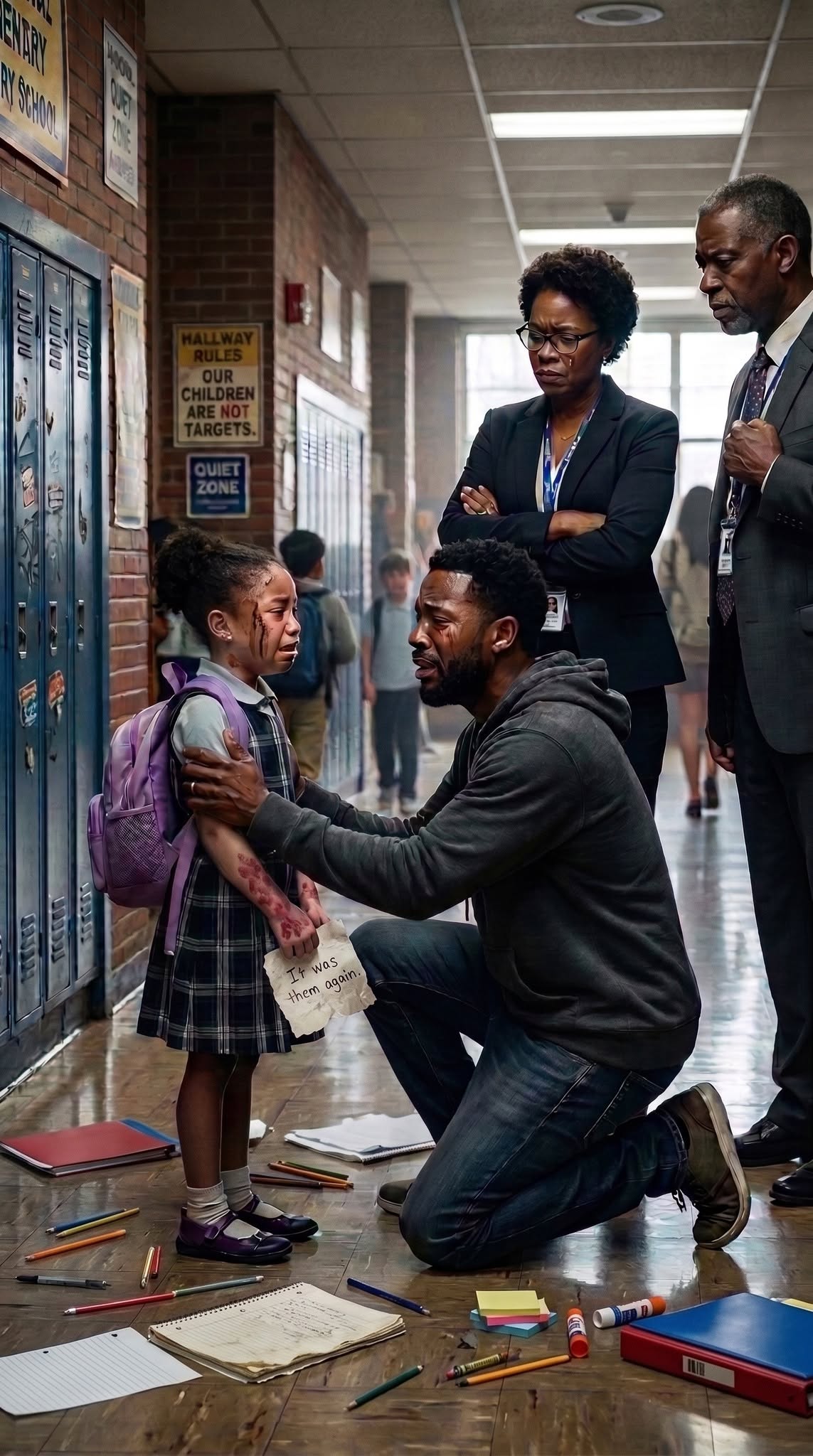
Chapter 1: The Weight of a Whisper
Sleep was a foreign concept that night. I sat anchored to a worn wooden chair at my kitchen table long after the house had surrendered to the heavy silence of the early morning hours. The harsh, blue light of my smartphone screen illuminated my exhausted face. I stared at the digital message sent by the administration of St. Catherine Academy until the meticulously typed words blurred into one ugly, undeniable truth: they were not trying to uncover what had happened to my six-year-old daughter, Lucía. They were orchestrating a cover-up.
By the time the first gray light of dawn crept through the blinds, an unshakeable resolve had solidified in my chest. If the academy’s polished administration refused to surrender the truth, I would have to pry it from their manicured fingers myself. I was a warehouse operations manager, not a wealthy donor. I possessed neither the political leverage nor the generational wealth that could terrify a prestigious private institution with a single, well-placed phone call. But I was Lucía’s father. And in that terrifying, lonely moment, that biological imperative was enough armor to keep me standing.
The following morning, I bypassed the school’s “recommended network” of physicians and drove Lucía to an independent clinic across town. Dr. Ellen Whitaker, a composed woman in her mid-fifties with kind eyes and a gentle demeanor, examined the archipelago of bruises flowering across Lucía’s shoulders, upper arms, and back. Dr. Whitaker’s hands were incredibly light. She did not interrupt when my daughter, clutching her threadbare stuffed bunny, whispered the fragmented narrative of her torment.
When the examination concluded, Dr. Whitaker asked me to step into the sterile, fluorescent-lit hallway. The maternal softness in her expression had completely evaporated, replaced by a chilling professional gravity.
“These discolorations are not consistent with the typical rough-and-tumble of a playground,” she murmured, her voice barely rising above the hum of the air conditioner. “Several of them are distinct contusions indicating a forceful, sustained grip. I am documenting every millimeter of this, Javier. And I am legally obligated to file an immediate report with Child Protective Services.”
A cold dread coiled in my gut, and I felt my knees threaten to buckle. I had desperately wanted a professional to validate my suspicions, but hearing a medical expert articulate the nightmare made it horrifyingly real. I peered through the narrow observation window of the heavy oak door. Lucía sat on the examination table, the crinkly sanitary paper rustling beneath her, hugging her stuffed animal as though it were a life raft in a turbulent ocean.
That afternoon, I dialed the academy’s front office. Director Martha Collins answered. Her tone was smooth, practiced, and dripping with corporate condescension—as if we were casually reviewing a discrepancy in my tuition invoice rather than the physical abuse of a child. I informed her that an independent pediatrician had thoroughly documented the trauma and that the state authorities would be contacting her office shortly.
For a fractured second, the line went dead silent. The polished veneer cracked. When Martha spoke again, her voice was a sharp blade wrapped in velvet. “Mr. Morales, I sincerely hope you understand that launching baseless, false accusations against our esteemed faculty can carry severe legal and financial consequences.”
A bitter, humorless sound escaped my throat. The threat was far too rehearsed.
“I am intimately familiar with consequences, Director,” I replied, my voice dangerously steady. “That is precisely why I am entirely unstoppable now.”
By Friday evening, the digital landscape of the parent group chat had mutated into a hostile wasteland. My peers had turned on me. Some offered passive-aggressive prayers for “everyone involved,” a sentiment that felt infinitely more toxic than outright hostility. Others vigorously defended Ms. Patricia, claiming she had shaped their children for years and was merely a “strict but loving disciplinarian.”
Kids exaggerate, one father typed, his willful ignorance glaring through the pixels. Schools need immunity from overly emotional, helicopter parents, another chimed in. I absorbed every toxic syllable without hitting reply. The isolation was suffocating.
Then, at precisely 11:43 p.m., the screen vibrated. A direct message materialized from an unknown number.
“My daughter was in Patricia’s class two years ago. She came home with bruises too. We pulled her out. I was too terrified of their lawyers to fight.”
My heart hammered against my ribs like a trapped bird. My thumbs hovered over the glass screen, shaking uncontrollably as I drafted a response. “Who is this?”
The blinking ellipsis felt like an eternity. Finally, the reply arrived, carrying a revelation that would pull me entirely into the abyss.
“My name is Renee Carter. Please don’t tell a soul yet. I have something you absolutely need to see.”
Chapter 2: The Ghosts of St. Catherine
The morning air was thick with humidity when I met Renee Carter at a claustrophobic, independent coffee shop miles away from the manicured lawns of St. Catherine. She looked like a woman who hadn’t slept in a decade. Dark, bruised circles hung heavy beneath her eyes, and her knuckles were stark white as she clutched a thick manila folder to her chest, terrified someone might rip it away.
Over cooling, bitter espresso, she unspooled her nightmare. Her daughter, Mia, had been assigned to Ms. Patricia’s first-grade classroom at the age of six. The descent had been gradual. First came the sudden, tearful refusal to eat breakfast. Then the nocturnal terrors and the regression into bedwetting. Finally, the undeniable, violent thumbprints blooming like dark ink on Mia’s fragile wrists.
“We raised hell,” Renee confessed, her voice fracturing into a raspy whisper. “But Director Collins sat across from us and called Mia ‘dramatically inclined.’ She praised Patricia as a pillar of the institution. They even deployed the school psychologist to suggest Mia was acting out because my husband and I were navigating a messy separation.”
Anger—hot, blinding, and absolute—surged through my veins. I recognized that insidious script. It was the same venom they had tried to feed me. Sensitive. Dramatic. Emotionally unreliable.
With trembling hands, Renee opened the folder. The contents were a graveyard of buried truths: high-resolution photographs of bruised skin, printed email threads dripping with administrative gaslighting, and the official withdrawal documentation.
One particular email from Martha Collins made my stomach churn: “While we empathize with your anxieties, there exists zero empirical evidence that Ms. Patricia acted inappropriately. We strongly advise seeking external emotional therapy for Mia.”
They had perfected this routine. Lucía wasn’t a tragic anomaly; she was merely the latest casualty in a protected hunting ground.
Renee swallowed a sob and slid one final artifact across the table. It was a crumpled sheet of lined paper. Upon it, scrawled in the uneven, wobbly handwriting of a traumatized first-grader, was a note: “Ms. P squeezes my arms when I cry. She whispers that nobody loves bad girls.”
I pressed my palm hard over my mouth, the metallic taste of adrenaline flooding my tongue. Renee frantically wiped at her cheeks, apologizing for tears she had earned the right to shed a thousand times over.
“I should have burned the place down,” she wept softly. “I convinced myself that running away was saving her. I didn’t realize I was just leaving the door open for the next child.”
“You did what you had to do to protect your blood,” I assured her, leaning forward.
“And so are you,” Renee replied, her red-rimmed eyes locking onto mine. “That is precisely why I am handing you the matches.”
By Monday, the whispers had turned into a chorus. Following Renee’s discreet outreach, my encrypted inbox swelled with messages from four separate families. The geography of their stories varied, but the architecture of the abuse was identical. The fear. The physical marks. The terrifying specter of Ms. Patricia. And, most damning of all, the administration’s relentless campaign to label the victims as pathological liars.
I transformed my dining room into a war room. I purchased heavy-duty binders, color-coded tabs, and meticulously cross-referenced medical records with digital correspondence. For the first time since my daughter had confessed her pain, the paralyzing terror was eclipsed by something far more dangerous: purpose.
But the academy was not entirely asleep. On Tuesday morning, a courier handed me a heavy envelope bearing the wax seal of St. Catherine’s elite legal counsel. The letter was a masterpiece of legal intimidation, explicitly stating that my “ongoing campaign of defamatory falsehoods” was inflicting severe reputational damage. They threatened ruinous litigation if I did not cease my communications immediately.
I sat in the cab of my truck, the engine idling, reading the threat. Inside the house, Lucía was safely watching cartoons with my sister, blissfully unaware of the dragons circling our castle. I slowly folded the heavy parchment in half, then again, and slid it into the front pocket of the master binder.
I knew they were scared. But as my phone buzzed with an incoming call from an unknown number, I realized the war had just escalated beyond my control.
Chapter 3: The Architecture of Silence
That evening, I sat in the austere, glass-walled office of Grace Mitchell. Renee had passed along her contact information with a hushed reverence. Grace was a former state prosecutor who had transitioned into private practice, specializing exclusively in child endangerment civil litigation. She possessed the icy, unblinking focus of an apex predator. When she reviewed my binder, she didn’t gasp. She didn’t express shock. She merely cataloged the evidence with the clinical detachment of a bomb squad technician.
“No more social media posts,” Grace commanded, closing the binder with a sharp snap. “No more engaging with the parent militia. No more dramatic ultimatums directed at the administration. Let them bask in the illusion that you are just an unhinged, grieving father. While they relax, we assemble a guillotine they cannot possibly dismantle.”
I inhaled sharply. The urge to drive to the academy, stand on the hood of my truck, and broadcast Lucía’s trauma through a megaphone was intoxicating. But Grace’s icy pragmatism anchored me.
“Can we force them to surrender the surveillance footage?” I asked, my voice tight.
“Eventually,” Grace noted, leaning back in her leather chair. “But first, we must apply structural pressure to the right pressure points.”
The pressure manifested swiftly. Armed with Dr. Whitaker’s report, Child Protective Services initiated a formal inquiry, scheduling interrogations with Lucía, Ms. Patricia, and the administrative staff. The academy retaliated by issuing a sprawling, chillingly detached manifesto to the entire parent body. They proclaimed their “unwavering confidence” in their pedagogical staff and condemned the “malicious attempts to weaponize a young child’s temporary emotional confusion.”
Weaponize.
The word struck me like a physical blow. My daughter was not a weapon. She was a tiny, fragile human being who now instinctively flinched if I raised my hand too quickly to grab a coffee mug. She was a little girl who had begun interrogating her own soul, asking if she was inherently wicked because her teacher had assured her that “bad girls cause trouble.”
I printed their grotesque manifesto and violently hole-punched it into the binder.
Two days later, the landscape shifted dramatically. I was forced to return to the academy’s front office to retrieve Lucía’s remaining medical files, as she had been permanently withdrawn. The air in the lobby was suffocatingly tense. As I waited by the receptionist’s desk, the heavy mahogany door of the administrative corridor swung open.
Mr. Bell, the aging, soft-spoken head custodian, shuffled out, dragging a heavy mop bucket behind him. As he passed, he paused. For one agonizingly long second, his tired eyes locked onto mine. There was a desperate, panicked urgency in his gaze. Then, he quickly dropped his chin and vanished down the hall.
I thought little of it until I returned to my truck in the sweltering parking lot. Tucked discreetly beneath the rubber blade of my windshield wiper was a folded, neon-yellow sticky note.
I plucked it from the glass, my hands suddenly slick with cold sweat. I unfolded it.
Check the security camera mounted outside the custodial supply closet. Not the main classroom feed. They forgot that the corridor camera records audio.
I spun around, frantically scanning the asphalt sea of luxury SUVs, but Mr. Bell had evaporated. The game had just changed.
Chapter 4: The Invisible Eye
I bypassed my house entirely and drove straight to Grace’s law firm, slapping the crumpled yellow note onto her mahogany desk. She read the scrawled handwriting twice. A slow, terrifyingly confident smile spread across her face—the first time I had seen her break her stoic facade.
“Well, Javier,” she whispered, her eyes gleaming. “Now we know precisely which technological vein to open with the subpoena.”
The academy’s legal phalanx fought the subpoena with feral desperation. They flooded the docket with objections. They argued that releasing footage of minors violated stringent privacy statutes. They suggested that the specific servers in question had undergone “routine archival deletion.” They cited technical impossibilities and procedural delays, throwing every piece of legal sand they had into the gears of justice.
Grace anticipated every parry. She filed an aggressive, emergency injunction to preserve the digital archives, attaching Dr. Whitaker’s affidavit, Renee’s historical documentation, and the anonymized tip regarding the audio-enabled corridor camera.
The presiding judge took less than twenty minutes to rule. The injunction was granted. St. Catherine Academy was legally bound to preserve and produce the unedited feeds from the specific dates Lucía had been assaulted.
For three agonizing weeks, I existed in a state of suspended animation. Lucía was enrolled in a modest public elementary school across town. Her new educator, Mrs. Henderson, was a vibrant, empathetic woman who greeted her new student on the first morning by dropping to one knee, ensuring they were exactly at eye level.
Lucía, however, was shattered glass. On her first day, she hyperventilated in the passenger seat of my truck, her small fingers digging into her knees as she begged me not to force her inside. I unbuckled my seatbelt, pulled her into my chest, and made a solemn vow: I would remain parked in that very spot, watching her classroom window, for as long as she needed. I spent three hours sitting in the baking truck cab, answering logistical emails on my phone, because promises were the only currency I had left to rebuild her trust.
Slowly, microscopically, the light returned to her eyes. She began sketching vibrant suns in the margins of her notebooks. She told me Mrs. Henderson smelled like warm vanilla and possessed a magical rule where she never initiated physical contact without asking permission first.
But my fragile peace was shattered on a rainy Thursday afternoon. My phone vibrated against my desk at the warehouse. It was Grace.
“They capitulated. The digital files were just couriered over,” she stated. Her voice was tightly controlled, but there was a dark, trembling undertow beneath the professionalism. “Javier, drop whatever you are doing and come to my office immediately. And whatever you do… do not bring your daughter.”
Chapter 5: The Unforgivable Truth
I navigated the slick, rain-soaked streets with a white-knuckled grip on the steering wheel, my jaw locked so tight my teeth ached. When I arrived at the firm, Grace was waiting in the cavernous, glass-walled conference room. Her laptop sat open like a dormant explosive device in the center of the polished table.
Renee was there, too, pacing the carpet, alongside another father from the anonymous inbox whose son had survived Patricia’s reign of terror.
Grace looked up as I entered. Her eyes were laden with profound sorrow. “Javier, I need you to understand something. As your counsel, I have what I need. You do not have to subject yourself to this.”
I pulled out a chair and sat down directly in front of the screen. “Play it.”
The digital file was grainy, the visual perspective angled downward from the ceiling of the corridor, capturing the heavy wooden door of the custodial supply closet and the entrance to Patricia’s classroom. At first, the mundane nature of the scene felt surreal. Small children shuffled in a crooked line. Backpacks swung wildly. Ms. Patricia stepped into the frame, offering a sickeningly sweet smile to a passing faculty member.
Then, the recess bell rang.
The corridor emptied in a rush of chaotic energy, but Lucía remained behind, her tiny fingers wrestling desperately with a jammed zipper on her coat.
Ms. Patricia reappeared in the frame. She scanned the empty hallway—left, then right, ensuring the coast was clear. Then, she lunged toward my daughter.
The microphone quality was poor, filled with the static of the ventilation system, but the venom in the audio feed was unmistakable.
“How many times do I have to remind you not to make me wait, you little brat?” Patricia hissed.
Lucía’s voice was barely a squeak. “I’m sorry…”
Patricia’s hand shot out, clamping down on Lucía’s upper arm with horrific, mechanical force.
I stopped breathing. The oxygen was sucked from the conference room.
On the screen, my little girl’s body went completely rigid. Patricia twisted her grip, hauling Lucía upward so brutally that my daughter’s face was tilted toward the ceiling, frozen in absolute terror.
“You go crying to your daddy again,” the teacher spat, her face inches from Lucía’s, “and I promise you, I will make sure everyone in this building knows what a pathetic, filthy liar you are. Do you understand me?”
A raw, guttural sound tore from my throat—an animalistic noise I didn’t recognize as my own. My fists slammed down on the mahogany table, the impact sending a shockwave through the wood.
Grace’s hand shot out, hovering over the spacebar. “I can stop it. We have the evidence.”
“Don’t you dare touch it,” I snarled, hot tears blurring my vision. “Play every single second.”
The nightmare continued. In a subsequent clip, dated a week later, Patricia was recorded physically shoving Lucía backward into the recessed alcove of the supply closet door. The impact wasn’t enough to drop her to the linoleum, but it forcefully threw her off balance. The teacher crouched down, cornering her prey.
“Bad girls destroy good teachers. Do you want your father to hate you for lying to him? Do you want him to leave you?”
On the screen, Lucía shook her head with violent desperation.
“Then wipe your face and smile when you walk out of this shadow.”
And she did. That was the psychological knife that gutted me. My beautiful, innocent baby stepped out of that alcove, swallowed her terror, and forced a broken, hollow smile onto her face because a monster had taught her that survival required complicity.
To my left, Renee collapsed into a chair, burying her face in her hands and sobbing hysterically. The other father turned his back to the screen, his chest heaving as he stared blindly out the window at the rain.
Grace gently reached out and closed the laptop. The silence in the room was deafening, heavy with the weight of shattered innocence.
“It’s over,” Grace said, her voice turning to cold steel. “We have them by the throat.”
Chapter 6: The Fall of the Ivory Tower