Grant Holloway’s voice sounded different over the phone.
Not weaker exactly. Grant never allowed weakness to touch anything that belonged to him, not his suits, not his companies, not his public smile, and certainly not his voice. But something in it had shifted. The careful smoothness was gone. The polished confidence I had once mistaken for strength had thinned into something tight and brittle.
“We need to talk,” he said.
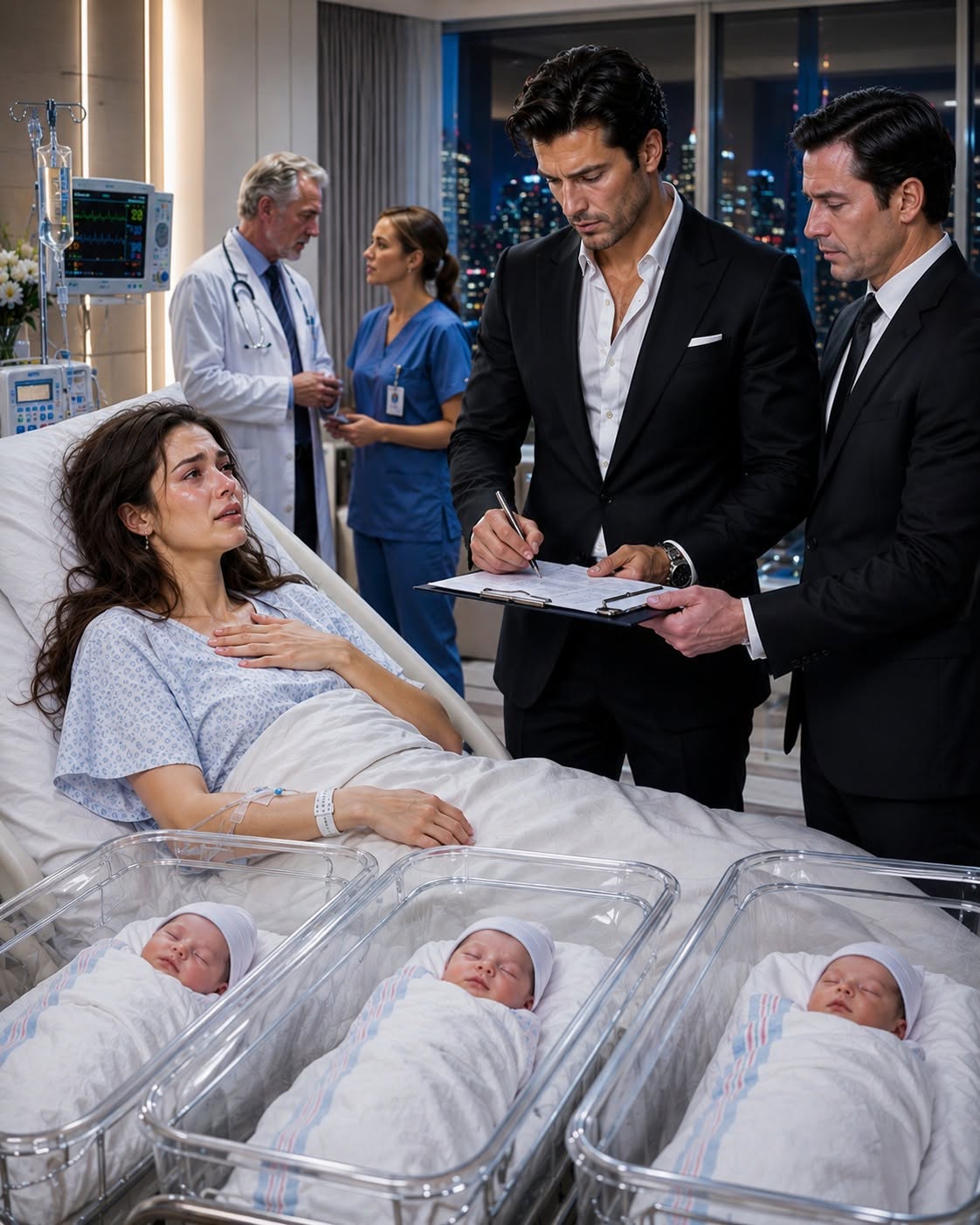
I lay propped against two hospital pillows, the receiver warm against my ear, the ache of the incision pulling low across my abdomen whenever I breathed too deeply. Outside my window, late afternoon light spilled over the city in pale gold strips, softening the edges of buildings that looked sharper and less forgiving at night.
For three days, I had drifted between pain medication, whispered conversations, and the kind of dreams that made me wake up reaching for children I had not yet been allowed to hold.
Triplets.
Three lives, three names I had repeated to myself like prayers even before I had seen their faces.
Lily.
Noah.
Rose.
Their bassinets were only two floors away, but hospital policy and the mess Grant had created had turned that short distance into a mountain.
A nurse named Marisol stood by my IV stand, pretending to adjust a line that did not need adjusting. She had been with me since I woke. She had gentle eyes, quick hands, and the kind of quiet anger women learn to carry when they have seen too much unfairness to be surprised by it anymore.
I looked at her, then back toward the phone.
Grant waited.
Once, that would have been enough to make me answer quickly. Once, silence from him would have sent me scrambling to fill it, to soothe whatever displeasure was gathering behind his blue eyes.
But something had changed in me during those terrifying minutes when my heart stopped.
Death had taken me to a narrow door and then sent me back.
I did not return as the same woman.
“No,” I said.
There was a pause.
“What?”
The single word carried disbelief, not confusion. Grant was not used to being refused. Not by assistants, not by board members, not by me.
“I said no.”
“Caroline.”
My name in his mouth used to sound like a promise. Now it sounded like a document he was trying to reclaim.
“You do not get to call me because your lawyer found a problem,” I said, my voice hoarse but steady. “You do not get to walk away from an ICU and come back when it becomes inconvenient.”
He exhaled sharply. I imagined him standing in his office on the forty-seventh floor of Holloway Tower, one hand braced against the glass, the city beneath him like something he owned.
“This is bigger than you understand.”
A strange calm moved through me.
“No,” I said. “For the first time, I think I understand exactly how big it is.”
Marisol’s gaze lifted.
On the other end, Grant’s silence deepened.
“You’ve spoken to someone,” he said.
“I’ve spoken to several people.”
It was not entirely true. I had spoken to one hospital administrator, two nurses, a social worker, and an attorney named Evelyn Hart, who had arrived less than an hour ago wearing a gray coat dusted with rain and an expression that told me she had seen families break in every possible way.
Evelyn was not my attorney yet. Not officially. But she had been sent by someone I never expected.
Grant’s mother.
That fact had unsettled me more than the divorce papers.
Vivian Holloway and I had never been close. She was elegant, reserved, and precise, the kind of woman who remembered every birthday but rarely hugged anyone while giving the gift. During my marriage, she had always seemed to be observing me from behind a pane of glass, polite but distant, as though deciding whether I belonged in a family that measured affection in assets and loyalty in silence.
Yet when Evelyn introduced herself, she had said, “Mrs. Holloway asked me to come as soon as she heard what happened.”
I had blinked at her, still weak from surgery and shock.
“My mother-in-law?”
Evelyn’s expression had softened. “Yes. Vivian.”
Then she had opened a leather folder and explained the clause.
Years before Grant and I married, Grant’s father, Henry Holloway, had created a family trust after a business scandal nearly destroyed the company. Henry had been a hard man, by every account, but he had possessed one quality Grant lacked: he understood consequences. The trust held controlling interests in several family assets, including voting rights tied to Holloway Legacy Holdings. Most beneficiaries assumed the arrangement protected the family from outside threats.
But there was a clause hidden in the marital provisions.
Any spouse of a direct Holloway heir who was abandoned, divorced, or legally separated under circumstances involving medical incapacity, pregnancy, childbirth, or dependent children would trigger a review by the trust’s independent guardians. Until that review concluded, certain assets would be frozen, executive voting rights suspended, and temporary protective funds released to the spouse and children.
It sounded almost impossible when Evelyn said it.
Then she explained why it existed.
Henry Holloway’s own sister had been abandoned by her husband while recovering from childbirth. The family had used money to bury the humiliation, but Henry had not forgotten the cost of silence. Years later, he built a clause no one discussed into the trust documents.
“Your husband’s timing,” Evelyn had said carefully, “activated nearly every protective condition at once.”
I had stared at her.
“So what happens now?”
“The trust guardians have already been notified. Grant’s authority over certain family-controlled assets is suspended pending review. Temporary funds for your medical care and the children’s needs should be released within twenty-four hours.”
“And my babies?”
Evelyn’s face had changed then. Less legal, more human.
“That is more complicated, but not impossible. We are working with the hospital and family court to correct the emergency status. You were not conscious when the hospital records changed. The divorce does not erase biological parentage, and it certainly does not make you a stranger to your children.”
I had closed my eyes then, too exhausted to cry, too afraid to hope.
Now Grant had called.
And every word from him proved Evelyn was right.
“Caroline,” Grant said again, colder this time, “listen to me carefully. The clause was never intended for a situation like this.”
I laughed once, softly.
It hurt.
I pressed my palm against my abdomen until the pain settled into a dull burn.
“A situation like what?” I asked. “A woman nearly dying after giving birth while her husband signs divorce papers outside the ICU?”
He did not answer.
Behind Marisol, the room door opened.
Evelyn Hart stepped inside. She was in her early fifties, with silver threaded through her dark hair and reading glasses hanging from a chain around her neck. Nothing about her looked dramatic. She did not sweep into rooms; she entered them with calm purpose, as if she trusted facts more than volume.
She saw the phone in my hand and lifted one eyebrow.
I held it out slightly. “It’s Grant.”
Evelyn crossed the room and held out her palm.
“You may tell him all communication should go through counsel,” she said.
Grant heard her.
“Who is that?” he demanded.
I looked at the woman standing beside my bed, then at Marisol, who had stopped pretending with the IV and now watched me with open support.
Someone had fought to bring me back to life. Someone had sent help. Someone had stood beside my bed when my husband would not.
“My attorney,” I said.
Then I ended the call.
For one long second, I simply stared at the blank screen.
My hand shook.
Marisol gently took the phone from me and placed it on the bedside table.
“You did good,” she whispered.
The words broke something open.
Not loudly. Not dramatically. I did not sob the way women do in movies, folding into themselves while violins swell. My tears came silently, slipping down my temples into my hair, warm and humiliating and necessary.
Evelyn pulled a chair close.
“Caroline,” she said, “I need to ask you something important.”
I wiped my cheek with the back of my hand. “All right.”
“When you are strong enough, do you want to see your children?”
The question seemed so simple that for a moment I could not understand why she would ask it. Then I realized she was not asking because she doubted me. She was asking because, for the first time since waking, someone wanted my choice to matter.
My throat tightened.
“Yes,” I said. “More than anything.”
Evelyn nodded. “Then that is what we focus on first.”
It took seven more hours.
Seven hours of forms, calls, medical clearances, verification, and signatures. Seven hours during which my body felt like a house after a fire: still standing, but smelling of smoke, every room damaged in ways no visitor could see. The social worker, Denise, returned twice with updates. The hospital’s legal office reviewed the emergency custody status. Evelyn made calls from the corner of my room in a low, controlled voice. Marisol came and went, bringing ice chips, pain medicine, and once, without being asked, a warm blanket tucked around my feet.
Night settled over the hospital.
The city lights glittered beyond the glass.
At 10:43 p.m., a pediatric nurse arrived with a wheelchair.
“Are you ready?” she asked.
No.
Yes.
I did not know how a person could feel both.
Marisol helped me sit upright. Pain flashed white-hot through my abdomen, and the room blurred for a moment. I bit down on a sound, embarrassed by how weak I was.
“No heroics,” Marisol said gently. “You just gave birth to three babies and came back from the edge. Slow is still moving.”
I nodded, swallowing.
They helped me into the wheelchair with the careful choreography of people trained to handle fragile things. I had always hated needing help. During my marriage, Grant had turned dependence into a quiet weapon. If he paid for something, he owned the outcome. If he made a decision, gratitude was expected. If I hesitated, he called it insecurity.
But this was different.
Marisol was not diminishing me by helping me stand. Evelyn was not controlling me by guiding the process. Denise was not pitying me by walking beside the chair.
They were making room for me to remain human.
The NICU doors opened with a soft electronic click.
Inside, the world changed.
The air was warmer. The lights were dimmer. Machines hummed and blinked around tiny sleeping bodies, each one surrounded by clear walls and careful hands. Nurses moved quietly from station to station, speaking in murmurs. Somewhere, a baby gave a small, indignant cry that sounded too delicate for the size of feeling behind it.
My heart began to pound.
“There they are,” the pediatric nurse said softly.
She wheeled me toward three bassinets placed near one another beneath a row of monitors.
For a moment, I could not breathe.
Lily was first. She had a rosebud mouth and a crease between her brows, as if she had already formed opinions about the world and found it lacking. A tiny cap covered her head. Her hand rested near her cheek, fingers curled like a secret.
Noah lay beside her, smaller than his sisters, his chest rising and falling beneath a patterned blanket. One fist had escaped the swaddle. He looked impossibly serious in sleep.
Rose was last, her face turned slightly toward the others. She had Grant’s chin. The sight of it pierced me unexpectedly, not because I wanted him there, but because I realized my children would carry pieces of him forever, whether he deserved that or not.
The nurse locked the wheelchair.
“You can touch them,” she said. “Gently.”
My hand hovered over Lily first.
I was afraid.
That surprised me. After everything, after fighting my way back into my body, after facing Grant’s betrayal, I was afraid of touching my own child.
“What if I hurt her?” I whispered.
Marisol crouched beside me. “You won’t.”
My fingers touched Lily’s arm.
Her skin was softer than anything I had ever known.
She stirred, mouth puckering, and her tiny hand opened against my fingertip. Instinctively, she gripped me.
A sound escaped me then, half laugh, half sob.
“Hi,” I whispered. “Hi, my sweet girl.”
Lily held on.
No one spoke for a while.
The machines continued their steady rhythm. The city turned beyond the windows. Somewhere in another part of the hospital, elevators opened and closed, doctors moved between emergencies, families waited for news that would change them. But in that small circle of warm light, the world became my daughter’s hand around my finger.
Then Noah made a soft noise, almost a sigh.
I touched him next.
“My brave boy,” I murmured. “I’m sorry I wasn’t here.”
Marisol’s hand touched my shoulder.
“You were fighting to get here,” she said.
Rose opened her eyes when I reached for her.
They were dark and unfocused, newborn eyes searching without knowing what they were searching for. But when I whispered her name, her face turned slightly toward my voice.
Rose.
I had chosen the name because roses could be soft without being fragile. Because they bloomed beautifully and still had thorns. Because when I found out there would be three babies, I had sat alone in the nursery with paint samples spread around me and imagined a little girl who would grow up knowing beauty and strength could belong to the same body.
I pressed my fingers to my mouth and then touched them lightly to her blanket.
“I’m here,” I whispered. “I came back.”
The next morning, Vivian Holloway arrived.
The nurse had just helped me return from another short visit with the babies. I was exhausted in a way sleep did not fix. My body trembled from the effort of sitting upright. My hair had been brushed but not washed. My face looked pale and unfamiliar in the dark reflection of the window.
When Vivian stepped into the room, she paused just inside the door.
For the first time since I had known her, she looked uncertain.
She wore a cream wool coat over a navy dress, pearls at her throat, her silver-blonde hair pinned at the nape of her neck. She held a small paper bag from the hospital gift shop, the handles pinched between fingers that were too elegant for something so ordinary.
“Caroline,” she said.
I looked at her.
A thousand responses moved through me.
Where were you?
Did you know?
Why did you never warn me?
Instead, I said, “Vivian.”
Her gaze flickered toward the monitors, the IV, the bruises blooming along my arms from failed lines and emergency care.
“I am sorry,” she said.
It was not dramatic. She did not rush to my bedside. She did not perform grief for the room.
She stood there and said it plainly.
Somehow, that made it harder to dismiss.
“For what part?” I asked.
Her mouth tightened.
“All of it.”
The answer was honest enough to hurt.
I turned my face toward the window. “Did you know he was planning to divorce me?”
“No.”
“Did you know there was someone else?”
A pause.
“No,” she said, quieter.
I looked back.
For the first time, I saw not the Holloway matriarch, not the polished woman at charity galas, not the careful hostess at Christmas dinners where Grant spent most of the evening on his phone.
I saw a mother who had just discovered something terrible about her son and was trying to stand inside that knowledge without collapsing.
“Did you send Evelyn?” I asked.
“Yes.”
“Why?”
Vivian walked to the chair beside the bed but did not sit until I gave a small nod.
“Because Henry’s clause exists for a reason,” she said. “And because Grant was wrong.”
There it was.
Simple. Clean.
Not enough, maybe. But something.
I studied her. “Grant told me once your family believes divorce should be handled privately. Quietly.”
“Grant often confuses silence with dignity.”
The sentence surprised me so much I almost smiled.
Vivian looked down at the paper bag in her lap.
“I brought you something,” she said. “It is not much.”
She reached inside and removed three tiny knitted blankets. One pale yellow. One soft green. One lavender.
“I started them when Grant told us you were pregnant,” she said. “Before we knew there were three.”
My throat tightened despite myself.
“You made these?”
“My mother taught me. I am not as good as she was.”
The blankets lay across her knees, tender and imperfect, each one marked by the slight unevenness of human hands.
“I did not give them to you earlier because Grant said you wanted everything custom ordered from Paris.” Vivian’s eyes lifted to mine. “I should have asked you directly.”
The room seemed to tilt.
“He said that?”
Vivian’s expression changed.
“Yes.”
“I never said that.” My voice came out thin. “I would have loved these.”
Something like regret moved across her face.
“I am beginning to understand,” she said slowly, “that my son translated many things for the rest of us.”
Translated.
It was such a polite word for what he had done.
Grant had built walls out of misunderstandings and called them preferences. He had kept me from his family by telling them I was overwhelmed, private, sensitive. He had kept them from me by telling me they were cold, judgmental, impossible to please. When invitations stopped coming directly, I assumed Vivian did not want me there. When Vivian received brief refusals supposedly from me, she assumed I wanted distance.
Grant had stood in the center, controlling the temperature of every room.
And I had mistaken loneliness for failure.
Vivian folded her hands over the blankets.
“I failed you,” she said.
I looked away quickly.
Forgiveness was not a door I could open just because someone knocked. Not yet. Maybe not ever in the way people expected. But truth deserved acknowledgment.
“You didn’t know everything,” I said.
“No,” she replied. “But I knew my son could be selfish. I called it ambition because that was easier.”
Her honesty settled between us.
Outside the room, a cart rattled past. Somewhere a nurse laughed softly at something another nurse said. Life continued with astonishing nerve.
Vivian cleared her throat.
“The trust review begins tomorrow morning.”
Evelyn had told me that too. Three independent guardians would examine the circumstances of the divorce, Grant’s conduct, and the children’s immediate welfare. It was not a courtroom. It was not a trial. But the outcome could change everything. Grant’s voting power, access to family-controlled funds, and even his position at the company could remain frozen if the guardians determined he had acted against the protective intent of the trust.
“I don’t want a war,” I said.
Vivian looked at me carefully. “What do you want?”
The question stayed with me.
What did I want?
A week ago, I might have answered from inside the narrow room Grant had built around my life. I would have wanted him to explain. To apologize. To choose us after all. To make the nightmare reversible.
But holding Lily’s hand had changed the size of my world.
“I want my children safe,” I said. “I want to recover. I want legal clarity. I want Grant to stop deciding what happens to me.”
Vivian nodded once.
“That is not war,” she said. “That is boundaries.”
Later that afternoon, Grant came to the hospital.
He did not come to my room first.
He went to the NICU.
I learned this from Denise, who arrived looking professionally calm in a way that immediately made my pulse quicken.
“He is asking to see the babies,” she said.
My fingers tightened around the blanket in my lap.
“Can he?”
“He is their biological father,” Denise said carefully. “But given the active administrative review and the circumstances, access must be supervised. We wanted to inform you first.”
A strange feeling moved through me. Not jealousy. Not exactly fear.
Something closer to grief.
Part of me had wanted him never to look at them. Another part, smaller and more painful, had once imagined Grant holding our children with wonder softening his face. I had imagined him counting fingers, whispering promises, becoming better because fatherhood demanded it.
But children are not medicine for a person’s emptiness.
They should not arrive in the world with the burden of transforming someone who refused to change.
“Does he want to see me?” I asked.
Denise hesitated.
“He asked whether you were awake.”
Of course he did. Not how I was. Not whether I could sit up. Not whether I had held them.
Whether I was awake.
A condition. A complication.
I closed my eyes.
“Tell him any conversation goes through Evelyn.”
Denise nodded.
After she left, I asked Marisol to take me to the NICU.
“You don’t have to see him,” she said.
“I know.”
But I needed to see myself not disappear.
Grant stood outside the nursery window with his back to me when the elevator doors opened. He wore a charcoal suit, no tie, his dark hair perfectly styled. Even from several feet away, he looked composed. Expensive. Untouched.
Then he turned.
For a brief moment, something crossed his face.
Shock.
Not because I was alive. He knew that already.
Because I was upright.
Because someone had placed a blue robe around my shoulders, because Marisol stood behind my wheelchair like a quiet guard, because I did not look like the erased woman he had expected to leave behind in paperwork and hospital records.
“Caroline,” he said.
His gaze moved over me, taking inventory. The hospital bracelet. The pale face. The wheelchair. The incision I protected with one hand. He had always been good at assessing damage.
I looked past him through the glass.
Lily, Noah, and Rose slept beneath soft lights.
Grant followed my gaze.
“They’re small,” he said.
It was such a foolish, inadequate thing to say that I almost laughed.
“They were born early,” I replied.
His jaw tightened slightly. “I know that.”
“Do you?”
A nurse inside the NICU adjusted one of Noah’s monitors. Grant watched the movement with an expression I could not read.
“I came to see them,” he said.
“Why?”
His eyes returned to mine.
“Because they’re my children.”
The words should have meant something. Maybe they did, somewhere beneath all the damage. But spoken now, after everything, they sounded like a legal position.
“You remembered,” I said.
He flinched, barely.
Grant Holloway did not like visible wounds, especially his own.
“This doesn’t need to become hostile.”
“It became hostile when you canceled my insurance while I was unconscious.”
“I didn’t know the cancellation would process that quickly.”
There were apologies that opened doors and apologies that rearranged furniture in a locked room.
That was neither.
“You didn’t know?” I repeated. “Grant, I was on machines. The babies were premature. You signed papers and left.”
His gaze sharpened. “You don’t know everything.”
The sentence landed between us like a dropped glass.
I studied him.
“Then tell me.”
For the first time, he looked away.
A hospital corridor is not a dramatic place. There is no thunder, no shadowed staircase, no music to announce secrets. There are vending machines, hand sanitizer dispensers, tired families with paper coffee cups, and nurses walking quickly in comfortable shoes.
Grant stood in that ordinary brightness and said nothing.
I understood then that whatever he meant, it was not an apology.
It was leverage he had not decided how to use.
Evelyn arrived before he could speak again. I had not seen anyone move so calmly and still interrupt so completely.
“Mr. Holloway,” she said.
Grant’s expression cooled. “Evelyn.”
“You know Ms. Hart?” I asked.
Evelyn did not take her eyes off him.
“I represented the trust in a prior matter.”
Grant gave a short laugh without humor. “That is one way to describe it.”
Something passed between them. Recognition, conflict, history. I caught it immediately, and so did Marisol, whose hand came to rest lightly on the back of my wheelchair.
Evelyn’s voice remained even.
“You are permitted a supervised viewing today. No physical contact without NICU approval, and no discussion with Caroline unless she initiates it.”
“I am not a stranger,” Grant said.
“No,” Evelyn replied. “You are a party to an active review.”
His face hardened.
For a moment, I saw the man his board members feared. Not loud, not theatrical. Simply used to winning by making other people calculate the cost of opposing him.
But Evelyn did not calculate. She waited.
Grant looked back through the glass at the babies.
“I’ll return with my attorney.”
“I expect so,” Evelyn said.
He turned to me. “Caroline, be careful who you trust.”
The old version of me would have heard concern.
The woman in the wheelchair heard warning.
Grant walked away, his shoes silent against the polished floor.
As he reached the elevator, the doors opened.
Vivian stepped out.
Mother and son faced each other for the first time since everything had happened.
Neither moved.
Grant’s expression changed first.
“Mother.”
Vivian looked at him as though trying to reconcile the child she had raised with the man standing before her.
“I saw them,” she said.
Grant glanced toward the NICU. “Then you understand what is at stake.”
“I understand more than I wish I did.”
His mouth tightened. “You sent Evelyn.”
“Yes.”
“You had no right.”
Vivian’s face remained composed, but something in her eyes hardened.
“I had every right to refuse silence.”
Grant leaned closer, lowering his voice, but the corridor carried it anyway.
“You don’t know what Caroline has been told.”
“I know what you did.”
His gaze flickered toward me.
Again, that suggestion. That there was another version of the story waiting somewhere like a sealed envelope.
Vivian saw it too.
“Grant,” she said, and her voice changed. Not louder. Older. “Do not make this worse.”
For one suspended second, he looked almost young.
Then the elevator doors opened again behind him. A woman stepped out holding a leather tote and wearing a camel-colored coat.
I recognized her from the photograph that had appeared on Grant’s phone in the reflection of the ICU window when a nurse had described it to me later.
Not her face exactly. The nurse had not shown me a picture. But I knew.
Some facts arrive before proof.
The woman stopped when she saw us.
Grant turned sharply.
“Alina,” he said, under his breath.
Vivian’s eyes moved from Grant to the woman.
So did mine.
Alina was beautiful in a quiet, expensive way. Smooth dark hair. Fine features. A tense elegance that suggested she had expected discomfort but not an audience. Her gaze fell briefly on my wheelchair, then on the hospital bracelet around my wrist. To her credit, she went pale.
“I’m sorry,” she said. “I didn’t realize—”
Grant stepped toward her. “You shouldn’t be here.”
“I got your message,” she said.
“What message?” His voice was too quick.
Alina reached into her tote and withdrew her phone.
“You said there was a problem. You said to come.”
Grant stared at her.
“I didn’t send that.”
The corridor seemed to narrow.
Evelyn’s posture changed almost imperceptibly.
Vivian looked at Grant. “What is going on?”
Alina swallowed, then turned the phone outward.
On the screen was a message thread.
Grant’s name at the top.
The latest message read:
Come to the hospital. Bring the original agreement. Caroline knows enough.
My breath caught.
Agreement.
Grant looked genuinely shaken now. Not embarrassed. Not angry at being caught.
Afraid.
“That didn’t come from me,” he said.
Evelyn stepped closer. “Ms. Voss, may I see that?”
Alina hesitated.
Grant snapped, “No.”
That single word told everyone in the corridor the message mattered.
Alina’s hand trembled.
“I don’t understand,” she whispered. “You told me this would be handled before the birth.”
The sentence passed through me slowly, each word finding a place to cut.
Before the birth.
Handled.
Vivian’s face drained of color.
Grant closed his eyes for half a second.
“Alina,” he said, in a low voice, “stop talking.”
But Alina was looking at me now.
Not with triumph. Not with malice.
With dawning horror.
“You don’t know?” she asked.
My mouth was dry.
“Know what?”
Evelyn moved beside me, but she did not interrupt.
Alina looked from me to the nursery window, where my three babies slept beneath steady lights.
Then she reached into her tote again and withdrew a sealed cream envelope, bent at one corner from being carried too long.
“I wasn’t supposed to bring this unless Grant refused to honor the terms,” she said.
Grant’s face went cold.
“Alina, give that to me.”
She stepped back.
For the first time since he had entered the hospital, Grant lost his polished stillness.
Vivian whispered, “Grant?”
Alina held the envelope out toward me.
Evelyn took it before I could move.
On the front, written in dark blue ink, was my name.
Caroline.
Not Mrs. Holloway.
Not Caroline Holloway.
Just Caroline.
Evelyn examined the seal.
“Who wrote this?” she asked.
Alina’s eyes filled with tears she seemed determined not to shed.
“Henry Holloway,” she said.
Vivian made a small sound.
I turned toward her. “Grant’s father?”
Vivian nodded slowly, but her eyes were fixed on the envelope as if she had seen a ghost.
“That’s impossible,” Grant said.
His voice was flat now. Empty.
Alina looked at him. “No. What’s impossible is that you let her nearly die without telling her why everyone was so afraid of those babies being born.”
The warmth of the NICU seemed to vanish.
My hand gripped the armrest of the wheelchair.
“What does that mean?” I asked.
No one answered.
Behind the glass, Rose stirred in her sleep, her tiny face turning toward Lily and Noah.
Evelyn broke the seal.
Inside was a single folded page and a small brass key taped carefully to the bottom.
She read the first lines silently.
Then her expression changed.
Not shock.
Recognition.
As though one mystery had opened into another she had hoped never to revisit.
“Evelyn?” I whispered.
She looked down at me, and for the first time since I had met her, the certainty in her eyes faltered.
“This letter was written nine years ago,” she said. “Before Grant ever met you.”
My pulse beat painfully in my throat.
“That doesn’t make sense.”
Evelyn unfolded the page fully.
At the top, in elegant handwriting, were words that made Vivian reach for the wall to steady herself.
To Caroline, when the children are born.
Grant stepped forward.
“Do not read that here.”
Evelyn looked at him.
“Why not?”
The corridor held its breath.
Grant’s answer came quietly.
“Because once she knows, none of us can undo it.”
Evelyn turned back to the letter.
And in a voice low enough that only those nearest could hear, she read the next line.
The triplets are not the beginning of this story. They are the return of what the Holloway family took from you.
END OF PART 2 – LIKE, SHARE AND COMMENT “”THE ENTIRE STORY”” IF YOU WANT TO READ THE FULL STORY