
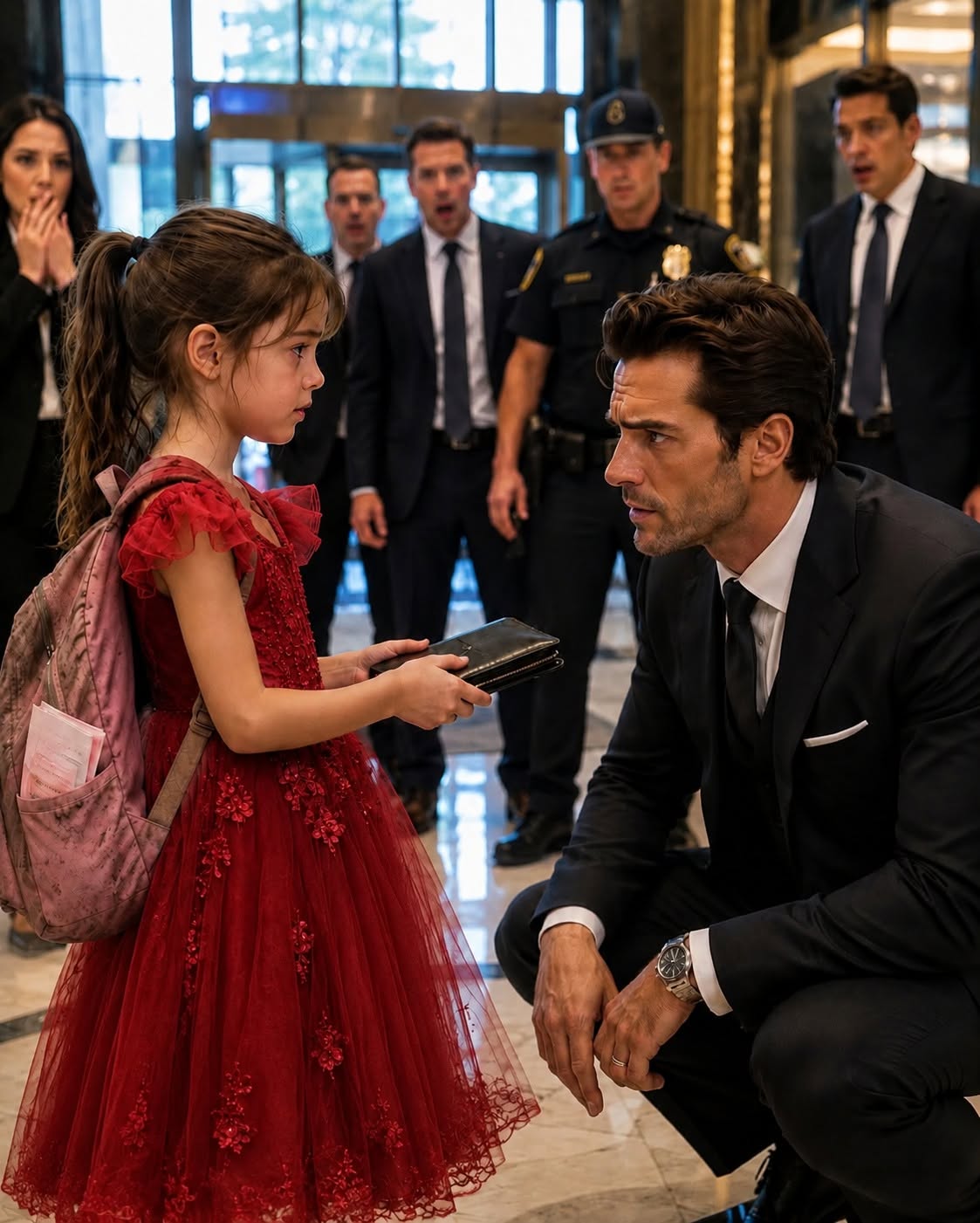
PART 2
Nathaniel did not wait for the old man to explain.
For a few seconds, no one moved. The huge lobby of Graves Tower, which had been roaring with voices only minutes earlier, felt like a room underwater. Even the security guards stood frozen near the glass doors, their hands hovering uselessly at their belts.
The old man swallowed hard.
Nathaniel’s voice dropped lower. “Tell me exactly what you buried, Arthur.”
Arthur.
I had seen that name before.
It was printed in tiny gold letters on a plaque near the elevators: ARTHUR BELL — SENIOR LEGAL ADVISOR.
He looked even older now than he had when he stepped out of the elevator. His white hair was neatly combed, but his face had suddenly become loose and tired, like a mask falling away.
“Not here,” Arthur said.
Nathaniel’s jaw tightened. “You lost the right to decide where this conversation happens.”
Arthur glanced at me, then at the eviction notice hidden inside Nathaniel’s jacket. “The child shouldn’t hear this.”
“The child,” Nathaniel said coldly, “is the reason we’re having this conversation.”
I clutched the straps of my backpack.
My fingers brushed against the folded drawing I had made for my mother during recess that morning. In it, she and I were standing in front of a yellow house with blue windows and a red door. I had drawn flowers in the yard even though we had never had a yard. I had drawn smoke curling from the chimney even though our apartment had no fireplace.
A home, I had written in purple crayon.
Now I wondered if I had been drawing something I was never meant to have.
Nathaniel turned to me, and the sharpness left his face.
“Ruby,” he said softly, “I know this is frightening. But I promise you, no one here is going to hurt you.”
I nodded, though I wasn’t sure I believed him.
Rich people made promises differently. They spoke like the world was a door they owned the key to.
Nathaniel looked toward the security guards. “Unlock the doors.”
The nearest guard fumbled with his keys.
“And bring the car around,” Nathaniel added. “We’re going to Miller’s Diner.”
Arthur flinched. “Nathaniel, please. Think before you do this.”
“I have been thinking for twelve years,” Nathaniel said. “That was the problem.”
The glass doors opened again, letting in the noise of the city, but no one in the lobby dared speak.
Outside, a black car waited at the curb, long and polished enough to reflect the gray sky. A driver opened the back door. I hesitated before climbing inside. My sneakers were wet from the puddles on the sidewalk, and I was afraid to stain the creamy leather seats.
Nathaniel noticed.
“Don’t worry about the car,” he said.
That was easy for him to say. It probably cost more than our whole building.
Arthur sat across from us, silent and pale. Nathaniel sat beside me, not too close, his hands clasped together. He kept staring out the window as the city slid by in streaks of rain and traffic lights.
Finally, I found my voice.
“Do you know my mom?”
Nathaniel turned slowly.
“I knew someone named Sarah Collins,” he said. “A long time ago.”
“My mom doesn’t talk about old stuff,” I said. “She says old stuff gets dusty if you keep touching it.”
Something painful flickered in his eyes.
“She always said things like that.”
Arthur shifted in his seat.
Nathaniel looked at him. “Start talking.”
Arthur pressed his lips together. For a moment, I thought he would refuse. Then he folded his hands over the silver handle of his cane.
“Your father discovered Sarah was pregnant,” he said. “After you left for London.”
Pregnant.
The word landed in the car like a dropped plate.
Nathaniel went completely still.
Arthur continued, each sentence heavier than the last. “He believed the relationship was a threat to the family. To the company. He believed Sarah would use the child against you.”
“My father knew?” Nathaniel asked.
Arthur nodded once.
“And you knew?”
Another nod.
The city outside became blurry. My mother had never told me anything about my father. Whenever I asked, she would kiss my forehead and say, “He belonged to a different life, Ruby.” I used to imagine that meant he lived far away, maybe across the ocean, maybe in a country where people wore long coats and had castles.
I never imagined he might be sitting beside me in a black car, wearing a suit that smelled like rain and expensive soap.
Nathaniel’s voice was barely a whisper. “What did he do?”
Arthur closed his eyes. “He paid Sarah to leave.”
“My mother would never take money to leave someone,” I said before I could stop myself.
Both men looked at me.
My cheeks burned, but I kept going. “She works two jobs. She saves ketchup packets. She cuts my sandwiches into stars when we have bread that isn’t smashed. She wouldn’t take money to disappear.”
Arthur’s face cracked with shame.
“You’re right,” he said quietly. “She refused.”
Nathaniel leaned forward. “Then what happened?”
Arthur looked at the floor of the car. “Your father arranged documents. False messages. He made Sarah believe you wanted nothing to do with her or the child. He made you believe Sarah had chosen money and vanished. I delivered both lies.”
The car seemed to shrink around us.
Nathaniel’s breathing changed.
It became slow, careful, dangerous.
“All these years,” he said, “you let me believe she left me.”
“I was loyal to your father.”
“My father is dead.”
“Yes,” Arthur said. “And still, I was afraid of him.”
No one spoke after that.
Miller’s Diner sat on the corner of a cracked street between a laundromat and a pawn shop. Its sign flickered even during the day, buzzing red letters against the rain: OPEN 24 HOURS.
Through the window, I saw my mother carrying a tray with three plates balanced on one arm. Her brown hair was tied in a messy bun, and her apron had a coffee stain near the pocket. She looked tired. She always looked tired lately, but she still smiled at the old man in booth four because he tipped in quarters and called her “kiddo.”
Nathaniel watched her through the glass.
For the first time since I had met him, he looked afraid.
I opened the car door before anyone could stop me and ran inside.
The bell above the diner door jingled.
My mother turned. “Ruby?”
Then she saw my wet shoes, my backpack, my scared face.
“What happened?” she asked, rushing over. “Are you hurt?”
I shook my head and hugged her waist.
“I found a wallet,” I said into her apron.
“A wallet?”
“And I gave it back.”
“Okay,” she said slowly, stroking my hair. “That’s good, sweetheart. That was the right thing to do.”
The bell jingled again.
My mother looked up.
Nathaniel Graves stood in the doorway.
The tray slipped from her hand.
Plates shattered across the floor.
The whole diner turned to stare.
For one breath, my mother did not move at all. Then all the color drained from her face, and she gripped the counter to keep herself standing.
“Nate,” she whispered.
Nathaniel took one step forward.
“Sarah.”
The way he said her name made the room disappear.
It was not the voice of a billionaire. It was not the voice from the newspapers or the giant screens downtown. It was the voice of someone who had lost something and had found it standing under fluorescent lights, wearing a faded apron and trembling hands.
My mother looked from him to me.
“No,” she said.
Her voice broke.
Nathaniel stopped.
“I didn’t know,” he said.
My mother laughed once, but it didn’t sound like laughter. “Don’t.”
“Sarah, I swear to you—”
“Don’t stand there in your thousand-dollar suit and tell me you didn’t know.”
Arthur entered behind him.
The moment my mother saw the old man, her expression changed. The hurt became something sharper.
“You,” she said.
Arthur lowered his head. “Sarah.”
My mother stepped in front of me.
I had seen her face like that only once before, when a man shouted at us on the bus because I dropped my juice. She had become a wall then, small but unbreakable.
“What do you want?” she asked Nathaniel.
He reached inside his jacket and pulled out the eviction notice.
My mother’s eyes widened.
“Ruby,” she said softly, “where did you get that?”
“It was in my backpack,” I whispered. “I’m sorry.”
She closed her eyes.
Nathaniel unfolded the paper. “This building is owned by a Graves subsidiary.”
My mother stiffened.
“I didn’t know that either,” he said quickly. “But I do now. The eviction is canceled.”
My mother’s mouth trembled. “You can’t just say that.”
“I can.”
“That’s not how the world works for people like us.”
Nathaniel looked around the diner, at the cracked vinyl seats, the steam on the windows, the customers pretending not to listen.
“Then I’ll make it work differently.”
My mother shook her head. “You don’t get to walk in after eight years and fix things because your conscience got uncomfortable.”
Eight years.
My stomach twisted.
I looked at Nathaniel.
At his dark eyes. At the tiny line between his eyebrows. At the way his hands shook when he held the notice.
“Are you my dad?” I asked.
The diner went so quiet I could hear the rain tapping against the glass.
My mother covered her mouth.
Nathaniel looked at me like I had reached inside his chest and touched his heart.
“I think so,” he said.
The word think hurt more than no.
My mother knelt in front of me. “Ruby, sweetheart—”
“Why didn’t you tell me?”
Tears filled her eyes. “Because I thought he left us.”
Nathaniel’s voice cracked behind her. “And I thought you left me.”
My mother stood again, slowly.
Arthur stepped forward. “I owe you both the truth.”
“No,” my mother said. “You owe us twelve years.”
Arthur had no answer.
The diner manager came from the kitchen, wiping his hands on a towel. “Sarah, do you need me to call someone?”
She looked at him, then at me, then at Nathaniel.
“No,” she said, though her voice was unsteady. “I need five minutes.”
We moved to the last booth by the window. The one with a tear in the red seat that scratched the back of your legs if you wore shorts.
Nathaniel sat across from my mother. Arthur sat at the end like a prisoner waiting for judgment. I sat beside Mom, tucked under her arm.
Arthur told the story.
Years ago, my mother had worked as a junior designer at a small firm hired by Graves Industries. She met Nathaniel during a charity project for low-income housing. He was young then, not yet the cold man on magazine covers. He brought coffee to meetings. He remembered people’s birthdays. He laughed too loudly when he was nervous.
They fell in love.
Nathaniel’s father, Theodore Graves, hated it.
Sarah Collins was not from the right family. She had no money, no name, no powerful connections. She was kind, which Theodore considered a weakness, and proud, which he considered an insult.
When Nathaniel was sent to London to negotiate a merger, Sarah discovered she was pregnant.
She wrote to him.
He never received the letters.
Nathaniel wrote to her.
She never received his.
Instead, Arthur delivered a message with Nathaniel’s signature, saying he wanted nothing to do with her or the baby.
At the same time, Nathaniel was shown documents claiming Sarah had accepted a large payment and disappeared.
“He believed it,” my mother said, staring at the table.
Nathaniel looked ashamed. “I was twenty-four. Angry. Proud. And my father knew exactly where to press.”
“You could have looked for me.”
“I did,” he said. “For months.”
Arthur nodded. “Theodore moved her records. Changed addresses. Paid people. By the time Nathaniel hired investigators, Sarah Collins had vanished on paper.”
My mother’s hand tightened around mine.
“I didn’t vanish,” she whispered. “I was right here.”
That was the saddest sentence I had ever heard.
Nathaniel looked as though it might destroy him.
“I’m sorry,” he said.
My mother wiped her cheek quickly, angry at the tear. “Sorry doesn’t pay rent.”
“No,” he said. “But I will.”
“I don’t want your money.”
“This isn’t charity.”
“It feels like charity.”
“It’s responsibility.”
“It’s eight years late.”
He accepted that like a blow.
Outside, thunder rolled over the city.
The old man in booth four lifted his coffee cup with shaking hands. The waitress by the register pretended to count change, though there was nothing to count.
Finally, my mother stood.
“I have a shift to finish.”
Nathaniel rose too. “Sarah—”
“No. You don’t get everything today. You got the truth. That’s enough.”
He nodded, but his eyes moved to me.
My mother saw it.
“She has school tomorrow.”
“She also has an eviction notice.”
“You said it was canceled.”
“It is.”
“Then we’ll go home tonight like normal people.”
Nathaniel reached into his pocket and placed a card on the table.
“My private number. Call me anytime. For anything.”
My mother didn’t touch it.
I did.
The card was thick and white, with his name printed in black.
Nathaniel Graves.
My father’s name.
Maybe.
That night, we went home in a taxi Nathaniel insisted on paying for, though my mother argued until her voice went hoarse.
Our apartment looked smaller than usual when we walked in. The ceiling stain near the kitchen had spread again. The radiator hissed like an angry cat. Two boxes sat by the door, half-packed because my mother had thought we might have to leave by Friday.
She took off her coat and sank onto the couch.
For a while, she just stared at nothing.
I sat beside her.
“Mom?”
“Yes, baby?”
“Did you love him?”
Her face crumpled.
Then she pulled me close.
“I loved who I thought he was.”
“Is he bad?”
She kissed the top of my head. “I don’t know.”
“Am I rich now?”
A startled laugh escaped her, wet with tears. “No, Ruby. You are eight.”
I thought about that.
Then I asked the question that had been sitting heavy inside me since the diner.
“Did he not want me?”
My mother turned me toward her. Her eyes were fierce.
“Listen to me. Nothing about what happened was your fault. You were wanted by me from the first second I knew you existed.”
“But by him?”
She looked toward the window, where rain crawled down the glass like tiny silver worms.
“I think,” she said carefully, “he never got the chance to know he wanted you.”
That answer was too big for my heart.
Later, when my mother thought I was asleep, I heard her crying in the bathroom with the water running so I wouldn’t hear.
I stayed under my blanket and held Nathaniel’s card in one hand.
The next morning, everything changed.
At 7:10, someone knocked on our door.
My mother opened it with a frying pan in her hand.
Two men in dark coats stood outside. Not Nathaniel’s men. These men did not smile. One held a folder, the other a tablet.
“Sarah Collins?” the first asked.
My mother lifted the frying pan slightly. “Who wants to know?”
“We represent the estate of Theodore Graves.”
My mother went pale.
The man opened the folder.
“Due to the public emergence of claims regarding paternity, the estate is requesting immediate legal review. Until verification is complete, we advise you not to contact Mr. Nathaniel Graves directly.”
My mother’s voice hardened. “You advise?”
The man looked past her at me.
His eyes were empty.
“We also need to speak with the child.”
My mother stepped fully into the doorway, blocking me.
“No.”
The second man tapped his tablet. “Refusal may complicate your housing situation.”
My mother went still.
The first man smiled slightly. “Graves Holdings has many subsidiaries, Miss Collins. Many leases. Many debts. Many ways to help. Or not help.”
I felt cold all over.
My mother tried to close the door, but the man slid his polished shoe into the gap.
That was when another voice spoke from the stairwell.
“Remove your foot.”
Nathaniel stood there, soaked from the rain, his tie loose, his face darker than the storm behind him.
The men turned.
“Mr. Graves,” one said smoothly. “We were acting on behalf of—”
“I know exactly whose behalf you were acting on.”
“It would be best to keep this matter private.”
Nathaniel walked up the stairs slowly.
With every step, the hallway seemed to shrink around him.
“You came to a child’s home before breakfast and threatened her mother.”
The man lifted his chin. “We merely explained legal realities.”
Nathaniel stopped inches away from him.
“Here is another legal reality. You are trespassing.”
The men exchanged a glance.
“This is not over,” the first said.
Nathaniel smiled without warmth. “No. It isn’t.”
They left.
Only when their footsteps disappeared did my mother lower the frying pan.
Nathaniel looked at it.
“Good choice of weapon.”
She gave him a look. “Don’t make jokes.”
“I’m not very good when I’m angry.”
“You noticed?”
For one tiny second, they almost smiled.
Then the moment broke.
Nathaniel turned to me. “Are you okay, Ruby?”
I nodded.
But I wasn’t.
The world had grown teeth overnight.
By noon, reporters were outside our building.
Someone had leaked the story.
There were cameras on the sidewalk, microphones near the entrance, strangers shouting questions every time someone opened the door.
“Is Ruby Graves your daughter?”
“Did Sarah Collins hide the child?”
“Is this about inheritance?”
“Ruby! Ruby, look here!”
My mother shut the curtains and turned off the lights.
We sat on the kitchen floor eating cereal from mugs because we had packed most of the bowls.
Nathaniel made calls from the hallway. His voice was calm, but his face looked carved from stone.
By evening, a black SUV took us through the garage so the reporters wouldn’t see.
My mother refused to go to Nathaniel’s penthouse.
“I’m not stepping into your glass castle,” she said.
So he brought us somewhere else.
It was a brownstone on a quiet street lined with trees, the kind of street where every window glowed warm and golden. The house had a green door, brass numbers, and flower boxes filled with purple pansies.
My breath caught.
It looked almost exactly like the house from my drawing, except the door was green instead of red.
Nathaniel noticed me staring.
“This belonged to my mother,” he said. “No company owns it. No board. No lawyers. Just me.”
My mother crossed her arms. “And now us?”
“For tonight,” he said. “Only because it’s safe.”
Inside, the house smelled like cedar, dust, and lemon polish. There were books everywhere, framed photographs on the walls, and a piano in the front room with a cracked ivory key.
On the mantel was a photograph of Nathaniel as a boy, standing beside a woman with kind eyes.
“My mother,” he said softly. “Elena.”
I looked closer.
She was wearing a silver necklace with a tiny moon.
I touched my own throat.
Under my shirt, on a thin chain, I wore the same moon.
My mother had given it to me when I turned six. She said it had arrived in an envelope with no return address when I was a baby.
Nathaniel saw the necklace and stopped breathing.
“Where did you get that?”
Mom’s hand flew to her mouth.
“It came in the mail,” she said. “After Ruby was born. I thought you sent it.”
Nathaniel shook his head. “My mother’s necklace disappeared the week she died.”
He stepped toward me slowly. “May I?”
I nodded.
He turned the tiny moon over.
There, scratched into the back, were two letters.
E.G.
Elena Graves.
Arthur, who had followed us quietly inside, gripped the back of a chair.
“Oh no,” he whispered.
Nathaniel turned. “What?”
Arthur’s lips trembled. “Theodore didn’t send the necklace.”
“Then who did?”
Arthur stared at me as if seeing a ghost.
“Your mother did.”
Nathaniel’s face went blank. “My mother was dead.”
Arthur shook his head. “That is what your father told everyone.”
The room tilted.
My mother grabbed my shoulders.
Nathaniel took one step back, then another.
“No,” he said. “I saw her grave.”
Arthur’s eyes filled with tears. “You saw a coffin. You saw a ceremony. You saw what Theodore wanted you to see.”
Nathaniel looked like a man standing at the edge of a cliff.
“Arthur,” he said carefully, “where is my mother?”
Before Arthur could answer, the lights went out.
Every lamp in the house died at once.
My mother pulled me against her.
From outside came the soft crunch of tires stopping at the curb.
Then another.
And another.
Headlights swept across the curtains like pale searching eyes.
Nathaniel moved to the window and lifted the fabric a single inch.
His face changed.
“What is it?” my mother whispered.
He let the curtain fall.
Standing beneath the yellow streetlight were the same men from our apartment.
But this time, they were not alone.
A woman stood between them in a long dark coat, her silver hair pinned neatly at the back of her head. Around her neck hung a necklace shaped like a tiny sun.
Nathaniel stared through the glass, frozen.
Arthur began to cry.
And then the woman outside lifted her face toward the window, looked straight at me, and smiled as if she had known exactly where to find me all along.
…If you want to know what happened next, please type “YES” and like for more.