There is a specific kind of silence that follows a betrayal. It doesn’t roar, and it doesn’t crash like thunder. It suffocates. It settles in the back of your throat like dry sand, making it impossible to scream.
I learned the texture of that silence when I was thirteen years old, sitting in Room 314 of St. Jude’s Medical Center.
The room smelled of sharp antiseptic, freshly unwrapped plastic tubing, and the sickly-sweet artificial lavender from an air freshener plugged into the wall. I was perched on the edge of an examination table, wearing a paper gown that scratched against my bare thighs. My legs were too short to reach the linoleum floor, so my heels tapped a nervous, hollow rhythm against the metal base of the table.
Dr. Robert Lawson sat across from my parents. He held a silver tablet in his lap, his face set in the careful, practiced neutrality that adults wear when they are about to drop an anvil on a child’s life.
“It is acute lymphoblastic leukemia,” Dr. Lawson said. His voice was steady, but his eyes flickered toward me before returning to my parents. “It is the most common type of childhood cancer. With aggressive, immediate chemotherapy, Emily’s survival rate is around eighty-five to ninety percent.”
I was young, but I understood percentages. I heard treatable. I heard survival. I looked toward my mother, waiting for her to rush forward, to wrap her arms around me and tell me we were going to fight this.
Karen sat near the window, her knuckles white as she gripped a designer leather purse in her lap. She didn’t move. She didn’t even look at me. Her eyes were fixed on a smudge on the glass.
My father, Thomas, stood with his arms crossed over his tailored suit jacket. Beside him sat my sixteen-year-old sister, Megan. She was scrolling through her phone, her manicured thumb swiping upward in a repetitive, apathetic motion, as if my cancer diagnosis was merely an annoying delay in her social schedule.
“How much?” Thomas asked.
The question hung in the air, cold and metallic. Dr. Lawson paused, his brow furrowing slightly.
“The full treatment protocol usually lasts two to three years,” the doctor replied, his tone cooling. “With your current insurance deductible and copays, your out-of-pocket responsibility may fall somewhere between sixty and one hundred thousand dollars. Of course, there are assistance programs—”
Thomas let out a sharp, breathless laugh. It was a terrible sound for a hospital room. “You’re telling me I have to drain a hundred grand because she got sick?”
“Thomas, please,” Karen whispered. She didn’t sound heartbroken. She sounded embarrassed.
“Megan is applying to colleges next year,” Thomas snapped, gesturing wildly toward my sister, who finally looked up, annoyed. “Stanford, Harvard, Yale. We’ve saved for over a decade. We have one hundred and eighty thousand dollars in her college fund, and I am not wiping out her potential, her future, for this.”
“Emily is your daughter,” Dr. Lawson said, his voice dropping an octave, heavy with a warning. “She is a child who needs life-saving treatment, not a financial debate.”
My father ignored him. He stepped toward me. His eyes were dark, calculating, completely devoid of the warmth a father should have.
“Em,” he said, his voice suddenly shifting into a soft, persuasive purr. It was the voice he used when he was closing a real estate deal. He pulled a clipboard from his briefcase, a document already printed and neatly aligned. “The state has a special medical assistance fund for… complex cases like this. It’s a legal loophole. If you sign this, it makes you a temporary ward of the state purely on paper. The hospital bills the government directly. It saves our family from bankruptcy, sweetie. I’m trying to protect all of us.”
I looked at the dense legal jargon. I didn’t understand the words Voluntary Relinquishment of Parental Rights. I only understood that my father was asking for my help to fix things. I wanted to be a good daughter. I wanted to be less of a burden.
“Will you still visit me?” I whispered, my voice trembling.
“Of course, sweetie,” he lied, pressing a heavy gold pen into my shaking hand. “Every single day. Just sign right there on the bottom line.”
I signed my name. Emily Higgins.
Thomas snatched the clipboard back with a swift, eager motion. He didn’t hug me. Karen didn’t look at me. They turned and walked out of the room. The heavy wooden door clicked shut.
That click was the sound of my family severing themselves from me forever.
Hours later, the chemotherapy began. I lay in the dark, shivering violently as cold, toxic fluids dripped into my veins through an IV port. The room was terrifyingly quiet. I waited for my mother to come back. I waited for my father to bring me the teddy bear he promised.
At 9:00 PM, a woman with a kind face and a state ID badge walked into my room. Her name was Susan. She sat in the chair beside my bed, her eyes shining with unshed tears.
“Emily, honey,” she said gently, taking my small, freezing hand in hers. “I’m your assigned social worker. Your parents… they aren’t coming back. The paper you signed… it gave you up to the foster system.”
The monitor beside my bed began to beep wildly as my heart rate spiked. A cold dread coiled in my gut. I couldn’t breathe. The walls of Room 314 began to spin, the edges of my vision turning black as the realization of what my own father had done dragged me under.
I didn’t cry that first night. The shock was a heavy, leaden blanket that smothered all other emotions. I lay completely still, staring at the ceiling tiles, counting the little perforated dots until they blurred together.
The next morning, the nausea hit. The poison they were pumping into me to kill the cancer felt like it was killing me first. I spent hours hanging over a plastic basin, my stomach violently rejecting even the concept of food.
In the afternoon, a young nurse accidentally left her iPad on the rolling tray table near my bed. The screen was glowing, open to Facebook. My hands trembled as I reached for it. I don’t know why I did it. Some masochistic part of my thirteen-year-old brain needed to know what my family was doing while I was drowning in a hospital bed.
I typed my sister’s name into the search bar. Megan Higgins.
Her profile was public. The top post had been uploaded three hours ago.
It was a vibrant, sun-drenched photograph. The glaring sunlight bounced off the crystal-blue ocean behind them. Thomas, Karen, and Megan were standing on the polished deck of a rented luxury yacht. My father was holding a bottle of expensive champagne. My mother was laughing, holding a crystal flute. Megan was wearing a designer sundress, holding up a banner that read: STANFORD BOUND!
The caption read: “Celebrating Megan’s bright future! We’ve worked so hard for this moment. #Blessed #FamilyFirst #Unstoppable.”
Family First.
The words burned into my retinas. On the exact day my hair was beginning to thin, on the exact day I was legally orphaned to save them a medical bill, they were drinking champagne on a yacht, celebrating the daughter they deemed worthy of their investment.
A ragged, animalistic sob tore out of my throat. I threw the iPad across the room. It shattered against the wall, the glass raining down on the linoleum. I curled into a tight ball, ripping the IV from the back of my hand, not caring as bright red blood began to pool on the white sheets. I wanted to disappear. I wanted the machine to stop beeping. I wanted to die.
The door flew open.
A woman in dark blue scrubs rushed in. She had wild, curly dark hair pulled into a messy bun and eyes the color of a stormy sea. She didn’t scream for security. She didn’t yell at me for breaking the tablet.
She immediately clamped a gloved hand over my bleeding vein, her other arm wrapping fiercely around my shaking shoulders.
“I’ve got you,” she whispered, her voice a low, steady anchor in the hurricane of my panic. “I’ve got you, Emily. Breathe with me. Come on, kiddo. Just one breath.”
Her name was Laura Davidson. She was thirty-four, a pediatric oncology night nurse.
Laura didn’t offer me empty platitudes. She didn’t tell me everything happened for a reason, or that my parents were probably just scared. She cleaned my hand, reinserted the IV with expert precision, and then pulled a chair directly up to my bed. She sat there for the rest of her shift.
Over the next month, Laura became my entire world. When the chemotherapy stole my hair in massive, terrifying clumps, she didn’t avert her eyes. She brought in a set of clippers, gently shaved the rest off, and handed me a beautiful, soft knit beanie she had made herself. When I couldn’t keep food down, she smuggled in lemon ice pops—the only thing I could stomach.
On the thirtieth day, Dr. Lawson came in with a smile. The cancer was in remission. I was moving to outpatient care. But the reality of my situation crushed the joy of the news. Susan, the social worker, arrived with a thick manila folder to discuss my transfer to a group foster home on the other side of the county.
Laura was standing by the window. She had just finished a twelve-hour shift. She looked exhausted, but her posture was rigid.
“She’s not going to a group home,” Laura said, her voice cutting through the room like a scalpel.
Susan blinked, startled. “Laura, you know the protocols. The state has to—”
“I am a state-approved foster parent,” Laura interrupted, taking a step forward. She looked directly at me, her eyes shining with a fierce, protective light. “I have the medical training to handle her outpatient care. I have an empty guest room. And I want her.”
She turned to me, her voice softening into something incredibly fragile. “Only if you want to come home with me, Emily. It’s not a big house, and my cat is a bit of a jerk, but… you will never, ever be a burden there.”
I looked at the woman who had held my hand through the darkest nights of my life. I didn’t hesitate. “Yes,” I cried, the tears finally falling freely. “Please.”
Three years passed. The legal system moved slowly, but eventually, the ink dried on the adoption papers. I moved into Laura’s small, creaky house on a quiet suburban street. For the first time in my life, I knew what it felt like to be loved unconditionally, without a price tag attached.
I thrived. I poured my trauma into my textbooks. I became obsessed with biology, with the human body, with the very medicine that had saved me. By sixteen, I was at the top of my high school class, aiming for a full scholarship to pre-med.
Life was beautiful. It was safe.
Until a Tuesday afternoon in late October.
I was sitting at the kitchen table, struggling with calculus, when Laura walked in from work. She didn’t greet me. Her face was the color of ash. Her hands were shaking violently as she set her purse on the counter.
“Mom?” I asked, the word still feeling like a precious gem on my tongue. “What’s wrong?”
She looked at me, and my world shattered all over again.
“Dr. Lawson called,” she whispered, her voice breaking. “Your routine bloodwork came back. Emily… the leukemia. It’s back.”
The second time you hear you have cancer, it doesn’t induce the same frantic panic as the first. It brings a cold, suffocating exhaustion. You already know the terrain of this particular hell. You know the smell, the pain, the endless nights of vomiting until your ribs feel like they might snap.
But this time was different. The cancer had mutated. It was aggressive, vicious, and completely resistant to the standard chemotherapy protocols that had saved me at thirteen.
I sat in Dr. Lawson’s office, clutching Laura’s hand so tightly my knuckles ached.
“We need to pivot to an experimental targeted immunotherapy,” Dr. Lawson explained, his face grim. “It’s a new biologic drug. It has shown incredible success rates in cases exactly like Emily’s.”
“Then we do it,” Laura said instantly, not missing a beat. “When do we start?”
Dr. Lawson let out a long, heavy sigh. He looked down at the file on his desk. “Laura, because it’s experimental, the state Medicaid program—which still covers Emily through the foster-to-adoption medical extension—has denied the claim. They deem it ‘investigational and not medically necessary’.”
The silence in the room was deafening.
“How much?” Laura asked. The exact same question my biological father had asked three years ago. But where his voice had held annoyance, hers held only terrifying desperation.
“For the full course?” Dr. Lawson swallowed hard. “Two hundred and fifty thousand dollars.”
I stopped breathing. Two hundred and fifty thousand dollars. It was an astronomical sum. Laura was a nurse. She made a modest living. We lived paycheck to paycheck, saving whatever extra we had for my future college applications.
“I’ll fight the appeal,” Laura said, her voice rising in pitch. “I’ll call the board, I’ll go to the local news—”
“The appeals process takes months, Laura,” Dr. Lawson said gently. “Emily doesn’t have months. The blast cells are multiplying rapidly. She needs the first infusion by next week.”
I pulled my hand away from Laura’s. I felt completely hollow. “I’m not doing it,” I said, my voice eerily calm.
“Emily, don’t you dare—” Laura started.
“Mom, look at me!” I yelled, tears finally spilling over my cheeks. “You don’t have that kind of money! We can’t do this. I am not going to let you destroy your life for me. I’ve had three wonderful years with you. That’s enough.”
Laura grabbed my face with both hands. Her eyes were ferocious, blazing with a terrifying kind of love. “You listen to me, Emily Davidson. You are my daughter. You are my entire world. I would burn this whole city to the ground to keep you breathing. Do you understand me? We are doing this.”
For the next four days, Laura was a ghost. She worked her shifts, came home, made a barrage of phone calls behind closed doors, and barely slept. I was growing weaker by the hour, the fatigue settling into my bones like lead. I prepared myself for the end.
On Friday afternoon, Laura walked into my bedroom. She held a single piece of paper. She looked ten years older, but there was a fierce, triumphant smile on her face.
“We’re starting treatment on Monday,” she said.
“How?” I gasped, sitting up. “Mom, how did you get the money? Did the state approve it?”
“No,” she said softly. She sat on the edge of my bed and smoothed my hair back. “I found a cash buyer. An investor who flips properties.”
My heart stopped. “What?”
“I sold the house, Emily. The closing is expedited. The funds wire to the hospital on Monday morning.”
“No!” I screamed, horrified. This house was her sanctuary. It was the only thing she owned. She had spent years tending to the little garden out front, painting the walls, making it a home. “You can’t do that! Where are we going to live?”
“We are moving into the Oak Street Apartments,” she said calmly, referencing a rundown complex near the hospital. “It’s small, but it’s close to your treatment. Emily, bricks and wood mean absolutely nothing to me if you aren’t inside them. You are my home. The house is just a building.”
I cried until I choked. I cried for her sacrifice, for the monumental, crushing weight of a mother’s true love. While my biological family wouldn’t spare a dime of their luxury to save me, this woman gave up everything she had in the world to buy me a tomorrow.
The treatment was brutal. We moved into a cramped, noisy, two-bedroom apartment that smelled of stale cigarettes and damp plaster. Laura worked double shifts to pay the rent while I lay in agony, fighting the war inside my cells.
But the drug worked.
By my eighteenth birthday, I was completely cancer-free.
I promised myself two things. First, I would become a doctor. I would become the best oncologist in the state. I would save lives the way Dr. Lawson and Laura had saved mine.
Second, I would make sure the world knew exactly who the Higgins family really was.
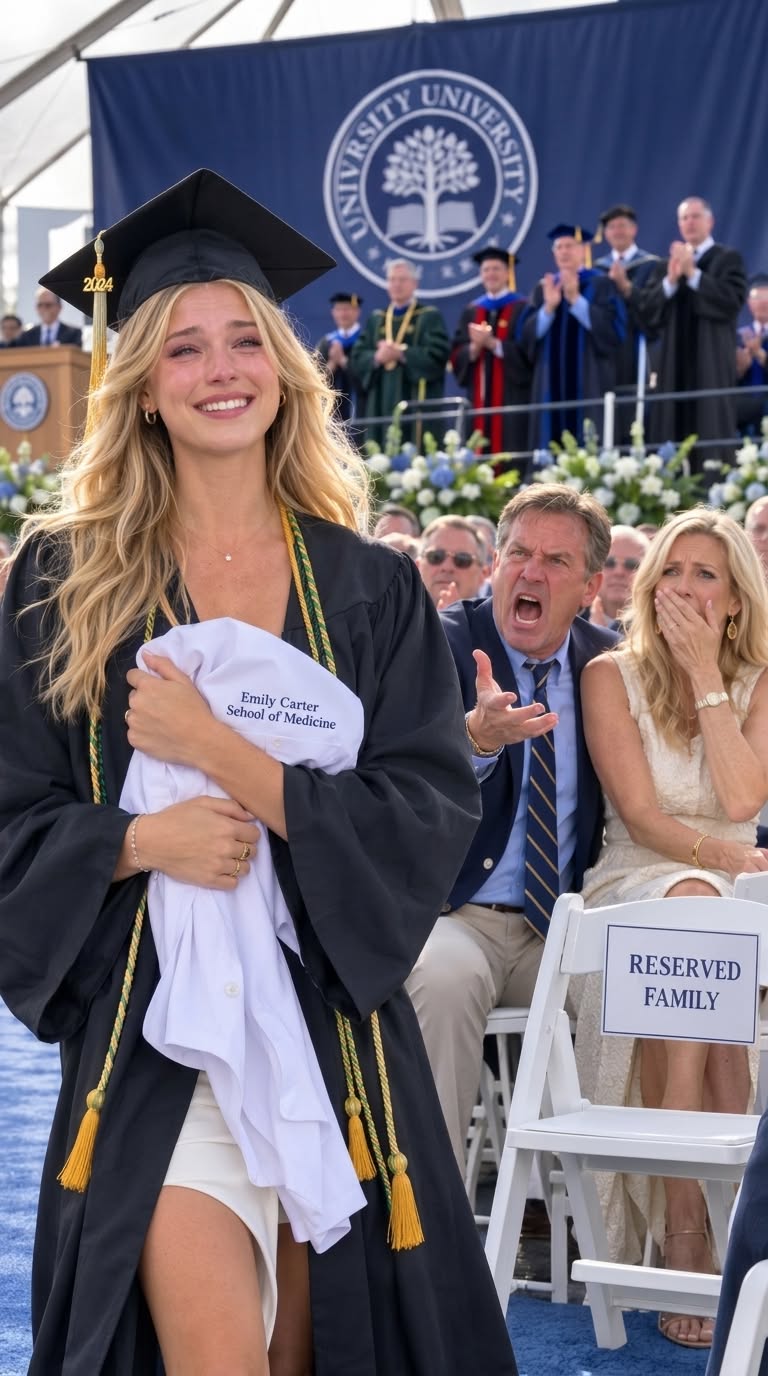
Ten years later. I was twenty-six, a week away from graduating as the Valedictorian of my medical school class at a prestigious university. I had secured a highly competitive residency. My life was finally coming together.
I was sitting in the campus library, finalizing my valedictory speech, when my phone buzzed. It was an email from an unknown sender. The subject line made my blood run cold.
Subject: So proud of you, Emily. Let’s talk. – Dad.
I stared at the screen until the letters blurred. Dad. The audacity of the word made me physically nauseous.
I opened the email. It was a perfectly crafted, slickly worded message from Thomas Higgins. He mentioned how he had “followed my career from afar,” how “incredibly proud” he and Karen were of my impending graduation, and how he desperately wanted to meet for coffee to “bridge the gap that time and unfortunate circumstances had created.”
I was about to delete it when I did a quick Google search on his name.