3. The Truth Behind the Silence
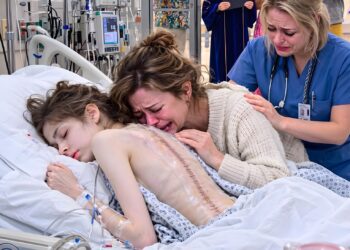
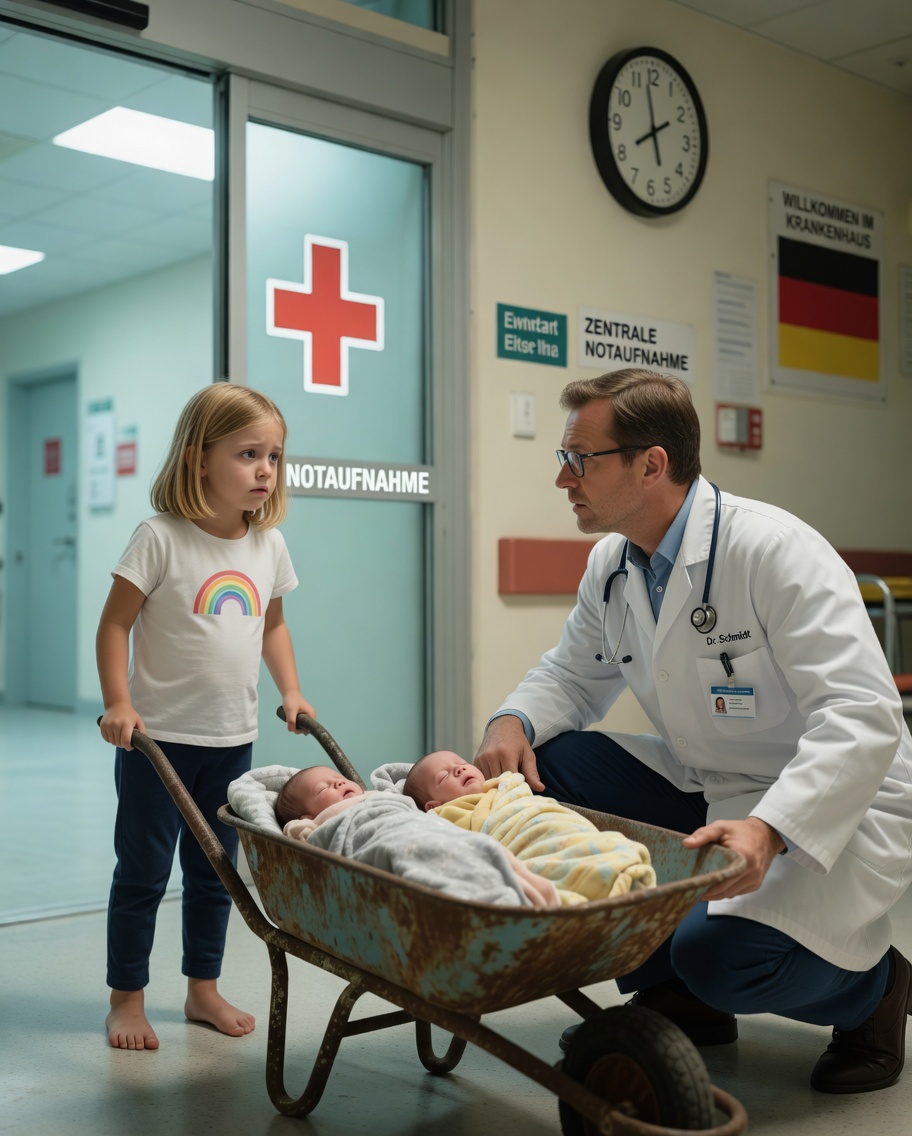
Back at the hospital, Dr. Weber reviewed Anna’s medical records. Severe dehydration, malnutrition, and complications from untreated postpartum depression. He looked at Nurse Helga and sighed. “If the girl hadn’t kept giving her water, she wouldn’t be here anymore.”
When Leni woke up the next morning, Helga was sitting by her bed, smiling. “They found your house, sweetheart. Your mom is in another hospital now. The doctors are helping her wake up.” “Is she still asleep?” Leni asked softly. “Yes, but she whispered your name when she briefly opened her eyes.” Leni stared at the ceiling for a long time. “I counted how many times I tried to wake her. I gave her water with a spoon, just like she showed me with the babies.” “You did everything right,” Helga said, fighting back tears. “You saved them all.”
4. A Home of Her Own
Weeks passed. Anna slowly regained consciousness, but she would need months to recover. The children needed a safe place. That night, Sister Helga couldn’t sleep. Her house had been quiet since her husband had died. The next morning, she knocked on Dr. Weber’s door. “I was a certified nursing supervisor before,” she said. “I’d like to take Leni and the twins in.”
A week later, Leni moved into Helga’s cozy house on Maple Street. The guest room had been prepared with light-colored linens and a small desk for drawing. One evening, as Leni tucked the twins in, Helga said, “Your mother is getting stronger every day.” Leni hesitated. “I just hope she remembers me.” “She could never forget you,” Helga said. “You are her heartbeat.”
5. The Visit
It was a crisp spring morning when they pulled up in front of the Weidenbach Rehabilitation Center. Through the glass doors, Leni saw her mother sitting in a wheelchair under a blossoming cherry tree. “Mom!” Leni cried and ran towards her. Anna opened her arms. They held each other tightly, and tears of relief streamed down her face. “Let me look at you,” Anna said, cupping her daughter’s face in her hands. “My brave girl. You kept your promise.” “I did,” Leni whispered. “I looked after Jakob and Emma.”
6. The Letter
Later, Leni sat with Dr. Weber under the tree. She pulled a note from her bag. “I found this in Mom’s drawer.” It was a letter written in shaky handwriting: “My beloved Leni, if you are reading this, something has happened to me. None of it is your fault. You are my light and my strength. If the darkness wins for a while, remember—it is not because I stopped fighting.” Dr. Weber swallowed hard. “This proves what we always knew: Your mother never gave up.”
7. The Beginning of Something New
By summer, Anna was strong enough. Thanks to a new family support initiative established after her story became public, she received a subsidized apartment near the hospital—and near Helga. On moving day, Leni carried her diary filled with drawings: the blue house, the hospital, Helga’s home, and her new apartment. Helga hugged her tightly as she said goodbye. “You’ll visit me, won’t you?” “Of course,” Leni said, handing her a picture of two houses connected by a line of hearts. “See? We’re still connected. No more dashed lines—a solid connection.”
8. One year later
A banner hung in the hospital’s main hall: “The Leni-Maren Family Program – 1st Anniversary.” Dr. Weber stepped up to the microphone. “What began as the courage of one little girl has grown into a program that has already helped fifty families in the district.” In the front row sat Anna, healthy and radiant, with the twins on her lap. Leni, now nine years old, stepped forward. “My mom says family means people who are there for each other when things get tough,” she began. “But I think community means people who notice when a family needs help—and then actually help.”
9. The Garden
That evening, Leni sat on a picnic blanket in a small park. The twins played nearby while Helga gently pushed them on the swings. Anna leaned forward. “What are you drawing?” Leni smiled. “Our family—the one we’ve built together.” The drawing showed a circle of hands closing around two small babies. And in the background of the page, the sketch of a wheelbarrow rested very quietly – not as a reminder of the suffering, but as a symbol of the strength that had carried them all this far.