This last part drove her into a frenzy. Margarete hated secrets she couldn’t control. At first, she masked her resentment as concern. Over dinner, she asked if Lukas was still doing that little consulting job. She reminded him that the family ought to know, just in case something happened. She laughed too loudly and said she hoped he wasn’t entrusting me with all his passwords—after all, women could be unpredictable when money was involved.
Lukas usually let those remarks roll off him. But one night, after she had left our apartment, he locked the door, pressed his forehead against it, and said very quietly, “My family doesn’t love information. They love access.”
That was the night he finally told me the worst of it. Years earlier, after his father’s death, Lukas had discovered that Margarete and Dominik had misused estate documents to secure short-term loans. At first, it was nothing major. Petty fraud. Altered signatures. Temporary substitutions. A family helping themselves to the assets of the dead, convinced the living would keep forgiving them. Back then, Lukas cleaned everything up to protect his father’s reputation. He covered some of it himself. He blocked the rest through legal channels. Quietly. Always quietly.
They mistook that for weakness. It wasn’t weakness. It was grief. Later, when Lukas stopped bailing them out, they called him cold. Ungrateful. Changed. Margarete told anyone who would listen that I had turned him against his own flesh and blood. The truth was simpler and harsher: once he had experienced a life free from constant taking, he no longer volunteered to be a victim.
Then came the hospital. Lukas’s collapse happened quickly. Chest pains that were supposedly nothing to worry about. A night in the emergency room that turned into a stay in the intensive care unit. A diagnosis that suddenly made every hour count differently. He remained lucid long enough to do what men like Lukas do when they know upheaval lies ahead. He prepared himself.
The lawyer Elena Kreuz arrived at the hospital the next morning, a leather portfolio under her arm and accompanied by a notary from her firm. I still remember the click of the pen. The blue seal. Lukas’s hand trembled once before going still. He signed documents I couldn’t fully grasp at the time, because I was trying not to imagine a world without him.
He transferred final control of the apartment—and all associated holdings—to the Regensburg Harbor Trust Fund. I was named sole administrator and beneficiary. He updated the beneficiaries on his investment accounts. He revoked any family access rights that remained in old records. He finalized a letter of instruction to Elena.
And then—because Lukas was Lukas—he created something he called a “contingency file.” “If they behave like human beings,” he said wearily, “it won’t matter.” I asked what was in it. He gave me that tired, knowing smile. “Enough.”
He died two days later.
Now, as I stood in our apartment and watched Margarete Helmer step over the funeral flowers, I finally understood what “enough” meant. My phone vibrated in my hand.
Elena: We’re downstairs.
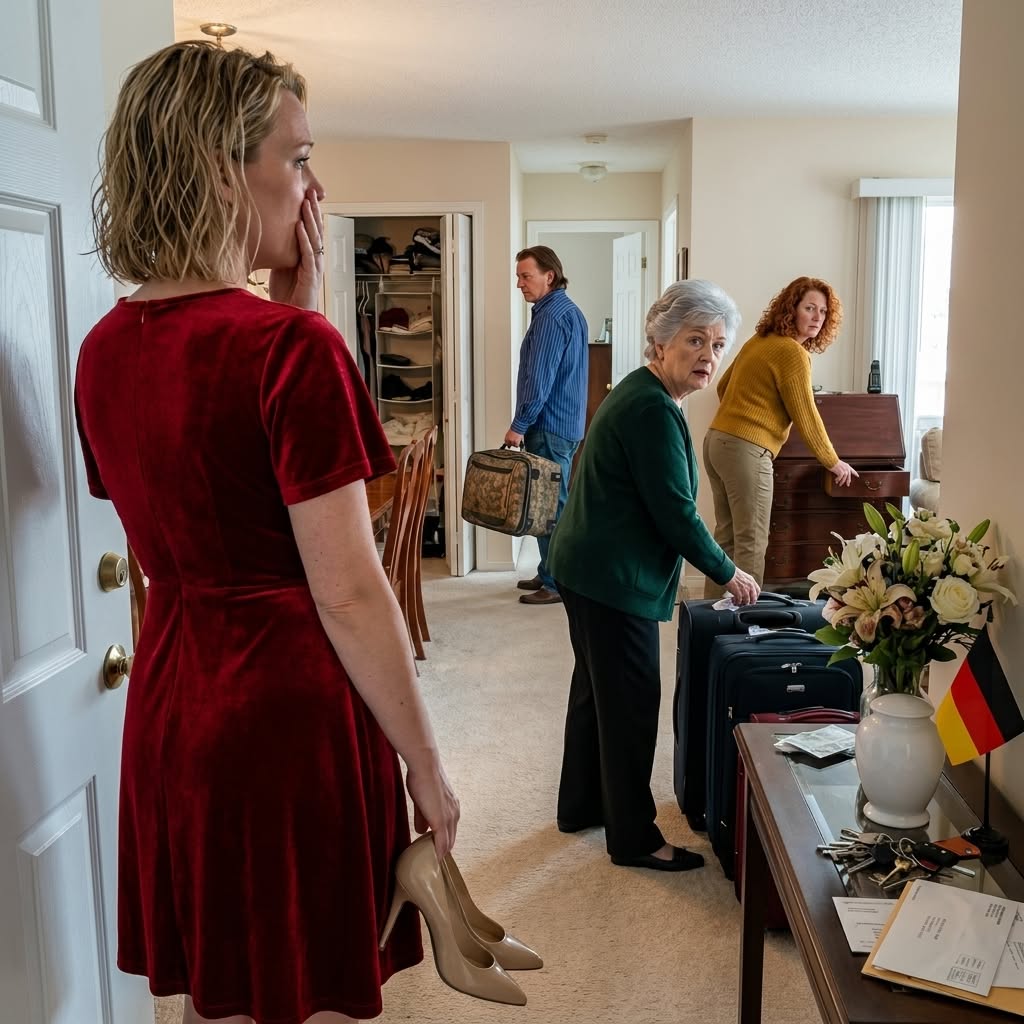
I looked at Margarete. Then Dominik. Then Frieda, who was still hovering over Lukas’s desk as if something valuable might be hidden beneath the paperclips. “You should probably put those suitcases down,” I said.
Margarete let out a sharp, impatient laugh. “Or what?”
There was a knock at the door. I walked back through the hallway, past the urn, and opened it. Elena Kreuz was standing there in a dark blue suit; the rain had dampened her shoulders. Beside her stood Luis Ortega, the property manager, holding a clipboard. And next to him stood Police Officer Collins—calm, broad-shouldered, and already wearing that bored expression law enforcement officers get when other people’s audacity has made the outcome a foregone conclusion.
Elena held a black folder under her arm. “Ms. Helmer,” she said.
Margarete appeared in the hallway behind me. “Who is that?”
Elena looked past my shoulder and took in the suitcases. The open cupboards. The people. The list on the dining table. When her eyes returned to Margarete, they betrayed no emotion. “Elena Kreuz,” she said. “Legal counsel for the late Lukas Helmer and the Regensburg Port Trust Fund. I am here because this residence is under active legal protection, and the trustee has reported unauthorized entry and an attempted theft of property.”
You could feel the atmosphere shift at that sentence. Dominik stepped back. Margarete lifted her chin even higher. “This is family property.”
Luis opened his clipboard. “No, madam. This unit belongs to Hafen Wohnungs-Holding, which was transferred to the Regensburg Port Trust Fund six days ago. The right of use belongs solely to Ms. Anneliese Helmer. We also have a written revocation of all previous access rights.”
Margarete’s features tightened. “That’s impossible.”
Elena pulled the first document from the folder and held it up so everyone could see the seal. “It’s not impossible,” she said. “It’s been notarized.”
Frieda was the first to try to regain her composure. “There is no will. We checked.”
“Exactly,” Elena replied. “There is hardly anything that needs to go through probate. That was intentional.”
The silence that followed was exquisite. For with a single, precise sentence, Lukas had defeated them using the one thing they had never tried to understand: structure. Margarete looked at me now—really looked at me—and for the first time since I had opened the door, a flicker of uncertainty crossed her face.
“What did he tell you?” she asked.
“Enough,” I said.
Chief Constable Collins stepped forward just far enough to seem unmistakably real. “I must ask you to identify your personal belongings and vacate this property. If anyone wishes to contest the right of ownership, that is a matter for elsewhere. Not while you are removing items from a residence over which you have no authority.”
Dominik made one last attempt. He pointed to the desk and claimed Lukas had promised him a payout from a business deal. Frieda muttered that Margarete, as his mother, had every right to secure family documents. A younger cousin quietly began to unzip the suitcase he had packed, as if invisibility might save him.
Elena opened the black folder and pulled out a second sheet. “Before anyone says something rash,” she said, “you should know that Lukas anticipated resistance. He left behind signed copies of previous warning letters regarding the unauthorized use of his name, evidence of attempted access to his accounts, and surveillance stills from an earlier visit to this apartment while he was in the hospital.”
Dominik went ashen. That was when I knew. Lukas hadn’t just expected them to come; he had foreseen exactly who would touch what.
Elena placed three stills on the dining table. In the first, Dominik was standing in Lukas’s study during the week of his hospital stay, with one hand inside a drawer. In the second, Frieda was holding a folder open under the desk lamp. In the third, Margarete was using her key on the door while glancing back over her shoulder.
No one spoke. Even Officer Collins seemed impressed. “He installed internal cameras after an earlier incident,” Elena said. “These files are backed up externally.”
Margarete’s mouth opened, then closed again. Finally, she said the only thing people like her say when certainty slips away: “He wouldn’t do that to the family.”
I almost answered. Elena beat me to it. “He did exactly that to the family,” she said. “Because of what the family had repeatedly done to him.”
She pulled a final item from the folder: a sealed envelope in Lukas’s handwriting. My name was on the front. Elena handed it to me. “He asked that you read this only if they came to the apartment after his death,” she said.
My hands trembled as I opened it. Inside was a single sheet of paper.
Anneliese, if you are reading this while my mother is in the room, then I was right, and she arrived before the flowers had wilted. Laugh first.
I did. More quietly this time, but it was enough. The rest of the letter was brief. Lukas apologized for leaving me alone with this ugliness while I was grieving. He told me he loved me. He told me not to negotiate with people who viewed loss as an opportunity. He told me that the documents Elena held were more than sufficient to remove them, and that if his family chose humiliation over decency, he had left them exactly what they deserved in a separate letter regarding the estate.
That caught Margarete’s attention. “What does that mean?” she asked.
Elena answered without sympathy. “It means Lukas made a single testamentary provision. Each named relative receives one euro and a warning against contesting the will. Furthermore, any further interference triggers the release of supporting documentation to the relevant civil and law enforcement authorities regarding past fraudulent activities involving estate instruments and unauthorized use of credit.”
Frieda sank heavily onto one of my dining room chairs. Dominik swore softly. Margarete stared at Elena as if language itself had turned against her. “He left me one euro?”
“Yes,” said Elena. “His mother?” “His decision.”
Margarete turned to me, and what flashed in her eyes at that moment wasn’t grief. It was the shock of exposure—the realization that the quiet man had kept a record. For years, she had treated Lukas as if he existed solely to cushion the consequences of her greed. Now, his final act was one of refusal.
Chief Officer Collins cleared his throat and instructed everyone to gather only personal items. No documents. No electronics. No boxes. Luis oversaw the process as bags were reopened and Lukas’s possessions were returned piece by piece. Shirts back in the closets. Cables back in the drawers. Two watches back on the tray atop the bedroom dresser.
The process took nearly an hour. No one looked at the urn. Before leaving, Margarete paused in the doorway and turned to me. “You think this makes you safe?”
I stood beside the entryway table, one hand near Lukas’s flowers, with Elena still behind me in the apartment. “No,” I said. “Lukas made me safe. This just makes you visible.”
She left without another word. The door clicked shut. And finally, the apartment fell silent. Not peaceful—not yet. But honest.
I stood there for a long time, gazing at the room they had picked almost clean. The half-open closet. The dining table strewn with legal papers. The sofa where Lukas used to fall asleep with a book resting on his chest. The temporary urn sitting beside flowers that were already beginning to wilt at the edges.
Elena placed a hand lightly on my arm. “There’s one more thing,” she said.
We sat at the dining table after Luis and the police officer had left. Elena opened the final section of the black folder and slid a small USB drive toward me. “Lukas recorded a message the morning after he’d signed everything,” she said. “For you. And a part for the record, in case the family decided to contest the trust fund.”
I plugged it into Lukas’s laptop with hands that still didn’t feel like my own. His face appeared on the screen. Hospital light. Pale skin. Eyes—tired, but unmistakably his. He smiled at the camera—that crooked smile he always wore when he knew he was being more sentimental than usual.
“Anneliese,” he said. “If you’re watching this, then first of all, I’m sorry. Second: If my family is in the apartment while you’re watching this, I hope you laughed.”
I laughed again, and the sound cracked something open inside me.
He went on. He said he’d spent too many years confusing loyalty with submission. He said loving me had taught him that peace requires boundaries, not just patience. He said he’d arranged everything the way he did because he wanted the one person who never reached for his wallet before holding his hand to be the first one protected.
Then his expression changed. “For the record,” he said, his voice losing its softness, “my mother, Frieda Helmer, and Dominik Helmer have absolutely no authority over any property, accounts, or documents connected to me, Konrad Ledger Inkasso, Hafen Wohnungs-Holding, or the Regensburg Port Trust Fund. Any claim to the contrary is false. Any use of old keys, old documents, or old family stories should be treated as what it is: trespassing disguised as grief.”
The screen went black a moment later. I sat there, tears on my face, a hand over my mouth. Not because I was surprised. But because, even in death, Lukas sounded exactly like himself—precise, deliberate, and possessing a quiet force.
The official challenges never came. Perhaps Margarete realized that Lukas had built the kind of case one doesn’t challenge unless one is prepared to lose publicly. Perhaps Dominik remembered the camera stills. Perhaps Frieda realized that probate court is a terrible place to improvise innocence.
Whatever the reason, the dispute Elena had expected never materialized. Within three weeks, the trust fund transfers were complete. The apartment remained mine. The investment accounts were settled outside of probate. Lukas’s private charitable donations continued based on instructions he had already signed.
In those weeks, I learned more about his work than I had in the ten years we’d spent together—not because he had been hiding things, but because I had never judged him by what he controlled. That was the irony of it all. The people who wanted Lukas’s fortune had never cared enough about Lukas himself to understand him.
A month later, I walked alone through the Old Town at sunset. The alleyways glowed the way they do when the day slowly fades, when the tourists thin out and the old city begins to sound like itself again. I paused in front of the place where we had once had coffee and debated whether reticent people are born that way or made that way.
Lukas had said: “Made. Usually by surviving the wrong kind of attention.”
And he had been right about that, too.
When I returned home, the apartment was quiet. My quiet. I placed fresh flowers beside his urn. Opened the windows. Let the evening air drift through the rooms. Nothing had been stolen. Nothing had been lost, except the illusion that blood guarantees reliability. I stood in the doorway for a moment before turning on the light. Then I laughed again—softly this time—and whispered into the apartment he had protected to the bitter end: “They never knew who you really were. But I did.”