
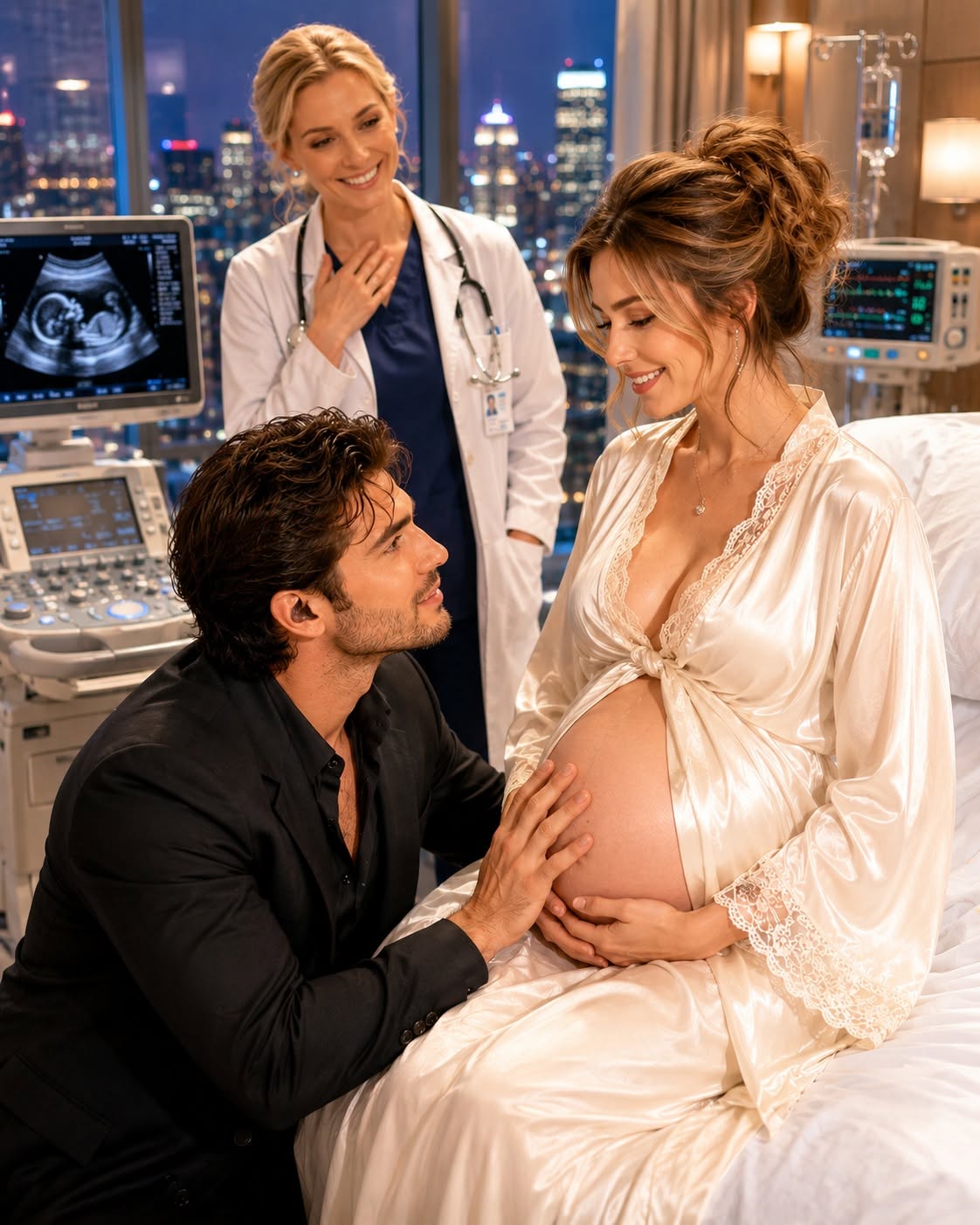
Adrian sent Luca to retrieve a bag from my apartment.
I objected.
Adrian said, “He won’t enter unless you give permission.”
I called my elderly neighbor, Mrs. Alvarez, who had been feeding my plants and pretending not to know I was lonely. She agreed to let Luca in and supervise the packing with the sternness of a retired school principal.
“She will make him fold everything twice,” I warned.
“She may try,” Adrian said.
“She will succeed.”
And strangely, he smiled.
A real one.
It vanished quickly, but not before my heart betrayed me and noticed.
Night settled over Chicago.
The hospital room dimmed, filled with the soft glow of monitors and the endless rhythm of Sofia’s heartbeat. Nurses came and went. Dr. Nair checked on me twice. My blood pressure rose, then eased. Sofia kicked whenever the monitor straps shifted, furious at being watched.
“She hates being controlled,” Adrian said from the chair.
I looked over at him. “Again, definitely your daughter.”
“Or yours.”
“I’m very cooperative.”
His eyebrow lifted.
I almost smiled.
Then the silence returned, but it was different now. Not comfortable. Not yet. But less sharp at the edges.
Around nine, Luca returned carrying a small overnight bag, a tote, and a paper sack from the bookstore café where I worked. Mrs. Alvarez had apparently packed snacks, a robe, slippers, and three novels “because hospitals are boring and men are useless when women need distraction.”
Luca delivered the message without expression.
I laughed so hard the monitor slipped.
A nurse hurried in.
Adrian looked alarmed.
“I’m fine,” I said, still laughing.
The nurse adjusted the strap, smiling despite herself. “Try not to laugh the baby off the monitor.”
When she left, I reached into the tote and pulled out the smallest item Mrs. Alvarez had packed.
A soft yellow baby hat.
I had bought it from a craft market in September, before I knew Sofia was a girl, before I knew how deeply fear could root itself inside hope.
Adrian stared at it.
“She has things?” he asked.
“Of course she has things.”
“I didn’t mean—”
“I know what you meant.”
He leaned forward, elbows on his knees. “Can I see?”
I hesitated.
The tote held pieces of the life I had built without him. A folded blanket. Tiny socks. A paperback on newborn sleep that had frightened me more than any crime story. A small stuffed rabbit with one floppy ear.
Sharing those things felt like opening a door.
But he was Sofia’s father.
And part of me, the most tired part, wanted someone else to know how much I had loved her before she ever arrived.
I handed him the rabbit.
Adrian took it with both hands.
The sight was absurd. This feared man in a tailored suit, holding a toy rabbit as if it were made of glass.
“I bought that after the first ultrasound,” I said. “She looked like a bean. I panicked and bought a rabbit.”
“A logical response.”
“I thought so.”
He ran his thumb over the rabbit’s stitched ear.
“I bought something too,” he said.
I blinked. “What?”
He reached into his coat pocket again, but this time what he withdrew was not a photograph.
It was a small silver bracelet.
My breath caught.
A baby bracelet, delicate and bright, with a tiny charm in the shape of a star.
“I bought it years ago,” he said. “Before we knew whether we could have children. Before everything became… complicated.”
I remembered.
There had been a winter two years into our marriage when I had wanted a baby so badly it hurt to walk past playgrounds. Then Adrian’s world had grown darker, more demanding, closer to our front door. We had stopped talking about children without ever deciding to stop.
“You kept it?” I asked.
“I kept everything.”
There was too much in that sentence.
The room seemed to narrow.
“Adrian,” I said softly, “why did you really sign those papers yourself?”
He looked at me.
I had wondered about it for months. The papers had been prepared by lawyers, delivered by strangers, wrapped in cold procedure. But his signature had been real. I knew the shape of his name, the hard slant of the A, the decisive line beneath it.
He could have had someone else handle it.
He hadn’t.
His eyes moved to my IV, my stomach, the monitor, anywhere but my face.
“Because if I didn’t sign them,” he said, “I knew I would come home.”
The confession settled between us.
Not enough to heal anything.
But enough to prove the wound had gone through both sides.
I turned my head toward the window.
Outside, Chicago glittered in the dark, indifferent and beautiful.
“I waited,” I whispered.
“I know.”
“No, you don’t. I waited in stupid ways. I left the porch light on for three nights after you moved out. I kept thinking maybe you’d come back for your watch, your passport, your black coat. Anything. I hated myself for it.”
His voice roughened. “I came back once.”
I looked at him sharply.
“When?”
“The fourth night.”
My heart stopped.
“The light was off,” he said. “I thought you had accepted it.”
I stared at him.
Then I laughed once, softly and without humor.
“The bulb burned out.”
His face changed.
Such a small thing.
Such a ridiculous, ordinary thing.
A porch light bulb.
Between us, it became tragedy.
“I sat in the dark that night,” I said. “I thought you hadn’t come because I finally stopped believing hard enough.”
Adrian bowed his head.
For a while, neither of us spoke.
The machines did the speaking for us. Sofia’s heartbeat. My blood pressure cuff inflating. The IV pump clicking quietly. A hospital lullaby chimed somewhere overhead, announcing a baby born on another floor to another family whose joy was uncomplicated for at least one perfect minute.
Eventually, Adrian said, “I don’t expect forgiveness.”
“Good.”
He nodded.
“I don’t know what I expect,” I admitted.
“That makes two of us.”
I looked at him then, really looked.
Not at the legend. Not at the man in the city’s whispers. Not at the husband who had left.
At the father sitting in a hospital chair, holding a stuffed rabbit and looking terrified of hope.
“You can be here for Sofia,” I said slowly. “But I need boundaries.”
“Name them.”
“No decisions without me.”
“Yes.”
“No moving me into one of your houses.”
His mouth opened.
I raised an eyebrow.
He closed it.
“Yes.”
“No security team scaring my neighbors.”
A faint grimace. “Define scaring.”
“Adrian.”
“Yes.”
“No deciding we’re a family again because the timing is dramatic.”
That one struck him.
I saw it.
He nodded anyway. “Yes.”
“And no lying to me.”
His gaze lifted.
“That one may be harder,” I said.
“It shouldn’t be.”
“But it is.”
He looked down at the rabbit. “Yes.”
The honesty was painful.
But lies had destroyed us more efficiently than enemies ever could.
At midnight, the contractions started.
At first, I thought they were cramps. A tightening, low and strange, like my body was practicing an argument it had not yet decided to have. I shifted in bed. Drank water. Told myself not to panic.
Then another came.
Stronger.
The monitor changed.
Adrian was on his feet before I said his name.
“Elena?”
“I don’t know.”
He pressed the call button.
A nurse appeared almost immediately, checked the monitor, then my expression, and called for Dr. Nair.
Within minutes, the room filled with controlled movement.
Not chaos.
That made it worse.
Dr. Nair checked me, listened, watched the monitor.
“You’re having contractions,” she said.
“But it’s too early.”
“Thirty-four weeks is early, but not too early for us to manage.”
“I’m not ready.”
Her eyes softened. “Most people aren’t.”
Adrian stood near the head of the bed, one hand resting lightly on the rail.
He looked at me for permission before touching me.
I nodded.
He took my hand.
His palm was warm, familiar, steady.
I hated that it steadied me.
The contractions continued for an hour, then slowed after medication and fluids. Sofia’s heartbeat dipped once, just enough to freeze every face in the room, then recovered.
When the room emptied again, I was shaking.
Adrian sat beside me, still holding my hand.
“You can let go,” I whispered.
“I know.”
He didn’t.
I didn’t ask again.
Sometime near dawn, exhaustion pulled me under.
I woke to pale light and quiet voices outside the door.
Adrian was not in the chair.
For one disoriented second, old grief rushed back with such force that I could not breathe.
Gone.
Again.
Then I saw him through the glass wall near the hallway, speaking with Luca in low voices.
His coat was off. His sleeves were rolled up. He looked as if he had aged five years overnight.
Luca handed him a phone.
Adrian listened, and whatever he heard changed his posture completely.
The softness vanished.
The old Adrian returned—not cruel, not dramatic, but alert in a way that made the air seem colder.
I could not hear the words.
But I saw the moment his eyes moved to my hospital door.
I sat up too quickly.
The monitor shifted and crackled.
Adrian ended the call and came in.
“What happened?” I asked.
“Nothing you need to worry about right now.”
Wrong answer.
The last remnants of sleep disappeared.
“Try again.”
He stopped beside the bed.
For a moment, I thought he would lie.
I watched the decision move through him.
Then he said, “A man was picked up outside your apartment building last night.”
My blood chilled.
“What man?”
“We don’t know his name yet.”
“Was he the one from the clinic?”
“Possibly.”
“What was he doing there?”
Adrian’s gaze moved to the tote bag Mrs. Alvarez had packed.
“He had photographs.”
The room became too bright.
“Of me?”
“Yes.”
I touched my stomach. “Of Sofia?”
His silence was answer enough.
My breath came shallow and fast.
“Elena,” he said, reaching for me.
I pulled back. “No. Tell me.”
“He also had a copy of your hospital admission form.”
“That’s impossible.”
“It should be.”
“Who gave it to him?”
“We don’t know.”
The door opened before I could respond.
Dr. Nair entered with a nurse and a fresh scan report.
She paused, sensing the tension, but continued with professional calm.
“Good morning. We have some updates.”
I forced myself to breathe.
Adrian stepped back, but not far.
Dr. Nair checked the monitor strip, then smiled faintly. “Sofia behaved herself for most of the night after that little scare.”
“She gets that from neither of us,” I said weakly.
Adrian’s mouth twitched.
Dr. Nair sat at the foot of the bed. “Your blood pressure is still borderline. Not terrible, not ideal. The repeat ultrasound shows the placenta is functioning, but not as well as we want. Sofia’s growth is a little behind where we’d expect.”
Tears burned behind my eyes.
“Did I do something wrong?”
“No,” Dr. Nair said immediately. Firmly. “Nothing about this suggests you caused it.”
I looked away.
I had spent months hiding, working on my feet, counting money, pretending I could carry fear like groceries and never drop anything.
“It may be safest to deliver within the next few days,” Dr. Nair continued. “Not this minute unless something changes. But soon.”
Adrian took that in silently.
I placed both hands over my stomach.
A few days.
After months of imagining birth as a distant storm, it was suddenly at the door.
“Can I think?” I asked.
“Of course,” Dr. Nair said. “But we’ll keep monitoring. Sofia may have her own opinion.”
After she left, Adrian and I sat in stunned quiet.
A few days.
My daughter might be born in a few days.
I had not washed all her blankets. I had not installed the car seat. I had not decided whether to be brave enough to give her his last name as a middle name. I had not forgiven her father. I had not forgiven myself.
Adrian spoke first.
“What do you need from me?”
I laughed softly, near tears. “A time machine.”
“If I had one, I’d use it.”
“I know.”
That was the saddest part.
I believed him.
He moved to the small table by the window and picked up the yellow baby hat.
“She’ll fit this?”
“For about five minutes, probably.”
He held it carefully. “Then we’ll make those five minutes count.”
Something inside me loosened.
Not forgiveness.
Not trust.
But perhaps the beginning of a bridge.
“You said boundaries,” he reminded me. “I’ll follow them. But I need to ask one thing.”
“What?”
“Let me keep watch until she’s born.”
“Adrian—”
“Not control. Not orders. Just watch. There is a leak somewhere. At the clinic, the hospital, your apartment building—I don’t know yet. Until I do, I can’t walk away.”
His voice did not rise.
That made the fear in it clearer.
“I don’t want your world around my child,” I said.
His face tightened, but he nodded. “Neither do I.”
The answer surprised me.
He looked at Sofia’s monitor. “I’ve spent my life telling myself power could protect the people I loved. Maybe I was wrong. Maybe power only tells danger where to look.”
I had no answer.
Because that was the most honest thing he had ever said.
Before noon, Mrs. Alvarez arrived like a storm in orthopedic shoes.
She marched into the room carrying a rosary, a thermos of soup, and enough suspicion to fill the maternity ward.
“So,” she said, looking Adrian up and down. “You are the husband.”
“Ex-husband,” I said.
Adrian inclined his head. “Adrian Moretti.”
“I know who you are.” She narrowed her eyes. “You made her cry.”
Adrian accepted this like a formal charge. “Yes.”
Mrs. Alvarez seemed mildly annoyed that he did not argue.
“She is stubborn,” she said.
“Yes.”
“And too thin.”
“She is pregnant,” I protested.
Mrs. Alvarez ignored me. “And she works too much.”
Adrian looked at me.
I looked at the ceiling.
“Do not start,” I warned.
“I haven’t said anything.”
“You thought it loudly.”
Mrs. Alvarez pulled a chair to my bedside. “Good. Maybe someone should.”
Within fifteen minutes, she had fed me soup, corrected Adrian’s blanket-folding technique, and told Luca in the hallway that standing like a statue was bad for circulation.
Luca, to his credit, walked three slow laps past the nurses’ station.
For the first time since the clinic, the room felt almost normal.
Almost.
Mrs. Alvarez stayed for two hours. Before she left, she bent and kissed my forehead.
“You let people help you now,” she whispered. “Pride is heavy. Babies are heavier.”
I squeezed her hand.
At the door, she stopped in front of Adrian.
“You hurt her again,” she said, “and I will be very disappointed.”
It was possibly the least threatening threat Adrian Moretti had ever received.
He bowed his head. “I understand.”
After she left, Adrian looked at me.
“She terrifies me.”
“She should.”
By late afternoon, my blood pressure rose again.
The mood shifted.
Dr. Nair ordered medication and another round of monitoring. Sofia’s heartbeat remained steady, but the concern in the nurses’ eyes returned.
Adrian stayed calm in a way that told me he was not calm at all.
I tried to focus on small things.
The weight of the blanket.
The taste of ice chips.
The soft scrape of Adrian’s chair when he moved closer.
At some point, rain began streaking the window.
Chicago blurred into silver.
I must have dozed, because when I opened my eyes, Adrian was standing near the foot of the bed with Dr. Nair. They were speaking quietly.
“No decisions without me,” I murmured.
Both of them turned.
Adrian came to my side. “No decisions have been made.”
Dr. Nair smiled gently. “We were discussing possibilities, not plans. You’re still the captain.”
“The captain is tired.”
“That’s allowed.”
I looked at Adrian. “What possibilities?”
Dr. Nair answered. “If your blood pressure continues rising, we may induce labor. If Sofia shows distress, we may recommend a cesarean. Right now, we’re trying to buy time safely.”
“How much time?”
“A day. Two days. Maybe longer if things improve. But I want you emotionally prepared for soon.”
Soon.
The word followed me into the evening.
It sat with me through another blood draw, another scan, another round of medication. It curled beside me when Adrian stepped out to take a call and returned with his face carefully blank. It whispered in the quiet moments when Sofia kicked beneath my palm.
Soon, I would meet her.
Soon, everything would change again.
Near midnight, Adrian finally fell asleep in the chair.
His head tipped back against the wall, one hand still resting near the bed rail. In sleep, the hard lines of his face eased. He looked younger. Almost like the man I had met at twenty-six, before I knew his last name carried shadows.
I watched him longer than I should have.
Then I whispered, “I don’t know how to do this with you.”
His eyes opened.
Of course he had not been fully asleep.
“Neither do I,” he said.
The honesty made me brave.
“I wanted her to be only mine.”
Pain moved through his expression, but he did not interrupt.
“I know that sounds selfish,” I continued. “But after you left, she was the one thing that felt untouched by all of it. She was mine before she was part of your world.”
“She still is,” he said.
“No. She’s ours.”
The word changed the room.
Ours.
I had avoided it for months.
Now it sat between us, fragile and undeniable.
Adrian leaned forward. “I will earn whatever place you allow me to have.”
I searched his face. “And if that place is not beside me?”
His throat moved.
“Then I will stand where I’m told,” he said.
It should not have hurt.
But it did.
Because some part of me wanted to ask him to stand closer.
Morning came with a decision.
My blood pressure spiked just after six.
The nurse’s calm voice sharpened. Dr. Nair arrived quickly. Sofia’s heartbeat remained steady, but my headache had returned, bright and pulsing behind my eyes.
Dr. Nair sat beside me.
“Elena,” she said, “I think it’s time.”
The words were gentle.
They still felt like a door opening beneath my feet.
“Today?”
“Yes. We can induce and monitor closely. Given your labs, blood pressure, and Sofia’s growth concerns, I believe delivery is the safest path now.”
Adrian stood at my other side, silent.
Waiting.
Not deciding.
I looked at the monitor. At the strip of paper recording my daughter’s heartbeat. At the yellow hat on the table. At the man who had broken my heart and somehow still looked like home from the wrong angle.
I placed one hand on my stomach.
“Sofia,” I whispered, “are we doing this?”
She kicked.
Hard.
Dr. Nair smiled. “I’ll take that as an opinion.”
I laughed, then cried, then laughed again.
“All right,” I said. “Let’s meet her.”
The hours that followed were a blur of preparation.
Consent forms. Medication. Explanations. Nurses introducing themselves. Adrian changing into a plain dark sweater Luca somehow produced from nowhere. My hospital bag opened and reorganized. Mrs. Alvarez called and cried and ordered me to breathe “like civilized people.”
Adrian remained beside me through it all.
When contractions strengthened, he counted with me.
When I snapped that his counting was annoying, he stopped.
When I snapped that stopping was also annoying, he resumed more quietly.
At one point, I gripped his hand so hard his knuckles whitened.
“Sorry,” I gasped.
“Don’t be.”
“You’ll lose circulation.”
“I’ve survived worse.”
I glared at him.
“Not helpful,” he said quickly.
Despite the pain, I almost laughed.
Labor stripped everything down.
No mafia names. No divorce papers. No locked gates or whispered threats. Just breath, pain, fear, and the impossible work of bringing a child from one world into another.
Hours passed.
Or minutes.
Time lost shape.
Sofia’s heartbeat dipped once, and the room changed instantly. Nurses moved. Dr. Nair’s voice stayed calm but firm. I watched Adrian’s face drain of color.
“Talk to her,” Dr. Nair told him.
He looked startled. “To Elena?”
“To the baby.”
Adrian bent close to my stomach.
For the first time, I heard him speak to our daughter.
“Sofia,” he said, voice rough, “this is your father. We haven’t met yet, but I need you to listen carefully. Your mother is doing all the hard work, as usual. All you have to do is stay with us.”
Tears streamed into my hair.
The monitor fluttered.
Then Sofia’s heartbeat steadied.
A nurse smiled. “She listened.”
Adrian closed his eyes.
Hours later, just as dusk stained the windows purple-gray, Sofia Bennett Moretti came into the world with a furious cry that silenced every fear in the room.
She was small.
So small my heart nearly stopped.
But she cried.
Her tiny fists waved as if offended by existence. Her dark hair was plastered to her head. Her mouth opened wide, indignant and alive.
Dr. Nair held her up for one breathtaking second.
“There she is.”
I sobbed.
Adrian did not move.
He stared as if the entire universe had been placed in someone else’s hands.
Then the neonatal team took Sofia to check her.
The distance was only a few feet.
It felt endless.
“Why isn’t she with me?” I asked, panic rising.
“She’s early,” Dr. Nair said. “They’re helping her transition. She’s breathing. Listen.”
I listened.
A thin, angry cry filled the room.
My daughter.
My Sofia.
Adrian leaned close. “She’s here.”
I turned my face toward him, too exhausted to pretend anything.
“She’s here,” I whispered.
His forehead touched mine for one brief second.
Neither of us moved away.
When they finally placed Sofia against my chest, wrapped in blankets and wearing the yellow hat, the world narrowed to her warmth.
She was lighter than I expected.
Heavier than anything I had ever held.
Her cheek rested against my skin. Her eyes were closed, lashes impossibly fine. A tiny hand emerged from the blanket and curled near my collarbone.
“Hi,” I whispered. “I’m your mom.”
Adrian stood beside the bed, one hand over his mouth.
I looked up at him.
“Do you want to touch her?”
He nodded, unable to speak.
I shifted the blanket enough for him to place one finger near Sofia’s hand.
She gripped it.
Adrian Moretti broke.
Not loudly. Not dramatically. His shoulders simply folded inward, and tears slipped down his face without shame.
“My daughter,” he whispered.
For a little while, nothing else mattered.
Not the past.
Not the danger.
Not the unknown man with photographs or the leak in the hospital.
There was only Sofia breathing against me and Adrian’s finger trapped in her tiny fist.
For a little while, we were not healed.
But we were together.
Later, after Sofia was taken to the special care nursery for monitoring, after Dr. Nair assured us again and again that she was stable, after I had been settled into recovery beneath fresh blankets, Luca appeared at the door.
His face was unreadable.
Adrian stood immediately.
I knew that look now.
“What is it?” I asked.
Luca glanced at Adrian.
“No,” I said. “Not outside. Not whispered in hallways. Whatever it is, I hear it too.”
Adrian’s eyes met mine.
Then he nodded to Luca.
Luca stepped inside and closed the door.
“We identified the man from outside the apartment,” he said. “His name is Daniel Voss. Former private investigator. Lost his license three years ago.”
I frowned. “I don’t know that name.”
“He had a file on you,” Luca continued. “Clinic dates, work schedule, apartment photos.”
Adrian’s jaw tightened. “Who hired him?”
Luca hesitated.
The room seemed to hold its breath.
“We don’t know yet,” he said. “But there was something else.”
He reached into his coat and withdrew a clear evidence sleeve containing a folded piece of paper.
Adrian took it.
The moment he opened it, his face changed.
Not anger.
Not fear.
Recognition.
“What?” I demanded.
Slowly, he handed the paper to me.
It was a copy of Sofia’s hospital bassinet card.
But it had been printed before Sofia was born.
My hands began to shake as I read the name typed neatly across the top.
Baby Girl Moretti.
Beneath it, in the same precise black handwriting from the photograph, someone had added four words.
She was never hidden.
END OF PART 2 – LIKE, SHARE AND COMMENT “”THE ENTIRE STORY”” IF YOU WANT TO READ THE FULL STORY