
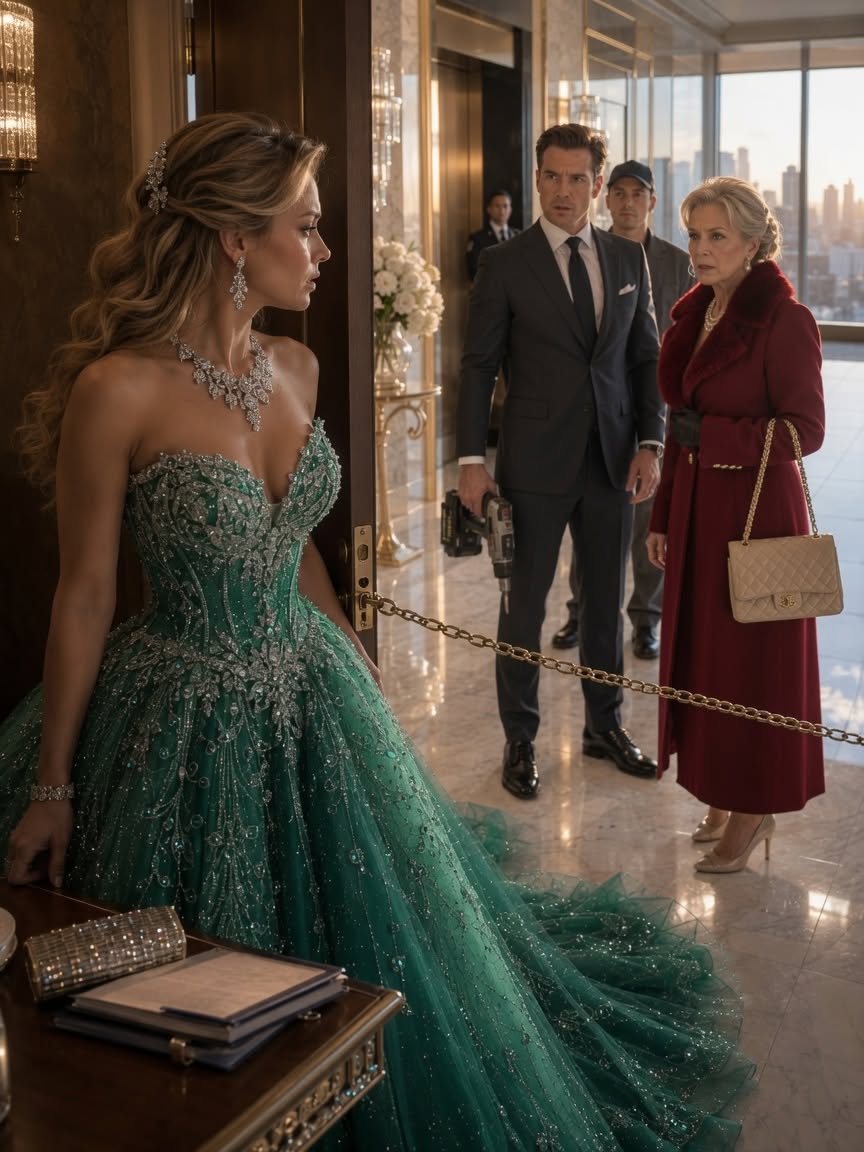
Now he was beginning to understand they had only proved I was generous.
Priscilla recovered first.
“This is financial deception,” she declared. “Ronald is entitled to half.”
“He waived all claims yesterday,” I said.
Ronald stared at me.
I continued quietly.
“Your attorney proposed the final settlement. You insisted on keeping your retirement accounts, your car, your personal investments, and the condo your mother lives in. In exchange, you waived any claim against my separate property, disclosed or undisclosed, inherited or gifted.”
His fingers tightened around the folder.
“You said signing quickly would prevent me from dragging your name through court.”
His eyes moved as he remembered his own words.
Priscilla whispered, “You signed that?”
Ronald did not look at her.
She grabbed his arm. “Tell me you didn’t sign that.”
He shook her off.
The motion was sharp enough to make everyone step back.
“You told me she had nothing,” he said.
Priscilla blinked.
“You told me her business barely covered the lifestyle. You said the accounts were leveraged and the penthouse was probably financed.”
“I believed it was.”
“You told me to push for speed.”
“Because she was humiliating us!”
“No,” he said, voice hollow. “You were afraid the court would audit the spending.”
Her lips parted.
There it was.
The midpoint where every lie turned around and faced its owner.
Ronald looked at the statement again, then at his mother.
“You knew how much you charged.”
Priscilla’s hand trembled against her coat.
“I was maintaining our position.”
“With her money.”
“She was your wife.”
“She was not your bank.”
The words came from Ronald, but they landed too late to save him.
The elevator chimed again.
This time, my attorney, Caroline Shaw, stepped out carrying a slim black briefcase. Behind her came a woman in a gray suit whom Ronald recognized immediately.
His face went white.
“Ms. Bell?”
Dana Bell had served as the independent financial examiner during our divorce.
Caroline walked toward us.
“Lexi called me after the alarm,” she said. Then she looked at Ronald. “Mr. Cobb, Ms. Bell and I were scheduled to meet with the state attorney’s financial crimes unit at eight-thirty.”
Priscilla’s voice turned brittle. “Financial crimes?”
Dana removed a sealed evidence envelope from her bag.
“The luxury credit card was not the only account accessed without proper authorization.”
Ronald stared at his mother.
Priscilla took one step backward.
Dana continued.
“During the divorce review, we found repeated transfers from Mrs. Cobb’s business account into an entity called Cobb Heritage Consulting.”
Ronald frowned. “That’s my mother’s company.”
“It has no employees,” Dana said. “No office. No clients. Its registered address is her condominium.”
Priscilla’s composure began to crumble around the edges.
Caroline’s gaze stayed fixed on her.
“Over twenty-six months, $612,000 was transferred into that entity using electronic authorizations linked to Ronald’s credentials.”
I felt the air leave my lungs.
I had known money was missing.
I had not known the amount.
Ronald shook his head. “I didn’t authorize that.”
Priscilla spoke too quickly.
“You gave me access when you set up the family accounts.”
“I gave you access to pay household bills.”
“And I paid them.”
“You transferred six hundred thousand dollars?”
Her silence answered him.
Ronald looked physically unsteady.
The officer nearest him reached out, but Ronald braced one hand against the wall.
Priscilla turned to me.
“This is your fault. You watched us struggle while hiding millions.”
I stared at her.
“You lived in a mortgage-free oceanfront condo I paid to renovate.”
Her mouth tightened.
“You traveled first class.”
She said nothing.
“You wore jewelry purchased on my card and told people your son gave it to you.”
Her eyes shifted toward Ronald.
He had heard that.
He closed his eyes.
Caroline handed one officer a copy of the preliminary report.
“The Coral Gables property was entered this morning without permission,” she said. “The alarm company recorded the access. A rear window was forced.”
Ronald looked at Priscilla.
“You said you had a key.”
“I did.”
“You broke a window?”
“I needed proof.”
“For what?”
“That she had deceived us!”
The words bounced off marble walls.
Doors had begun opening along the corridor.
Neighbors stepped into the hallway in robes, workout clothes, and silk pajamas. A woman from the penthouse across from mine raised her phone, then slowly lowered it when she saw the police.
Priscilla noticed the witnesses.
Her spine straightened.
She smoothed her coat and summoned the ballroom version of herself.
“This family matter has been blown grotesquely out of proportion.”
Dana opened the envelope.
Inside were photographs of bank records, digital login logs, and copies of cashier’s checks made out to jewelers, travel agencies, and an auction house.
At the top sat a charge authorization bearing my forged signature.
Ronald saw it first.
His face changed.
Not anger.
Recognition.
He reached for the page but stopped before touching it.
“That’s not Lexi’s signature.”
Priscilla’s expression remained still.
Ronald’s voice dropped.
“Mom.”
“I was protecting what would eventually belong to you.”
“You forged her name.”
“You would have inherited everything if you had stayed married.”
The hallway went utterly silent.
Even Priscilla seemed to realize what she had said.
Ronald stared at her as if the woman in front of him had become a stranger.
“You didn’t care whether we were happy.”
She looked toward the elevator.
“You cared whether I stayed legally connected to her money.”
“Ronald—”
“You pushed me to fight her every time she asked for boundaries.”
“I was trying to preserve your future.”
“You destroyed it.”
His voice did not rise.
That made it worse.
The officers separated them.
Priscilla resisted when one officer asked her to turn around.
“Do you know who I am?”
“Yes, ma’am,” he replied. “That is why I am asking only once.”
The click of the handcuffs was quiet.
Priscilla looked at Ronald.
For the first time that morning, fear replaced entitlement.
“Tell them this is a misunderstanding.”
Ronald’s hands hung at his sides.
She waited.
“Ronald.”
He did not move.
Her voice cracked.
“I am your mother.”
He finally looked at her.
“And she was my wife.”
Priscilla’s face collapsed.
Not dramatically.
Just a small loss of tension around the mouth, as if some invisible string holding her upright had been cut.
The officers escorted her toward the elevator while the neighbors watched.
The woman who had once commanded ballrooms walked past them in silence, her cream coat folded awkwardly around cuffed wrists.
Ronald remained by my damaged door.
Caroline quietly explained that he could also face charges for unlawful entry and attempted forced access.
He nodded without arguing.
Then he looked at me.
“I didn’t know about the transfers.”
“I believe you.”
Relief flickered across his face.
I finished the sentence.
“But you knew what she was doing to me.”
His relief vanished.
“You saw the bills. You heard the insults. You watched her introduce me as ‘Ronald’s little consultant’ while she spent money I earned.”
He looked down.
“I thought keeping her happy kept the peace.”
“It kept your peace.”
His eyes lifted.
“And it cost me mine.”
The officer asked whether I wanted to pursue charges for the attempted entry.
Ronald waited.
I thought about five years of shrinking myself inside rooms I paid for. Five years of pretending not to hear Priscilla’s contempt. Five years of Ronald asking me to be the bigger person because being smaller was more convenient for him.
“Yes,” I said.
His face tightened, but he nodded.
No outrage.
No threat.
Only the first honest consequence he had ever accepted from me.
Before leaving with the officer, Ronald placed the leather folder on the floor instead of handing it directly to me.
“I’m sorry,” he whispered.
I did not tell him it was okay.
It wasn’t.
The elevator doors closed.
The hallway slowly emptied.
Caroline stood beside me while the city brightened beyond the windows.
“You never told him about the full trust,” she said.
“My grandmother told me never to reveal it to anyone who made me feel guilty for having choices.”
Caroline studied my face.
“She knew you well.”
I looked at the damaged lock.
“She knew fear well.”
Three months later, the ballroom where Priscilla’s card had been declined hosted a restitution hearing for the charity whose name she had used to obtain social access and favorable auction terms.
The room was filled with many of the same people who had watched her bid fifty thousand dollars she did not possess.
This time, she wore no cream coat.
No diamonds.
No commanding smile.
Ronald sat two rows behind her, not beside her.
Dana presented the records. Caroline presented the forged authorizations. The charity’s board chair confirmed that Priscilla had pledged donations using funds taken from my accounts, then accepted public recognition for generosity that had never been hers.
Every relationship she had built around appearance fractured in the same room where she had tried to display power.
People avoided her eyes.
Two board members removed her name from the donor wall before the hearing ended.
When the judge ordered restitution, probation, community service, and the liquidation of several luxury purchases, Priscilla turned toward Ronald.
He did not stand.
Her lips formed his name.
He looked down at his hands.
That was the moment she understood what she had truly lost.
Not the card.
Not the jewelry.
Her son’s unquestioning loyalty.
Outside the ballroom, Ronald approached me beneath the warm light of the hotel awning.
“I’m selling the condo,” he said. “The proceeds will cover part of the restitution.”
“That was included in our settlement. It belongs to you.”
“I know.”
Rain whispered against the pavement.
He rubbed his thumb across the edge of his wedding-ring mark, though the ring had been gone for months.
“I spent years thinking love meant preventing conflict,” he said. “But I was really choosing who had to absorb it.”
I did not answer immediately.
Cars moved through the wet Miami streets, headlights stretching across the black pavement.
“I hope you learn from that,” I said.
He nodded.
“Not for us.”
“No.”
He swallowed.
“For whoever you become next.”
That was all the forgiveness I could honestly offer.
It was enough.
In the months that followed, I restored my grandmother’s Coral Gables house instead of selling it. I repaired the broken window but kept the original wooden frame, scratches and all.
Caroline helped me turn the downstairs study into a small legal clinic for women trying to separate from financially controlling partners.
Dana volunteered one Saturday each month.
Even Mr. Alvarez came by to install new locks, refusing payment and pretending not to notice when I left lunch for him on the porch.
The first morning the clinic opened, I made coffee in my grandmother’s old blue pot.
A young woman arrived early with a folder pressed tightly against her chest. She stood uncertainly in the doorway, apologizing for taking up space before she had even entered.
I recognized that habit.
I pulled out the chair beside mine.
“You don’t have to apologize here,” I said.
She sat.
That was the small victory no court order could have given me.
Someone frightened had walked into a room I owned and felt safe enough to stay.
Near sunset, while clearing the study, I found a narrow envelope taped beneath the bottom drawer of my grandmother’s desk.
My name was written across it in her careful handwriting.
Inside was a single page.
Lexi,
If you are reading this, someone has finally made you doubt whether protecting yourself is an act of cruelty.
It is not.
The money was never the inheritance I worried about most.
Your freedom was.
Beneath the note was the original authorization creating the trust.
The date stopped me.
It had been signed one week after my grandmother first met Ronald.
I remembered that dinner. Priscilla had ordered the most expensive bottle of wine and joked that marrying into our family might finally teach Ronald “how real wealth behaves.”
My grandmother had smiled politely.
I had mistaken her silence for approval.
Now I understood.
She had seen the danger before I had words for it.
The trust had never been a secret born from shame.
It had been a door she quietly left unlocked for me.
That evening, I carried her letter onto the back porch.
The restored windows glowed behind me. From inside came the soft sounds of Caroline stacking files and Mr. Alvarez arguing with the coffee machine.
Someone laughed.
A chair scraped across the floor, making room at the table.
I folded my grandmother’s letter along its old crease, pressed it gently to my heart, and walked toward the light.