
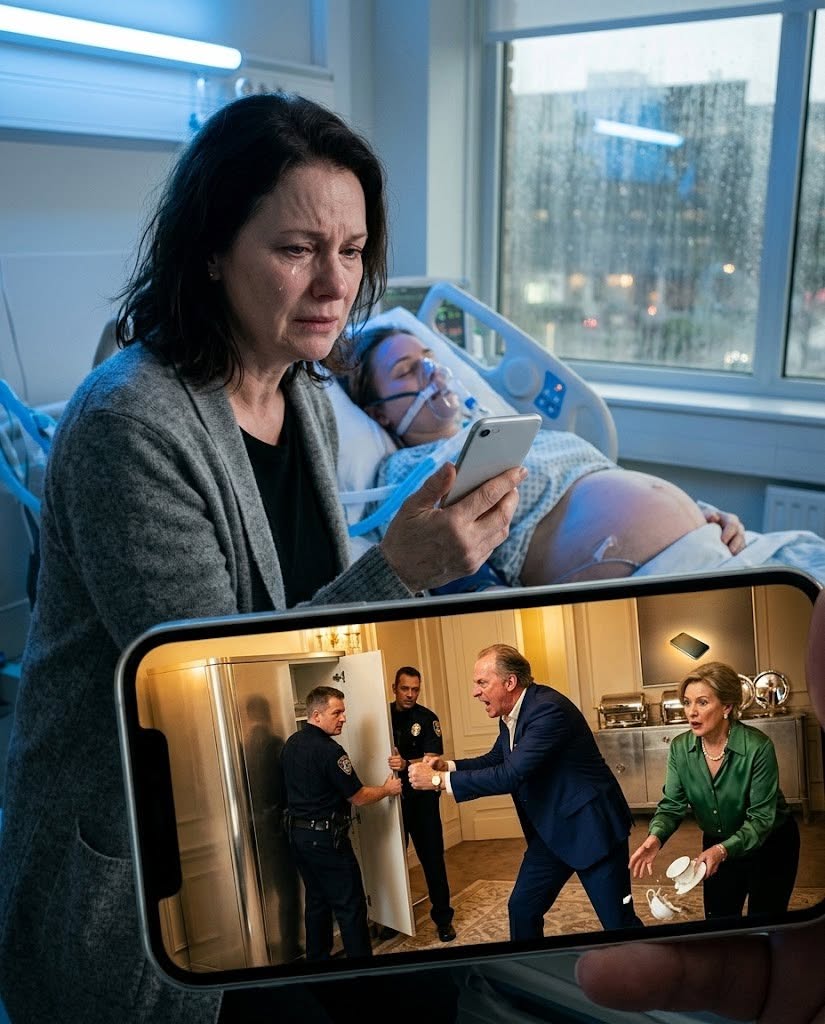
why the violence escalated that night.
Emma had discovered that Carter and Victoria were stealing from the Whitmore Foundation, a charity publicly dedicated to housing vulnerable mothers.
Millions in donations had been transferred through consulting companies controlled by family associates.
Some of the money paid for Carter’s cars, Victoria’s jewelry, and renovations to the mansion.
Emma had copied the financial records and planned to deliver them to authorities.
Carter found her packing.
The unpolished silver was never the reason for the attack.
It was the excuse Victoria gave the servants after they heard screaming.
Emma had hidden her phone in the cabinet before confronting them because the room’s thick wooden doors made it the one place Carter’s security system could not detect the device’s signal.
She started an automatic upload to an encrypted account I had helped her create months earlier.
The beating interrupted the upload at ninety-seven percent.
But the local recording survived.
By evening, Carter, Victoria, and Dr.
Price were all under arrest.
The charges initially included aggravated assault, attempted murder, unlawful imprisonment, evidence tampering, and conspiracy.
Financial investigators opened a separate case involving the foundation.
The judge denied Carter and Victoria immediate release after prosecutors played part of the recording and described the attempt on Emma’s life inside the hospital.
The Whitmore attorneys attacked from every direction.
They argued that the mansion search was rushed.
They questioned Emma’s mental health.
They suggested the injuries resulted from a fall.
They claimed Dr.
Price carried potassium chloride for a legitimate medical purpose.
Then the witnesses began talking.
The Whitmore chauffeur admitted that Carter ordered him to clean blood from the back seat of an SUV.
He had refused to drive Emma to the bus stop, so Carter drove her himself.
A housekeeper turned over photographs of blood on the dining room floor.
She had taken them secretly after Victoria ordered the staff to scrub the marble before sunrise.
A gardener recovered Emma’s shoes and coat from an outdoor furnace where Carter had attempted to burn them.
The young maid who polished the silver testified that Victoria told the staff Emma had “gone hysterical” and attacked the family.
The maid had seen Emma carried from the dining room unconscious.
Most damaging of all was the mansion’s security system.
Carter believed he had erased the footage.
He had deleted the visible files from the main server, but investigators found an automatic backup stored by the security company.
The video showed Carter dragging Emma through the foyer by her arms while Victoria carried Emma’s shoes and phone.
It showed Dr.
Price checking Emma’s pulse near the front door.
It showed Carter returning forty-seven minutes later with blood on his shirt.
He looked directly into one of the cameras and smiled.
At the hospital, Emma remained in a coma for nine days.
The baby’s heartbeat weakened twice.
Doctors prepared me for the possibility that neither would survive.
I slept in a chair beside her bed and read aloud from the books she had loved as a child.
I told her about the case, not because I knew she could hear me, but because silence felt like surrender.
“The cabinet opened,” I whispered.
“We found everything.
You do not have to protect them anymore.”
On the tenth morning, Emma’s fingers moved beneath mine.
At
They claimed Dr.
Price carried potassium chloride for a legitimate medical purpose.
Then the witnesses began talking.
The Whitmore chauffeur admitted that Carter ordered him to clean blood from the back seat of an SUV.
He had refused to drive Emma to the bus stop, so Carter drove her himself.
A housekeeper turned over photographs of blood on the dining room floor.
She had taken them secretly after Victoria ordered the staff to scrub the marble before sunrise.
A gardener recovered Emma’s shoes and coat from an outdoor furnace where Carter had attempted to burn them.
The young maid who polished the silver testified that Victoria told the staff Emma had “gone hysterical” and attacked the family.
The maid had seen Emma carried from the dining room unconscious.
Most damaging of all was the mansion’s security system.
Carter believed he had erased the footage.
He had deleted the visible files from the main server, but investigators found an automatic backup stored by the security company.
The video showed Carter dragging Emma through the foyer by her arms while Victoria carried Emma’s shoes and phone.
It showed Dr.
Price checking Emma’s pulse near the front door.
It showed Carter returning forty-seven minutes later with blood on his shirt.
He looked directly into one of the cameras and smiled.
At the hospital, Emma remained in a coma for nine days.
The baby’s heartbeat weakened twice.
Doctors prepared me for the possibility that neither would survive.
I slept in a chair beside her bed and read aloud from the books she had loved as a child.
I told her about the case, not because I knew she could hear me, but because silence felt like surrender.
“The cabinet opened,” I whispered.
“We found everything.
You do not have to protect them anymore.”
On the tenth morning, Emma’s fingers moved beneath mine.
At
first I thought it was a reflex.
Then she squeezed once.
Her eyes opened slowly.
She could not speak because of the breathing tube, and terror filled her face when she saw the machines.
I leaned close enough for her to see me clearly.
“You are safe,” I said.
“Carter cannot reach you.
Victoria cannot reach you.
The baby is still here.”
A tear slid into her hair.
The doctors warned me that recovery would be long.
Emma had weakness along one side of her body, gaps in her memory, and difficulty forming words.
She required additional surgery and months of rehabilitation.
But she was alive.
So was her daughter.
At thirty-four weeks, doctors delivered the baby by emergency cesarean section after Emma developed complications from the original trauma.
The child weighed just over four pounds and spent several weeks in neonatal care.
Emma named her Hope.
The criminal trial began almost a year later.
Carter entered the courtroom wearing a tailored navy suit.
He looked thinner but still carried himself with the old entitlement.
Victoria sat behind another defense table in pearl earrings and a gray dress, her posture rigid.
They had separate lawyers by then.
They also had separate stories.
Carter’s attorney portrayed him as a frightened husband dominated by an abusive mother.
Victoria’s attorney described Carter as violent and unstable.
Each hoped to survive by sacrificing the other.
Emma attended in a wheelchair for the first week and later walked into court using a cane.
Her speech was slower than before, but her voice did not shake.
She described the first slap, the apologies, the isolation, and the night of the attack.
She explained how Carter forced her to kneel beside the dining table while Victoria held her hair.
She remembered the first blow from the golf club striking her ribs.
She remembered begging them to call an ambulance.
She remembered Victoria saying, “A clean tragedy is better than a dirty divorce.”
Carter stared at the table.
Victoria stared at Emma.
Neither apologized.
The defense tried to use Emma’s memory gaps against her.
They asked whether medication affected her recollection.
They questioned why she had remained in the marriage.
They implied that a reasonable woman would have left sooner.
Emma looked at the attorney and answered quietly.
“I tried to leave.
That is why I was almost killed.”
The courtroom went still.
The recordings, financial documents, medical evidence, security footage, and witness testimony left little room for doubt.
Dr.
Price accepted a plea agreement and testified against the Whitmores.
He admitted that Carter called him after the assault and paid him to advise them.
He also admitted entering the ICU to stop Emma from waking.
The jury convicted Carter and Victoria on every major count.
Carter received a lengthy prison sentence for attempted murder, conspiracy, aggravated assault, and financial crimes.
Victoria received a similarly severe sentence.
Dr.
Price lost his medical license and was imprisoned under the terms of his agreement.
The Whitmore Foundation was dissolved.
Recovered assets were transferred into a court-supervised fund supporting survivors of domestic violence and their children.
The mansion was seized to satisfy restitution orders and civil judgments.
Months later, I stood with Emma outside the gates as workers removed the Whitmore name from the stone entrance.
She held Hope against her
A pale scar crossed her temple, and she still walked carefully, but she was standing without her cane.
“I used to think that house was the safest place in the world,” she said.
“Because it had gates?”
She nodded.
“Because everyone respected them.”
I looked at the empty windows and remembered Carter’s warning that people believed families like his.
For a long time, he had been right.
People had believed the tailored suits, charity photographs, polished silver, and respectable name.
They had mistaken money for character and silence for peace.
But Emma had preserved the truth in the one place her abusers never thought to search until it was too late.
The silver cabinet had held more than evidence.
It had held her voice.
Emma moved into a small house near mine, where sunlight reached every room and no door locked from the outside.
She continued therapy, learned to drive again, and slowly rebuilt the parts of her life Carter had taken from her.
On Hope’s first birthday, we placed one object in a box for her to open when she was older: the handwritten note Emma had hidden in the cabinet.
Not the photographs.
Not the medical records.
Not the ugliest details.
Only the final page, where Emma had written a sentence none of us noticed until after the trial.
My daughter must grow up knowing that love never asks her to disappear.
Emma read it aloud at the kitchen table while Hope reached for the candle on her cake.
Then Emma folded the page, kissed her daughter’s forehead, and smiled.
The Whitmores had tried to erase two lives in the cold before sunrise.
Instead, the truth survived the night with them.