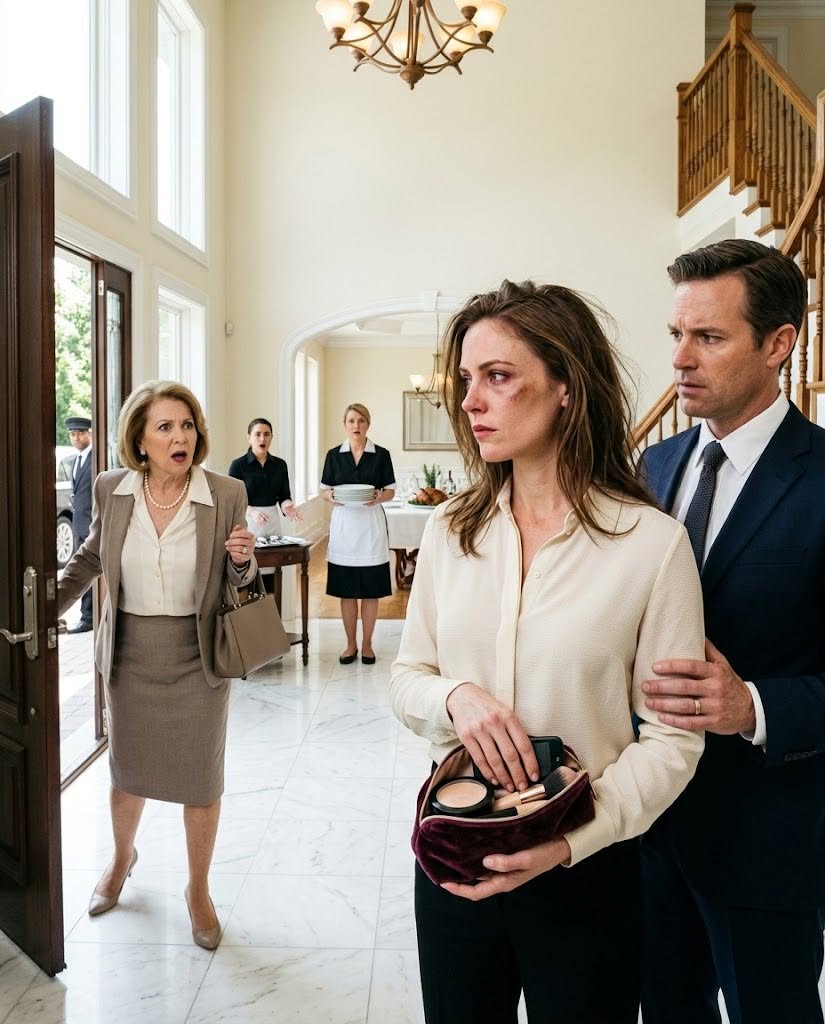
She asked Richard in front of me if I really had to work so much when our house was big enough to support a family.
She placed her hand on my forearm and said, “Women like us have to learn to stay soft.”
I often wondered later if I should have understood what “soft” meant in their language that very first evening.
It meant malleable.
It meant quiet.
It meant grateful for the chains, as long as they were gold.
Richard didn’t change suddenly.
He shifted his position.
A comment here.
A glance there.
A silence when Beatrice said something cruel disguised as concern.
When we moved into the house, he said it was our home.
The paperwork was more complicated.
Part of the house was through my family assets, part through a trust structure my father had set up before he died, and part through Richard’s financing.
Richard still always referred to it as his house.
I let it go for a long time because I was tired.
Tiredness is dangerous.
Tiredness makes you accept injustice as the price of peace.
Beatrice started staying more often.
One night.
Two nights.
A week after her water heater supposedly broke down.
She put her supplements in our pantry, her slippers in our wardrobe, and her opinion on every decision.
Then came the dinner when she stopped trying to hide it.
It was a Thursday.
I remember because the housekeeper had delivered the white lilies that morning, and their scent lingered in the dining room that evening, sweet and almost musty.
The table was set for three.
Richard sat at one end, Beatrice at the other.
I sat between them, like a contract both parties thought they had already signed.
Beatrice cut her chicken into small, even pieces.
“I’ve been thinking,” she said.
Richard didn’t put down his glass.
That alone should have been a warning.
“My house is too big for me alone,” Beatrice said. “And yours is too big for a woman who’s out of the house half the day.”
I put down my fork.
Silver on china sounds very loud when a room has already decided not to defend you.
Richard said, “Mother has some good points.”
Beatrice smiled, as if he had handed her the stage.
She wanted to move in.
Not into the guest room.
Into the master suite.
She said the stairs to the upstairs guest rooms were bad for her knees.
She said she could organize the kitchen better.
She said I needed guidance anyway if Richard was going to continue entertaining guests.
Then she looked down at me and said, “And perhaps a little structure in other areas would help, too.”
She meant my body.
She meant my age.
She meant the children I hadn’t had.
Richard looked into his glass.
The candles between us continued to burn quietly.
I heard the air conditioner whirring through the vents.
I felt my heart race, but my voice remained calm.
“No,” I said.
Beatrice blinked.
Richard finally looked up.
“Excuse me?” he asked.
“No,” I said again. “Beatrice isn’t moving into our master suite. She’s not taking over our kitchen. She won’t have access to my closets, my daily life, or my marriage.”
It wasn’t loud.
It wasn’t dramatic.
It was just a sentence that drew a line.
For people who have never had to respect boundaries, a boundary feels like an attack.
Beatrice placed her napkin next to her plate.
“Richard,” she said quietly, “I didn’t know your wife had become so hostile.”
My wife.
Not Victoria.
Not daughter-in-law.
Property that wasn’t functioning properly.
Richard smiled through the dessert.
He asked for her tea.
He talked about the market.
He kissed her on the cheek as we left and promised to sort everything out tomorrow.
In the car, he didn’t say a word.
The city lights drifted across the windshield.
I sat beside him, my hands in my lap, watching his profile in the shifting light.
I thought about getting out once, when we stopped at a gas station.
Then I saw his hand on the steering wheel.
Quietly.
Firmly.
Safely.
Too safely.
At home, the heavy mahogany front door clicked shut.
The sound was final.
I had just taken off my coat when he said, “You’ll never treat my mother like that again.”
I turned to face him.
“I didn’t treat her badly.”
His hand struck me before I could say the rest.
The blow wasn’t like in the movies.
There was no music.
There was no dramatic build-up.
There was only the hard, clean sound of skin on skin and the sudden white flash behind my left eye.
I stumbled against the dresser.
A perfume bottle tipped over, rolled across the marble countertop, and didn’t fall.
I remember it because my brain clung to that small miracle while my body understood that a much larger one had just shattered.
Richard stood over me in the bedroom.
His shirt sleeves were rolled up.
His breathing was perfectly still.
“You embarrassed me,” he said.
The first thing I tasted was blood.
The second was betrayal.
I pressed a hand to my cheek.
“Because I said no?”
His jaw tightened.
“Because my mother asked for something simple.”
Something simple.
Move into our house.
Take the master suite.
Check the kitchen.
Looking at me every morning as if I were an employee she hadn’t yet been able to fire.
I sat on the floor and looked at him.
He waited.
He wanted tears.
He wanted panic.
He wanted the old Victoria, who would instantly lower the temperature in the room the moment he became unpleasant.
I gave him nothing.
That was the moment he truly became angry.
Not at the “no.”
Not at dinner.
At the silence.
“You think you’re strong?” he asked.
His voice was soft.
I had learned to fear that softness.
“You live in my house, Victoria. You use my prestigious name. You spend my hard-earned money.”
His money.
My name had opened doors before his business card even gleamed.
My inheritance had paid for the walls he showed off to his colleagues.
My patience had welcomed his mother into my home for years.
But I said nothing.
Sometimes silence isn’t submission.
Sometimes it’s taking stock.
Richard stepped over me.
He changed his clothes.
He placed his watch neatly on the bedside table.
He brushed his teeth.
Then he went to bed.
Within minutes, he was asleep.
I stayed on the floor until the ceiling stopped moving.
Then I crawled into the suite’s bathroom.
The tiles were cold under my palms.
The taste of blood was still there.
In the mirror, I saw a woman I knew and didn’t know.
A dark bruise began to appear under my eye.
I touched it once.
The pain was sharp.
Honest.
Behind the slightly loose porcelain tile under the sink lay the small black prepaid cell phone.
Richard knew nothing about it.
Neither did Beatrice.
I had bought it three months earlier, after Beatrice “accidentally” opened my drawers at Thanksgiving and asked Richard if I was keeping any financial secrets from him.
That evening, I understood for the first time that she wasn’t snooping.
She was collecting.
So I started collecting, too.
Not revenge.
Evidence.
Photos of broken things that Richard later called “accidents.”
Screenshots of messages in which Beatrice told him to “bring me to my senses.”
A copy of the Blackwell County deed.
Extracts from the escrow account that Richard never mentioned when talking about his house.
The phone number of Elise Hartmann, a lawyer recommended to me by an old college friend.
At 12:17 a.m., I took a picture of my face.
At 12:22 p.m., I uploaded the picture to the encrypted folder.
At 12:31 p.m., I sent Elise a single message: “He did it.”
Three replies were already waiting when I turned on my phone.
“Documents secured.”
“Access confirmed.”
“Wait until she comes.”
I sat on the closed toilet seat and read those four words over and over.
Wait until she comes.
I didn’t understand everything.
But I understood enough.
The next morning, Richard had ordered fresh coffee.
That was his way of asserting normalcy.
The kitchen smelled of butter, rosemary, and the roast Beatrice had chosen for a proper lunch.
The marble floor in the foyer was polished.
The silver frames on the console table were perfectly straight.
Everything looked like a house where no one had sat on the bathroom tiles at night to document a bruised face.
Richard came out of the bathroom, clean-shaven and impeccably dressed.
His cuffs were fastened.
His gaze glimpsed my bruise but didn’t linger.
Then he tossed a velvet makeup bag into my lap.
It was soft.
Heavy.
Complete.
Concealer.
Powder.
A small sponge.
A brush with a gold handle.
Beatrice’s brand.
Of course.
“My mother’s coming for lunch,” he said. “Cover it all up and smile.”
I held the bag in my hands.
The velvet felt warm, almost alive.
“And if I don’t?” I asked.
Richard straightened his tie in the mirror.
“Then you remember who this life belongs to.”
I didn’t get up immediately.
I counted my breaths.
One.
Two.
Three.
My hands wanted to tremble, but I didn’t let them.
Cold rage is useful.
Hot rage wants to break things. Cold rage remembers where the doors are.
I applied the concealer, but not enough.
Just enough for Richard to believe I was obeying.
Not so much that Beatrice wouldn’t see.
The staff was waiting downstairs.
No one looked directly at me.
There’s a sound in itself when people look away.
It’s not silence.
It’s participation.
The housekeeper was holding plates when she saw me.
A server stopped at the edge of the dining room.
The cook stirred a sauce that no longer needed stirring.
A spoon clanged against the edge of the pot.
Everyone knew enough to know nothing.
No one moved.
I placed the velvet cosmetic bag next to my plate.
I tucked the small black cell phone under the folded napkin.
At 11:56 a.m., it vibrated once.
“At the gate.”
At 11:58 a.m., the doorbell rang.
Richard smiled.
Beatrice was on time.
She was always on time when she thought she had the right to humiliate someone.
He went to the door.
I followed slowly.
My face throbbed, but I kept my back straight.
When the door opened, her perfume wafted in first.
Heavy.
Powdery.