
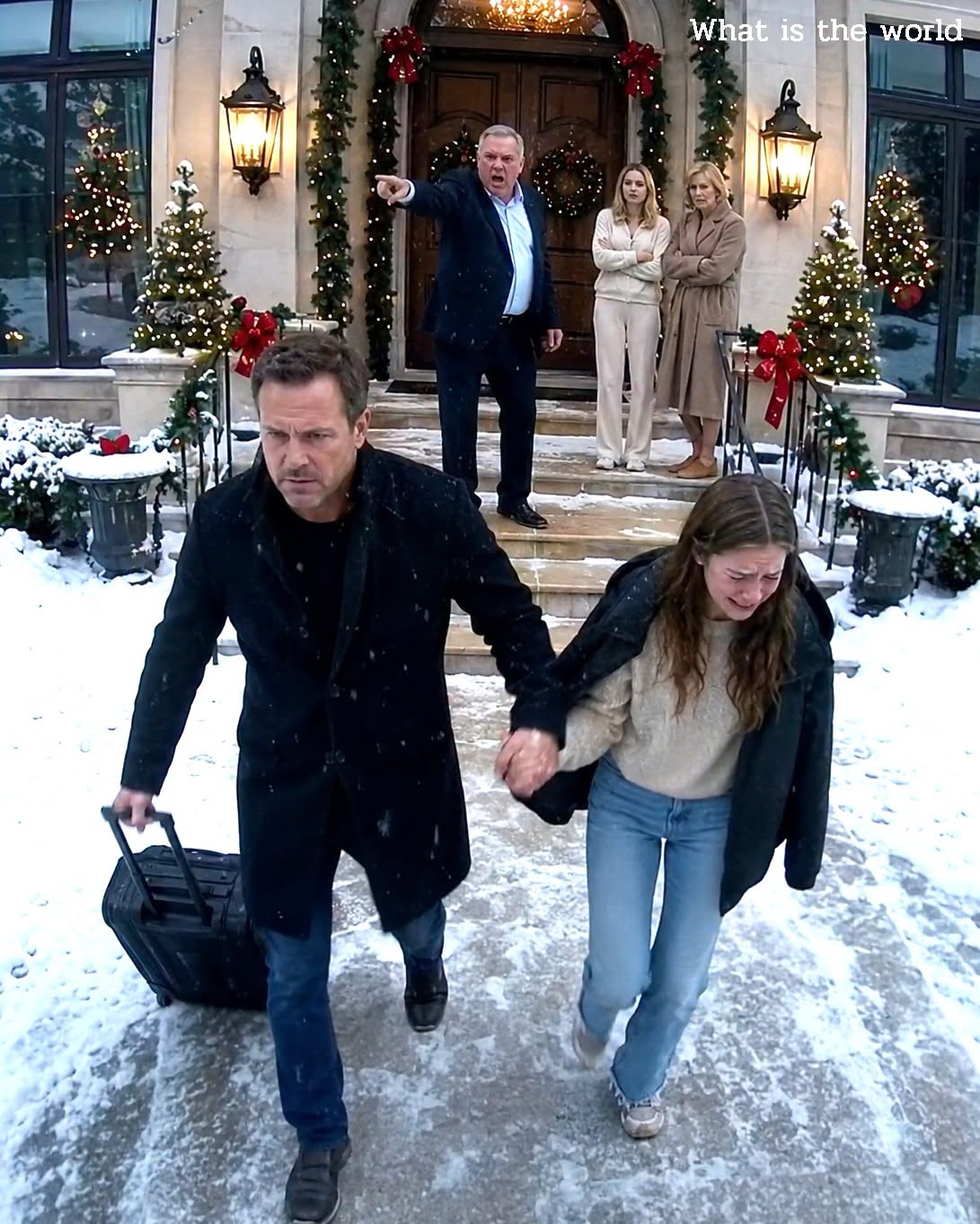
I wanted to tell her nothing. I wanted to place my body between her and every ugly truth in the world. I wanted, for one impossible second, to go back to when her biggest worry was getting primer on her shoes at a volunteer build.
But that was the mistake I had made for too long—turning protection into silence.
“There may be some documents we need to review,” I said carefully. “They might involve you.”
Her pencil was still in her hand. She looked down as if surprised to find it there.
“Me?”
“I don’t know how yet.”
She came into the conference room, wearing my old company sweatshirt, sleeves covering half her hands. She looked younger than sixteen and older than I could bear.
“I don’t want everyone talking around me,” she said.
I nodded. “Then we won’t.”
Priya studied her gently. “Sophie, we’ll only show you what is appropriate for you to see, and only with your dad beside you. But you have a right not to be treated like furniture in your own life.”
Sophie looked at her for a long moment.
“I like her,” she said to me.
Despite everything, Margaret almost smiled.
Then my email chimed.
The first photo loaded slowly, line by line.
It was the agreement Martin had thrown on the table.
Only this time, I could see the original clearly. The paper was creased. The ink looked faded. My signature sat at the bottom like an accusation wearing my face.
Priya zoomed in.
“Interesting,” she murmured.
“What?”
“The signature looks traced.”
Margaret leaned over. “You can tell that from a photo?”
“Not conclusively. But see the hesitation points? A natural signature moves. This looks careful.”
I stared at it, feeling both relief and dread.
The next photos showed bank transfers to Northline Strategic Services. Then a registration form. Then a mailbox agreement.
Then the envelope.
Cream-colored. Old. Sealed once, then reopened. My name written across the front.
Daniel Whitaker.
On the back, in smaller handwriting:
For Sophie when she is old enough.
I stopped breathing.
Because I knew that handwriting.
Sophie saw my face change.
“Dad?”
I took the phone closer to the window, as if more light could alter what I saw.
The handwriting belonged to my first wife.
Sophie’s mother.
Emily.
The room blurred at the edges.
Emily had left when Sophie was six. That was the version everyone knew. That was the version I had carried around like a stone until it became part of my bones. She moved out of state. She wanted a different life. She called sometimes, then less often. She sent birthday cards for a while. Then the cards stopped, too.
I had told myself anger was easier than grief.
I had told Sophie that adults sometimes made choices children could not understand.
But Emily’s handwriting was in Linda Collins’s safe.
“Dad,” Sophie said again, smaller this time.
I lowered the phone.
“That handwriting,” I said, “is your mother’s.”
Sophie’s face went pale.
No one spoke.
The final photo loaded.
It was the first page of a letter.
Daniel,
If this reaches you, then I was right not to trust Martin Collins.
I gripped the edge of the table.
For years, I had imagined Emily’s last real words to me as the ones she had said in our kitchen, one hand on a suitcase, eyes swollen from crying.
I can’t keep disappointing you, Daniel.
But here was another sentence, written later, hidden from me, waiting inside the house of a man who had spent eight years calling me small.
I looked at Priya.
“We need that letter.”
Priya nodded. “We need it lawfully.”
Margaret’s phone buzzed. She checked it.
“Claire just texted. She’s leaving the house. She says she has the envelope with her.”
Priya exhaled through her nose. “That complicates things.”
“She took it?”
“She says it belongs to Daniel,” Margaret replied.
Priya looked at me. “Do not celebrate that yet.”
I almost laughed. There was no celebration in me. There was only a door opening onto a room I had never known existed.
Claire arrived twenty-three minutes later.
She came through the lobby without her cream coat buttoned, hair damp from melting snow, face stripped of makeup at the edges. In her hands, she carried a leather document pouch.
Security looked to me.
I nodded.
Claire stepped into the conference room and stopped when she saw Sophie.
For the first time in all the years I had known her, Claire Collins Whitaker seemed truly unsure of where to stand.
“Sophie,” she said quietly.
Sophie’s fingers curled into the hem of the sweatshirt.
Claire did not come closer.
“I’m sorry,” she said. “For Christmas Eve. For before Christmas Eve. For all the times I made you feel like you were in the way.”
Sophie stared at her.
Claire swallowed. “I’m not asking you to answer. I just needed to say it where you could hear my voice.”
Sophie’s chin trembled, but she did not cry.
“Why didn’t you help me?” she asked.
The question was so simple it seemed to pass through everyone in the room.
Claire’s eyes filled.
“Because I was afraid of my father,” she said. “And because I cared more about avoiding his anger than doing the right thing. That is not an excuse. It is just the truth.”
Sophie looked down.
“I was afraid too,” she whispered.
Claire closed her eyes, and one tear slipped down.
“I know.”
Margaret turned toward the window, giving them privacy without leaving.
Sophie wiped her cheek with her sleeve. “I don’t know if I forgive you.”
“You don’t have to,” Claire said. “Not today. Not ever, unless it becomes true.”
That answer did something to Sophie. I saw it. Not healing, not yet, but the first loosening of a knot.
Claire placed the leather pouch on the table.
“My father kept a safe behind the paneling in his study,” she said. “I found it open after he left. I think he was in a hurry. I took pictures first, then I saw the envelope and…” She looked at me. “Daniel, I know I should have called Priya before touching it.”
“Yes,” Priya said.
Claire looked at her. “I’m sorry.”
Priya opened the pouch carefully with gloved hands from a small evidence kit she carried in her briefcase, which immediately made me grateful and mildly afraid of her.
Inside were the agreement, bank statements, copies of Northline documents, and Emily’s letter.
The letter was four pages long.
My hands shook when Priya gave me a scanned copy to read while she preserved the original.
Sophie stood beside me.
I read aloud because she asked me to, and because secrets had done enough damage.
Daniel,
If this reaches you, then I was right not to trust Martin Collins.
I know that sentence will make no sense yet. I hope it never has to.
I met Martin because of a clinic renovation proposal your company submitted. He approached me after a community fundraising meeting and said he wanted to invest in you without embarrassing you. I should have told you immediately, but I was tired, and we were already breaking in quiet ways.
He said he could help you expand. He said all you had to do was sign standard introduction documents. I saw the papers after the lunch. One of them was not what he said it was.
I stopped reading.
My memory of that lunch returned sharper now: Martin sliding pages across a white tablecloth, his gold pen glinting between his fingers, saying, Just standard language. Nothing dramatic.
I had signed two forms.
Or thought I had.
The letter continued.
The page with your signature was removed from one document and attached to another. I confronted him. He laughed and said no one would believe me because I was “the unstable wife leaving a good man.”
Sophie made a small sound.
I looked at her, but she nodded for me to continue.
I was not leaving because I stopped loving Sophie. I was not leaving because I wanted another life. I was leaving because I had become sick in ways I did not know how to explain. The medicine made mornings feel like climbing through wet cement. I was ashamed of how little of myself was left to give.
Then Martin offered me money to go quietly.
Claire covered her mouth.
I read the sentence again silently, hoping it would become something else.
It did not.
He said if I stayed away, he would “protect Daniel’s company from scandal.” He showed me the forged agreement. He said he could ruin you with it before the company was strong enough to survive a fight. I did not know what to do. I was not thinking clearly. I believed leaving would protect you and Sophie.
I know now that sounds foolish. Maybe it was. But I was tired, Daniel. I was so tired.
Sophie was crying silently now, tears falling straight down onto the oversized sweatshirt.
The rest of the letter explained that Emily had gone to treatment in Michigan with help from her sister. She had written twice in the first year, but the letters came back marked undeliverable. She believed I had moved offices. She believed, eventually, that I wanted no contact. Then her health worsened. She remarried briefly, divorced quietly, and kept a box of letters for Sophie she never mailed because shame had become another locked door.
The final page was addressed directly to my daughter.
Sophie,
If you are reading this, then you are old enough to know adults can love deeply and still fail badly.
I did not leave because you were hard to love. You were the easiest person in the world to love.
You had a habit of holding my thumb when we crossed streets, even when there were no cars. You called dandelions “sunflowers that wanted to travel.” You used to fall asleep with one sock on and one sock missing, and your father would search the blankets like he was rescuing treasure.
I was ill, sweetheart. I was ashamed, and I was afraid, and I let those things make choices love would never have made.
That is my sorrow to carry. It was never yours.
If Daniel has raised you the way I believe he has, then you are safe, and kind, and stronger than anyone should have to be. Please do not spend your life proving you were worth staying for.
You always were.
Love,
Mom
By the time I finished, there was no sound in the room except Sophie trying to breathe through tears she had held back for years.
I set the paper down and turned toward her.
She did not collapse dramatically. She simply folded inward, as if some invisible string holding her upright had been cut. I caught her before she reached the floor.
“I thought she forgot me,” she said into my shirt.
“No,” I whispered, though my own voice broke. “No, sweetheart.”
Claire was crying openly now.
“I didn’t know,” she said. “Daniel, I swear I didn’t know about Emily. I didn’t know he did that.”
I believed her.
The realization surprised me, but it came calmly. Claire had hidden behind her father. She had enabled him. She had chosen silence when it mattered most. But the horror on her face was too raw to be performance.
Margaret’s expression was steel wrapped around grief.
Priya closed the folder. “We need to contact law enforcement. And a forensic document examiner. And your family attorney.”
I nodded, but my arms were still around Sophie.
Justice could start in an hour.
My daughter needed me now.
So I sat with her on the conference room floor while the company I had built hummed around us, and for once, I did not try to fix the whole world before holding the person who mattered most.
The next weeks did not unfold like a movie.
There was no single moment when Martin Collins was exposed beneath a chandelier while everyone gasped and turned away from him. Real life prefers paperwork. Interviews. Subpoenas. Quiet meetings in offices where coffee goes cold before anyone drinks it.
But truth has a sound of its own.
It is the click of a scanner preserving old letters.
It is the calm voice of a forensic examiner explaining that a signature was transferred, copied, and manipulated.
It is an accountant saying, “We found another payment.”
It is a detective closing a folder and asking, “Mr. Whitaker, are you prepared to make a formal statement?”
I was.
Claire made one too.
That was the first unexpected thing.
She could have retreated. She could have claimed ignorance and disappeared into the Collins family’s familiar fog. Instead, she sat in a police interview room with her hands folded so tightly her knuckles whitened and told the truth about the safe, the documents, the family pressure, the things her father had said after drinking, the threats dressed as jokes.
When the detective asked why she was coming forward, Claire looked at me through the glass partition where I waited with Priya.
“Because I learned silence can become someone else’s prison,” she said.
I did not forgive her in that moment.
But I saw her.
That was different, and it mattered.
Linda Collins was harder to understand.
At first, she denied everything. She called it a misunderstanding. She called Martin a generous man. She called Emily troubled and me ungrateful. Then, during a meeting with investigators, they showed her copies of the Northline payments and asked why one transfer had gone into an account used to pay for the Collins family lake house renovation.
Linda stopped talking.
Two days later, she called me.
I almost didn’t answer.
“Daniel,” she said, and for once, there was no polished social warmth in her voice. “I want to see Sophie.”
“No.”
The word came out before she finished breathing.
A long silence followed.
“I understand,” she said.
I was so startled I said nothing.
“I found something else,” Linda continued. “Not in the safe. In my sewing room. Martin gave it to me years ago and told me to throw it away. I didn’t.”
“What is it?”
“A box. Letters. I think from Emily.”
My hand tightened around the phone.
“Why didn’t you say anything?”
Her breath trembled. “Because in this family, Daniel, cowardice was easier when everyone called it loyalty.”
That sentence stayed with me longer than I wanted it to.
The box arrived the next day by courier, sent to Priya’s office, documented and photographed before Sophie and I opened it.
There were eleven letters.
Some addressed to me.
Most addressed to Sophie.
None had been mailed.
Some envelopes had my old home address, perfectly correct. Others had the office address Martin claimed was undeliverable. One had been opened and resealed with tape.
Sophie read them slowly over several nights, never more than two at a time. We made a ritual of it without planning to. Hot chocolate. The living room lamp. A blanket over both our knees. A tissue box between us.
In one letter, Emily described the treatment center gardens.
There’s a maple tree outside my window, and every morning a cardinal lands on the same branch. I pretend he is a tiny red supervisor making sure I get out of bed.
Sophie smiled through tears at that.
In another, Emily wrote about seeing a girl with a backpack in a grocery store and having to leave because the pink keychain reminded her of Sophie’s first day of kindergarten.
In the last letter, written three years before the Christmas Eve that changed everything, Emily included a phone number.
I am well enough now to be honest, if either of you ever wants honesty from me.
I stared at that number for a long time.
Sophie sat beside me, knees drawn up, face unreadable.
“Do you think it still works?” she asked.
“I don’t know.”
“Do you want to call?”
The question should have been easy.
For years, I had imagined what I would say if Emily ever came back into our lives. I had speeches ready. Accusations. Questions sharpened by loneliness. But holding her letters, seeing the places where shame and manipulation had twisted all of us into separate rooms, I found that the speeches had turned to dust.
“I’m scared to,” I admitted.
Sophie leaned her head against my shoulder.
“Me too.”
So we called together.
The number rang four times.
A woman answered.
“Hello?”
The voice was older than memory, softer around the edges, but I knew it before she said another word.
My throat closed.
Sophie’s hand found mine.
“Emily,” I said.
There was a silence so complete I could hear the faint buzz of the refrigerator in our kitchen.
Then a breath.
“Daniel?”
Sophie covered her mouth.
I closed my eyes.
“Yes.”
A small sound came through the phone, half sob, half disbelief.
“I tried,” Emily whispered. “I tried for so long.”
“I know,” I said. “We found the letters.”
Another silence.
Then Emily said the name that mattered most.
“Sophie?”
My daughter’s fingers tightened painfully around mine.
“I’m here,” Sophie said.
On the other end of the line, Emily began to cry.
Not loudly. Not theatrically. Just the quiet breaking of someone who had spent years believing a door was locked from the other side.
“I am so sorry,” Emily said. “There aren’t words big enough. There aren’t years enough. But I am sorry, Sophie.”
Sophie stared at the table.
“You said I called dandelions sunflowers that wanted to travel.”
Emily laughed through tears. “You did.”
“I don’t remember that.”
“I do.”
Sophie wiped her cheek. “I wanted you to remember me.”
“Oh, sweetheart,” Emily said. “Remembering you was the only part of me that never got sick.”
That was when Sophie cried.
I held her hand while she spoke to the mother she had mourned while still alive. They did not solve sixteen years in one call. They didn’t try. Emily did not ask for a visit. Sophie did not promise one. They began with small truths: where Emily lived now, what Sophie studied, the fact that both of them hated cooked carrots and loved thunderstorms.
When the call ended, Sophie sat very still.
“How do you feel?” I asked.
She looked at the phone.
“Like I found a room in my life I didn’t know was there.”
I nodded, because I felt the same.
By mid-January, the business had begun to steady.
The employees who had feared the Collins family influence started speaking more freely. Managers brought forward old concerns and new ideas. Natalie Collins requested a meeting with me and Margaret, arriving with a folder thick enough to stop a door.
“I want my last name removed from the conversation,” she said.
Margaret raised an eyebrow. “That may take time.”
Natalie nodded. “Then I’ll earn it.”
She had discovered irregularities in vendor compliance months earlier but had been warned by Martin to stop “digging in family soil.” She handed us documentation that helped unwind three inflated contracts. Because of her, we saved more jobs than we lost.
Evan Price came in the following week looking like he expected to be fired for breathing too loudly.
“I didn’t know what Uncle Martin was doing,” he said.
“I believe you.”
His shoulders sagged with relief.
Then he surprised me.
“I don’t want special treatment anymore. Even the good kind.”
That became the beginning of a company-wide policy change: no direct family reporting lines, transparent salary bands, independent review for executive hires, and a whistleblower hotline managed outside the company.
Margaret called it governance.
Sophie called it “finally building it right.”
She was not wrong.
Martin’s world grew smaller in public records and legal filings. He was charged with fraud-related offenses after investigators traced Northline, the forged agreement, and misdirected correspondence connected to Emily’s letters. The process would take time, maybe years. Priya warned me that justice rarely moved at the speed of pain.
But the important part was this: he no longer controlled the room.
Not the company’s rooms.
Not Claire’s.
Not Sophie’s.
Not mine.
The divorce papers remained unsigned on my desk for nearly a month.
Not because Claire and I were reconciling. We were not. Some fractures reveal what a thing always was. Our marriage had been built around avoidance, and the truth had not destroyed it so much as removed the wallpaper.
But we did not end it the way she had tried to begin the ending.
No dining room performance.
No gold paperclip pressed against my chest.
We met in a small conference room at Priya’s office with our attorneys, two cups of tea, and a window overlooking a gray Cincinnati afternoon.
Claire looked different. Not dramatically. She was still elegant, still careful. But the carefulness had changed direction. She was no longer arranging herself to be admired. She seemed to be trying to stand honestly inside her own skin.
“I’m going to sell the house,” she said.
I looked up from the settlement draft.
“Our house?”
She nodded. “I don’t want it. I don’t think I ever did. I wanted proof I had landed somewhere my father approved of.”
I studied her.
“What will you do?”
“I enrolled in counseling,” she said. “And I’m taking a leave from the foundation.”
The foundation was Linda’s pride, the place where Claire had spent years planning galas with people who measured kindness in table sponsorships.
“I thought you loved that work.”
“I loved being praised for it.” She gave a small, honest smile. “That isn’t the same.”
I signed the papers quietly.
Claire signed after me.
When it was done, she touched the edge of the folder but did not close it.
“Daniel,” she said, “I know I don’t have the right to ask anything of you.”
I waited.
“Will you tell Sophie that if she ever wants a conversation, even years from now, I’ll answer honestly?”
“I’ll tell her.”
Claire nodded.
Then she removed her wedding ring and placed it in her purse.
“I hope you find a life that doesn’t require you to disappear to keep peace,” she said.
It was the closest thing to a blessing our ending could hold.
“You too,” I replied.
And I meant it.
Spring came slowly that year.
Snow retreated from the curbs in dirty ridges. The first warm day arrived like a rumor nobody trusted. Sophie began wearing lighter jackets and leaving her hair down again. She joined the robotics club at school after years of saying she was “too busy,” which I learned meant “too afraid of being noticed.”
Emily and Sophie spoke every Sunday evening.
At first, Sophie kept the calls short. Ten minutes. Fifteen. She would hang up and go quiet for an hour. Then the calls grew longer. They talked about books, recipes, therapy, bad movies, good music, and the strange awkwardness of trying to love someone through a phone line after years of absence.
In March, Sophie asked me if Emily could visit.
I was repairing a loose cabinet hinge when she said it. Some habits remain useful.
I paused with the screwdriver in my hand.
“Here?”
“Maybe somewhere neutral first.”
“Good idea.”
“You’re doing the calm voice.”
“I am calm.”
“You’re doing the fake calm voice.”
I set down the screwdriver.
“I want this for you,” I said. “I also want to protect you. Those feelings are wrestling.”
Sophie sat on the kitchen counter, swinging one foot.
“I don’t need you to stop being scared. I just need you not to let scared make the decision.”
I looked at her.
There it was again—the child teaching the father the lesson he had tried to teach too late.
So we met Emily at a public garden outside Columbus, halfway between her life and ours.
She stood near the entrance beneath a blooming dogwood tree, holding a small paper bag in both hands. Her hair had silver in it now. Her face was thinner than memory, but her eyes were the same gentle brown.
Sophie stopped walking.
Emily did not rush forward.
She simply stood there and let Sophie decide the distance.
For a while, neither moved.
Then Emily lifted the paper bag slightly.
“I brought something,” she said, voice trembling.
Sophie took one step. “What is it?”
Emily smiled through tears. “A terrible peace offering.”
Inside was a single baby sock, faded yellow with a tiny stitched bee.
Sophie frowned, then looked at me.
“You wore one and lost the other every night,” I said softly.
Emily nodded. “I kept this one in my purse after I left. I don’t know why. Maybe because it proved I had been real.”
Sophie’s face changed.
Then she crossed the last few feet and hugged her mother.
Emily closed her eyes, but she did not cling too tightly. She held Sophie as if afraid gratitude itself might bruise her.
I looked away toward the dogwood blossoms, giving them the privacy of my blurred vision.
We walked the gardens for two hours.
There were awkward silences. There were questions Emily answered with visible effort. There were moments when Sophie laughed and then seemed startled by the sound. At one point, Emily apologized to me directly.
“I should have trusted you with the truth,” she said.
I watched a pair of ducks move through the pond reeds.
“I should have looked harder for it.”
She shook her head. “You were raising our daughter.”
“I was also nursing my hurt.”
“Maybe both can be true.”
That sentence stayed with me too.
By the time we left, Sophie had Emily’s phone number saved under “Mom Emily.” It was a small label for a very large beginning.
The final unexpected truth arrived in May.
It came from Margaret, because of course it did.
She entered my office carrying an old cardboard file box with a faded label: COMMUNITY BUILDS 2013–2016.
“You need to see something,” she said.
“I’ve learned to fear that sentence.”
“This one is good.”
Inside were photographs from early volunteer projects. Clinics, shelters, small homes repaired for families after storms. Margaret pulled one from the middle and placed it on my desk.
It showed Sophie at twelve in oversized safety goggles, painting primer at the Habitat build—the same photo hanging in the hallway.
But this was a wider shot.
I was standing behind Sophie with one hand on the ladder.
And at the far edge of the frame, half turned away, holding a clipboard, was Emily.
My breath caught.
“She was there?” I whispered.
Margaret nodded. “Apparently under a volunteer group from Michigan. We cross-checked sign-in sheets after Emily mentioned she once saw Sophie from a distance.”
I stared at the photo.
Emily had seen us.
Not in some dramatic reunion. Not across a courtroom or hospital bed. She had stood thirty feet away on a warm Saturday while Sophie painted primer on a wall, and she had not come closer.
At first, sorrow rose in me.
Then I noticed something else.
In the photo, Emily was speaking to a boy of about ten who held a bent paint roller and looked near tears. She was crouched slightly, smiling gently, showing him how to straighten the handle.
That was Emily. Not only the woman who left. Not only the woman who was afraid. Also the woman who came back in the only way she could manage at the time and helped a stranger’s child hold a tool correctly.
Margaret handed me the sign-in sheet.
Beside Emily’s name was a note in the volunteer coordinator’s handwriting:
Requested assignment away from Whitaker family. Donated anonymously to children’s education fund.
I looked up.
“What education fund?”
Margaret smiled faintly. “Sophie’s scholarship account.”
I blinked.
“What?”
“Remember the anonymous donor who contributed every year? Small amounts at first, then larger ones?”
I sat back slowly.
Emily.
All those years, when I thought some grateful client had been helping my daughter’s future, Emily had been sending what she could.
Not enough to erase absence.
But enough to reframe it.
Love had been there, imperfect and hidden, traveling underground like water beneath frozen soil.
That evening, I showed Sophie the photo.
She held it carefully with both hands.
“She was that close?”
“Yes.”
Sophie touched the edge of the image where Emily stood.
“Why didn’t she come talk to us?”
I hesitated.
“You should ask her.”
So she did.
Emily cried when Sophie sent the photo.
Then she wrote back:
Because I saw you laughing with your dad, covered in paint, and I thought maybe the kindest thing I could do was not interrupt the life he had built safe around you. I was wrong about many things. Maybe that was one. But I loved seeing you happy.
Sophie read the message three times.
Then she said, “I think people can love you and still not know how to reach you.”
I nodded.
“And I think,” she added, “we can decide whether to open the door without pretending the wall didn’t hurt.”
That became our family’s new language.
Not simple forgiveness.
Not bitterness preserved like a museum exhibit.
Doors and walls. Truth and time.
On the first anniversary of that Christmas Eve, Whitaker Construction opened the Whitaker Family Trades Scholarship at the renovated community center in Dayton.
The idea had been Sophie’s.
“Not my name,” she said when I suggested it. “Family doesn’t have to mean perfect. It can mean people who help you build.”
So we named it for everyone who had ever taught me what building meant: my father, Margaret, my crews, Sophie, and even the parts of the past that had hurt enough to become lessons.
The ceremony was small. Employees brought their kids. Apprentices stood awkwardly in new button-down shirts. Natalie Collins attended as the newly promoted Director of Compliance. Evan Price came with his mother and cried when one of his projects was mentioned. Linda sent a handwritten apology to Sophie but did not attend because Sophie had not invited her.
Claire came alone.
She stood near the back in a navy dress, hands folded, face quiet.
When Sophie saw her, she stiffened.
“You okay?” I asked.
Sophie nodded slowly. “I think so.”
After the ceremony, Claire approached but stopped several feet away.
“Hi, Sophie.”
“Hi.”
“You spoke beautifully.”
“Thanks.”
There was a pause.
Claire looked at me, then back at Sophie. “I’m moving to Indianapolis next month. I’m going to work for a nonprofit that helps people leaving controlling family situations. Administrative work, mostly.”
Sophie studied her. “That sounds… right.”
Claire smiled a little. “I hope it will be.”
Another pause.
Then Sophie said, “I don’t want to be close right now.”
Claire nodded. “I understand.”
“But I’m glad you’re trying to become someone different.”
Claire’s eyes shone.
“Thank you,” she whispered.
Sophie surprised both of us by stepping forward and hugging her briefly.
Not a daughter’s embrace. Not yet. Maybe not ever.
But a human one.
Claire closed her eyes, then let go first.
That mattered.
Across the room, Emily stood beside the scholarship table, speaking softly with Margaret. She had come too, at Sophie’s invitation. She looked nervous but present, and sometimes present is the miracle.
At the end of the evening, when most people had left and folding chairs were being stacked, Sophie wandered onto the small stage where scholarship recipients had taken photos. She looked out over the room—the employees laughing, Margaret directing cleanup like a general, Claire helping an elderly guest with her coat, Emily taping a torn corner of a poster board so no one would trip.
Then Sophie looked at me.
“Dad?”
“Yeah?”
“Do you ever miss who you were before everything happened?”
I joined her on the stage.
The community center smelled of coffee, winter coats, and fresh paint. Outside, snow had begun to fall, gentle and quiet, covering the sidewalks without urgency.
“I miss who I thought people were,” I said. “Sometimes.”
She nodded.
“Do you wish you’d fired everyone sooner?”
I smiled faintly. “I wish I had told the truth sooner. The rest would have followed.”
Sophie leaned against my shoulder.
“I used to think being strong meant not needing anyone,” she said.
“What do you think now?”
She looked across the room, where Emily and Claire were carefully avoiding awkwardness by helping Margaret stack the same three chairs twice.
“I think being strong means knowing who can hold the other end of something heavy.”
My throat tightened.
“That’s a good definition.”
She grinned. “You can use it in a speech someday.”
“I’ll cite my source.”
She laughed, and the sound filled the room in a way the old house never had.
A few minutes later, Margaret called my name.
“We found something in the storage closet,” she said.
Her tone was too innocent.
I narrowed my eyes. “What did you do?”
She rolled out an old metal toolbox on a dolly.
My father’s toolbox.
The one from the first truck.
The one I thought had been lost in a warehouse move years earlier.
The room quieted as she pushed it toward me.
“We found it during the renovation,” Margaret said. “Behind a temporary wall. There’s a note inside.”
I crouched and opened the lid.
The smell hit me first: old metal, sawdust, machine oil, memory.
Inside lay a folded piece of yellowed paper in my father’s blocky handwriting.
Danny,
If you are reading this, then either I forgot where I put my own toolbox, or you finally built something big enough to lose things inside.
I laughed once, but it broke halfway.
The note continued.
Don’t let the business turn you into a man who only knows numbers. Numbers matter. So do contracts. So does paying people fairly and keeping promises.
But remember this: a building stands because every hidden beam does its job even when nobody claps for it.
Be that kind of man.
Build it right, or don’t build it at all.
—Dad
I read it twice.
Then Sophie knelt beside me and placed one hand on the toolbox.
“He knew,” she said.
“About what?”
She smiled softly. “You.”
I looked at the old tools, worn smooth by hands that had taught mine.
For years, I had thought strength was endurance. Then I thought it was correction. Then justice.
But standing there with my daughter beside me, my past no longer arranged as a wound, I understood strength was something quieter.
It was telling the truth before silence became shelter for harm.
It was letting consequences arrive without turning them into cruelty.
It was accepting apologies without rushing forgiveness.
It was calling the woman who left and hearing why, without pretending the leaving hadn’t hurt.
It was allowing a broken family to become something different instead of demanding it become what it was before.
Outside, snow fell on the city.
Inside, Sophie rested her head against my shoulder.
“Dad?”
“Yeah?”
“Can we go home?”
I looked around the community center—at Margaret locking up files, at Emily carefully folding programs, at Claire stepping into the cold with her coat pulled tight, at employees carrying chairs two at a time, laughing as they worked together.
Home had once meant a house where I stayed quiet to keep peace.
Now it meant my daughter asking the question without fear of the answer.
“Yeah,” I said, closing my father’s toolbox. “Let’s go home.”
We stepped outside into the snow.
My old truck waited under the parking lot lights, paint scratched, tires muddy, heater unreliable until the engine warmed. Sophie climbed into the passenger seat and buckled herself in, then looked over at me with a smile that carried every version of her: the little girl with one missing sock, the teenager on the porch, the young woman learning that love could return through unexpected doors.
“You know,” she said, “Grandpa Martin was wrong about the truck.”
I started the engine. It coughed once, then rumbled awake.
“Oh yeah?”
She nodded, pulling her sleeves over her hands.
“It never ruined the neighborhood aesthetic.”
I laughed.
The sound surprised me. It was full, unguarded, alive.
Snow gathered on the windshield, melting where the heat began to rise. Ahead of us, the road curved away from the community center and toward the lights of the city, toward a home that no longer required pretending, toward a future none of us could have predicted when one cruel door closed on Christmas Eve.
I put the truck in drive.
Sophie reached over and turned up the radio.
And together, under a sky soft with falling snow, we went forward.
THE END