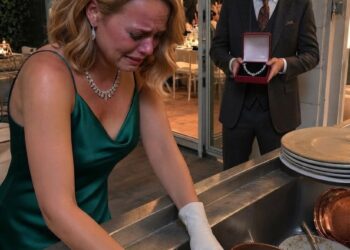
Thirty-seven people sat at long tables under candles and string lights.
The same intimate rehearsal dinner I had been told was immediate family only.
The timestamp sat in the corner.
8:48 p.m. Friday.
Rosewood Ridge Vineyard.
My parents were smiling at the table like proud royalty.
Rebecca stood with a microphone in her hand.
At first, I thought maybe she was making a toast.
Then I heard my name.
She told the room I was bitter.
Jealous.
Trying to sabotage her wedding.
She said I had been invited only because my parents insisted.
Then she laughed and said I was “not really part of this family anymore.”
The room laughed with her.
My family laughed with her.
I watched the video twice.
Not because I needed more pain.
Because sometimes the body refuses to believe what the eyes have already seen.
My mother did not tell her to stop.
My father did not stand up.
Nobody reminded Rebecca that I had paid for the shower, planned the bachelorette, answered her late-night texts, carried her emergency kit, and made sure her wedding day ran like something out of a magazine.
Not confusion.
Not misunderstanding.
Permission.
I stood there in the bridal suite with my phone in my hand while the women around me pretended nothing had changed.
But everything had.
I did not make a scene.
That was the part that surprised me later.
For one ugly second, I imagined turning the phone around and playing the video for the whole room.
I imagined the sound dropping out of Rebecca’s perfect morning.
I imagined my mother’s face when everyone heard what she had allowed.
Then I locked the screen.
Some people mistake restraint for weakness because they have only ever seen power used loudly.
They forget that silence can be a door closing.
The ceremony went on.
I stood where I was told to stand.
I held my bouquet.
I smiled for pictures when someone pointed a camera at me.
I listened while Rebecca promised devotion to Trevor in a voice so soft and polished that half the room wiped tears from their eyes.
My mother dabbed at her face with a tissue.
My father looked proud enough to hurt.
I wondered if either of them had ever looked at me that way.
After the ceremony, guests began drifting toward the reception barn.
The sky had cooled into that blue-gray Wisconsin evening color that makes everything look expensive for about twenty minutes.
The vineyard smelled like damp grass and perfume.
My feet hurt badly enough that I could feel my pulse in my toes.
Rebecca finally glanced my way near the barn doors.
Her veil glowed under the Edison bulbs.
Trevor stood beside her, smiling the polite, bland smile of a man who still believed he understood the family he had married into.
My mother stood close enough to hear.
My father did too.
I stepped forward.
My hand tightened around the little satin clutch where my phone waited, dead and quiet for the moment.
“Congratulations,” I said warmly.
Rebecca looked through me.
Not at me.
Through me.
Behind her, Meredith smirked.
Aunt Carol looked down at the program.
My mother touched Rebecca’s elbow as if I were a draft coming through an open door.
That was the moment I stopped negotiating with people who had already written me out.
I did not argue.
I did not cry.
I did not play the video.
I did not ruin the first dance.
I walked to the coatroom, took my overnight bag, and removed my name card from table fourteen.
Then I left without a sound.
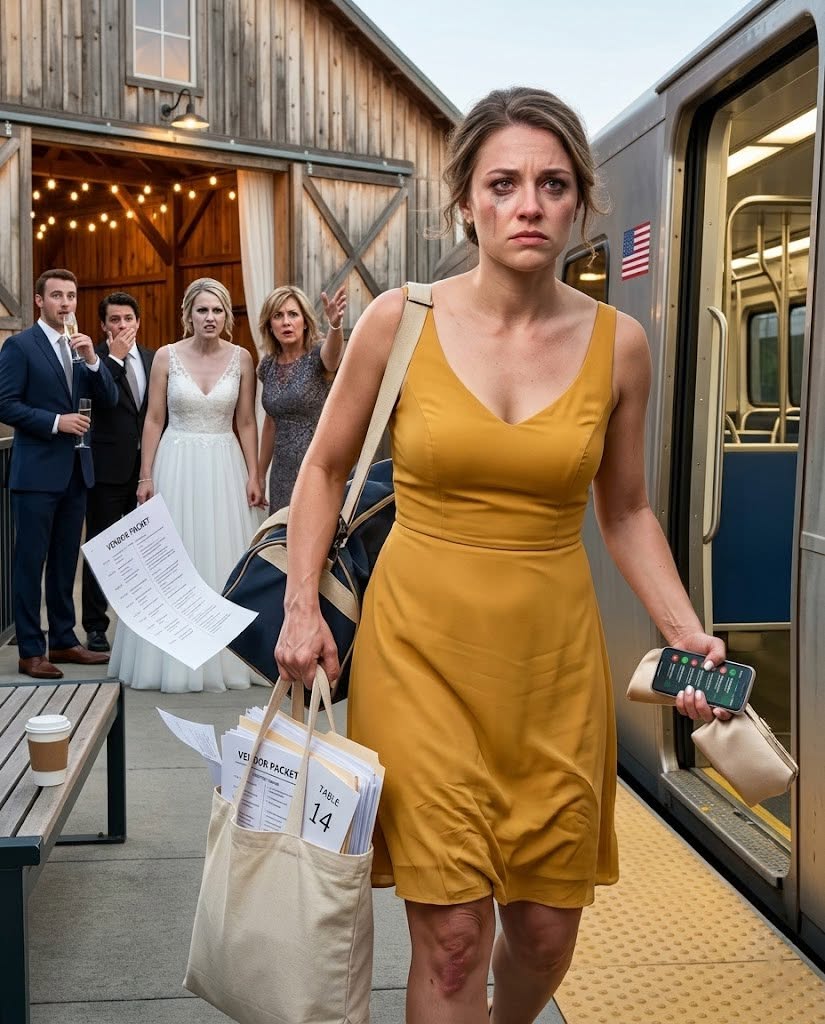
At 6:31 p.m., I boarded the train back to Chicago.
At 7:04 p.m., my phone started ringing like the emergency belonged to me.
Somewhere behind me, the reception barn was glowing with fake joy.
Somewhere back there, an empty chair was becoming visible.
Somewhere back there, Rebecca was realizing the sister she had humiliated was also the person holding the final vendor packet, the shuttle schedule, the emergency contact list, and the only printed copy of the reception timeline.
For the first time in my life, I was not fixing it.
When I turned my phone back on, the screen lit up with forty-three missed calls.
Fourteen text messages.
Three voicemails.
The first voicemail from my mother said I needed to stop being dramatic.
The second said Rebecca was crying in the bridal suite.
The third was only seven seconds long.
In the background, I heard my father say, “Ask her where the packet is.”
Not “Is Selena okay?”
Not “Did we hurt her?”
The packet.
I looked at the tote bag beside my feet.
Inside it was the final vendor packet Rebecca had shoved into my hands that morning like I was staff.
Timeline.
Shuttle list.
DJ cues.
Final payment notes.
Emergency contact sheet.
Every neat little page I had printed, clipped, and protected while she told thirty-seven people I was not really family.
Then a message came in from Meredith.
You need to come back. The shuttle drivers are asking questions and Rebecca is losing it.
I almost responded.
The reflex was still there.
The old Selena would have apologized for leaving, given instructions from memory, called the shuttle company, soothed my mother, and made sure Rebecca’s perfect night stayed perfect.
The old Selena would have made herself small enough to be forgiven for being useful.
I was tired of her.
Then Trevor texted.
Selena. I just saw the rehearsal video. Please answer me. Did Rebecca know you saw it before you left?
My fingers went still.
That was the first message that did not treat me like a missing employee.
Across the aisle, a woman holding a paper coffee cup looked up at me, saw my face, and politely looked away.
My mother called again.
I let it go to voicemail.
A second later, my father texted.
Do not make this worse.
I stared at those five words for a long time.
Do not make this worse.
As if I had stood up at a dinner and mocked my own sister.
As if I had laughed while the room laughed.
As if leaving quietly were the real cruelty.
I opened Trevor’s message first.
No, I typed. She did not know.
Then I added: But everyone else in that room did.
He did not respond right away.
Three dots appeared.
Then disappeared.
Then appeared again.
Finally, he wrote: I need to talk to her.
I almost felt sorry for him.
Almost.
Because Trevor was not the villain of my life, but he had married into a family that specialized in making the truth sound inconvenient.
My mother’s next voicemail came through while I was still staring at his text.
“Selena,” she said, her voice tight and breathless. “This is not the time for one of your moods. Your sister needs you. People are asking where the shuttles are supposed to go, and the DJ says he doesn’t have the final entrance order. You have the packet. You know you do. Turn around right now.”
Then my father’s voice came from farther away.
“She’s doing this on purpose.”
My mother did not disagree.
That was when something in me stopped hurting and started documenting.
I saved the voicemails.
I screenshotted every text.
I screen-recorded Meredith’s story before it disappeared.
I copied Trevor’s message into a note with the timestamp.
7:21 p.m.
That was the minute I finally understood that I did not need to convince anyone of what had happened.
I only needed to stop hiding the evidence for them.
Rebecca called next.
I watched her name fill the screen.
For twenty-eight years, that name had pulled me back into rooms where I knew I would be minimized.
This time, I answered.
For two seconds, there was only noise.
Music.
Voices.
A sharp breath.
Then Rebecca snapped, “Where are you?”
I looked out the train window at the dark fields rolling past.
“On my way home,” I said.
“You need to come back.”
“No.”
The word sounded strange in my mouth.
Small.
Clean.
Powerful.
Rebecca made a sound that was half laugh, half disbelief.
“Selena, I do not have time for this. The timeline is missing. The shuttles are confused. Mom is freaking out. You can be mad later.”
“You told thirty-seven people I was not really part of this family.”
Silence.
Not long.
But long enough.
Then she said, “Oh my God. Is that what this is about?”
That sentence told me everything.
Not denial.
Not surprise.
Annoyance that the thing she had done had consequences.
“Yes,” I said. “That is what this is about.”
“You were not supposed to see that.”
I closed my eyes.
There it was.
The whole truth, handed to me without a bow on it.
Not “I did not say it.”
Not “I am sorry.”
You were not supposed to see that.
People like Rebecca think cruelty only counts when the target is present.
They call it venting when they do it behind your back and drama when you finally hear it.
I opened my eyes.
“I did see it,” I said.
“You’re ruining my wedding,” she hissed.
“No,” I said. “I left your wedding.”
Behind her, I heard my mother say, “Give me the phone.”
Rebecca lowered her voice.
“You have no idea what you’re doing.”
For the first time all day, I smiled without performing it for anyone.
“I know exactly what I’m doing.”
Then I hung up.
My hands were shaking afterward, but not from regret.
From release.
The train rolled toward Chicago, and I sat in that ugly yellow dress with my blistered feet tucked under the seat, holding the vendor packet on my lap like a piece of evidence from a life I was no longer willing to manage.
Trevor texted again ten minutes later.
She admitted it.
Then another message followed.
I am sorry.
I believed the second one more than I expected to.
Not because it fixed anything.
It did not.
But because it was the first apology anyone connected to that wedding had offered me all day.
My mother called six more times before the train reached the city.
My father sent one final text.
You owe your sister an apology.
I looked at it while the train slowed into the station.
The fluorescent lights inside the car buzzed overhead.
People gathered their bags.
The woman across the aisle tossed her empty coffee cup into the trash and gave me a small, sympathetic smile.
I typed back one sentence.
No, I don’t.
Then I blocked him.
I blocked my mother next.
Then Meredith.
Then Aunt Carol.
I did not block Rebecca.
Not yet.
There are some doors you do not slam right away.
Sometimes you leave them open just long enough for the other person to hear themselves speaking.
The next morning, I woke in my Chicago apartment with my dress in a heap on the floor and my phone full of new messages.
Some were angry.
Some were embarrassed.
A few were from people at the wedding who had suddenly found their consciences after dessert went sideways.
One bridesmaid wrote, I should have said something.
A cousin wrote, I didn’t know they excluded you from the dinner.
Trevor wrote only once.
I watched the whole video. You deserved better from all of us.
I sat on the edge of my bed and read that message twice.
Then I opened my laptop.
I made a folder.
Not because I planned revenge.
Because I was done being the family archive for everyone else’s version of events.
Screenshots went in first.
Then voicemails.
Then the screen recording of Rebecca’s rehearsal dinner speech.
Then the photo of my table fourteen name card, still tucked inside my tote.
Then a note with every timestamp I could remember.
10:06 a.m., bridal suite.
10:19 a.m., video found.
6:31 p.m., train boarded.
7:04 p.m., calls began.
7:21 p.m., evidence saved.
It looked cold written out that way.
It looked official.
Maybe that was why it helped.
Pain is easier to doubt when it is only a feeling.
It becomes harder to deny when it has timestamps.
Around noon, Rebecca finally texted me.
You made your point.
I stared at the sentence.
Then another came through.
Are you happy now?
I thought about the bridal suite.
The way the laughter stopped when I walked in.
The way my mother looked out the window instead of at me.
The way my father’s only concern had been the packet.
I thought about every year I had mistaken usefulness for belonging.
Then I answered.
No.
A minute passed.
Then I added: But I am done.
She did not respond.
For a while, nobody did.
The silence that followed was different from the silence at the wedding.
That silence had been punishment.
This one was space.
I did not know yet what my relationship with my family would become.
I did not know whether Rebecca would ever understand what she had broken.
I did not know whether my parents were capable of loving me without needing me to perform a service first.
But I knew this.
I had walked into that wedding carrying safety pins, breath mints, a seventeen-page itinerary, and the last small hope that if I did enough, they might finally see me.
I walked out carrying the truth.
And the truth was heavier at first.
Then, slowly, it became lighter.
Because for once in my life, I was not fixing it.
I was not smoothing it over.
I was not translating their cruelty into something easier for everyone else to swallow.
I was simply letting the room feel the empty chair they had created.
That was the thing none of them understood until it was too late.
I had not ruined Rebecca’s wedding.
I had only stopped saving it.