“You will,” I insisted.
“And if I don’t, I want to die as your wife, not your girlfriend,” she whispered, looking into my eyes.
Something inside me broke at those words. “Don’t talk like that, Chloe.”
“And if I do survive, we’ll have gotten married anyway, which seems efficient,” she added with a small smile.
I laughed, then I started crying, and so did she.
“Is that a yes?” she asked softly.
“You’ve made me wait four years, so I need time to think,” I teased through my tears.
She stared at me intensely. I lasted about three seconds before folding.
“Yes,” I said.
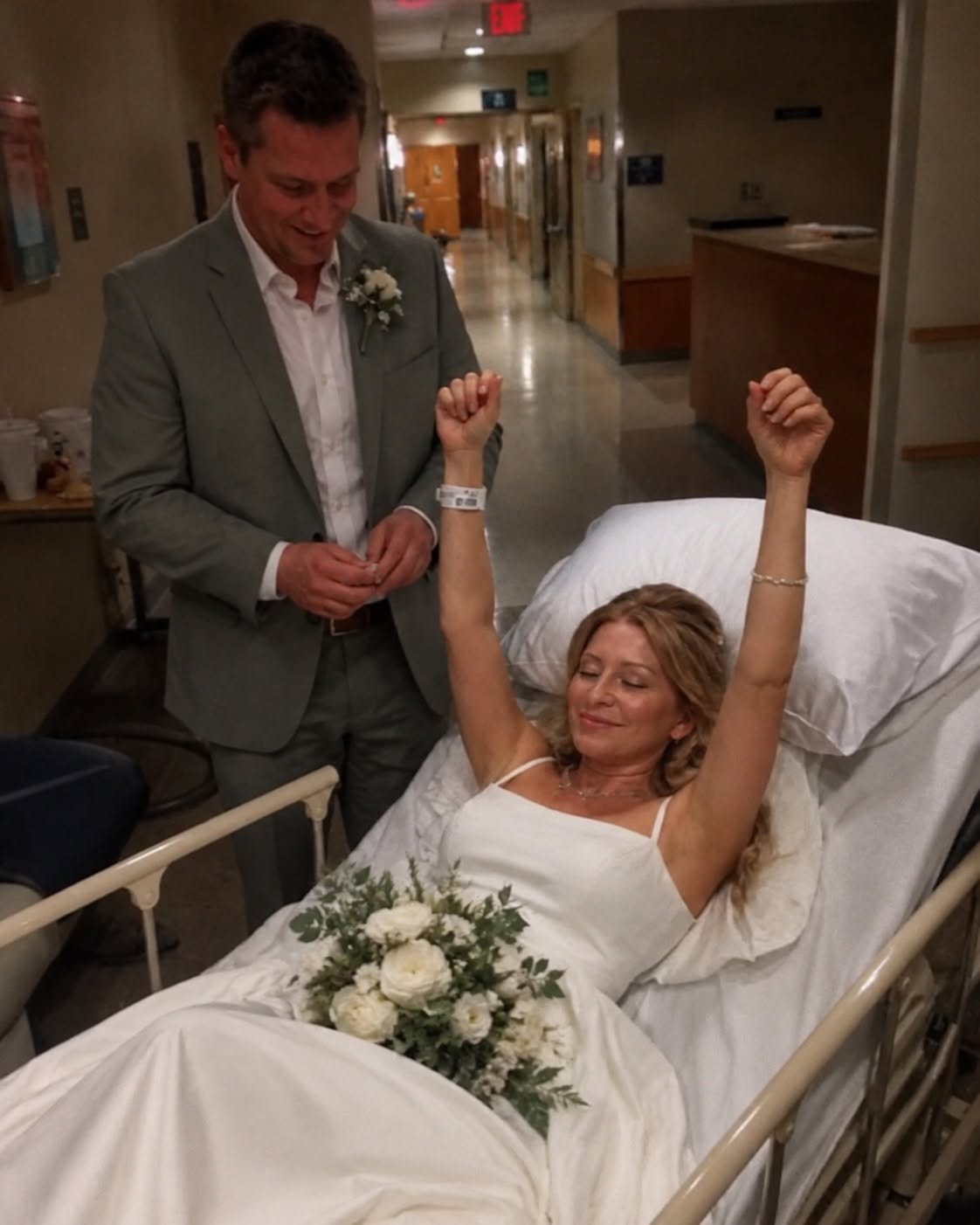
And that was how we got married. We threw the lamest, most beautiful hospital wedding imaginable. Our parents came, a few close friends came, and even a couple of doctors and nurses we’d grown close to over the years stood there with us. There were no expensive flowers, no ballroom, no elaborate decorations, and no first dance. One nurse found a white ribbon in the gift shop and tied it around Chloe’s bed rail, while my mother brought a grocery store cake. Across the top, in bright blue icing, were the words: “CONGRATULATIONS CHLOE AND LUCAS.”
The icing was so bright it practically stained everyone’s teeth blue. Chloe wore a simple white cardigan over her hospital gown, and I wore the only suit I owned. When I saw her, I started crying before the ceremony had even begun.
“Oh, stop crying,” she whispered smilingly.
“You’re beautiful,” I managed to say.
“I have compression socks on underneath,” she pointed out.
“Very bridal,” I countered.
“Shut up,” she chuckled softly.
Everyone laughed at our exchange, and then we promised ourselves to each other in front of about twenty people. When it was time for the rings, Chloe’s hands were swollen from medication, so the nurse helped us choose a slightly larger band. I slipped it onto her finger, and she stared at it for a long moment before looking up at me.
“My husband,” she said softly.
“My wife,” I replied.
She smiled brightly. “Clover.”
“Don’t ruin this moment,” I warned playfully.
Everyone laughed again, and for maybe twenty minutes, something extraordinary happened. Chloe wasn’t a patient, I wasn’t a caregiver, and we weren’t thinking about medications, doctors, surgeries, hospital rooms, or possible outcomes. We were newlyweds, and that was all that mattered.
Part 3
Six days later, Chloe went into surgery wearing that ring. I kissed her gently on the forehead before they wheeled her away down the hallway.
“I’ll see you afterward,” I told her firmly.
“You better,” she replied with a weak grin.
“I mean it,” I added.
“So do I,” she said.
Those were the last words we ever said to each other. The surgery didn’t go the way we’d prayed it would, as there were complications, followed by even more complications. There are hours from that day I still can’t reconstruct properly in my mind. I remember a doctor speaking, I remember Chloe’s mother screaming in pain, I remember my father holding my shoulders, and I remember someone putting a cup of water into my hand. I remember staring at a clock on the wall and wondering how it could possibly keep moving while my entire life had stopped completely.
Chloe was 31, and she had been my wife for exactly six days. She was buried wearing our wedding ring. The following weeks are difficult for me to remember clearly. People brought casseroles, but I forgot to eat them. Friends called, but I just watched the phone ring on the table. I slept on the couch because our bed still smelled like her shampoo, and everything in the house reminded me of her presence, including her favorite mug, her clothes, her books, and the little things she’d left in random places without thinking.
Then, one afternoon, Chloe’s family lawyer called me unexpectedly. He wanted to talk to me about a will she’d written before she died. His name was Mr. Harrison, an older gentleman with a warm tone over the phone.
“I think you should sit down, Lucas,” he said gently.
So I obeyed his advice. If a sad old lawyer tells you to sit down before reading your dead wife’s will, you sit down immediately. I perched on the edge of my kitchen counter, holding an unopened packet of instant ramen in one hand and my phone in the other. There was a long pause on the line before Mr. Harrison sighed deeply.
“I guess it makes sense now why she wanted to marry you,” he said with a sad little chuckle.
My stomach tightened instantly. “What do you mean by that?”
I heard papers rustling on his end of the call. Then he spoke quietly into the receiver.
“Here’s what she wrote in her own words,” he explained. He cleared his throat before reading aloud. “To my husband, Lucas, who spent years trying to give me more time when there was none left to give, I leave everything that remains of mine. And before he gets angry with me for keeping this from him, please tell him to keep reading.”
I stood up straight. “What is this?”
“Keep listening, Lucas,” Mr. Harrison urged gently.
He then explained something I had never known about her family background. Chloe’s grandfather had created a family trust decades earlier, and while it wasn’t enormous, it wasn’t small either. Chloe had inherited an interest in it when her grandfather died, but she had barely touched the money. I hadn’t even known it existed at all.
“How much are we talking about?” I asked nervously.
Mr. Harrison hesitated for a second before answering. “After taxes, existing distributions, and other obligations, Chloe’s share and a spousal survivorship benefit came to a little over $400,000.”
I nearly dropped the phone on the floor. “No way.”
“Lucas, listen,” he said.
“No, that’s impossible,” I argued. “She didn’t have $400,000.”
“Not personally,” he corrected. “Most of it remained inside the trust structure.”
My deep grief suddenly found room for a new emotion, which was overwhelming anger.
“She watched me empty my savings,” I said bitterly.