
Within three weeks, Grant landed me a job at a cross-border trading firm.
The company needed someone to handle European clients, and I was hungry enough to view a modest salary as a starting point.
I translated contracts, explained German precision to American executives, and soothed French clients who hated it when someone said “soon” without specifying a date.
Grant took me along to receptions.
He introduced me to German investors, Austrian consultants, and Swiss banking executives.
He called me his “secret weapon.”
The first time, I blushed.
The last time, I felt a chill run down my spine.
People call you a talent as long as they’re profiting from you. The moment you realize you’re being used, they call you difficult.
The evening at the Union League Club began with rain.
It lashed against the tall windows, while the room smelled of expensive cigars, wet wool, and old money.
Grant kept his hand on the small of my back—not firmly enough to seem rough, but firmly enough to steer me, as if positioning an asset.
He would laugh when I answered in perfect German.
He would squeeze my waist when an investor was impressed.
“See?” he said. “My Amelia opens doors.”
I believed he meant it affectionately.
Around 9:07 p.m., I stepped into a side corridor to take a call from my mother.
She asked if I was happy.
I said yes.
Some lies aren’t told to deceive people, but to give them a night’s sleep.
As I walked back, I was still holding my phone, and my folder of certificates was tucked under my arm.
The folder was thin, black, and unassuming.
It held my Goethe-Institut certificate, my confirmation of graduation from Vienna, letters of recommendation from two professors, and copies of translation samples that no one was ever meant to see.
Grant’s voice drifted in from the balcony.
He was speaking German.
Then I heard a woman laugh.
Vivienne Krauss was standing outside with him—blonde, poised, polished—wearing a cream-colored suit that looked as though it had never seen the inside of a crowded subway car.
I recognized her from the internal newsletter at Grant’s company.
Head of HR for Europe.
Daughter of a major shareholder.
According to Grant, “just a colleague.”
His hand was resting on her waist.
I stopped a meter and a half away, hidden behind the ajar door, my fingers pressing so hard against the edge of the folder that the cardboard buckled.
“She thinks I brought her here because I love her,” Grant said in German.
His voice was soft.
Amused.
“But Amelia is a ladder. And you don’t marry a ladder. You use it to get to the next floor up.”
Vivienne laughed softly.
“That’s cruel.”
“That’s business.”
I had thought pain would be hot.
It was cold.
No anger.
No tears.
A standstill.
Grant told her that my contacts in Vienna had made him useful.
That my language skills had opened doors for him.
Once his transfer to Frankfurt was secured, he planned to make a “clean break” with me.
He saw me as emotional, loyal, predictable, and too grateful to ask questions.
He knew my strengths.
He just mistook them for weaknesses.
I didn’t walk out.
I didn’t scream.
I didn’t throw my phone in his face—though part of me wanted to know what his certainty sounded like when it shattered.
I went back into the room as if I hadn’t heard a thing.
Two weeks later, Grant ended our engagement.
He said he needed “space.”
He said Europe had changed him.
He told me not to make a scene.
Then he vanished to Frankfurt, just as the company I worked for at the time suddenly decided my position needed to be “structurally re-evaluated.”
A client Grant had gained through me switched points of contact.
A promotion I’d been expecting never materialized.
A manager who had previously praised my work asked if I was “too emotional” to sit in on sensitive negotiations.
I understood whose words I was hearing.
In court, I wouldn’t have been able to prove a thing.
In life, sometimes it’s enough just to recognize the source of a wound.
I took the next job I could get.
Blackwood Global offered me an administrative role in their international division, but the application form had one field that stared back at me longer than the others.
Languages.
I wrote: English.
No additional details.
No certificates.
No negotiation capabilities.
Madison Reed reviewed my paperwork back then in the conference room on the 31st floor.
She was the HR director—calm, precise, and not easily impressed.
“Just English, Miss Cross?” she asked.
I looked her in the eye and said, “Just English.”
She held my gaze a second too long.
Then she nodded. I worked like that for four years.
I wrote memos, organized calls, prepared travel documents, and kept my head down.
When German executives walked down the hallway, I stared at my screen.
When French suppliers swore in the elevator, I kept a blank expression.
When a Japanese consultant accidentally left the wrong folder on my desk, I returned it to him without revealing that I had understood the heading.
It wasn’t pride.
It was survival.
On a salary of $72,000 a year, I was paying off my student loans, helping my mother with her health insurance, and living in a Queens apartment where the radiator screeched like a dying animal in the winter.
Sometimes I dreamed in German and woke up startled, as if my own body had betrayed me.
Then came the annual gala at the Plaza Hotel.
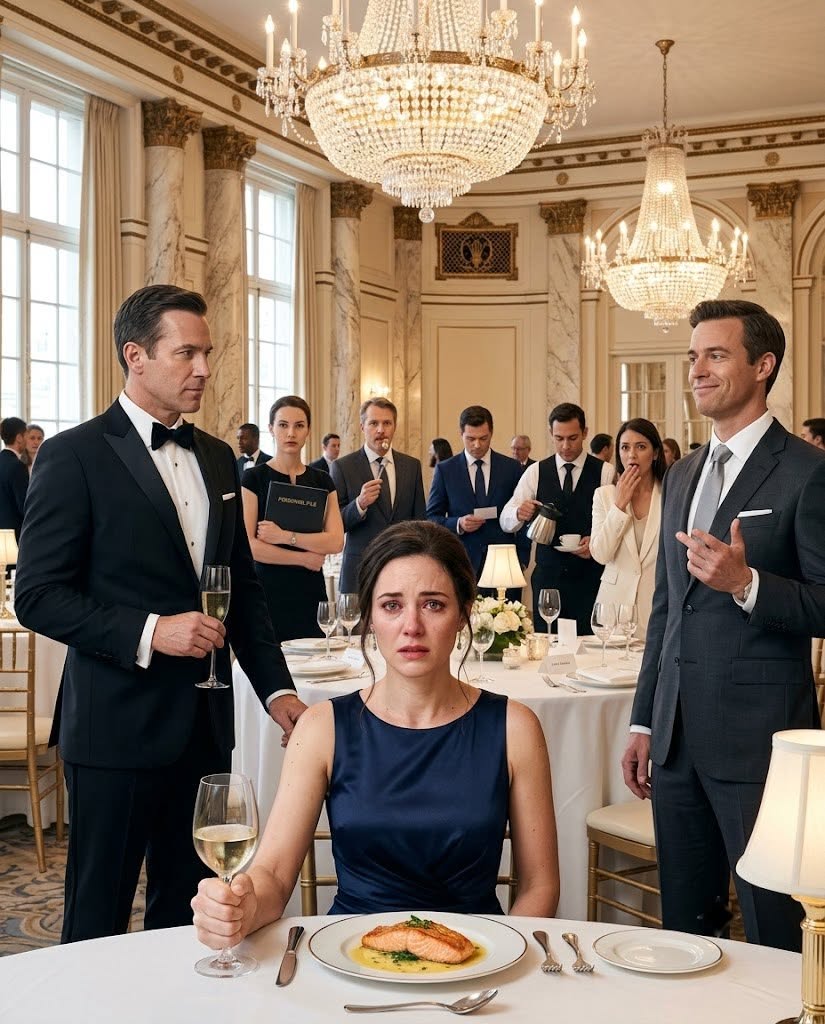
Blackwood Global had invited three hundred employees, investors, and foreign executives.
The ballroom smelled of salmon, hot butter, white wine, and perfume.
Crystal chandeliers cast a cold light over silver forks, champagne flutes, and faces that looked friendly—as long as no one lost anything.
I sat at table twelve—not important enough for the stage, but important enough to be seen.
Madison Reed was sitting three tables away.
Grant Holloway was standing with the VIPs.
I hadn’t seen him up close in years.
He looked older, but not humbler.
His hair was still perfect.
His suit was still expensive.
His smile was still that same thin blade.
When the CEO of Blackwood Global stepped up to the microphone, the room fell silent.
He was a billionaire—polite and dangerous in the way of people who rarely need to raise their voices.
He raised his champagne glass.
Then, in flawless German, he said: “Next year, every employee in this room who speaks German at a professional level will receive a sixty-five percent raise.”
A few people laughed in surprise.
A few hands went up.
Mine didn’t.
Sixty-five percent of $72,000 meant an extra $46,800 a year.
I calculated it faster than I could breathe.
It meant the end of my remaining debt.
It meant a better insurance policy for my mother.
It meant, perhaps, a bedroom where metal pipes didn’t scream every January.
My glass felt cold between my fingers.
I looked down at my salmon.
Grant looked at me.
Then he leaned toward a German board member and whispered something.
I heard the word “Cross.”
I heard the word “German.”
I heard his soft laugh.
The atmosphere in the room shifted, though hardly anyone knew why.
Forks paused in mid-air.
A waiter held a coffee pot over a cup, stopping mid-pour.
An investor stared at his place card as if he might turn into cardboard.
Madison laid her napkin beside her plate.
No one moved.
The chairman of the board walked over to my table.
Grant didn’t follow him directly, but he stayed close enough to position himself like a witness.
He had always been good at that.
He never placed himself at the center of the blame.
He stood on the sidelines and handed others the right words to say.
The chairman stopped beside my chair.
“English only, Miss Cross?” he asked in German.
The room waited.
Grant smiled.
I looked at him and realized, for the first time, that he hadn’t come to expose a lie.
He had come to own it.
“You’ll have to excuse her,” Grant said in English before I could reply.
His voice was warm.
It sounded like the voice of a man who had convinced many a room that he was the voice of reason.
“Amelia has a habit, at times, of making things seem bigger than they are.”
Madison stood up.
She was carrying a slim black folder.
She walked slowly across the hall, past tables full of people who were suddenly all pretending that discretion was a virtue rather than just cowardice in evening wear.
She placed the folder on the table.
“This is Miss Cross’s original personnel file,” she said.
Then she looked at me.
“And an internal memo that was forwarded to us when she was hired.”
Grant blinked.
Just once.
But I saw it.
The CEO opened the folder.
On top lay my job application from four years ago.
Languages: English.
Beneath it lay a memo, copied onto Blackwood letterhead, dated the month I was hired.
Author: Grant Holloway.
I had never seen this memo.
Madison had.
“Miss Cross is professionally reliable,” the CEO read aloud in German—slowly enough for the German guests to understand every word.
Then he faltered.
The room grew quieter, even though it was already silent.
“To the best of my knowledge, she possesses no verifiable professional foreign-language proficiency and tends to embellish her international background in social situations.”
Grant went pale.
Not much.
Just enough for Vivienne Krauss—who was by now standing at the edge of the VIP area—to shift her gaze from him to me.
Yes, she was there.
Of course she was there.
Frankfurt hadn’t taken him to the next floor up.
Just to a different corridor.
The CEO looked at me.
“Is this assessment accurate, Miss Cross?” I could have lied.
I had practiced for four years.
Instead, I placed my napkin on the table and stood up.
My knees didn’t feel strong.
My voice did.
“No,” I said in German.
A sound rippled through the ballroom.
Not a scream.
Not applause.
Just a collective intake of breath, as if three hundred people had simultaneously opened a door inside their heads.
Grant said my name.
“Amelia.”
I raised a hand without looking at him.
That was all.
A small signal.
A stop.
Four years earlier, I had hidden behind a balcony door and remained silent.
Not this time.
“I speak German at a professional level,” I said.
Then I switched to French and repeated it.
Then Russian.
Then Japanese.
I didn’t say it to show off.
I said it like an inventory list after a theft.
English.
German.
French.
Russian.
Japanese.
Korean.
Portuguese.
Arabic.
Italian.
With each language, Grant’s face fell a little further.
Madison closed her eyes for a moment, as if she had been waiting for a truth that finally spoke its own name.
The CEO set down his glass.
“Why,” he asked in English, “didn’t Blackwood Global know this?”
I looked at the black folder.
Then I looked at Grant.
“Because the last man who knew what I was capable of used it until it served his purposes, and then made sure no one else believed it.”
Grant gave a short laugh.
It was an ugly sound.
“That’s absurd.”
Vivienne said nothing.
Her hands were clasped together.
The CEO took the copies of the certificates that Madison pulled from the folder.
They weren’t my old originals.
They were duplicates Madison had requested over the past few weeks, after the German compensation initiative had been set in motion.
Goethe Certificate.
Confirmation of graduation from Vienna.
Letters of reference.
Translation samples.
Timestamps, stamps, signatures.
Not revenge.
Documents.
Madison said, “I never pressured Miss Cross to change her details, because an employee has the right not to assert certain qualifications. But when Mr. Holloway implied to several guests today that she had lied about her language skills, this file became relevant.”
That was when I understood why she had looked at me the way she had for four years.
Not because she was waiting for me to fail.
Because she was waiting for me to allow myself to be whole.
The CEO turned to Grant.
“You provided a professional assessment of a woman to whom you were engaged.”
Grant opened his mouth.
Nothing came out.
“You did not disclose that relationship in your memo.”
Grant looked at Vivienne.
That was his mistake.
Everyone saw it.
Vivienne took a step back.
The CEO closed the folder.
“Mr. Holloway, you will conduct no further discussions this evening on behalf of your firm or our partnership.”
It wasn’t an arrest.
It wasn’t a dramatic dragging-out.
For a man like Grant, it was worse.
It was a public stripping away of his credibility.
No security guard came running.
An assistant simply stepped quietly to his side and said something I didn’t need to hear.
Grant looked as though the ground had suddenly ceased to belong to him.
I later learned that Blackwood had put the partnership review with his firm on hold.
Madison forwarded an internal compliance report.
Vivienne flew back to Frankfurt two days later.
Grant called me three times.
I didn’t pick up.
Then he sent a message.
You didn’t have to humiliate me in front of everyone.
I stared at the sentence for a long time.
Then I deleted it.
Not every message deserves a reply.
Some things prove themselves.
On Monday, I was back on the 31st floor—this time, not sitting across from Madison alone.
The CEO was there.
The head of European strategy was there.
A new form lay on the table.
Languages: English, German, French, Russian, Japanese, Korean, Portuguese, Arabic, Italian.
Beside it lay a salary adjustment.
Sixty-five percent.
Retroactive to the start of the new compensation program.
No apology can give back four years.
But some sentences open a door you had walled shut yourself.
Madison slid a pen toward me.
“Just for the record,” she said.
For the first time in a long while, I smiled without making myself small.
“With pleasure,” I said in German.
My mother wept when I told her I could pay for better health insurance for her.
Three months later, I moved out of the apartment in Queens.
The new radiator was quiet.
That was a small detail.
Sometimes, small details are the things that prove you’ve truly escaped.
I no longer kept my folder of certificates in a drawer.
I placed it on a shelf.
Not as a trophy.
As a reminder that skills aren’t dangerous.
The wrong people are.
Grant had once called me a ladder.
He was right—just not in the way he meant.
I wasn’t a tool for his ascent.
I was the way out of the room where he’d wanted to leave me standing.
And that evening at the Plaza, when my boss asked in German if I really only spoke English, I finally realized that silence wasn’t safety.
Silence was just a lock for which Grant had held the key for a long time.
I took it back.