“I didn’t leave you,” I said. “You told me not to come back.”
Her head turned sharply. “What?”
“You wrote me a letter. You said you had met someone else. You said what we had was too complicated, that you needed a clean start.”
Her face emptied.
“No,” she said.
I took the envelope from my coat pocket. “Then what is this?”
She stared at it for a long moment before reaching into the diaper bag with shaking fingers. From an inner pocket, she pulled out another folded paper, protected inside a plastic sleeve. “This is what I got.”
She handed it to me.
The paper was familiar and impossible. My name was typed at the bottom, but the signature above it twisted my stomach. It was close to mine, close enough to fool someone who had loved me and was afraid to look too carefully, but wrong in the angle of the E, wrong in the pressure of the final line.
Rachel,
I received your letter. I’m sorry, but I can’t be part of this. I’m not ready to be a father, and I won’t let one mistake decide the rest of my life. Please don’t contact me again. It will be better for everyone if we both move on.
Evan.
The words blurred.
I had never written them.
I sat down heavily beside her. “Rachel, I swear to you, I never saw a letter from you about a pregnancy.”
Her eyes filled, though no tears fell. “I mailed it to your Chicago address. I waited every day for you to call. Then this came back.”
“I didn’t live at that address yet,” I said slowly. “The company changed my apartment the week before I moved. I told you that in the last voicemail I left.”
“I never got a voicemail.”
“I left three.”
She looked at me then, and the years between us opened like a cracked floor.
“I thought you knew,” she said. “I thought you chose not to come.”
“I thought you left me.”
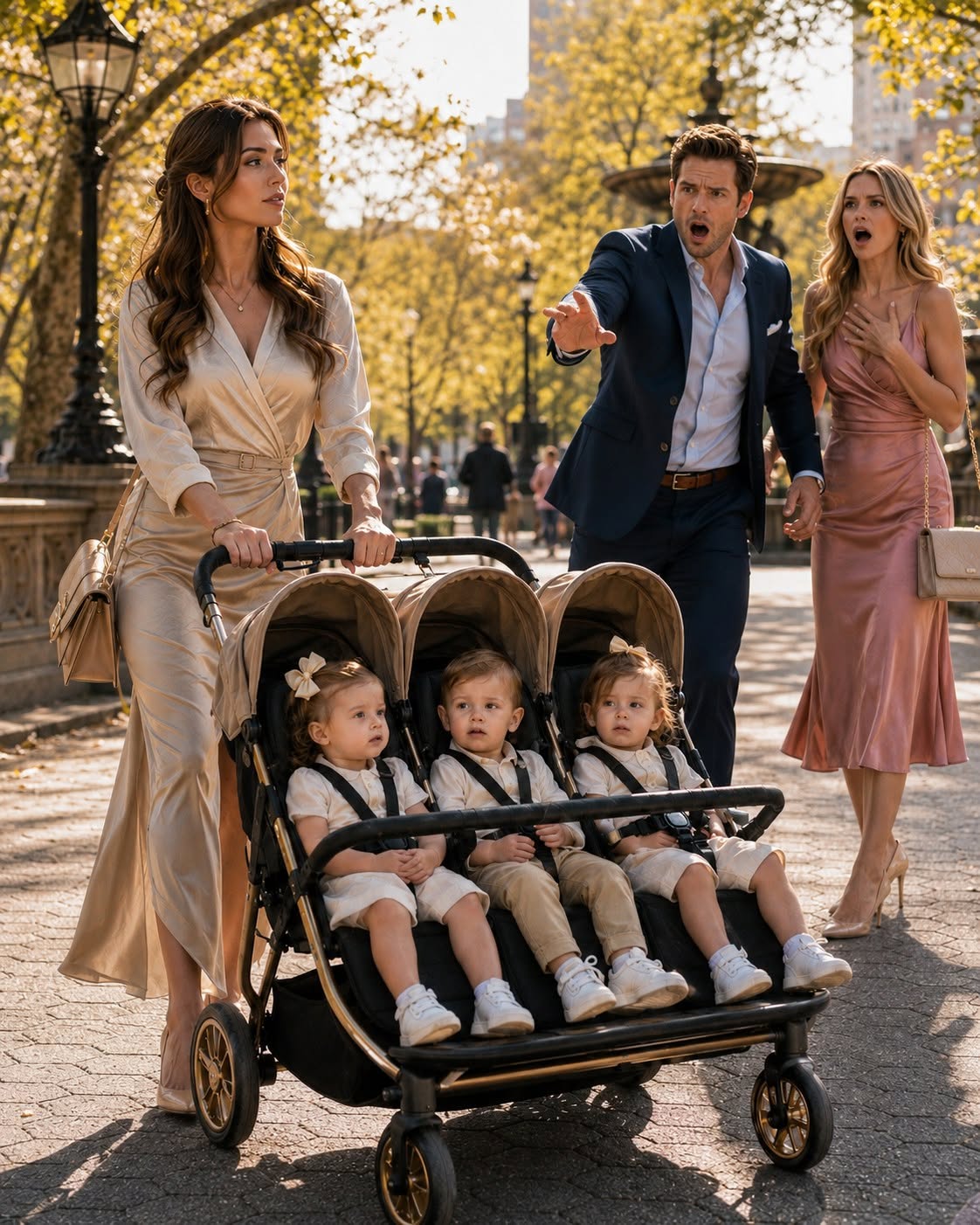
The children ate their pretzels, unaware of the quiet earthquake beside them. Lily hummed to herself and swung her boots. Noah was trying to balance a crumb on his knee. Sophie leaned her rabbit against the stroller bar and whispered something into its ear.
I looked at them and could barely breathe.
“Are they mine?” I asked, though the answer had already begun living in my bones.
Rachel’s face softened with pain. “I believed they were. I still do.”
“Why didn’t you try again?”
“I did.” She turned toward the diaper bag and pulled out another envelope, this one stamped and returned. “Twice. The second time, a woman called me. She said she was from your office. She said you were engaged already and that my calls were upsetting you. She said if I cared about you, I would stop.”
My mouth went dry. “What woman?”
“I don’t know. She didn’t give a name.”
“Rachel, I wasn’t engaged. I wasn’t even dating anyone seriously for almost two years.”
“I know that now,” she said. “Or I’m beginning to.”
The fountain splashed behind us. A breeze lifted the corner of the letter in my hand. It looked so ordinary, this small piece of paper. Cheap stationery. Black ink. A lie that had somehow carried enough force to separate four lives before three of them had even taken their first breath.
“I kept your letter,” I said. “The one that supposedly came from you. It’s at my apartment.”
Rachel’s eyes searched mine. “Why would you keep it?”
“Because I couldn’t let go of the last thing I thought you wanted me to know.”
For the first time, her composure broke. She turned away quickly, pressing two fingers beneath her eyes. I remembered that gesture. Rachel had always refused to cry in front of people until she felt safe, and sometimes not even then.
Lily noticed. “Mommy?”
“I’m okay, sweetheart.” Rachel’s voice warmed instantly. “Just something in my eye.”
Lily looked at me suspiciously, as if I might be responsible for whatever had gotten into her mother’s eye. Maybe I was.
I knelt slowly in front of the stroller. “Hi, Lily.”
She studied me with solemn authority. “Your eyes are like mine.”
“Yes,” I said. My throat tightened. “They are.”
“Mommy says mine are storm eyes.”
I looked up at Rachel. She was watching us with a face I couldn’t read.
“My mother used to say the same thing about mine,” I told Lily.
She brightened. “Do storms have birthdays?”
Noah sighed. “Storms don’t have cake.”
Sophie said, “Everything should have cake.”
And there it was—life, stubborn and sweet, going on in the middle of ruin.
Rachel checked her watch. “They need lunch soon.”
“Come to my apartment,” I said before fear could stop me. “We can compare the letters. We can figure out what happened.”
Her expression closed. “I don’t know if that’s a good idea.”
“I understand. Then a café. Anywhere public.”
She looked at the children, then at me. “There’s a small place on Spruce with a back table. They know us there.”
“Okay.”
She hesitated. “You should call Noelle.”
The sound of my fiancée’s name struck me with fresh guilt. “I will.”
Rachel’s mouth tightened, not with jealousy, but with an exhausted kind of compassion. “She deserves better than being left in a park with no explanation.”
“She does.”
“So did we,” Rachel said.
I had no answer.
The café on Spruce was warm and narrow, with fogged windows and mismatched chairs. The owner greeted Rachel by name and brought crayons before she asked. He glanced at me only briefly, but there was recognition in his look—not of who I was, but of what I might become in Rachel’s life, and therefore in the children’s.