No woman called from inside.
No man came out to take the horse.
The house had the held breath of a place waiting to see what she would do first.
Clara reached for her bonnet.
Then she heard it.
Not a cry.
Not quite.
A low murmur, quickly swallowed.
Then another.
Several voices, thin as threads behind the boards.
She stilled.
The horse tossed its head, and the harness gave a dry jingle.
Clara climbed down from the wagon, her boot heel catching on the wheel spoke as it always did.
She had meant to fix that since March.
There were always things a person meant to fix.
She stepped around the wagon’s flank.
The porch came into view.
And Clara stopped.
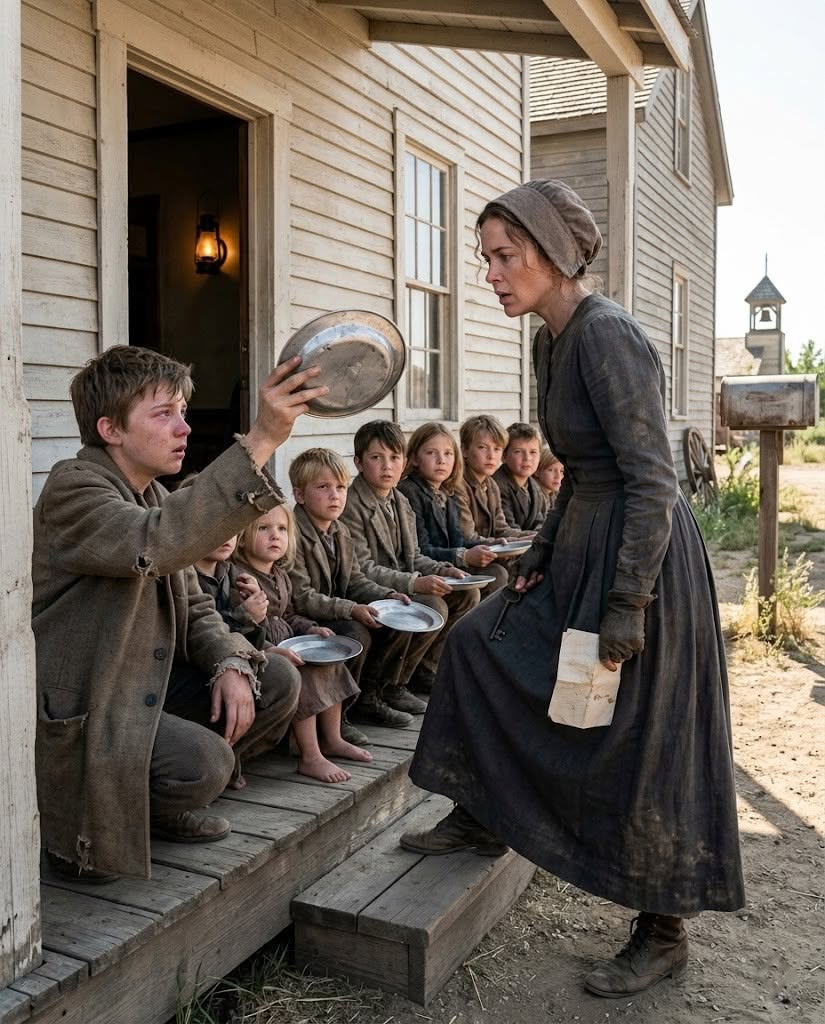
Nine children sat in a row across the front boards.
For a few seconds her mind refused the number.
It tried to count them as bundles.
As shadows.
As perhaps neighbors’ children waiting with the one she had been sent to claim.
Then one child shifted, and the row became undeniable.
Nine.
The oldest sat near the steps.
He might have been thirteen, though hunger and responsibility could make a child look older in one place and younger in another.
His coat was too broad through the shoulders.
The cuffs swallowed his wrists.
Beside him sat a girl with her hair braided unevenly, one ribbon missing and one ribbon tied too tight.
Two smaller boys leaned against each other as if neither trusted himself to sit alone.
Near the middle, a little child with no shoes tucked bare feet beneath an oversized coat.
At the far end, the smallest one stared at Clara with eyes too large for the face around them.
Every child held a tin plate.
Every plate was empty.
Clara had seen hunger before.
Not the polite kind people name when supper is late.
Real hunger.
The kind that changes how a body moves.
The kind that teaches children not to waste tears, not to swing their legs, not to speak unless speech might bring bread.
That was the stillness on the porch.
Not obedience.
Not peace.
Conservation.
Nine children saving themselves one motion at a time.
The letter inside Clara’s bodice seemed to burn against her skin.
One child, ma’am.
Boy.
Maybe seven.
She had been lied to before.
Most people had, if they lived long enough and listened carefully enough.
But some lies were not spoken to protect the liar from shame.
Some lies were spoken because the truth would have required action.
Clara stood in the yard with the iron key in her hand and looked at the children’s plates.
The oldest boy rose first.
He did not do it quickly.
He pushed himself up like every joint had to be asked and then persuaded.
The plate in his hand flashed dull silver in the sun.
“Ma’am,” he said.
His voice was rough but steady.
She looked at his face.
He looked past her shoulder once, toward the road, as if checking whether the wagon was leaving.
Then he looked back.
“They told you about me, didn’t they?”
Clara did not answer.
Not because she could not.
Because the answer was suddenly too small to be useful.
She drew the folded letter from her bodice and opened it.
The paper crackled in the quiet.
The grease mark from the stagecoach agent’s thumb stained the corner.
The words had not changed.
One child.
Boy.
Maybe seven.
No names.
No explanation.
No mention of the other eight.
The boy watched her read it.
Something in his face closed.
It was not disappointment.
Disappointment requires a little expectation first.
This was confirmation.
He had already known.
Behind him, the little barefoot child pressed the rim of the empty plate against her stomach.
A girl beside her lowered it gently before the metal could make noise.
That small act told Clara more than any letter could have.
They had learned to manage one another.
They had learned what sounds to prevent.
They had learned that even need could be too loud.
Clara folded the letter once, carefully.
Her hands did not shake.
That was one mercy.
She looked at the key again.
A key could open a door.
It could also lock one.
“Where is the adult in this house?” she asked.
The boy’s jaw moved.
No sound came.
The girl with the uneven braid looked down at her plate.
One of the smaller boys stared at the shutter tapping against the siding.
Nobody answered.
The silence spread across the porch, child to child, like a blanket too thin to warm anyone.
Clara took one step forward.
The children did not move away.
That almost broke her more than fear would have.
Fear would have meant they still believed distance could save them.
This stillness said they had learned waiting was the only thing left.
As Clara reached the bottom step, she saw the scrap of paper pinned beneath the porch rail.
At first she thought it was a receipt.
Then the wind lifted one corner.
Names.
Not one.
Several.
Written in different hands, or perhaps the same hand over too many days.
Some letters were careful.
Some slanted.
Some were barely formed.
Clara crouched and eased the rusted nail loose with the edge of the key.
The oldest boy made a sound then.
Small.
Warning or shame, she could not tell.
She flattened the scrap against her skirt.
Nine names.
Some had marks beside them.
Not ages.
Not proper records.
Just marks.
A cross.
A line.
A circle.
Household mothers learn to read what people do not write.
Clara had no proof yet of what those marks meant.
But her body understood the danger before her mind gave it words.
The littlest child folded forward suddenly.
The plate slid from her lap and struck the porch boards with a flat metal clap.
Every other child flinched.
Not at the plate.
At the possibility that the sound might bring someone.
Clara moved.
She was up the first step before she finished deciding.
The oldest boy raised one hand, not to stop her exactly, but to slow her.
“Don’t go in fast,” he whispered.
Clara stopped with her boot on the step.
The house behind them seemed darker than it had a moment earlier.
A lantern burned somewhere inside, a thin amber glow in the hall.
The front door had been shut when Clara arrived.
Now it stood open a finger’s width.
Clara saw the black line of the gap.
She saw the children notice her noticing.
The little barefoot child had gone still again, though her face had lost what little color it had.
Clara tightened her grip on the key.
Iron pressed into her glove.
The letter and the scrap of names lay against her other palm.
Three pieces of proof.
A contract that named one child.
A porch that held nine.
A list someone had tried to hide under a rail instead of putting it in a drawer like a decent record.
She did not know yet who had written the lie.
She did not know who was inside the house.
She did not know whether help in Caldera Flats would come quickly, slowly, or only after the right person had been shamed into it.
But she knew the first duty of the moment.
Children first.
Always children first.
“Can you stand?” she asked the little one.
The girl with the uneven braid answered for her.
“She can if there’s food.”
The sentence was plain.
That made it worse.
Clara swallowed dust and something sharper.
She wanted anger then.
Anger would have been easier.
Anger gives the body a place to put its hands.
But rage was a luxury, and there were nine empty plates in front of her.
So she did what practical women do when the world becomes monstrous.
She counted.
Nine children.
Nine plates.
One key.
One wagon.
A dry town with watchers in its windows.
A house with someone breathing behind a cracked door.
The oldest boy looked at her again.
This time his steadiness had begun to fail.
“Are you leaving?” he asked.
Clara looked at the wagon.
Then at the road.
Then at the children.
For one long second, all of Caldera Flats seemed to hold still with them.
The shutter tapped once against the siding.
The lantern inside the hall flickered.
The door opened another inch.
And someone from inside the dark house whispered Clara’s name.
She had not told anyone in that house her name.
The oldest boy’s face drained.
The girl with the uneven braid covered the little one’s mouth with trembling fingers.
Clara’s hand closed around the iron key until the edge bit through the glove.
She understood then that the lie had not begun at the stagecoach office.
It had only reached her there.
Those children had been waiting longer than the road from Redemption Creek.
They had been waiting through hunger, through silence, through whatever lived behind that door.
And now the door was opening.
Clara did not step back.
She set the folded letter on the porch rail, beside the scrap with nine names, so the children could see she was not hiding either one.
Then she looked at the oldest boy.
“I came for one child,” she said.
His mouth tightened.
The little barefoot child stared at her as though even breathing depended on what came next.
Clara lifted the iron key.
“But I can count.”
For the first time since she arrived, one of the children made a sound that was almost a sob.
Not relief.
Not yet.
Relief is what comes after safety.
This was the first crack in the stillness hunger had built around them.
Clara climbed the final step and placed herself between the children and the opening door.
The lantern glow widened across the boards.
A shape shifted inside the hall.
Someone inhaled sharply.
Clara did not know what waited in that house.
She only knew that nine children sat behind her with empty plates, and one folded letter had tried to erase eight of them before she ever arrived.
Years later, she would remember the sound of that shutter.
She would remember the dry dust on her tongue.
She would remember how heavy the key felt before she understood why.
Most of all, she would remember that row of children sitting like fence posts after a hard wind — crooked, weathered, but still standing.
And she would remember the lesson Caldera Flats taught her before supper ever touched the stove.
A child can survive being overlooked for a while.
But if enough grown people agree not to see him, hunger starts to look like silence.
Clara turned the key in her hand, squared her shoulders, and faced the dark hall.
Behind her, the oldest boy whispered, “Please.”
That was when Clara knew the contract had ended before it began.
This was no placement anymore.
This was a rescue that had not yet found its name.
And whether Caldera Flats liked it or not, by sundown, every empty plate on that porch was going to matter.