For one ugly second, I imagined driving to Dad’s house, dragging Sophia into the driveway, and yelling loud enough for every neighbor, every mailbox, and every small American flag on the porches to witness what she had done.
Then I swallowed it.
Rage makes noise. Proof makes consequences.
I gave Laura my keys, my phone charger, and the spare twenty dollars I kept in a mug above the stove.
“If Dad calls,” I said, “let it go to voicemail.”
She nodded, but her eyes stayed on mine.
“What if he doesn’t believe us?”
That question hurt more than the bruises.
Because I did not know.
I drove to Dad’s house with both hands locked on the wheel.
The roads were slick from the rain, and the streetlights turned every puddle into a stripe of yellow glass.
At 11:08 p.m., I pulled into the driveway.
The family SUV sat there.
The porch light was off.
The mailbox flag was down.
Everything looked normal, which made it worse.
That house had birthday photos in the hallway, a dent in the kitchen floor from when Dad dropped a cast-iron pan, and a backyard fence Laura and I had painted badly one summer while Mom laughed from a lawn chair.
It was still a home from the outside.
It was what had happened inside that had turned it into something else.
I used Laura’s key and came in through the garage.
I kept my head down.
I rounded my shoulders.
I moved the way Laura told me Sophia expected her to move.
Only one light was on.
The kitchen.
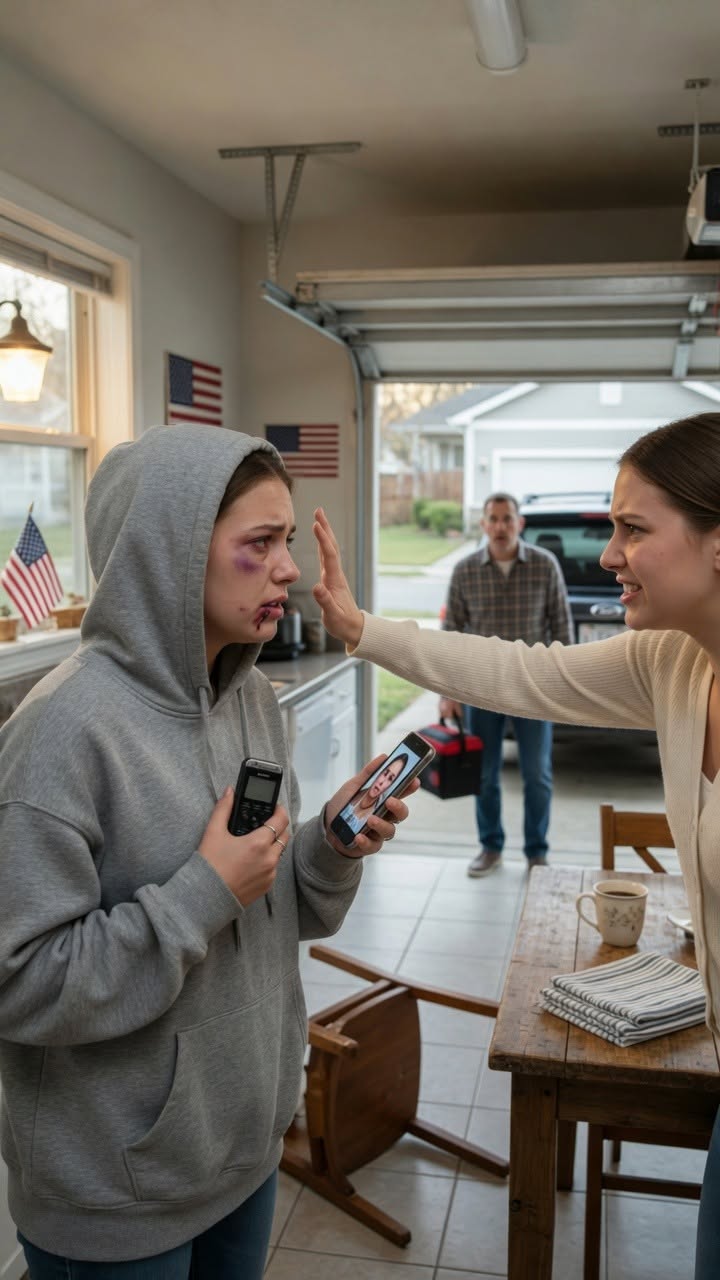
Sophia was sitting at the table in a cream cardigan, one hand wrapped around a coffee mug.
A stack of folded dish towels sat beside her.
She looked calm.
That calmness made my skin tighten.
“There you are,” she said.
I kept one hand near the hoodie pocket.
“I’m sorry I’m late.”
Her chair scraped back against the tile.
She stepped close enough for me to smell peppermint gum.
“You always are,” she whispered.
Behind me, the garage door lock clicked.
The sound was small, but it went through me like a warning.
Her hand came up toward my face.
It was slow. Practiced. Confident.
Not the motion of someone losing control.
The motion of someone who had done this before and expected the room to obey.
Before her palm reached my cheek, I whispered, “Say it again.”
Sophia froze.
For half a second, she did not recognize the danger.
She only recognized disrespect.
“You think you get to talk back now?” she said.
The recorder caught everything.
The click of her tongue. The scrape of her slipper. The soft, ugly certainty in her voice.
“After everything I let you have?”
I kept my chin tucked.
“What did you let me have?”
Her eyes hardened.
“That bed. Those clothes. That food you stuff into your mouth when your father is not looking.”
My hand curled around the recorder through the hoodie fabric.
She leaned closer.
“You think he kept you because he wanted you here?” Sophia whispered. “He kept you because you were convenient. A sad little girl who knew how to make him feel needed.”
The words hit me in a place I had not prepared for.
Because she thought she was talking to Laura.
She thought she was pouring poison into the same girl she had been weakening for months.
Then the garage door lifted.
Sophia’s face changed before she turned.
Dad’s work boots stopped on the concrete.
I had not called him.
Laura had.
From my apartment, at 11:06 p.m., she had sent him one message.
Come home quietly. Please.
Dad stepped into the kitchen holding his lunch cooler.
His eyes went first to Sophia’s raised hand.
Then to my face.
Then to the phone in my palm, where the pictures of Laura’s bruises were already open.
The cooler slipped from his fingers and hit the floor.
“What,” he said, “have you done to my daughter?”
Sophia moved fast.
Not physically. Socially.
Her voice softened.
Her shoulders dropped.
Her hand lowered, and the woman who had just been poison became the woman from church again.
“Oh, honey,” she said. “She’s lying.”
Dad looked at me.
For one terrible second, I saw the fight inside him.
He loved Laura.
He loved me.
But he had also married Sophia.
He had built a new life around her casseroles, her clean counters, her folded towels, her easy explanations.
People do not like finding out they mistook control for care.
It makes them feel foolish.
It makes them defensive.
It makes them dangerous to the person telling the truth.
So I did not argue.
I took the recorder out of my pocket and pressed play.
Sophia’s voice filled the kitchen.
“You think he kept you because he wanted you here?”
Dad stopped breathing.
Sophia reached for the recorder.
I stepped back.
The second line played.
“He kept you because you were convenient.”
Dad looked at Sophia like he had never seen her before.
She shook her head.
“That is not what it sounds like.”
But the recording kept going.
It had her voice.
Her words.
Her hand before the strike.
Her lie forming too late.
When it ended, nobody spoke.
The refrigerator hummed. The garage light buzzed overhead. Dad’s lunch cooler lay on its side with his thermos half out of the zipper.
Then Dad sat down on the nearest chair as if his knees had stopped being part of his body.
He covered his mouth with one hand.
“I left her with you,” he said.
Sophia started crying.
Not the kind of crying Laura had done in my apartment.
Sophia’s tears were quick and useful.
She cried like a person looking for the camera.
“You don’t understand,” she said. “She has been impossible. She pushes me. She manipulates you. She—”
“That is not Laura,” I said.
Both of them looked at me.
I unzipped the hoodie.
I pulled my hair loose.
And for the first time that night, Sophia really looked at my face.
Not Laura’s fear.
Not Laura’s posture.
Mine.
Her mouth opened.
Dad stood.
“Where is she?”
“Safe,” I said. “At my apartment.”
That was the moment Sophia’s performance finally cracked.
It did not shatter loudly.
It thinned.
Her face went flat, and for one second the woman underneath looked almost bored that the game had ended.
“You two planned this,” she said.
“Yes,” I said.
Then Dad moved between us.
It was the first useful thing he had done all night.
“Get your things,” he told Sophia.
Her head snapped toward him.
“You cannot be serious.”
“I am.”
“This is my home.”
“It is my daughter’s home first.”
The sentence landed heavily in the kitchen.
I wanted it to fix everything.
It did not.
No sentence can reach backward and make a father see sooner.
But it did something.
It opened the door.
Sophia left that night with one suitcase, two garbage bags of clothes, and the cream cardigan still buttoned wrong because her hands were shaking.
Dad did not touch her.
He did not scream.
He stood by the counter while she moved through the house, and every time she tried to speak, he said, “Not another word.”
At 12:31 a.m., I drove back to my apartment with Dad following behind me in his SUV.
Laura was sitting on my couch wearing my sweatshirt, both knees pulled to her chest.
When Dad walked in, she did not run to him.
That was the detail that broke him.
He stopped just inside the door.
“Laura,” he said.
She stared at him like she was trying to decide which version of him had arrived.
The father who used to braid our hair badly before school.
The man who taught us how to check tire pressure at a gas station.
Or the husband who had slept in the next room while Sophia took the door off her bedroom.
“I’m sorry,” he said.
Laura’s face folded.
But she still did not move.
Dad sank onto the floor in front of the couch because she could not stand having him tower over her.
“I should have known,” he said.
Laura whispered, “I tried.”
That was all she said.
I tried.
It was worse than any speech.
The next morning did not look like a movie.
It looked like bad coffee, swollen eyes, and paperwork spread across my small kitchen table.
At 8:12 a.m., the attorney called back.
She did not make grand promises.
She asked precise questions.
Dates. Photos. Witnesses. Medical records.
Whether Laura had somewhere safe to stay.
Whether Dad was willing to make a statement.
At 10:40 a.m., we went to the hospital intake desk so Laura could be checked and the bruises could be documented properly.
The nurse did not gasp.
She did not make Laura repeat everything twice.
She spoke gently, wrote carefully, and asked permission before touching her shoulder.
At 1:15 p.m., Dad and I went with Laura to file a police report.
I watched his hand shake while he signed his statement.
He looked older than he had twenty-four hours earlier.
That did not make me feel sorry for him.
Not yet.
Maybe later.
By 3:30 p.m., the attorney had helped us organize the photos, the timeline, the recording, and the hospital paperwork into one clean file.
She called it documentation.
Laura called it proof she was not crazy.
Those are not always the same thing, but that day they felt close.
Sophia tried to call Dad thirty-one times.
He did not answer.
She sent messages saying Laura was dramatic.
She sent messages saying I had always resented her.
She sent messages saying families should handle things privately.
That one made me laugh, but not because it was funny.
Private was where she had done her best work.
Private was the hallway wall.
Private was the empty plate.
Private was a bedroom with no door.
Dad read every message and then handed his phone to the attorney.
The woman who used sweetness as cover had finally written herself into the record.
Over the next week, the house changed.
Dad put Laura’s bedroom door back on himself.
He did it badly at first, because his hands would not stop shaking, so I held the hinges while he drove the screws in straight.
He threw away the dish towels Sophia had folded that night.
Laura said that was stupid.
Then she cried when he did it anyway.
Mom came over with soup in a grocery bag and did not yell at Dad until Laura went to sleep.
Then she took him onto the front porch and said everything she had been saving since the divorce.
I did not listen to all of it.
I heard enough.
“You do not get credit for believing her after proof made it impossible not to,” Mom said.
Dad did not argue.
That was new.
The legal process moved slower than our anger.
It always does.
There were statements.
Calls.
A family court hallway with vending machines humming under fluorescent lights.
A temporary order.
More forms than any hurt person should ever have to read.
Sophia’s attorney used words like misunderstanding and household discipline and stress.
Our attorney used photos, timestamps, medical notes, and the recording.
One sounded polished.
The other sounded true.
Laura sat beside me through most of it with her sleeves pulled over her hands.
Some days she looked stronger.
Some days she looked like the apartment doorstep again.
Healing did not make a straight line.
It circled.
It forgot things.
It jumped at garage doors.
It slept with the lights on.
It cried over a sandwich because nobody had counted the bites.
Dad learned that apologies are not a doorway you walk through once.
They are a floor you keep sweeping.
He drove Laura to appointments.
He sat in waiting rooms.
He put gas in Mom’s car without being asked.
He stopped saying, “Why didn’t you tell me?”
The answer was too obvious.
She had tried.
He had been comfortable not hearing.
The day Laura came home for the first time after Sophia left, she stood in the kitchen for almost ten minutes without sitting down.
Dad had made grilled cheese because it was the only dinner he could not ruin.
He put two plates on the table.
Then he put a third plate down for me.
Nobody counted.
Nobody commented.
Nobody made her earn it.
Laura stared at the plate until her eyes filled.
Dad looked like he wanted to say something enormous.
Instead, he slid the tomato soup closer to her and said, “It’s hot.”
That was the right thing.
Not perfect. Right.
Care shown through a bowl.
Through a door rehung.
Through silence that does not demand forgiveness before the hurt has finished speaking.
Months later, Laura moved into the room at Mom’s place for a while, then back and forth depending on what felt safe.
Dad did not rush her.
He had lost the right to rush anything.
The last time I saw Sophia in person was in a courthouse hallway.
She wore a beige coat and the same soft expression she used for strangers.
When she saw Laura, her mouth tightened.
Then she saw me standing beside her.
The smile never fully formed.
That was enough.
Laura squeezed my hand.
Her fingers were warm.
I thought about the night she stood on my doorstep and whispered, “Don’t tell Dad.”
I thought about how long she had carried pain because she was still trying to protect the man who should have protected her.
And I thought about the mirror in my bathroom, the hoodie, the recorder, the awful steadiness of Sophia’s raised hand.
She had picked the wrong daughter.
But the truth was bigger than that.
She had picked the wrong sisters.
Because Laura survived long enough to tell me.
And I loved her hard enough to listen.