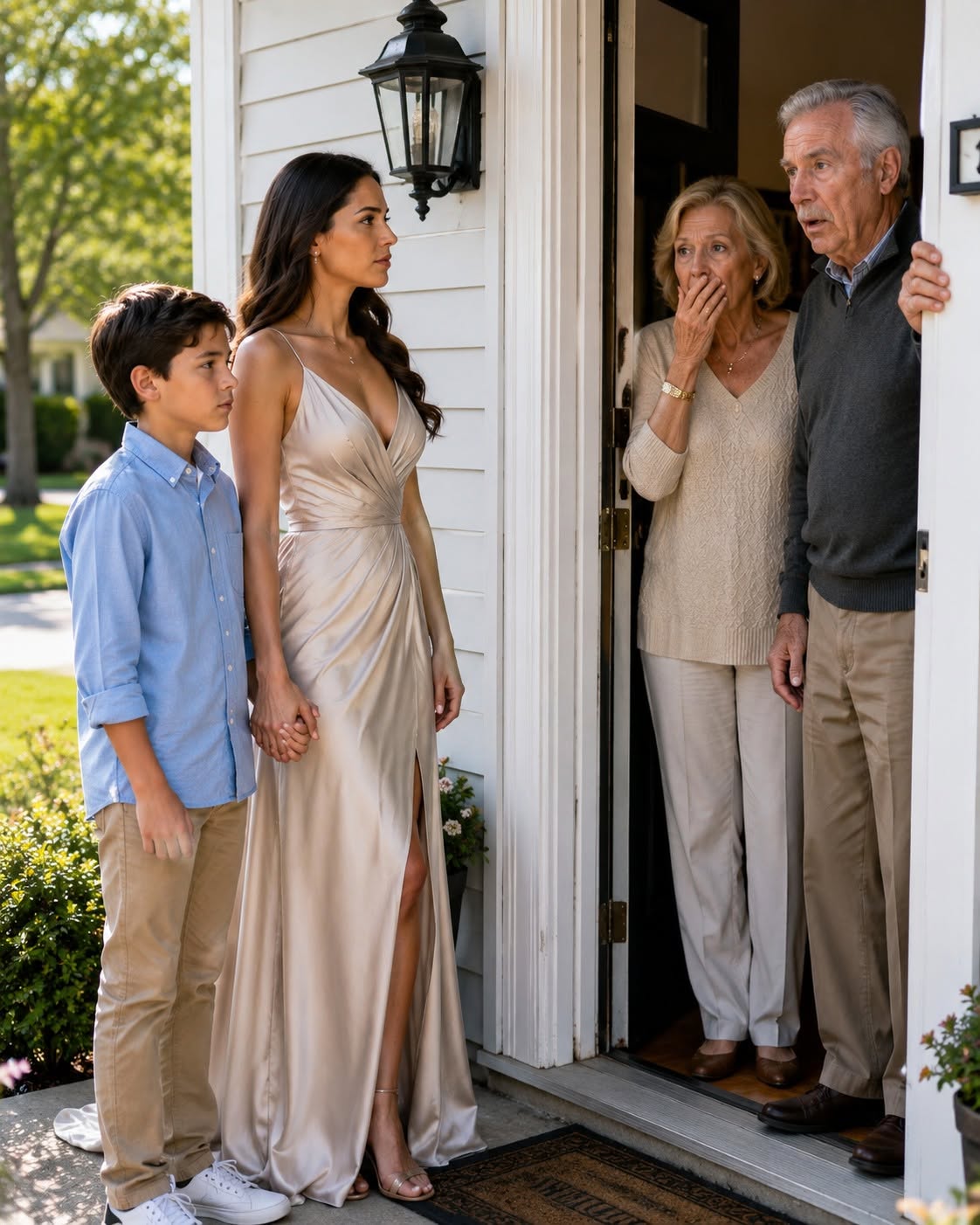
Frank stepped back as if the drive were burning.
“Don’t plug that in.”
“Why?”
He didn’t answer.
But Hannah saw something in his eyes.
It wasn’t anger.
It was fear.
“Dad, I spent ten years believing you hated me because I got pregnant. I thought you chose your pride over your daughter. But now I can see there’s something you know.”
Frank sank into a chair.
“I don’t know if I know it… or if they made me forget it.”
Diane shivered.
“What are you talking about?”
Frank buried his face in his hands.
He explained that ten years earlier, the Silver Creek Chemical Plant had been accused by workers of dumping waste into the river.
Several people in town had gotten sick.
Children with skin conditions.
Women losing pregnancies.
Elderly people with cancer.
But no one filed a real report.
The owner, Victor Hayes, paid off doctors, attorneys, police officers, and political campaigns.
“Caleb started asking questions,” Frank said. “He checked reports, collected samples, recorded conversations. One night, he came to me. He said he needed help.”
Hannah tightened her fingers around the USB drive.
“And did you help him?”
Frank started to cry.
“I think I did.”
The words cracked the room open.
Owen watched in silence, his fists clenched.
“What do you mean, you think?” Hannah asked.
Frank struggled for air.
He said he remembered seeing Caleb that night.
He remembered a folder.
Some maps.
A strong chemical smell.
After that, nothing.
He only remembered waking up inside his pickup on a dirt road, mud on his shoes and dried blood on his sleeve.
“Whose blood?” Diane whispered.
Frank lowered his eyes.
“It wasn’t mine.”
Hannah went cold.
“Did you kill him?”
Frank lifted his head, devastated.
“I don’t know.”
Diane let out a broken sob.
Owen moved closer to Hannah.
At that moment, the landline rang.
All four of them turned toward it.
Nobody used that phone anymore.
It rang again.
Frank slowly stood.
“Don’t answer it,” Hannah ordered.
But he picked it up.
His face changed within seconds.
The voice on the other end was male, calm, and old.
Frank barely managed to speak.
“How did you know she was here?”
Then he listened.
And hung up.
“What did they say?” Hannah asked.
Frank looked at Owen.
“They said Caleb should have stayed buried.”
Diane screamed.
Hannah grabbed Owen’s backpack.
“We’re leaving.”
“Where?” Frank asked.
“To someone who doesn’t owe Hayes any favors.”
They left in a light rain.
Hannah drove to Syracuse, where Rebecca Lane, her college friend and an independent journalist, lived.
Rebecca already knew part of the story.
In fact, she was the one who had warned Hannah not to hand the USB drive to just any police officer.
“In this country, honey, there are good cops, and then there are cops who belong to somebody,” she had told her.
When they arrived, Rebecca opened the door with her laptop already on.
“I copied your files,” she said. “But there’s one folder I couldn’t open.”
Frank looked at the screen.
The folder was labeled: LIGHTOFPORT.
His face went pale.
“That name…”
Rebecca looked at him.
“Does it mean something to you?”
Frank moved closer as if pulled by a memory.
“It was an old warehouse near the bus terminal. We used to store things there when we worked double shifts.”
Hannah felt the truth coming toward them like a storm.
That same night, the three of them went: Rebecca, Hannah, and Frank.
Diane stayed with Owen, though he begged to go.
“This is my story too,” the boy said.
Hannah touched his hair.
“That’s exactly why I’m coming back alive to tell it to you.”
The old terminal was nearly abandoned.
A security guard who recognized Frank let them in after hearing two sentences and seeing Caleb’s photograph.
“I never thought this would come out,” the man muttered.
Inside a warehouse with rusted doors, they found locker 214.
Frank cut the lock with pliers.
Inside was a cardboard box.
Old newspapers.
A yellow hard hat.
A handkerchief stained with dark marks.
And beneath a false bottom, another USB drive.
Black.
Unmarked.
Rebecca picked it up with gloves.
But before they could leave, a voice stopped them.
“What a touching family reunion.”
Victor Hayes stood at the end of the corridor.
Older now, elegant, wearing a black coat and the smile of a politician.
Two men stood beside him.