
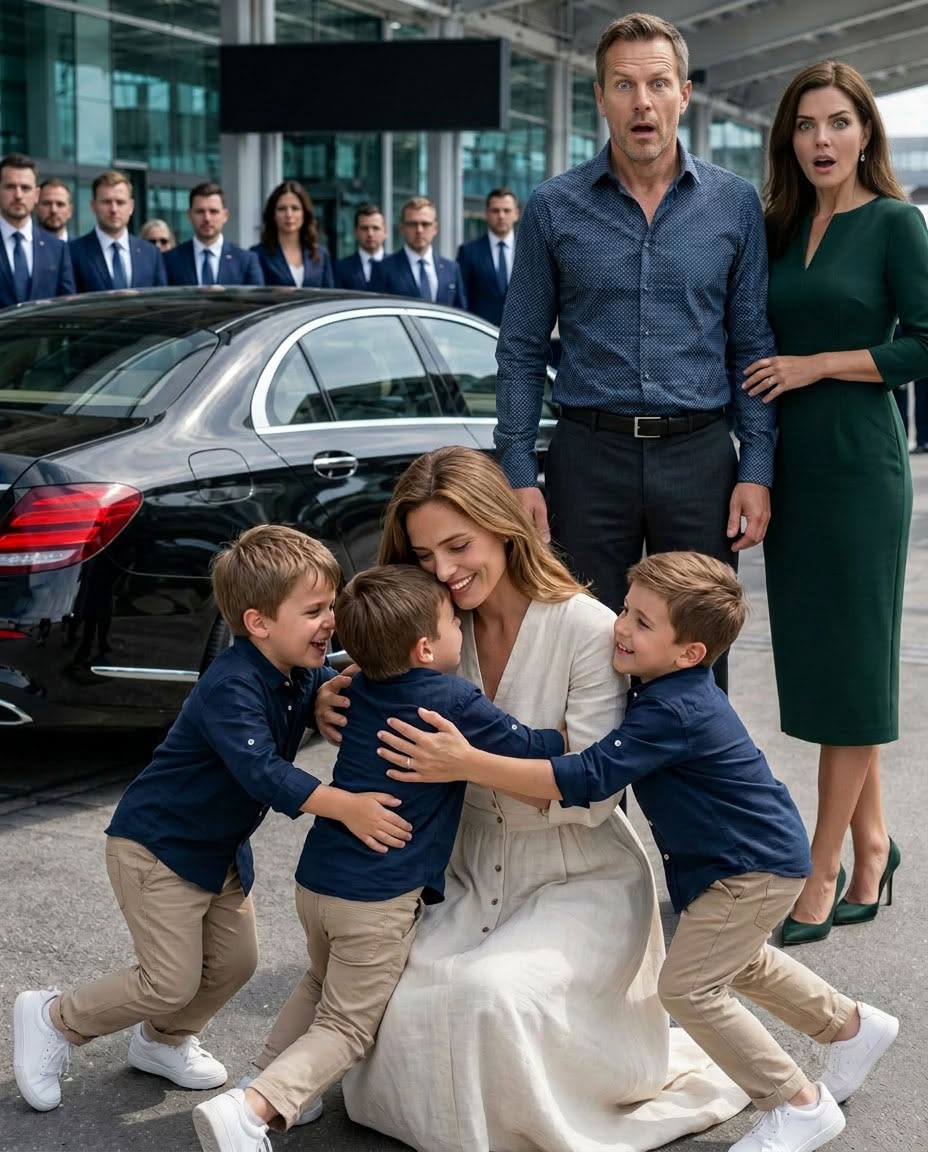
Back home in Schwabing, the boys were quiet. Their cozy brick townhouse—chaotically filled with drawings, socks, toys, and the scent of breakfast—was a far cry from Ben’s penthouse. But it was theirs. Finally, Elias blurted out, “Is that man really our dad?” “Yes,” Emma said. “Why didn’t he come to our birthdays?” Emma sat down with them. “When I found out I was pregnant, I tried to tell him. But the people around him kept me away from him. He didn’t know.” “Was he mean to you?” Oskar asked. Emma chose her words carefully. “He hurt my feelings deeply a long time ago.” “Did you hurt his, too?” She looked down at the floor. “Maybe.” “Are we going to live with him now?” Elias asked. “No. This is your home.” Then her phone rang; the caller ID was blocked. Ben. “I need to see them,” he said. “No.” “They’re my children.” “They’re five-year-old boys who learned the truth at an airport because you couldn’t control yourself.” “I know. I’m sorry.” Once, that apology would have meant everything. Now, it felt too insignificant. “They need time,” Emma said. “I’m not asking to take them with me. I just want to understand.” Finally, she agreed to meet him in a public park the next day. One hour. No lawyers. No security. No Martina. “Martina doesn’t work for me anymore,” Ben said coolly. Emma froze. He had checked the archived security logs. Emma really had been in his office five years ago. She had stayed for seventeen minutes before security guards removed her on Martina’s orders. Her calls had been rerouted. Her emails filtered. Her letters destroyed. “I told you,” Emma whispered. “I know,” Ben said, and those two words weighed more heavily than any apology. Then he asked about Daniel Reimann—the man he had believed to be Emma’s lover. “He wasn’t my lover,” Emma said. “He was a human geneticist.” Her mother’s neurological condition could have been hereditary. Emma had undergone testing before they tried to have children. The messages Ben had found concerned clinic appointments and results. “You never let me finish,” she said. He had seen phrases like “I can’t tell Ben yet” and suspected betrayal. But the truth was fear. Emma had been afraid that she might carry a dangerous genetic trait. “The results were negative,” she told him. “I wanted to tell you that night. I had bought baby shoes. The blue box on the table.” Ben whispered, “I threw them away.” “I know.”
The next day, Ben arrived at the park without an entourage, wearing a dark blue sweater and holding three small bags from a toy store. He looked nervous. Elias approached first. “What’s in the bags?” “Books,” Ben said. “And an apology.” Oskar narrowed his eyes. “Do you even know how to apologize?” “I’m learning.” Ben carefully crouched down, giving them space. “I’m Ben,” he said. “I know you found out something big yesterday. I’m sorry it happened the way it did. I didn’t know about you, but I should have listened to your mom.” Oskar studied him. “Are you our dad?” “Yes.” “Do you want to be?” Ben’s voice cracked. “More than I can explain.” Noah whispered, “Are you going to make Mom cry again?” Ben looked at Emma, then back at him. “No. Not on purpose.” Over the next hour, the boys peppered him with questions, displaying their trademark blunt honesty. Did he have stairs? Did he eat cereal? Could he make pancakes? He listened to every question as if it were more important than any business deal of his life. Eventually, Noah sat down next to him. Elias talked loudly about dinosaurs. Oskar remained cautious, watching everything. When the hour was up, Ben didn’t argue. “Thank you for letting me meet you,” he told the boys. Elias said, “You can come back if Mom says it’s okay.” Noah whispered, “Bye.” That single word nearly broke his heart.
Before Emma left, Ben handed her a folded document. “I dug up this year’s records,” he said. “Martina didn’t act alone.” Emma read the paper. Payment authorization approved: Karl Winter. Her father. Ben’s voice was grim. “Your father paid Martina three hundred thousand euros after she stopped you from seeing me.” Emma went cold. Her father had helped her after the divorce. He had bought her townhouse through a trust. Arranged for doctors. Protected her during her pregnancy. Or so she had believed. Then her phone vibrated. Dad: Don’t trust Ben. He knows less than he thinks. Another message arrived with a photo. Martina was standing with Emma’s father outside a private clinic. Beside them was Daniel Reimann. The human geneticist everyone thought had died four years ago. Yet the photo was dated three weeks ago. Daniel was alive. Emma looked up at Ben. “Daniel isn’t dead,” she whispered. “And my father knows where he is.” Across the park, her boys were laughing innocently. But beneath her feet, the past had opened up. And this time, it wasn’t a simple misunderstanding.