
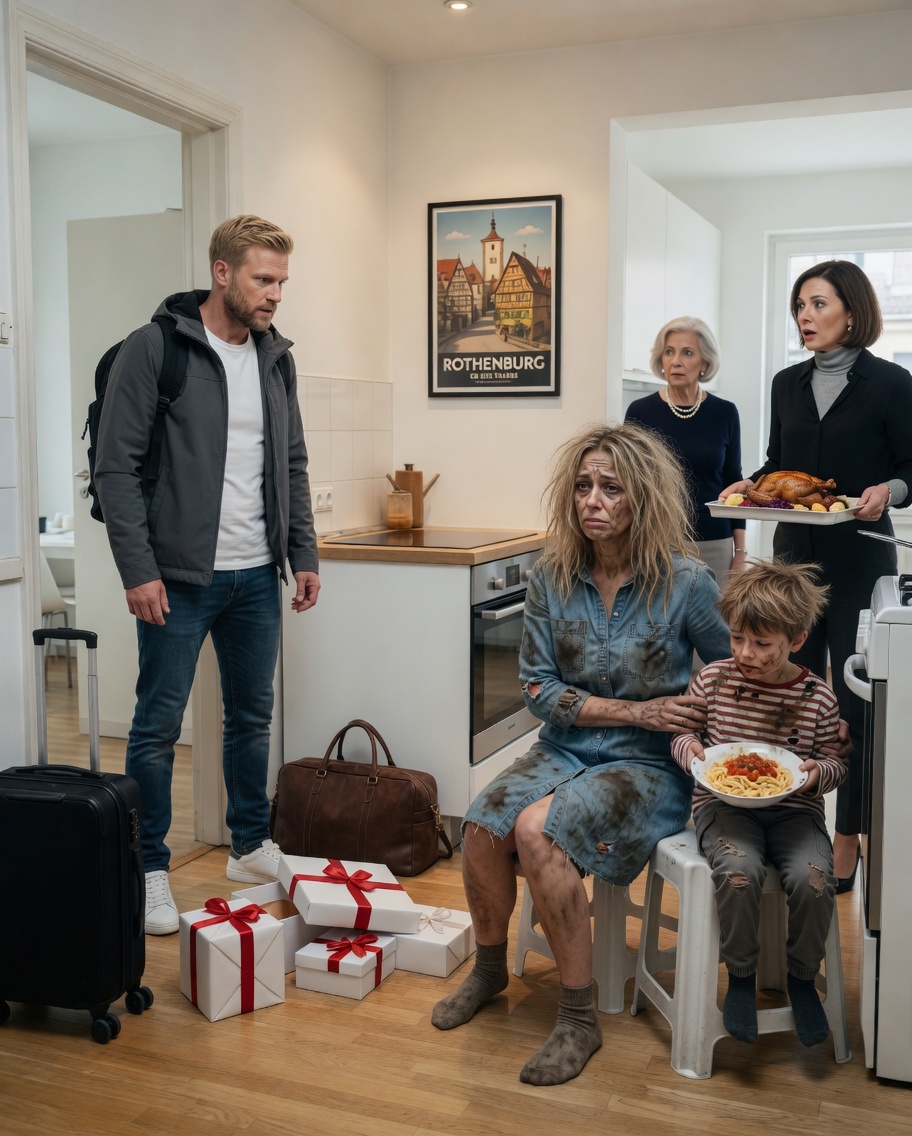
“Did you have a phone?” you ask Lena. She looks down. “I did at first.” Your breath catches in your throat. “What happened to it?” Your mother answers before she can. “She lost it.” Lena closes her eyes. Verena murmurs, “Or sold it, knowing her.”
You place both hands on the table. “Lena.” She looks up again, and whatever she sees in your face this time gives her something that has clearly been denied her for years: permission.
“Your mother took it,” she says. “She said too many calls to Saudi Arabia were distracting you and costing you too much. Then she said the bank transfers had become smaller because you were in debt. She said money was tight and I should learn to be grateful that Lukas and I were allowed to stay in the house.”
Each word peels away another layer from the facade of the room. One of the older guests—Verena’s fiancé’s mother—slowly puts down her fork and dabs her mouth with a napkin, not because she has to, but because some people physically need a task while the horror reorders their opinions of everyone present. Erik hasn’t moved. His face is bloodless.
You ask, “How long did you and Lukas sleep outside?” Lena swallows. “Almost four years.”
No one breathes. Your mother’s pearls gleam around her neck as she stands in the middle of your dining room, looking like a wealthy widow from a magazine. Four years. For four years, your wife and child lived behind your house while you toiled under the desert sun, believing every lie your own flesh and blood whispered in your ear.
Verena snaps, because that’s what spoiled people do when the silence ceases to protect them. “We gave them a roof over their heads!” she says. “If she’d wanted more, she could have acted like part of the family.”
You turn fully to face her. “What did she do to disqualify my son from eating?”
Verena actually recoils. Because there it is, finally in the bright light. No vague tension. No conflicting personalities. Hunger. A child. Deliberate deprivation in a house where imported cheese sweats on crystal trays.
“She was ungrateful,” your mother says, jumping in where Verena hesitates. “Always questioning everything. Always acting like it was her money. And the boy was wild. Broke things. Ran around the rooms when we had guests—”
“He’s six,” you say. “Exactly!” she snaps. “Old enough to learn.”
You stare at her. Then at Verena. Then, as the guests gather, they gradually realize that they dined beneath chandeliers paid for with your labor, while your relatives have turned your absence into a hierarchy and your son into a pawn. Public shame feels different when it has witnesses in good shoes. No one is staring at their phone anymore.
Erik finally speaks. “You told me the house was yours,” he says to Verena. Her head snaps around to him. “I said it was family property!” “You say you manage it.” Verena’s voice sharpens. “Well, I do manage it. Someone had to.”
Lena makes a tiny noise, the kind of sigh people make when an old humiliation is publicly confirmed. You lightly place a hand on her chair. She flinches at first, then recovers. It almost kills you.
You take out your phone. Your mother’s eyes immediately narrow. “What are you doing?” “I’m undoing five years.”
You log into the bank account you’ve used for every transfer. Your mother had the bank card, but not the login details. She never thought to ask for them because people like her can’t imagine that the lender might one day want to check the history. The transaction history fills the screen. 8,000 euros every month. For five years.
Your thumb moves. Then the linked cards of the authorized representatives appear. One in your mother’s name. One in Verena’s. You revoke their authorization. The process takes six seconds.
At the table, Verena’s phone vibrates next to her wine glass. Then your mother’s. Verena grabs it and turns pale. Card blocked. Your mother checks her phone more slowly, then again, as if a second reading could change the universe.
You continue. You call the bank’s international fraud hotline, identify yourself, and report the suspected embezzlement of household funds by the authorized representatives. You request a review of the last sixty months, a freeze on all outgoing transfers over €500, and note that the primary beneficiaries—your wife and minor child—have been denied access. Your voice is flat and clear. Years of negotiations, heated discussions, contracts, and superiors have taught you how to speak when anger could kill a man.
When you hang up, the room is deathly silent. Verena’s mouth falls open. “You can’t do that!” You look at her. “I just did.”
Your mother straightens up, trying to regain the composure that, for years, had been considered power here. “The money was family money.” “No,” you say. “It was for my wife and son.” Her face hardens. “We ran this house with dignity. We kept your name alive. We entertained people who could help us. We maintained appearances.”
There it is. The true religion. Not care. Appearances. They fed your wife shame and your son leftovers so that the front rooms remained perfect for guests whose names made your mother feel important.
You take a deep breath and walk over to the built-in wardrobe by the study. The hidden safe is behind the bottom shelf, exactly where you left it. You enter the code. The lock clicks. Inside are passports, original deeds, and the family trust folder your lawyer had foisted on you back then. You take out the blue folder and return to the table.
Verena laughs too loudly. “What’s that supposed to prove?” You put the papers down and turn to Erik instead. “This house isn’t in my mother’s name. Nor is it in Verena’s. I bought it through the Müller family trust. The trust names my wife, Lena Müller, as co-trustee and primary beneficiary. If something had happened to me abroad, full control would have passed to her, then to our son.”
Lena’s head jerks so fast you can hear her breath. She’d never known. And that knowledge hurts almost as much as anything else tonight. You wanted to protect her from the paperwork, and by keeping the legal structures invisible, you gave your mother the space to build her own kingdom on top of them. Good intentions are useless if they don’t guard the door.
Erik’s eyes are glued to the papers. “So neither of you owns this house?” “No,” you say.
Your mother makes one last desperate attempt. “That doesn’t mean anything. Families share.” You slide the last page across the table. The clause about occupancy rights is highlighted in yellow. Anyone other than the named beneficiaries living in the property without written permission can be removed immediately. “You have one hour to pack.”
She laughs incredulously. “You’d put your own mother out on the street in the middle of the night?” You glance toward the back kitchen, at the cracked stool and the damp nest where your family had to live. “You kicked my family out four years ago,” you say. “I’m just changing the address.”
No one speaks again. Then Erik stands up. He takes the box containing the engagement ring from his pocket, carefully places it on the table in front of Verena, and says, “You let a child eat garbage while you wore diamonds bought with his father’s money. Don’t ever call me again.”
Verena turns white. For the first time, her outrage erupts into something more honest. Not remorse. Loss. Social, financial, romantic loss—the only language she understands. She lunges at him. “Erik, wait—!” He backs away. His mother also stands up, her face contorted with disgust, and the rest of her side follows like a wave of silk and chairs. One by one, the guests leave the house.
Your mother watches the room empty and finally grasps the magnitude of the situation. The house she treated like a stage has become the place where her audience turned against her. She sits down very slowly. “You can’t do this,” she says again, but the words have lost their power.
You call the housing complex’s security service. Then your lawyer. And then, because there’s injustice that goes beyond money, you call Child Protective Services and ask what documents they need for long-term neglect and deprivation of basic needs of a minor in the care of relatives. You’re precise. Dates. Transfers. Living conditions. Communication restrictions. When you hang up, your mother is crying, and Verena is trembling with a rage she can’t channel anywhere to save herself.
Lena hasn’t moved. Lukas leans against her shoulder, half asleep, full for the first time in who knows how long, because one of the shocked waiters quietly placed a plate of warm chicken and mashed potatoes in front of him. He ate without asking permission.
You kneel beside Lena’s chair. “I’m sorry,” you say. It’s not enough. “I should have listened to my gut,” you say. “I should never have let them come between us.” Lena studies your face for a long time. Then she nods once. There’s no forgiveness yet, only exhaustion. “Lukas kept asking if you’d forgotten about us,” she says quietly. The sentence cuts deep.
It takes forty-two minutes until they’re outside. Your mother moves slowly, hoping that delay will somehow restore power. Verena tries to grab handbags, silverware, and small bronze sculptures until the security guard asks her if she also wants to file a theft report tonight. In the end, they leave with two rolling suitcases and their true faces revealed.
At the door, your mother turns around one last time. “You’ll regret humiliating me like this.” You stand in the hall and say, “I regret sending you money while my son learned not to ask for food.”
As the door clicks shut behind them, the sound of the house changes instantly. The silence is no longer tense. It’s simply a house again. Lukas breathes softly in his sleep.
“We’re not sleeping in this room tonight,” you say gently to Lena. “Or back there. Wherever you want. A hotel, another house, it doesn’t matter.” “Can we stay here?” she asks, almost whispering. “Just… not in this room yet.” “Yes,” you say. “Anywhere here.”
You don’t touch the master bedroom on the first night. You make Lukas a bed in the study because he refuses to sleep alone. Lena showers for almost an hour in the guest suite. You order food—a burger for you, soup for Lena, pancakes for Lukas because he says it’s “celebration food.”
At two in the morning, you sit alone in the office, opening five years’ worth of bank statements. Designer boutiques. Luxury resorts. Lease payments for Verena’s Mercedes. Jewelry. “Wellness weekends.” And in between, like clockwork, your money transfers from Saudi Arabia. By dawn, your lawyer has all the documents. By noon, your mother and Verena’s access to every account, every card, and every contract has been revoked.
The next few weeks are brutal in a quieter way. For a while, Lukas hides food in his room. Bread rolls in drawers. Apples under the bed. When you find a piece of chicken under his pillow for the first time, you sit on the floor crying after he’s fallen asleep.
Lena jumps at footsteps. She apologizes for things that aren’t mistakes. You don’t ask her for forgiveness. You cook. You clean. You sit with Lukas while he eats. You go to the bank with Lena and open accounts in her name.
Three months later, your mother tries to call. Then Verena. Verena sends a spiteful email and threatens legal action for “joint family property.” Your lawyer responds with a twelve-page letter announcing a civil lawsuit for the return of embezzled funds. Then there’s silence.
What finally ends it is the police report. The investigation documents the living conditions in the back kitchen and the financial coercion. There’s no dramatic arrest with handcuffs, but the consequences are harsh: bank account seizures, demands for repayment, lawyers who stop smiling.
A year later, the house feels different. Lukas runs across the marble floors without flinching when he laughs. Lena has replanted the garden with herbs and white roses.
On the anniversary of your return, Lukas asks if you’ll ever go back to Saudi Arabia. You watch him sitting at the kitchen counter, milk at the corner of his mouth, the sun warming the room. Lena stands at the stove, humming to herself. “No,” you say. “Promise?” You stroke his hair. “I promise.”
That evening, you’re sitting on the terrace with Lena. “When you came into the kitchen that day,” she says after a while, “I thought I was dreaming.” “Me too,” you admit. She turns to you. “Who did you look at first?” You know what she’s really asking. Not about the direction of your gaze, but about loyalty. The moment five years of deception were exposed, you had to decide whether the blood of your heritage still stood above the woman and child they had broken in your absence. “You,” you say. “And then Lukas.”
A long silence follows. Then Lena nods once, and a sense of peace dissipates between you. Because at least this answer came in time. And sometimes a family begins anew right there—not in the moment it’s attacked, but in the moment someone finally chooses the right people first.