
The news spread faster than I had expected. Four days later, Tobias was pounding on my apartment door. “Open up, Jona. I know you’re in there.” I opened the door. He pushed past me, a wild look in his eyes, his jacket only half-buttoned. “Where’s the key?” “It doesn’t belong to you.” “She was my mother. Not yours. Mine.” “And where were you then?” I asked calmly. Tobias paused. For a second, his expression faltered—that same brief spark I’d noticed in the café when he said he couldn’t bear to see his mother like that. Then his face hardened again. “You manipulated a sick, elderly woman. I have lawyers, Jona. Real lawyers. You’ll be lucky if you get to keep your delivery van.” “I didn’t manipulate anyone. She knew.” “Knew what?” “That I wasn’t you. The whole time.” He let out a short, ugly laugh. “Tell that to a judge. Let’s see how it sounds coming from the man I paid five hundred euros a week.” He slammed the door behind him so hard that a picture fell off the wall.
The legal documents arrived within a week. Tobias’s lawyer was contesting the bequest and accusing me of undue influence. Then came calls from relatives I’d never met, berating me as a fraud, a con artist, and a vulture. That night, I sat on my mother’s sofa with the papers spread out on the coffee table, on the verge of giving up. “What will you do, my boy?” she asked. “I don’t know, Mom. He has money. I have nothing.” “You have the truth.”
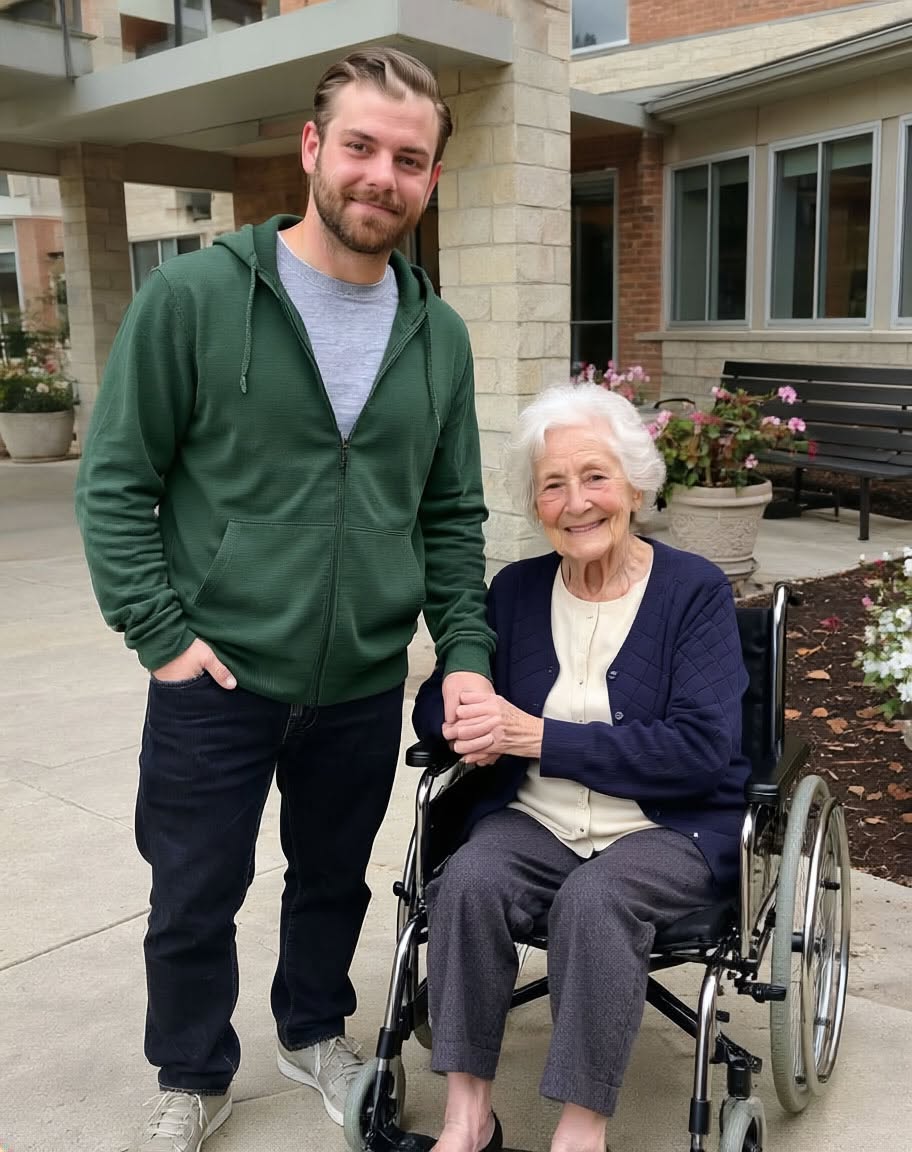
The next morning, I drove to the nursing home. Margarete sat in the conservatory, knitting something blue and uneven. “Jona,” she said, patting the chair beside her. “I’d been wondering when you’d come.” “He’s suing me, Margarete. Tobias. He says I tricked her.” She put down her knitting. “During her last week, Rosa told me about you every day. She called you the boy who decided to stay. Those were her words.” “Would you say that in court?” I asked. “I say it wherever anyone will let me.”
That same evening, I called a legal aid lawyer named Daniela—an exhausted woman who still answered her phone at nine o’clock at night. I gathered everything I could: visitor logs, receipts for flowers and chocolates, and statements from three female caregivers and one male caregiver. Daniela went through it all at her kitchen table. “Jona, I’ll take the case. But I need you to be ready. They’re going to paint you as a predator on the witness stand. They’ll bring up the money. Every single euro.” “I know.” “And tomorrow, you’re going to get a settlement offer. I can feel it.” It arrived by noon. Tobias’s lawyer sent a single line via email: “Back down now, or we’ll take everything you have and everything you’ll ever have.” I read it twice. Then I closed my laptop and thought of Rosa’s hand closing around mine.
The probate courtroom was smaller than I had imagined. Tobias sat in a sharp suit on the other side of the aisle while his lawyer whispered in his ear. When Tobias took the stand, his voice trembled with well-rehearsed grief. “He took advantage of my mother. He saw a sick woman and enriched himself at her expense.” My lawyer rose slowly and handed a folder to the judge. “Your Honor, these are bank records showing weekly transfers of 500 euros from Mr. Tobias to my client over a period of several months. We have also submitted text messages confirming that my client was hired to visit Mr. Tobias’s mother and pose as him.” For the first time that morning, Tobias looked cornered. Daniela turned toward him. “Mr. Tobias, do you deny these payments?” Tobias stared at the papers for a few seconds. “No.” “And when was the last time you visited her yourself?” The silence dragged on so long that the judge looked up from her notes. “I couldn’t,” Tobias said finally. “She didn’t look like my mother anymore.” For a brief moment, he was no longer a man in an expensive suit. He was a son who had run away from the wrong kind of pain and paid someone else to bear it.
Margarete testified after him—small in the witness box, yet unwavering. “Rosa told me in no uncertain terms that Jona was the boy who had decided to stay. She knew exactly who he was.”
When my turn came to speak, I didn’t try to hide behind a lie. “I took the money,” I admitted. “I needed it for my mother’s medication. But I kept coming back. I couldn’t leave her alone the way her own son had.”
The judge read Rosa’s letter in silence, then looked up. “The bequest stands.”
At the bank, I slid the key into the safe-deposit box. Inside were savings certificates, neat stacks of cash, and a photograph of a young woman holding a baby. My vision blurred. I read her final line again: “Use half for my friends. They have no one, either.”
A week later, I sat across from the care home director. “Half goes to the residents,” I said. “Outings, better food. Whatever Margarete tells you they need.” She nodded and smiled gently.
That month, I paid off my mother’s medical bills. For the first time in years, I slept without counting money. Every Saturday, I drove back to the home. Margarete always kept a spot by the window open for me—in Rosa’s old chair. One afternoon, I brought a small bouquet of tulips and placed it on the seat of that chair. Margarete watched in silence, her knitting needles resting quietly in her lap. “She taught me how to stay,” I said. Margarete gave a brief nod, and the sunlight slowly moved across the petals.