
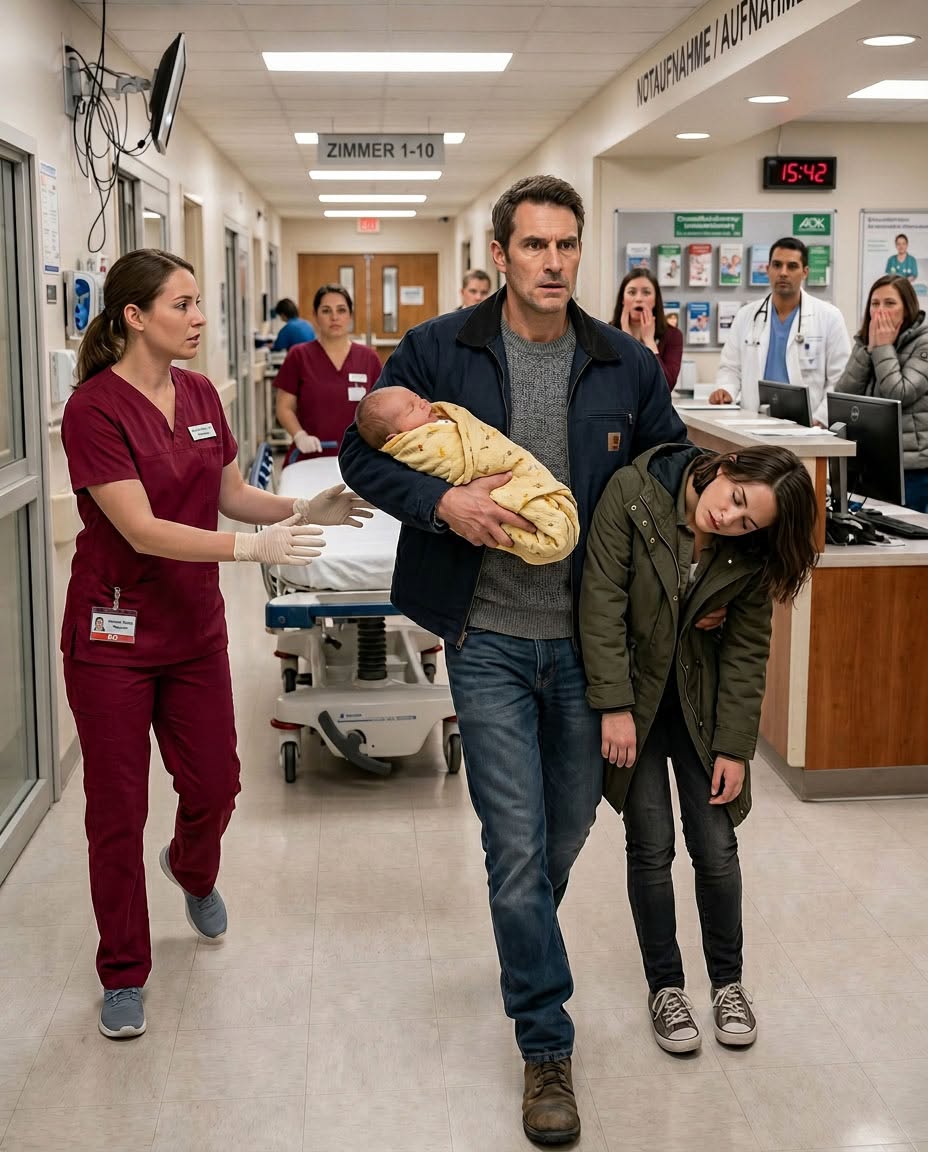
A nurse asked me for Emily’s discharge papers. I remembered the folder on the kitchen counter. Then I recalled seeing papers in the diaper bag when I’d grabbed it by the bedroom door. My hands were shaking so badly that Mr. Becker had to help me open it. Inside were diapers, wipes, a half-empty pack of tissues, and the folded instructions from the hospital. The nurse took the papers, smoothed them out on the counter, and pointed to the section listing warning signs.
Call immediately in the event of fever, fainting, severe weakness, refusal to eat, or signs of infection.
My mother stared at the page. For the first time that morning, she had no answer ready.
The police arrived while Emily was still lying behind the curtain and Noah was being examined in the pediatric unit. Two officers entered the ER, calm and alert. One spoke to the doctor. One spoke to me. He asked for names. Times. Who had been in the house. When I had driven. When I had last spoken to Emily. When I had first heard Noah cry. The questions were simple, but every answer felt like a blade. I handed them my phone. I showed them the call logs. Screenshots. Messages. The officer looked at the missed calls from that night and Ashley’s message from 2:03 a.m.
Everyone’s asleep. Stop worrying.
He made a note of it.
Ashley saw him writing. Her breathing changed. Then her phone buzzed. It was such a tiny sound. A brief vibration against a plastic case. But she looked down, and her face went chalk-white. The officer noticed. So did I. “What is that?” I asked.
“Nothing,” she said far too quickly.
My mother snapped at her, “Ashley.”
That single word told me everything. The officer asked Ashley to keep the phone visible. She began to weep more intensely. Not because of Emily. Not because of Noah. But because the phone had become a witness.
Later, I learned what was on it. Messages between my mother and my sister. Not just a single message. No misunderstanding. A pattern.
Emily asked for water. Ashley complained that Noah wouldn’t stop crying. My mother wrote: Let him cry. She wanted to be a mother, after all.
Emily asked for food. My mother wrote: Don’t coddle her. She needs to learn.
Ashley asked if she should call me. My mother replied: No. Otherwise, he’ll come running right away and blame us.
The worst one was from the night before. Ashley wrote: She looks really bad. My mother replied: She’s just putting on an act. Leave her be.
I’ve heard people say that anger is hot. Mine wasn’t. Mine was cold and clear. It flowed through me like ice-cold winter water. I wanted to scream. I wanted to smash something. Instead, I stood in that hospital hallway, my fists clenched so tightly that my nails dug into my palms—because my wife and son needed me, and I had to be of more use to them than my anger.
The doctor returned a short while later. She offered no words of comfort. Doctors learn not to do that while the truth is still unfolding. She told me Emily was severely dehydrated and fighting an infection. She told me Noah’s fever was life-threatening for a newborn and that they were doing everything humanly possible. She said that I had brought them in on time, and that mattered. I heard those words but couldn’t accept them as a mercy. Because I hadn’t brought them in soon enough. I had left.
Mr. Becker stayed by my side. At some point, he disappeared. I thought he had gone home. Then he returned with a paper grocery bag. With the officer’s permission, he had gone back to our house to fetch whatever the hospital might need from the bedroom and the diaper bag area. Inside the bag were things I still see whenever I close my eyes.
An unopened package of baby formula. Emily’s prescribed painkillers. A bottle of water with the seal still intact. The hospital discharge form, with the warning section circled in blue ballpoint pen. My handwriting. I had circled it before I left so that my mother and sister couldn’t possibly miss it.
Call immediately.
They had seen it. They had ignored it.
My mother looked at the paper, and something in her face finally shattered. Not guilt. Exposure. There is a difference. Guilt looks at the person who was wronged. Exposure looks at the door. She looked toward the exit. The officer didn’t miss that, either.
“Ma’am,” he said, “please stay where you are.”
Ashley sank heavily onto one of the plastic chairs in the waiting room. Her knees seemed to give way. She held both hands over her mouth, and for once, there was no smart remark. No joke about how babies just cry. No accusation that Emily just wanted attention. Only the ugly silence that remains when lies run out of room.
I asked to see my wife. The nurse said they were still working on her. I asked to see Noah. She said Pediatrics would let me know soon. I stood there, with nothing in my arms. It was the greatest sense of emptiness I had ever felt. I had been a father for a week. For four days, I had trusted the wrong people. In a single morning, I had learned how quickly a family history can turn into a police file.
My mother tried one last time.
“Elias,” she whispered, “you know I love you.”
Then the doctor came back out. She had pulled her mask down. Her face looked tired. She said my name. Even before the first word was spoken, I knew that the next sentence would determine whether I could stay on my feet.
“Mr. Müller,” she said.
I gripped the edge of the reception desk. Behind me, my mother whispered, “Please, God.” For the first time that morning, I didn’t know whether she meant Emily and Noah. Or herself. The doctor looked me straight in the eye and opened her mouth to tell me what was coming next.