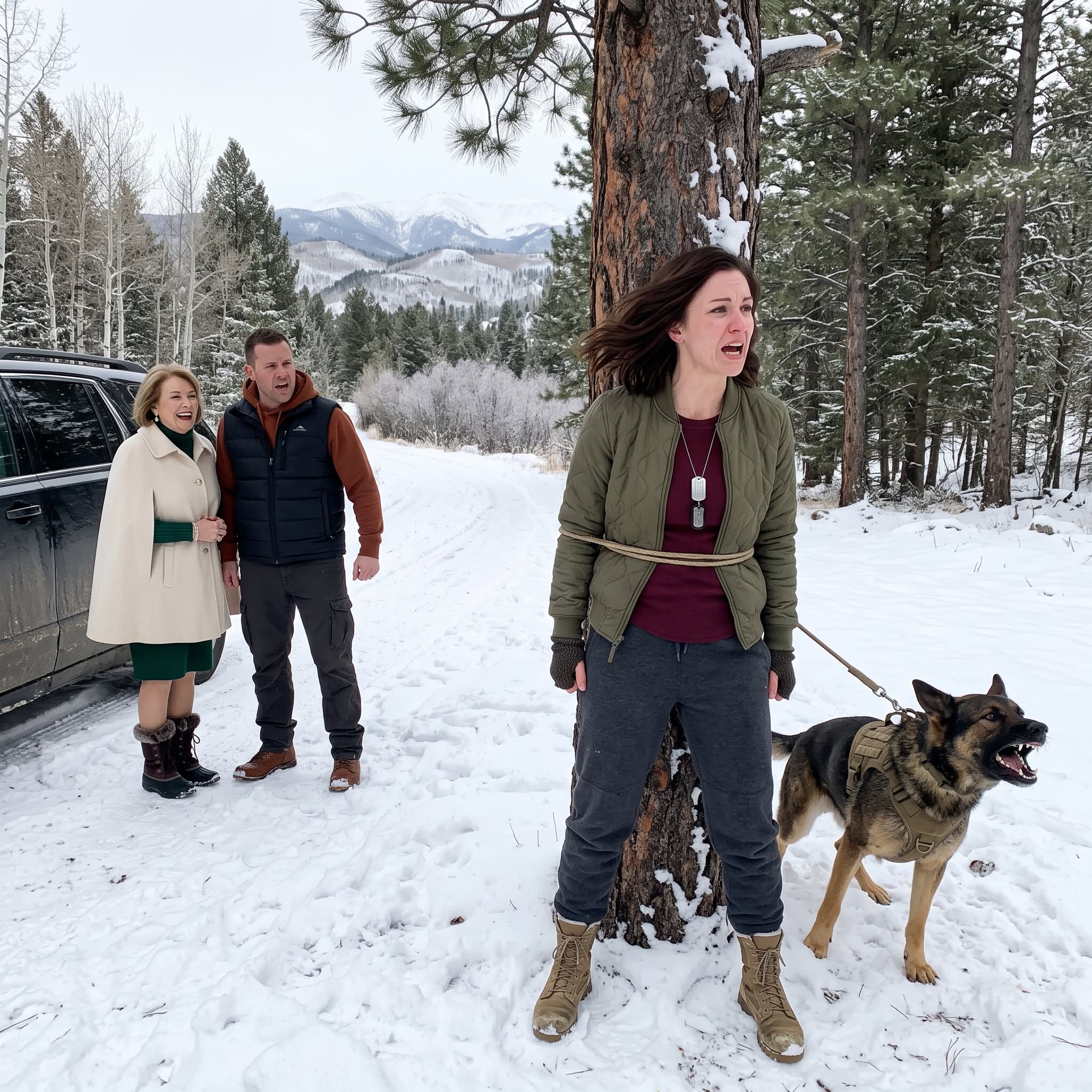
For a moment, I thought Evan might run. Instead, he switched tactics again. He looked wounded.
“Mara,” he said softly, “tell him you’re confused. You know how sick you are. You know you’ve been hallucinating.”
His voice had soothed me once. Years ago, before the convoy explosion, before my cane, before the nights when Ranger slept against the bedroom door because he did not trust the man on the other side of the bed.
I lifted my head. “You left me to die.”
His face emptied.
The sheriff’s SUV arrived first, tires grinding through snow. Deputy Alicia Brandt stepped out with one hand near her sidearm. An ambulance followed close behind. The scene became movement and lights: red, blue, white, the hiss of radios, boots punching into drifts.
Deputy Brandt separated everyone fast.
Caleb told her what he had found. The paramedics wrapped me in heated blankets and checked my pulse. One of them tried to move Ranger away, but he showed his teeth until I touched his collar.
“Easy,” I whispered. “They’re friends.”
Only then did he allow it.
A younger deputy walked toward the pine with a flashlight. He returned carrying the tow strap and Ranger’s chewed leash. He held them up without speaking.
Lorraine began crying when she saw the evidence bag.
Not sad crying. Angry crying.
“This is her fault,” she said. “She ruined his life. My son had nothing because of her.”
Evan turned on her. “Shut up.”
Deputy Brandt heard both of them.
By the time they loaded me into the ambulance, Evan was in handcuffs. Lorraine was in the back of the sheriff’s SUV, still talking, still trying to explain how a dying woman had somehow staged her own murder in a blizzard.
Ranger jumped into the ambulance before anyone could stop him.
The paramedic looked at me. “Is he medical equipment?”
I closed my eyes. “He’s better.”
At the hospital, they treated frostbite on two fingers, exposure, dehydration, and shock. My blood pressure crashed once before dawn. I woke to machines beeping and Ranger asleep beside the bed, his muzzle resting on my blanket.
Deputy Brandt came the next afternoon.
She did not ask me to tell the story all at once. She asked small questions. Where had Evan turned? What had he said? Which knot had he tied first? Had Lorraine touched the strap? Had either of them believed Ranger could get loose?
I answered what I could.
The forestry road had a traffic camera near the entrance, installed after illegal dumping complaints. It caught Evan’s Tahoe going in, then leaving forty-two minutes later. It caught the Tahoe returning after Caleb’s emergency radio call went out over a channel Evan monitored on an old scanner app. The hospital discharge records showed I had not been medically cleared for a trip into the mountains. My wrists matched the strap. Lorraine’s glove fibers were found on the knot.
Most important of all, Evan’s phone betrayed him.
He had searched three things that morning:
How long can hypothermia take?
Can a disabled veteran’s spouse inherit VA back pay?
Colorado missing person waiting period spouse.
People imagine evil arrives shouting. Often, it comes organized.
Evan had packed blankets in the Tahoe, but only for himself and his mother. He had brought a thermos, a shovel, and my old field jacket, which he planned to leave deeper in the woods later to make it look like I had wandered. He had chosen the storm because he thought it would bury his mistakes.
He had not planned for Caleb Dunn’s route changing because of a fallen tree.
He had not planned for Ranger’s training.
And he had not planned for me to survive one more night.
The trial happened nine months later in Larimer County. By then I could walk short distances with a brace. My lungs still hurt in cold weather. Two fingertips on my right hand stayed numb. Ranger had arthritis in his hips, but he walked beside me into court with his head high.
Evan wore a navy suit and looked smaller than I remembered.
His attorney argued stress, caregiver fatigue, confusion, panic. He said Evan had made a terrible decision in a moment of emotional collapse.
The prosecutor played Caleb’s dash camera footage.
There I was on the screen, half-buried in snow, wrists torn, Ranger standing over me like a wall. There was Evan stepping from the Tahoe, not running to me, not crying, not shocked. Just angry that I was breathing.
The courtroom went silent.
Lorraine testified against him to reduce her own sentence. She said Evan had planned it. Evan shouted that she was lying. Then the prosecutor showed text messages between them.
Tonight works.
Doctor says she is almost gone anyway.
No one will question it.
The jury took less than four hours.
Evan was convicted of attempted first-degree murder, conspiracy, assault, and elder-risk exploitation charges related to funds he had moved from my accounts. Lorraine was convicted of conspiracy and accessory charges. Neither of them looked at me when the verdicts were read.
I did not feel victory.
I felt air moving in and out of my lungs.
That was enough.
A year later, I moved to a small house outside Bozeman, Montana, where the winters were honest and the neighbors minded their business in a kind way. Caleb Dunn visited once with his wife and two daughters. They brought Ranger a ridiculous red sweater that said HERO, and he tolerated it for exactly seventeen seconds.
I framed three things in my hallway.
My honorable discharge certificate.
Ranger’s military service photo.
A newspaper clipping with the headline: RETIRED K9 SAVES ARMY VETERAN ABANDONED IN STORM.
People liked that headline. It was simple. Clean.
The truth was rougher.
Ranger had not saved me because he was a hero in the way newspapers needed heroes. He saved me because, years earlier, in a war zone full of dust and noise, we had made a promise without words. I watched his back. He watched mine. The uniform came off, the medals went into drawers, the scars changed shape, but the promise remained.
On the second anniversary of that night, snow fell again.
I opened the back door and let Ranger step onto the porch. He was slower now. His muzzle had gone almost white. He sniffed the air, then looked back at me.
“You remember?” I asked.
He wagged his tail once.
I sat beside him with a blanket over my knees. The cold still frightened my body. Sometimes my hands trembled when snow gathered on pine branches. Sometimes I heard Evan’s voice in dreams, soft and reasonable, telling the world I was confused.
But every time I woke, Ranger was there.
Breathing.
Watching.
Staying.
The world had believed I was a dying woman that night. Evan had believed it. Lorraine had laughed at it. Even the doctor had warned me my body might not hold.
They were all nearly right.
Nearly.
But a soldier does not need to be strong every second. Sometimes she only needs one loyal witness, one more breath, one animal who refuses to accept the end of the mission.
Ranger pressed his head against my knee.
I put my hand between his ears and looked out at the falling snow.
This time, it did not feel like a grave.
It felt like proof.
Disclaimer: This story is a work of fiction created for entertainment purposes. Any resemblance to real persons, events, or places is coincidental.