
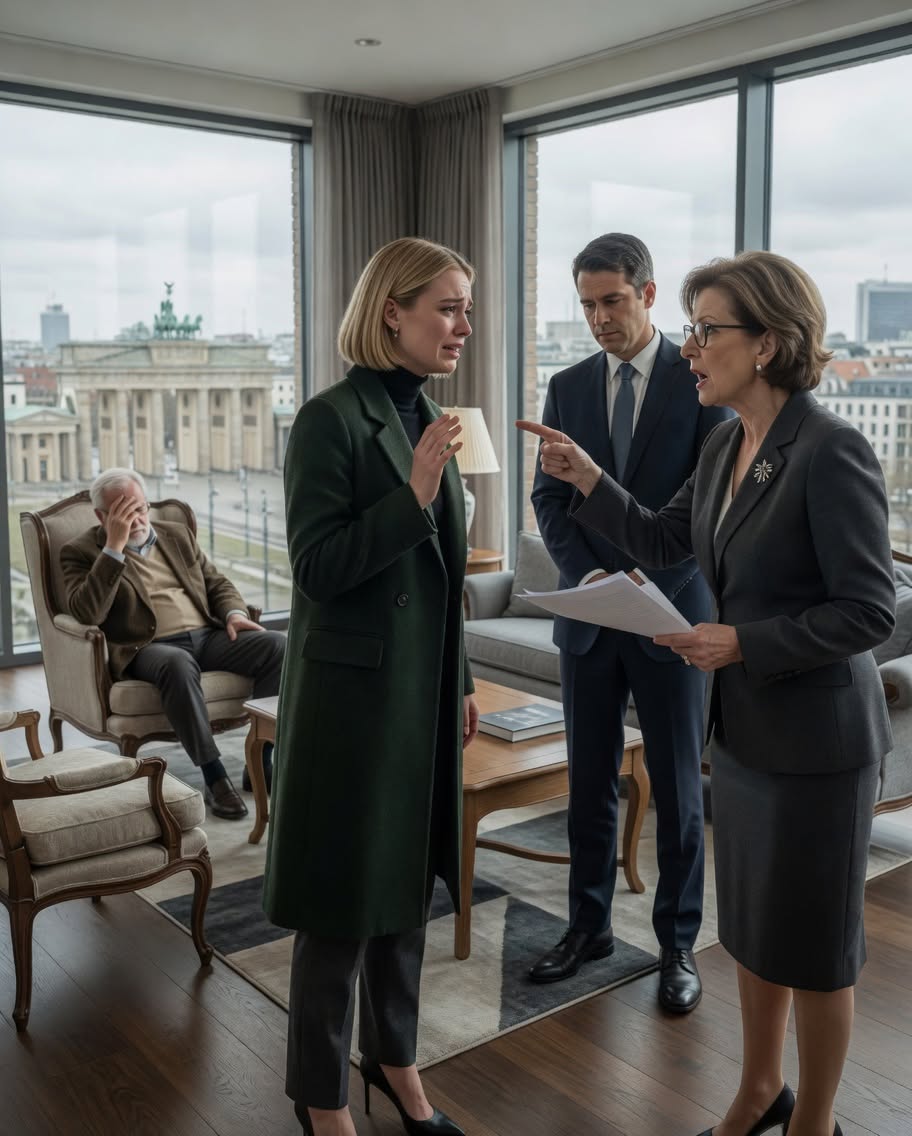
For a few seconds, the silence in the room felt almost palpable. Niklas was the first to move. “Mother, what is the meaning of this?” Claudia didn’t bat an eye. “Prudence,” she said coolly. “Something you’ve always lacked.”
The lawyer—a narrow-faced man named Gregor Schlote—cleared his throat and slid the papers forward. “This is a standard framework for a prenuptial agreement, designed to protect both pre-existing and future family interests. It is advisable to clarify these matters early on, before misunderstandings become costly.”
I almost laughed. Not because it was amusing, but because the ploy was so transparent. In this case, “future family interests” meant Niklas’s modest townhouse, a small architectural practice with an irregular income, and an investment account that Claudia had likely inflated into something massive in her own mind. She looked at me as if I were a gold digger in sensible flats.
Niklas pushed the papers away. “You bring a lawyer into my home to accuse my wife of marrying me for money?” Claudia’s lips tightened. “I brought a lawyer because emotions make men foolish.”
I should have been angry—and I was. But beneath the anger lay something else: relief. Had she waited longer—had she played the benevolent mother-in-law for a year or two—the betrayal would have cut much deeper. Instead, she revealed her true colors early, before my life had become even more deeply intertwined with hers.
“I think you should both leave,” Niklas said. Gregor Schlote spoke before Claudia could answer. “Mr. Peters, with all due respect: if your wife has nothing to gain, she should have no problem signing.”
That was enough. I set my cup down next to his briefcase. “Mr. Schlote, are you admitted to practice law in Germany?” He blinked. “Yes.” “Then you ought to know better than to present such a high-pressure document under the guise of routine paperwork. You showed up at a private home unannounced, carrying a legal instrument designed to coerce a party into relinquishing rights she hasn’t even claimed yet. That isn’t prudence. That’s theater.”
Claudia’s expression shifted—only slightly. Just enough to show she hadn’t expected such precision from the “simple” girl. Niklas glanced back and forth between us. “Evelyn, you don’t have to explain anything. I’m not signing anything, and neither are you.” I placed a hand on his arm. “I know.”
The truth was, even if I had entertained the idea, Claudia’s assumptions were already outdated. Before the wedding, acting on my father’s quiet advice, I had signed a carefully structured asset protection agreement covering the Hart family’s holdings, trust structures, and my own future property rights. It hadn’t been done out of fear of Niklas; it was done because family businesses survive through law, succession planning, and a sense of reality. Hart Industriesysteme wasn’t something one could simply grab during a divorce. It was a multi-generational enterprise protected by trusts, boards, and voting structures far more robust than Claudia could imagine.
But I didn’t say that. Not yet. Instead, I asked Gregor Schlote, “Did you draft this contract based on full financial disclosure from both parties?” He hesitated. “We drew it up based on the assets identified to us as currently relevant.” That meant: based on what Claudia believed Niklas possessed—and what she assumed I didn’t. I nodded. “Then it’s worthless.”
Claudia let out a brittle laugh. “How convenient.” “No,” I said. “How legally binding. An agreement based on incomplete assumptions, presented under duress six weeks after the wedding, isn’t the weapon you think it is.”
Niklas opened the door. “Leave. Now.” Claudia straightened up, clutching her gloves in one hand like a badge of rank. “You’re making a mistake over a woman you barely know.” Niklas’s voice turned ice-cold. “No. The mistake was believing you could humiliate my wife in our own home and then call it concern.”
She left without another word. Schlote followed her, irritably gathering up his papers. The door closed.
Niklas and I stood in the hallway for a long time; the house had suddenly gone far too quiet. I could see questions forming in his eyes—not mistrust, not greed, but confusion. He had just witnessed his mother accusing me of being after wealth, and I had dismantled her lawyer’s position like a pro. “I owe you an explanation,” I said. He studied me, then shook his head. “Only if you want to give one.” That was the moment I loved him even more.
So I told him everything. I told him how my father had founded Hart Industriesysteme in 1986 in a rented warehouse with a forklift and three clients. I told him how my mother handled payroll at the kitchen table while I drew on shipping receipts. I told him that the company now employed over six hundred people. I told him that I had worked my way through the procurement, operations, labor law, and compliance departments because my father believed that an inheritance without competence was merely decay in a polished box.
Niklas sat down right in the middle of the conversation, as if the puzzle pieces were finally falling into place. When I finished, he exhaled slowly. “You really thought I’d care about that?” “I thought your mother would care,” I said. He gave a humorless laugh. “That was obviously the safest bet in all of Germany.” Then his expression softened. “Why didn’t you tell me?” “Because I needed to know who loved me before he knew what I was bringing to the table.” He took my hand. “And now?” “Now,” I said, “I need to know if any of this changes anything.” He squeezed my fingers. “Just this: the next time my mother drags a lawyer into the house, I’d like five minutes’ warning before I discover that my wife is better prepared than all of us put together.”
I laughed, despite everything.
But it wasn’t over yet. I knew Claudia. Women like her don’t retreat after a humiliation—they regroup. And exactly eight days later, she proved me right.
Her second move came disguised as a courtesy. Claudia asked to meet for lunch at the Übersee-Club, sending a text saying she wanted to “clear up some unfortunate misunderstandings.” Niklas wanted to decline on my behalf, but I told him I would go. Not alone—my father’s chief legal counsel, Miriam Kessler, was standing by nearby in case things got complicated—but I went.
Claudia was already seated, impeccably dressed in ivory silk, looking as though she were attending a board luncheon rather than making amends for an ambush. She smiled with measured warmth. “Evelyn, thank you. I think we got off to a terrible start.” “We started with legal threats in my hallway,” I said. “That was more than just a bad start.” Her smile didn’t waver. “That’s certainly true.”
For ten minutes, she carefully feigned remorse—concern for her son, old habits, maternal instinct, embarrassment over that abrupt visit. Then, with precise control, she shifted gears. “I understand now that your family is… well-positioned,” she said. Well-positioned. The word almost made me smile. She continued: “That changes the nature of our discussion. Niklas has always been brilliant, but he lacks the right support. With the necessary capital, his firm could grow significantly. And, of course, when two families unite, a strategic partnership makes perfect sense.”
There it was. No apology—just a recalculation. Her first attempt had assumed I wanted what Niklas had. The second assumed she could capitalize on what I had.
I folded my napkin and placed it beside my plate. “A week ago, you were ready to have me sign a waiver regarding hypothetical claims.” “That was before I knew the full picture.” “Exactly,” I said. Her gaze turned cool. “You have to understand that a marriage isn’t just an emotional matter. It’s structural. Families support one another.” “Yes,” I said. “Healthy families do.” I stood up, thanked her for a lunch I had no intention of finishing, and walked out before she could channel her ambition into a new argument.
That evening, I told Niklas everything. He sat in silence for a long time, then placed both hands flat on the kitchen table. “I’m ashamed of her,” he said quietly. “You aren’t responsible for her choices.” “I know,” he said. “But I have to take responsibility for my own.”
Within a month, Niklas began setting boundaries he should have established years earlier. He removed his mother from his law firm’s advisory records, revoked her remaining access to financial documents, and stopped accepting guilt as a form of authority. It was painful. Claudia wept, raged, accused me of turning him against her, and told relatives I was domineering. She never mentioned the lawyer, of course.
My father watched it all with the stoic patience of a man who had witnessed power struggles in both business and family life. One Sunday, after Niklas had helped him repair a warped gate at the holiday home on Lake Plön, my father said to me quietly, “Your husband isn’t weak. He was raised to keep the peace at the cost of himself. That’s something one can unlearn.”
He was right.
The true ending to this story wasn’t a courtroom victory, because there was no courtroom. Claudia’s documents meant nothing—they were legally weak, strategically misguided, and based on a false version of who I was. What mattered was what came next. Niklas and I built our marriage on a more comprehensive truth. Not because wealth had entered the picture, but because the secrets had left it. He understood why I had been cautious. I understood that trust also requires truly revealing oneself.
When my father officially announced his succession plan the following year and named me the new CEO of Hart Industriesysteme, Niklas stood in the front row beside my mother, applauding like the proudest man in all of Germany—not possessive, not intimidated, simply proud.
As for Claudia, time accomplished what arguments could not. Distance diminished her influence. Consequences taught her what confrontation had merely exposed. Two years later—after a health setback and a lonely Christmas season that was largely of her own making—she asked to meet again; this time without a lawyer, without a strategy, and without confusing control with care. Her apology wasn’t perfect, but it was sincere enough to make a start. We didn’t become close overnight—true reconciliation never works that way—but I allowed a more modest, honest relationship to develop.
In the end, that was the human side of it. No victory. No punishment. Just clarity.
At first, I had remained silent because I feared what money might awaken in others. My caution was justified. But I also learned that silence alone does not protect a marriage; honesty does—guided by timing and good judgment.
My father spent forty years building a company strong enough to withstand market shocks, labor disputes, and recessions. What he gave me was more than wealth—he gave me the instinct to test foundations before trusting them.
Six weeks after the wedding, my mother-in-law showed up with a lawyer and a folder full of assumptions. She left without power and without a victory. Because paper means very little when character has already revealed the truth.