
PART 3
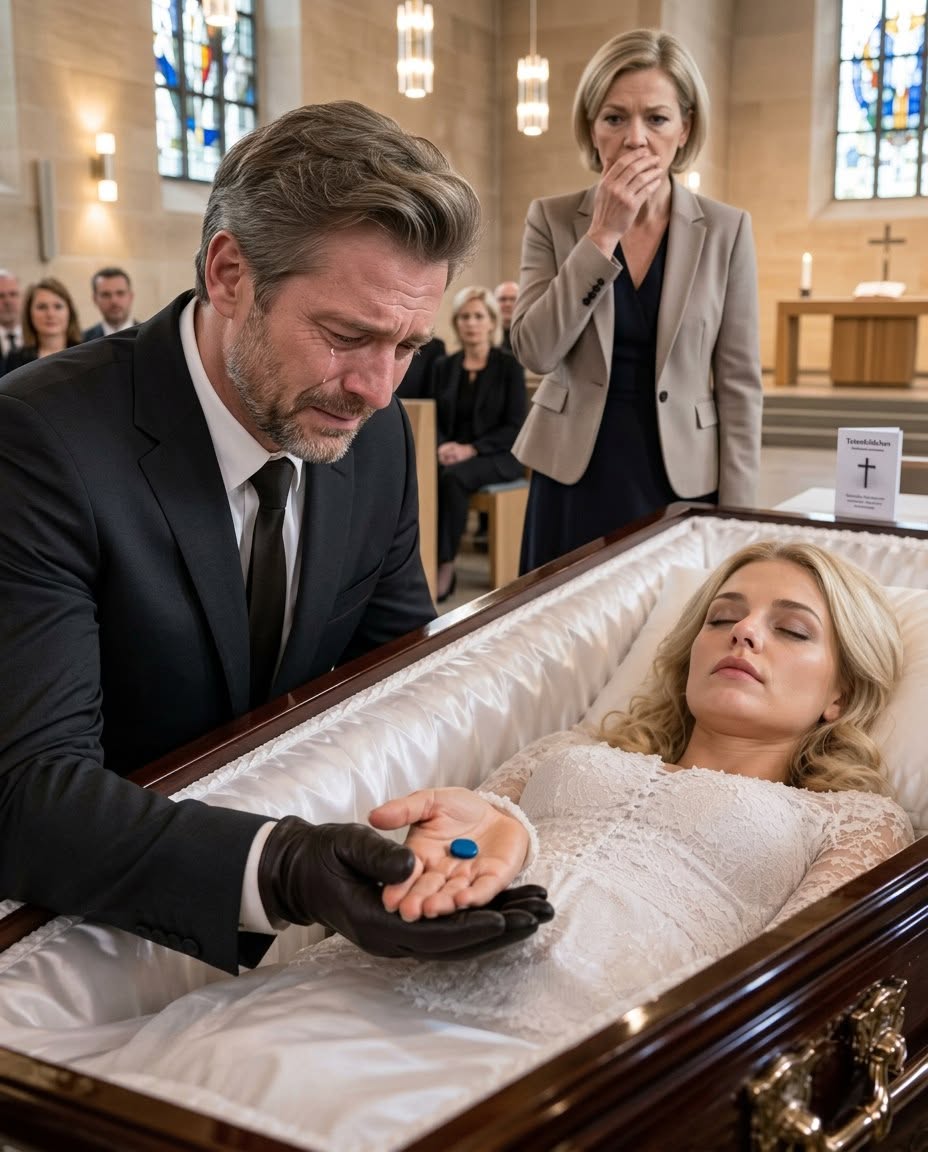
The funeral took place in a private chapel outside of Geisenheim. My mother had chosen white flowers, soft music, and a short guest list. She wanted to control every face, every tear, and every word spoken near Kamilla’s coffin. She had requested that no photos be taken, that no one be allowed too close, and that the ceremony be kept under thirty minutes. Traute Armenta had always confused elegance with innocence.
Roderich arrived late, wearing dark sunglasses and a new dark blue jacket. Not the same one as before. That confirmed what I had already suspected. He was starting to get scared.
I stood at Kamilla’s coffin when my mother approached me. “Julian,” she whispered through clenched teeth. “Don’t you dare ruin everything here.”
I looked at her. “What should I ruin, Mother? The funeral or your plan?”
Her face barely moved. But her eyes changed. For a second, I saw the real Traute. Not the grieving mother. Not the respectable widow. Not the matriarch. A cornered woman.
“Grief is making you talk nonsense,” she murmured.
“You said that yesterday too.”
The pastor finished the prayer. Some guests crossed themselves. Others stared at the floor, uncomfortably moved by a tragedy they didn’t understand. When the pastor asked if anyone else wished to speak, my mother stepped forward.
I was faster. “I do.”
Traute grabbed my arm. “No.”
I gently removed her hand. “Yes.”
I stood before everyone present. The workers from the vineyards. My father’s old business partners. Kamilla’s friends. Women from her prenatal classes. And in the third row sat Notary Salcedo, sweating in the cold chapel.
I took a deep breath. “Kamilla deserved a farewell based on the truth.”
My mother froze. “Julian, this is not the right time.”
I looked directly at her. “Yes, it is. This is exactly the right time.”
I reached into my pocket and pulled out the button. Then I held it up. Roderich stepped back. “What are you doing?”
“I’m saying goodbye to my wife.”
A murmur went through the chapel. “This button was in Kamilla’s hand when I came home. Not in a report. Not in an evidence bag. In her hand. She tore it off the person who was with her before she died.”
Roderich let out a forced laugh. “That proves nothing.”
“Not yet.” I nodded toward the entrance. The doors of the chapel opened. Two criminal investigators entered, along with a public prosecutor from Kassel, Dr. Anna-Lucia Meinhardt, and a forensic expert carrying a laptop. My mother turned deathly pale. Notary Salcedo stood up as if to flee, but an officer positioned himself right next to his row.
“This is disrespectful,” Traute said loudly. “We are at a funeral.”
The prosecutor replied calmly. “We are at a location connected to an investigation into suspected homicide, document forgery, coercion, and child abduction.”
The word child abduction hit hard in the chapel. Roderich stared at me. “Child?”
I walked slowly toward him. “My son is alive.”
I will never forget his face. It wasn’t relief. It was sheer terror. And that terror said more than any confession ever could.
My mother opened her mouth, but no sound came out.
The forensic expert connected Kamilla’s recovered phone to the chapel’s screen. The image was shaky, but clear enough. Kamilla’s heavy breathing filled the room. Then Roderich’s voice echoed through the chapel. “Sign it, Kamilla. Julian will never know.”
Someone held their breath. Then my mother’s voice followed. “Once the baby is here, we’ll just say there were complications. No one questions a grieving mother.”
Horrified, several people turned toward Traute. In the recording, Kamilla could be heard struggling to say: “My son does not belong to you.”
Roderich shouted: “That’s a forgery!”
Dr. Anna-Lucia stepped forward. “No. The file is subject to complete chain-of-custody evidence. Date, location, and audio authentication have been forensically confirmed. The medical findings also contradict the family’s account.”
My mother tried to walk toward the exit. An officer stopped her. “Traute Armenta, you are under provisional arrest on suspicion of involvement in a homicide, document forgery, coercion, and attempted child abduction.”
“I did everything for this family!” she screamed. Her voice shattered against the walls of the chapel.
I looked at her without moving. “No. You did it for the money.”
Roderich tried to push past an officer. It was a desperate, clumsy attempt. Within seconds, they had him pressed against a wooden bench. His sunglasses fell to the floor. The man who had always seemed untouchable began to cry.
“Julian,” he said with a breaking voice. “You don’t understand. Mother said that once the baby was born, everything would be over.”
“Yes,” I replied. “Your thefts are over.”
The prosecutor showed another folder. “There are transfers to Notary Salcedo, altered clinic records, an attempted cremation without autopsy, and DNA evidence secured from the victim. Roderich Armenta is also under arrest.”
The notary collapsed on the bench. “I didn’t know she would die,” he stammered. “They only asked me to draw up the papers.”
Traute snapped at him furiously: “Shut up!”
But it was too late. The chapel had already seen the crack. The family had heard the truth. And Kamilla, whom they thought they had silenced, had left more power in a small button than they possessed in all their wealth and names.
As they led my mother away, she screamed my name. “Julian! I am your mother!”
For the first time in my life, that sentence no longer had any power over me. I looked at Kamilla’s coffin. “And she was my wife.”
I didn’t smile. Justice doesn’t bring back the warmth of a hand. It doesn’t rebuild a laugh. It doesn’t fill an empty space. But sometimes, justice is the only thing that remains so that love isn’t buried twice.
Six months later, the house no longer smelled of candles or lies. I took down the black curtains and opened every window. I sold the furniture my mother had chosen and filled the living room with plants, sunlight, and photos of Kamilla smiling with her hair loose, exactly the way she had loved it.
Roderich was in pretrial detention awaiting his trial. Traute tried to put all the blame on him, but her own statements only made things worse. Salcedo lost his license and agreed to cooperate with the prosecution. The stolen shares were returned – not to me, but to the foundation that Kamilla had wanted to establish for pregnant women without family support.
I named it after her. The Kamilla Ríos Foundation.
Every morning, I carried Matthias into the garden. He was still small, but strong. He had his mother’s eyes and held my finger with the same stubborn grip that had saved his life.
One afternoon, I opened a small wooden box under the jacaranda tree that Kamilla had planted when she learned she was pregnant. Inside lay her wedding ring and the dark blue button.
I didn’t keep the button because I hated it. I kept it because it reminded me that Kamilla hadn’t given up. Not even at the end.
Matthias wrapped his tiny fingers around mine, and for the first time, I felt a small, incomplete, but genuine peace. I looked up at the clear sky above Geisenheim and whispered:
“Your mother won, my son. She just needed me to understand her last clue.”