Part 3
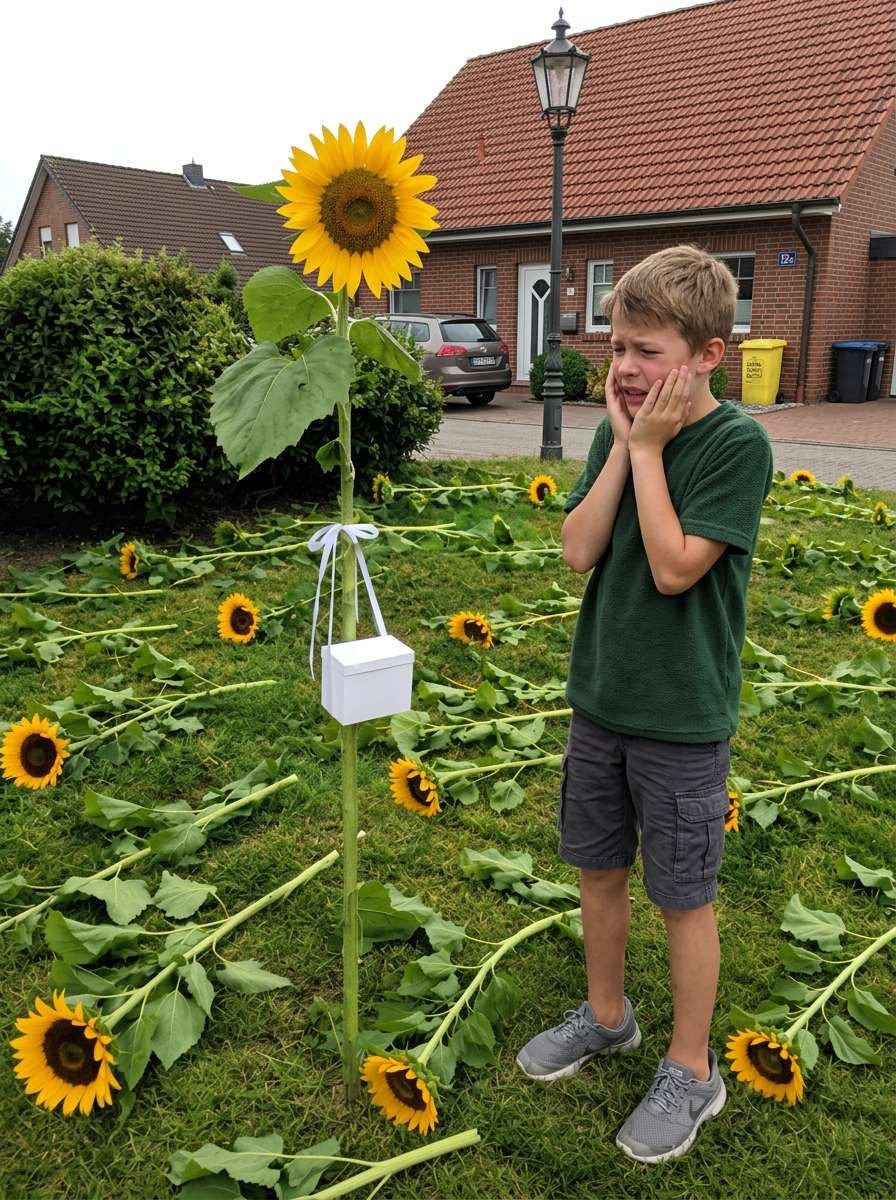
I had already witnessed him grieve for Lina once. He was not ready to lose her a second time. I called Commissioner Harris—the same officer who had searched for Lina six years ago and was now head of the station. He arrived at the farm within an hour. I showed him the note, the photo, the cut sunflower stems, and the old back gate that stood open. The flowers had been cut cleanly with pruning shears. Tire tracks were imprinted on the damp ground near the gate. Only the family and a few old neighbors even knew that this gate led directly to the sunflower bed. No one had stumbled upon our pain by accident. Someone had studied it. Harris instructed me to call the number from his phone with caller ID blocked and stall the man. I did. The same calm voice answered on the second ring. He repeated the instructions about the forty thousand euros and the “Waldblick” inn. This time, I heard something in the background. The jingling of a bell over a door. Then a woman called out: “One schnitzel for Reiner!” When the call ended, Harris said: “Reiner’s Village Pub.” There was only one establishment by that name near the inn.
Harris didn’t like it, but he agreed to let Lukas come along to the pub and wait in the car, as long as nothing else was said. Lukas sat in the back seat, the photo face-down on his knee. He could barely look at it, but he wouldn’t let it go. In the pub, we showed the waitress the picture and said we were looking for a cousin. She nodded. “That’s Amelie. She sometimes helps out at the Müllers’ vegetable stand. She lives with her grandmother over in Geislingen.” Lukas closed his eyes. We drove to Geislingen. Amelie’s grandmother opened the door, saw the photo, and tried to close it again immediately. Harris showed his badge, and she let us in. A man had taken the photo the week before, she told us. He had said he needed it for a flyer for the local harvest festival. “He said his name was Vinzenz.” Vinzenz. His face shot through my mind. Vinzenz must have known about the accident. He had been seventeen when Lina disappeared—old enough to hear the adults talking, and old enough to remember Lukas’s guilt. He had searched the pond with us that night. He also knew about the sunflower tradition and the plot of land we had sold the year before. With her grandmother at her side, Amelie told us one more thing. Vinzenz had asked her to hold a sunflower and look sad. She said he had mud on his shoes and a white ribbon had been sticking out of his pocket.
Harris arranged the meeting at the inn. Before I got out of the patrol car, he made me repeat the plan twice. No experiments. Do not follow Vinzenz anywhere. Do not hand over the envelope until he gave the signal. I went in with an envelope full of newspaper clippings and a microphone under my blouse. Vinzenz was waiting near the vending machines, his cap pulled low over his face. He started talking before I could say a word. Lina had survived, he claimed. A woman had taken her in. She remembered the farmhouse porch. She still talked about Lukas, though she called him Luki. I let him talk. Then I told him that our farmhouse hadn’t gotten a porch until four years after Lina’s disappearance. I told him that Lina had never called her brother Luki. She called him Luki-Mucki. Then I said: “I found Amelie.” His face changed. He tried to laugh. But I had Amelie’s grandmother. I had the photo. I had the audio recording. I had the ribbon, the tire tracks, and his own story collapsing around him. Harris stepped forward. Vinzenz ran toward the back stairwell and made it only three steps before another officer intercepted him.
By evening, he was in custody. Later, Harris told us that Vinzenz had never known more about Lina than the rest of the village. He had remembered Lukas’s guilt, heard about the land sale, and decided that our grief would make us easy to manipulate. The sunflowers, the ribbon, Amelie’s face, the note—it had all been theater. When I came home, Lukas was sitting next to the devastated garden. “So she wasn’t Lina,” he said. “No.” He nodded once and stared at the bent stems. Then he said: “We have to fix what he destroyed.” The next morning, Amelie and her grandmother came to help us clear away the cut stems. Amelie apologized over and over until Lukas finally looked at her. “You didn’t hurt us,” he said. “He did.” We planted new seeds in straight rows. Before we finished, Amelie pressed the last seed into the soil herself. “For Lina,” she said softly. Lukas nodded. “For Lina.” Then he tied a fresh white ribbon around a small wooden cross and wrote on it: “For Lina. Forever loved. Forever with us.” When he stood up, he didn’t reach for my hand. He stood on his own. And I looked at my son with pride. Because for the first time, he was no longer trying to stay close to Lina by punishing himself. He walked back to the house without looking back.