
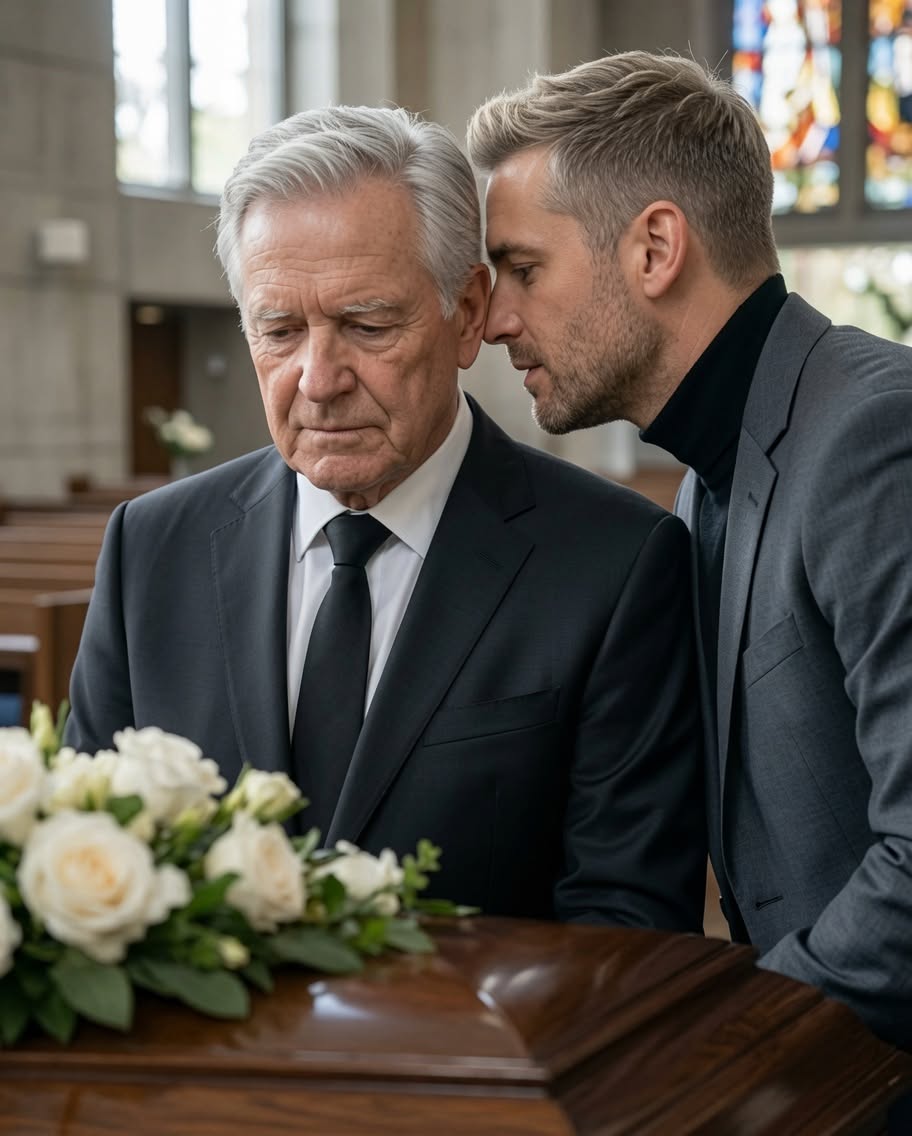
He stared at me as if seeing me for the first time. “And if I refuse?” I shook my head. “This isn’t a negotiation. This is me choosing not to crush you with the power you so carelessly placed in my hands years ago—thinking it would never matter.” He let out a long breath, and the last vestige of fight drained out of him. “I don’t deserve your mercy,” he said quietly. “No,” I replied. “You don’t. But this isn’t for you.” I thought of Laura again—her hope, her stubborn belief that people could change for the better if given time. “In her memory,” I said, “I’m giving you the chance to become the man she always insisted you could be.”
Over the following months, the company changed. We hired outside auditors—serious people who didn’t care whom they upset. They uncovered exactly what I’d expected: abuse of power, reckless spending—the kind of behavior that festers when someone believes they are untouchable. Nothing that would warrant a prison sentence, but more than enough to justify radical change.
Gradually, the employees began to relax. At first, they thought I was merely a figurehead—the old man occasionally spotted in the lobby meeting Laura for lunch or carrying a toy for his grandson. But as policies shifted, overbearing managers were replaced, pay became fairer, and contracts were honored, the atmosphere slowly transformed.
I visited every department myself. Not as a tyrant. Not as a savior. Simply as the majority shareholder who had finally stepped out of the shadows. I listened. I took notes. I raised the issues with the board. In the marketing department, a young woman hesitated when I asked if she had any concerns. Her colleagues gave her a gentle nudge. She was wringing her hands. “It’s just…” she said. “When Mr. Schmitz got angry, it was hard. He used to shout. A lot. We never knew where we stood.” She glanced around, as if expecting him to appear. “I understand,” I told her. “Thank you for saying that. That kind of behavior will no longer be tolerated—not from him or anyone else.” And I meant it.
Daniel changed too, albeit more slowly. At first, he resisted any kind of adjustment. Pride does not yield without a fight. But over time, his outbursts became less frequent. He listened more in meetings. Spoke less. Occasionally, he even asked questions instead of pretending he already knew the answers. Grief strips people bare. Some grow harder. Others become more reflective. I am still not sure which applied to Daniel. Perhaps both. We never became friends; that would have been too big a lie for both of us. But we found a strange sort of coexistence, bound not by affection, but by our love for the same woman.
Using a portion of the profits—profits I finally had the power to allocate—I founded an organization. I named it simply: “Laura.” Not “The Laura Foundation.” No complicated title. Just her name. Seeing it printed on the glass door of our modest office for the first time hit me harder than I had expected. Her name, plain and visible, felt like a way to carve her into the world so she could not be erased.
The mission was simple yet deeply personal. We supported founders with good ideas who lacked access to capital or connections. But we also supported something else—something rarely found in business plans. We supported parents. Parents who gave everything—time, money, energy, health—to help their children succeed, only to be sidelined or forgotten. Parents whose sacrifices never make the headlines. Parents who sleep on sofas so their children can live near better schools, who skip meals to pay tuition for just one more month. Every project we supported was tied to clear conditions: respect, ethics, and recognition. Not just a vague “thank you” post online. Genuine contractual protection. Written acknowledgment. Proof that the invisible hands behind the success would no longer be brushed aside.
Our first case was a young woman named Nadia. She walked in carrying a laptop, her weary-looking father trailing behind her. His hands were rough from a lifetime of hard work. His clothes were clean but worn. Nadia spoke rapidly about her app, her plan, and her projections. Her father sat silently in the corner. When she finished, I looked at him. “And what is your role in all this?” I asked gently. He looked uncomfortable. “I’m just the driver,” he said. “I take her to meetings when I can. I… also contributed a little money. Not much. I sold my delivery van.” Nadia turned around abruptly. “Dad,” she whispered. “You told me you sold it because you didn’t need it anymore.” He smiled at her in a way I recognized instantly. “I didn’t want you to feel guilty,” he said.
My chest tightened. We funded her project. But we wrote his contribution directly into the contract—not as a favor, not as a footnote, but as a formal investment. On the day of the signing, Nadia slid closer to him and took his hand. “I’m going to buy you a new van,” she said tearfully. “A better one.” He laughed softly and shook his head. “Just get to your next meeting on time,” he said. “That’s enough.”
Stories like these kept me going. They didn’t heal the emptiness Laura had left behind, but they gave it structure. They turned pain into a sense of direction.
Sometimes, late in the evening after everyone had gone home, I would sit alone in my office, thinking of Laura. Two photographs remained on my desk. One showed her at age eight, sitting on my shoulders at the beach. The other was from her university graduation—her arm around me, her mortarboard askew, a radiant smile on her face. Sometimes I would talk to her. “We approved another project today,” I’d murmur. “A single mother who took out a loan against her house so her son could open a bakery. We made sure her name was on the title deeds this time. You would have liked her.” Or: “Daniel didn’t raise his voice in today’s meeting. Can you imagine? Maybe part of him is actually learning.”
I don’t know if anyone hears such things. I no longer believe in dramatic miracles. But I do believe in echoes. In the way love lives on in the choices we make after someone is gone.
Every now and then, Daniel’s path and mine would cross outside of work. Once, months after the restructuring, we ran into each other at the cemetery. I was just leaving; he was arriving with a bouquet of white lilies. We stopped a few paces apart. “Hello,” he said. “Hello,” I replied. No handshake. No hug. Just the quiet knowledge that we both came here often, that we both stood before the same grave, that we both spoke into the same silence. “How are things at the company?” I asked. “Stable,” he said. “Better. The new systems… they make sense.” He paused. “Thanks for not destroying them.” “I didn’t do it for you,” I said again. He nodded. “I know. I’m trying to become the man she believed I could be.” “You’re late,” I told him. “But trying is still better than not trying.” He gave me a sad, weary smile and walked on toward the grave. I didn’t follow him. Some moments belong to a man and his memories alone.
As for me, I created my own rituals. Every Sunday morning, I went to the cemetery with fresh flowers. Sometimes roses, sometimes wildflowers from an old woman on the corner. I would clean Laura’s headstone, sweep away withered leaves, and sit on the small nearby bench. I told her about the week—the families we had helped, the dreams we had supported, the small ways her name was changing lives.
In time, the anger that had burned within me at the funeral cooled. It never vanished completely, but it transformed into something more enduring. Something clearer. Sometimes I thought back to that precise moment in the church when Daniel said, “You have twenty-four hours to leave my house.” At the time, it had sounded like a verdict. Now I see it differently. Yes, it was a door slamming shut. But it was also a door opening—one I had been too hesitant to open myself, out of deep respect for Laura’s desire for peace. It forced me into the role I had long held quietly in the background: not just father, not just grandfather, not just the man who helped with school pickups and bedtime. It turned me into the man who finally used his power.
People misunderstand power. They think it belongs to the person who speaks the loudest, commands the room, or intimidates others. But true power is quieter. It resides in contracts, in property, in the certainty that one need not shout to alter the course of a life.
Sometimes I recall the smile I gave Daniel in the church. It wasn’t weakness. It was certainty. The certainty that I had never been as invisible as he believed. The certainty that the truth eventually surfaces, even after years of being buried in silence. The certainty that the stories people tell about themselves—the self-made man, the brilliant founder, the good husband—must ultimately answer to what is written in ink and to the memories of those who watched silently from the sidelines.
I lost my daughter. Nothing will ever make that right. On some days, grief still washes over me without warning—in the supermarket when I see her favorite cereal, on the street when someone laughs with a voice like hers, or when the phone rings and, for one foolish second, I think it might be her. Yet I have also gained something, though at a terrible price. I have found a purpose. I have found a way to keep her name alive—not merely carved in stone, but as something living—something capable of protecting others.
Daniel made the greatest mistake of his life when he believed a single sentence could erase me. He thought that removing me from his house meant removing me from his story. What he never understood was that I had been there from the very beginning—not as a bit player, not as a burden, but as the foundation. And foundations cannot be so easily torn out. As I sit in Laura’s office now, watching the sun sink behind the city and bathe the glass in orange and gold, I feel something I once thought I had lost forever. Not happiness—that word is too light. But peace. A quiet, imperfect peace born of grief, memory, duty, and an unyielding truth: respect is rarely lost all at once. It is slowly eroded by repeated choices. And sometimes, if we are lucky—or determined enough—we get the chance to rebuild it, not for ourselves, but for the people whose love we hadn’t earned, yet were given nonetheless.
I take a sip of my coffee, look at her photograph, and whisper, “I’m still here, my love. And so are you.”