
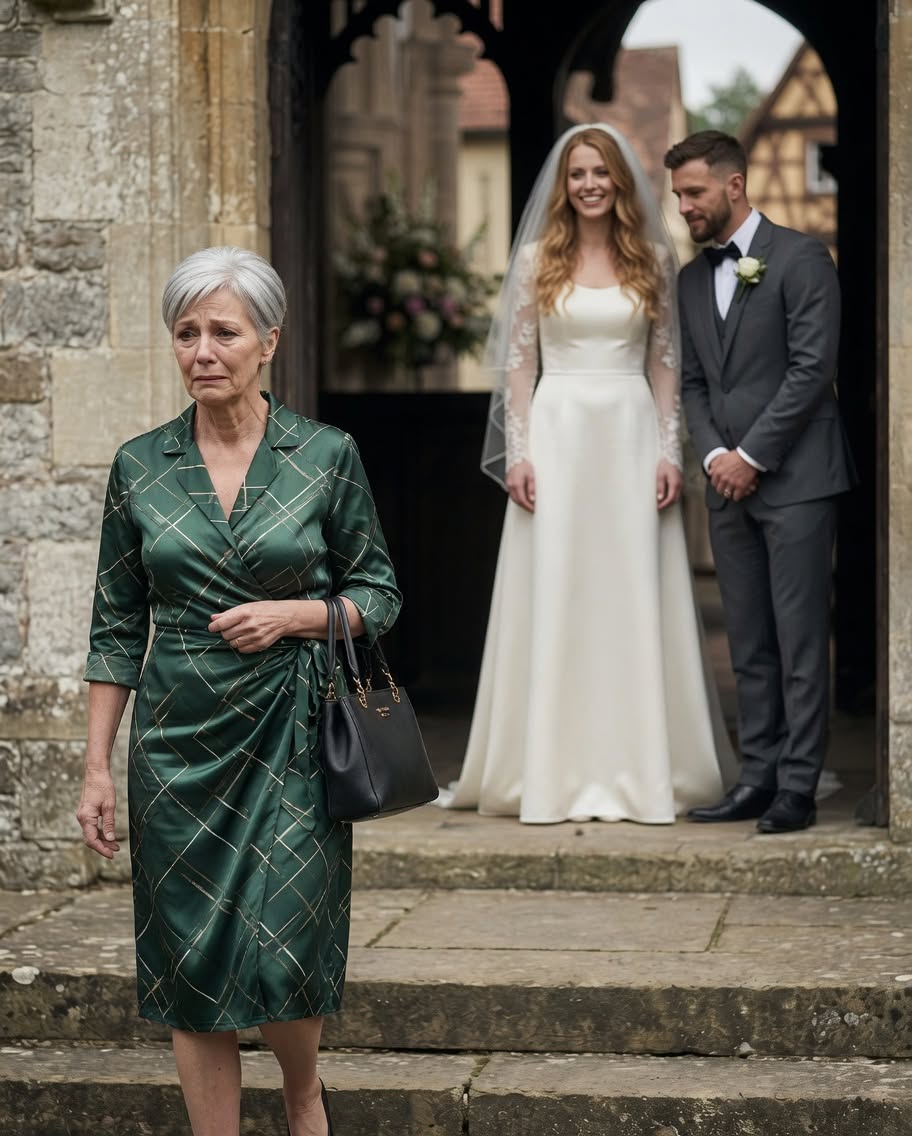
And in ten minutes, when he opened that planned message, the wedding she’d dreamed of would crumble like sand. But to understand how I got to this point, I have to go back. Back to the day my husband, Robert, took his last breath, leaving me with one final request: “Protect our son, even from himself.” Two years before the wedding, I was sitting by a hospital bed that creaked with every movement. The pungent smell of disinfectant filled the air. The fluorescent lights above us flickered. Robert held my hand with surprising strength. Sixty-three years of life. Forty-two years of marriage. All reduced to this cold room. Cancer had taken him quickly—pancreatic cancer. Silent, merciless. By the time you notice it, it’s already too late. Robert had always been a quiet, hardworking man. Every morning at five, he would open the auto parts factory we had built together from scratch. I took care of the office—the paperwork, the accounting, the suppliers. We were partners in everything, even if no one really knew it. To the outside world, Robert was just an ordinary working man. We lived modestly. A simple house in a middle-class neighborhood. No luxury cars. No designer clothes. No extravagant dinners. He always said, “Money screams when you flaunt it… and whispers when you keep it.” And we kept it quiet. “Promise me something,” he whispered that last night, his voice weak. “Don’t tell anyone about the money yet. Our son has to grow up first.” I promised. Three days later, I buried him under a gray, rainy sky. Lukas stood beside me, holding a black umbrella. He was forty then. Single. He had a decent job in IT. He lived comfortably, but nothing extravagantly. After the funeral, I met with our lawyer, Mr. Hartmann, who had known Robert for decades. “I’m going to be direct,” he said, opening a thick folder. “Your husband left behind a considerable fortune.” Considerable was an understatement. The factory alone was worth over a million euros. Our house, fully paid off and renovated, was worth almost three million. We owned a rental apartment that provided a steady monthly income. There were investments. Savings. Even a piece of land he had inherited from his parents. In total—over five million. I sat there frozen. “There’s more,” Mr. Hartmann added, sliding a sealed envelope toward me. “Your husband’s will.” My hands trembled as I opened it. “I’m leaving you everything,” Robert had written. “Lukas will receive his share when he’s ready—when he proves he can appreciate what we’ve built.”
I folded the letter and put it away. I didn’t tell my son. Not yet. I continued to live modestly. The same house. The same habits. The factory was run by a trusted manager. The income arrived quietly each month. Lukas assumed I was living on a small pension. He even sometimes offered to help me financially. “I’m fine, son,” I would say. “Don’t worry.” I thought I was protecting him. But six months later, everything changed. He turned up one afternoon, smiling in a way I hadn’t seen in a long time. “Mom, I want you to meet someone.” Behind him stood a woman. Blonde. Impeccably styled. Dressed far too provocatively for a spontaneous visit. She couldn’t have been older than thirty. “Hello, Mother-in-law,” she said brightly, extending her hand. “I’m Verena. It’s lovely to meet you.” The moment I touched her hand, something inside me tensed. I didn’t know it yet, but she was about to change everything. She walked into my house as if it were already hers. She didn’t ask to sit down. She didn’t take off her heels. She simply plopped down on the sofa and began scanning the room with sharp, calculating eyes. “What a charming house,” she said. “Very… vintage.” Vintage. Lukas sat beside her, beaming, completely oblivious. “She’s an influencer,” he said proudly. “She has thousands of followers.” Verena smiled modestly, but I saw the satisfaction in her eyes. She asked questions—too many questions. About the house. The business. My late husband. The future. Her eyes lingered on my desk. At one point, she even opened a drawer. “Oops, sorry,” she said quickly. “Bad habit.” But I had seen it. She had looked inside. And she had understood. That night, lying in bed, I knew exactly who had entered my life. A woman who didn’t love my son. A woman who had seen something—and started doing the math. What I didn’t know was that she was already one step ahead of me. And within three months, she would make a move that would change everything between my son and me. Three months later, my phone rang. “Mom, I proposed to her. She said yes.” Ninety days. And they were already engaged. The wedding was set for four months later. Too fast. Much too fast. But I said nothing. “Congratulations, son.” Two weeks later, they came by again. Verena was sitting there as if she owned the place. “Let’s talk about the wedding,” she said. “I’ve chosen everything—the venue, the dress, the church. It’s going to be perfect.” Then she looked directly at me. “Since you’re the groom’s mother… we thought you could help with the costs.” It wasn’t a request. It was a demand—wrapped in a smile.