
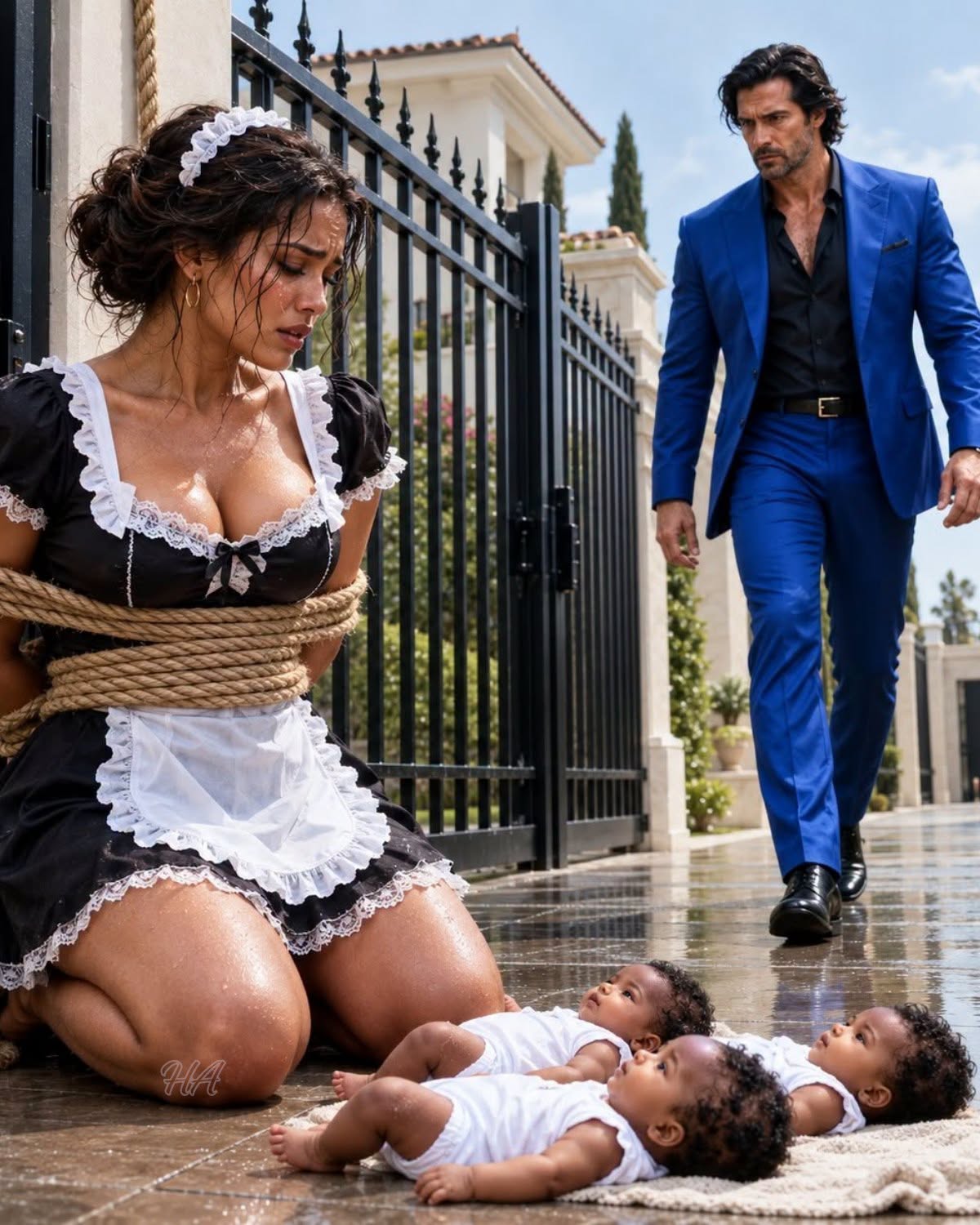
“They had food. They had shelter. Their mother contributed nothing. My son died ashamed because she could not give him an heir.”
The words echoed through the courtroom.
I rose before my lawyer could stop me.
“My daughters are his heirs,” I said. “Not because of money. Not because of a last name. Because he loved them. You punished three children for being born female, and you punished me because you needed someone beneath you.”
Teresa turned toward me, face twisted.
“You would have nothing without this family.”
I held up Diego’s notarized letter.
“I had a husband who tried to protect us, daughters who protected one another, and a name that was mine before I ever met you. You are the one who needed us powerless.”
The judge denied Teresa’s custody petition permanently and extended the no-contact order. She also referred the evidence of child abuse, coercive labor, document theft, and financial fraud to prosecutors.
Outside the courthouse, reporters surrounded us.
Ricardo’s security team opened a path, but I stopped.
For the first time, I faced the cameras myself.
“My daughters are not burdens or bargaining chips,” I said. “The account contains money legally left by my husband. I will answer every lawful question, but I will not apologize for leaving a home where my children were treated as less than human.”
A reporter shouted, “Are you romantically involved with Ricardo Montalvo?”
“No,” I said. “A man helping a woman does not purchase her.”
Ricardo stood three steps behind me and said nothing.
That silence protected me more than any speech could have.
The criminal case lasted fourteen months.
Investigators uncovered nine years of fake vendors and inflated invoices totaling more than 24 million pesos. Teresa’s attorney admitted fabricating documents to link my account to the theft. The mansion and Cancún apartment were seized, and the foundation was transferred to independent control.
Teresa was convicted of fraud, falsifying financial records, filing a false criminal complaint, and offenses related to the treatment of my daughters. The court sentenced her to prison and ordered restitution to the donors and programs she had exploited.
When the judge asked whether she wished to address me, Teresa stood and stared with the same cold pride she had worn the day she slapped me.
“You turned my son against me,” she said.
I did not answer.
There are accusations that deserve a defense. That one deserved only silence—the kind I chose, not the kind forced upon me.
The secret account was released after the investigation confirmed every peso came from Diego’s share sale. With interest, it had grown to almost 4 million.
I used part of it to recover our old apartment. Teresa had transferred the property into a company she controlled, but the court reversed the transaction after finding that my signature had been forged. When the girls and I walked inside for the first time, the rooms smelled of dust and closed windows.
Camila ran straight to the wall where Diego had marked their heights in pencil.
Sofía’s line was still there from the month before he died.
Luz had no line at all. She had been a baby.
I found a pencil in the kitchen drawer and measured them one by one. Sofía had grown nearly a foot. Camila stood on her toes and accused me of cheating her out of half an inch. Luz drew a crooked heart beside her name.
Then all three girls asked me to mark my own height.
“Why?” I laughed.
“Because you grew too,” Sofía said.
I turned away so they would not see me cry.
I completed the accounting degree I had abandoned. Laura testified at trial, and I forgave her slowly, with boundaries—not by pretending six lost years had never happened.
With the independent foundation board, I helped create a program for widows and children trapped in financially abusive households. We called it Three Doors—not after my daughters, as reporters assumed, but after the three exits every woman should be able to reach: legal help, safe housing, and money in her own name.
Ricardo funded the first year, but I insisted the program have outside oversight and no Montalvo name on the building.
He smiled when I told him.
“Diego would have approved.”
“Diego would have argued about the budget for six hours.”
“That too.”
For almost a year, Ricardo remained present without acting entitled to more. He attended Sofía’s school presentation, taught Camila chess, and became “the tall one” to Luz.
I noticed the way he watched us, but he never crossed the line I had drawn.
One evening, after the trial ended, he came to our apartment carrying a box.
Inside was Diego’s black binder.
The investigators no longer needed it. Between the audit pages, Ricardo had found a sealed birthday card Diego had bought for Sofía and never signed.
I sat at the table for a long time with the card in my hands.
Justice had returned property, money, and choice. It could not return a father to three girls or six years to the woman I had been.
Ricardo sat across from me without trying to fill the silence.
Finally, I said, “I’m afraid that being happy again will feel like leaving him behind.”
“It won’t,” he replied. “Leaving pain behind is not the same as leaving love.”
That was when I reached for his hand.
Not because he had taken us from Teresa’s house.
Not because he was wealthy.
Not because I owed him gratitude.
I reached for him because, after everything, the choice was mine.
We did not rush. My daughters set strict rules: no kissing in the kitchen, no canceling Saturday pancakes, and no choosing chess over bedtime stories.
Two years later, Ricardo proposed in the laundry room of the new Three Doors residence.
I stared at him in disbelief.
“Of all places?”
He looked around at the bright room with wide windows, locked cabinets, and a play area beside the folding tables.
“I wanted the place that once meant humiliation to become the place where you choose your future.”
I made him stand up before I answered.
Then I said yes.
Our wedding was small. Sofía carried Diego’s photograph, Camila carried the rings, and Luz covered the aisle in flowers. I wore my mother’s earrings, recovered from Teresa’s safe. No one measured my worth by the son I had never produced.
At the reception, my daughters gave a speech.
Sofía said, “People think Mr. Ricardo saved us. But Mom saved us first. He just opened the door when she was ready to walk through it.”
No sentence has ever made me prouder.
Sometimes, late at night, I still hear the washing machines from Teresa’s mansion in my dreams. I wake expecting to find my daughters on mattresses beside me, their breathing small beneath the heat of the dryers.
Instead, I hear Camila laughing in her sleep down the hall. I see Luz’s night-light under her door. I find Sofía reading long after bedtime, exactly as Diego used to do.
On the anniversary of his death, we visit the hill where his ashes were scattered. We tell him about school, about Three Doors, about the women who arrived frightened and left with bank cards, legal papers, and keys of their own.
I always save the last words for myself.
“You were right,” I tell him. “I endured more than I should have. But our daughters taught me that endurance is not the same as love.”
Then I look at the three girls Teresa once called useless.
Sofía wants to become a lawyer. Camila says she will run a hospital better than Ricardo. Luz has decided she will be an astronaut, a painter, and possibly the president, depending on the day.
They carry Diego’s name, but they do not exist to continue it.
They exist to become themselves.
And so do I.
THE END