
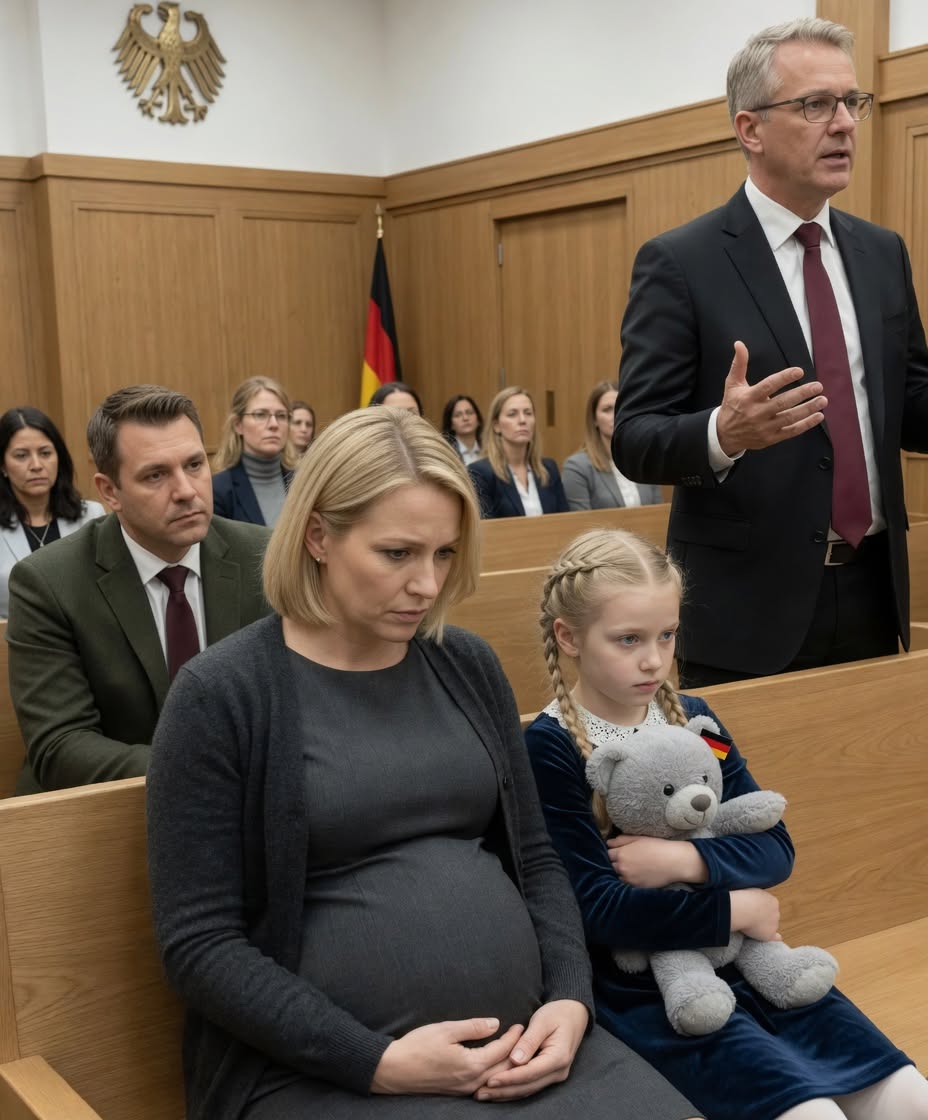
The appointments he cancelled before accusing her of missing them. The friends he warned that she was becoming difficult. The careful way he had made her appear unreliable to anyone who might later be asked. It hadn’t been carelessness. It had been architecture. Lilly leaned against her. “I didn’t know what the papers meant.” Emma pulled her close. “You did the right thing.” Lilly’s lips trembled. “Dad said you were stealing our house.” “No,” said Emma. “I tried to leave without a fight.” “Why?” Emma looked through the courthouse windows at the grey Frankfurt sky. “Because I was tired. And because I thought peace was more important than things.” Renate spoke gently. “Peace is important. But if you had let him have everything, it would have helped him hide what he’d done.” Emma nodded. The courtroom doors opened. Vanessa came out first, escorted by the bailiff; her flawless self-assurance was gone. She was still trying to walk elegantly, but fear had made her movements stiff. Her lawyer walked beside her, speaking earnestly to her as they headed toward the elevators. Daniel came out after her. For the first time, Emma saw him without a mask. He no longer looked like the charming man who remembered neighbors’ names and told people Emma was unstable while he remained infinitely patient. He looked cornered, angry, and—deep down—terrified. His gaze fell on Lilly. “Come here,” he said. Lilly pressed herself closer to Emma. Renate stepped in front of her. “Don’t go near her.” “Lilly,” Daniel said, ignoring Renate. “You don’t understand what you’ve done.” Judge Wittmer appeared in the doorway behind him. “Mr. Schneider.” He paused. The judge’s voice echoed down the hallway. “Restraining orders are in effect immediately. You are not to contact Ms. Schneider or your daughter—except during authorized, supervised visits—while the investigation is ongoing.” “She’s my child,” Daniel said. “She is a child,” Judge Wittmer replied. “Not a tool.” Vanessa stared at the floor. Daniel’s face twisted. “This is because of Emma. She turned Lilly against me.” Lilly stood up. Her knees were trembling, but her voice was clear. “Mommy Emma didn’t know I came here.” Silence fell over the hallway. Emma’s heart ached at the name. Lilly’s biological mother had died when she was two. Emma had raised her since she was three. She had packed her school lunches, braided her hair, sat by her bedside during fevers and nightmares, attended school plays and dentist appointments, and held her through that particular kind of fear felt by children who already know that people can vanish. Daniel had exploited that bond when it suited him. When it didn’t, he reminded Emma that she wasn’t Lilly’s real mother. Lilly took a step forward. “I heard you and Vanessa talking in the garage. You said that when the baby arrives, Emma won’t have anything left, and no one will believe her because she cries too much.” Daniel’s lips moved, but no sound came out.
Lilly looked at Vanessa. “You said I could live with Grandma if I was being annoying.” “I never said that,” Vanessa whispered. Lilly’s small face hardened. “Yes, you did.” Judge Wittmer turned to the investigator. “Put that statement on the record.” Over the following week, Daniel’s carefully constructed world began to crumble. The asset freeze brought to light withdrawals from the joint account that had been disguised as business expenses. Bank records revealed payments for Vanessa’s apartment, her car lease, and a diamond bracelet she had posted about online two months earlier. Renate requested the records from Daniel’s construction company and discovered that marital funds had been funneled through accounts belonging to suppliers controlled by one of his friends. The hidden documents were even worse. A handwriting expert confirmed that Daniel had practiced forging Emma’s signature on blank sheets of paper. His lawyer called it harmless preparation. That explanation fell apart when the prosecutor found text messages. Vanessa to Daniel: She’ll be exhausted after the delivery. Get her to sign when she’s emotional. Daniel to Vanessa: She trusts the tea routine. I’ll put everything in the tin and tell her they’re hospital papers. There was no dramatic confession. Just evidence. Methodical, clear, and impossible to explain away. Emma stayed in transitional housing arranged by her sister Natalie while the investigation proceeded. At first, she barely slept. Every noise outside the window made her chest tighten. But she wasn’t alone. Renate handled the paperwork. Natalie drove her to appointments. Lilly stayed with Emma under an emergency foster care arrangement after the court recognized Emma as the child’s primary caregiver. Emma went into labor on a rainy Tuesday morning. Lilly was at school. Natalie drove her to the hospital. Emma was terrified that Daniel would show up and play the concerned husband in front of the staff, who didn’t know the truth. But Renate had already sent the protective order to the hospital. Security had his photo. Daniel came anyway.
He arrived forty minutes after Emma was admitted, told the nurse he was her husband, and demanded to be let in. “She isn’t receiving visitors,” the nurse said. A security guard stepped closer. Daniel tried charm, then indignation, and finally the threat of a lawsuit. None of it worked. He was escorted out before Emma even caught a glimpse of him. Six hours later, Emma gave birth to a healthy boy. She named him Noah Jonas Schneider. When Lilly arrived at the hospital after school, she walked in slowly, still wearing her yellow cardigan. Emma was sitting upright, propped up by pillows—exhausted but smiling—and Noah lay against her chest, wrapped in a blue blanket. Lilly stood at the foot of the bed. “Is he okay?” “He’s perfect,” Emma said. “Do you want to meet your brother?” Lilly climbed carefully onto the bed. Emma positioned Noah so she could see him. The baby yawned and fell back asleep. “He’s so small,” Lilly whispered. “You were that small once, too.” “Did Dad come?” Emma answered honestly. “He tried. They wouldn’t let him in.” Lilly nodded. The relief on her face was so evident that Emma had to look away for a moment. Three months later, the final hearing took place. Emma wore a simple black dress. Noah was asleep in a carrier beside her. Lilly sat in the second row with Natalie, her rabbit on her lap, watching everything with the solemn concentration of someone who understood that this room was important. Daniel looked different. His suit was still expensive, but his self-assurance was gone. Vanessa wasn’t there. Their partnership had collapsed as soon as investigators got involved; she claimed Daniel had manipulated her. He claimed that Vanessa had fabricated everything. Her loyalty had lasted only as long as it served their mutual interests. Judge Wittmer entered the room. Everyone rose. The judge slowly reviewed the case files. Daniel had siphoned off assets. He had tried to pressure Emma into waiving her rights to marital property under false pretenses. He had exploited his daughter’s fear to keep secrets. Driven by financial greed, he had exposed both children to an unstable situation. Criminal proceedings were still pending, but the family court did not require a criminal conviction to protect the people before it. “This court will not reward deception,” Judge Wittmer stated. Then came the ruling. The family home was awarded to Emma—at least until Noah came of age or the property was later sold by mutual agreement—taking into account the length of the marriage and Emma’s role as the children’s primary caregiver. Daniel’s business shares were to be valued by an auditor, and Emma would receive her rightful share. Child support was set for Noah. Daniel’s visitation with both children would be supervised and would only be reviewed following counseling and cooperation with law enforcement authorities.
Then the judge looked at Lilly. “The court also recognizes the bond that has developed between Ms. Schneider and Lilly. Pending further review, Lilly will remain in Ms. Schneider’s care, with appropriate legal guardianship proceedings to follow.” Emma covered her mouth with her hand. Lilly burst into tears—not quiet, frightened tears, but the loud, liberating sobs that come when something terrible has finally ended. Natalie held her on one side. Emma reached back from the lawyers’ table and took her hand. Daniel stared at Emma, bitterness settling over his face. “You took everything from me,” he said. Emma looked at Noah, who was sleeping beside her. She looked at Lilly, who was still crying as she held her hand. Then she glanced around the courtroom—a place where, just three months earlier, she had been ready to give up everything because she had confused mere survival with giving up. “No,” Emma said. “I just stopped letting you take everything from us.” Judge Wittmer’s gavel came down—clean and final. Outside, the afternoon light broke through the gray Frankfurt sky. Emma carried Noah while Lilly walked beside her, the blue blanket in one hand and Emma’s sleeve in the other. Reporters had gathered on the courthouse steps, as Daniel’s company was well-known in the region, but Renate led them out through a side exit. In the parking lot, Lilly looked up. “Are we going home?” Emma thought about the house. The half-painted nursery. The kitchen where tea had been turned into a weapon. The bedroom door Lilly had been afraid to walk past. Then she thought about repainting the walls. Changing the locks. Opening the windows. Pancakes on Saturdays. Letting Lilly pick out new curtains. To let Noah grow up in rooms where no one whispered plans to steal his mother’s future. “Yes,” Emma said. “We’re going home.” Lilly smiled for the first time that day. Emma clicked Noah’s infant carrier into its base, double-checked the strap—as new mothers do—and then got in. She caught sight of her reflection in the rearview mirror. Tired eyes. A pale face that was still healing. A woman who had nearly given everything away, only to be saved by a six-year-old in a yellow cardigan who had decided the truth was worth the price. Behind her, Lilly began to hum softly to the baby. Emma drove away from the courthouse without looking back.