
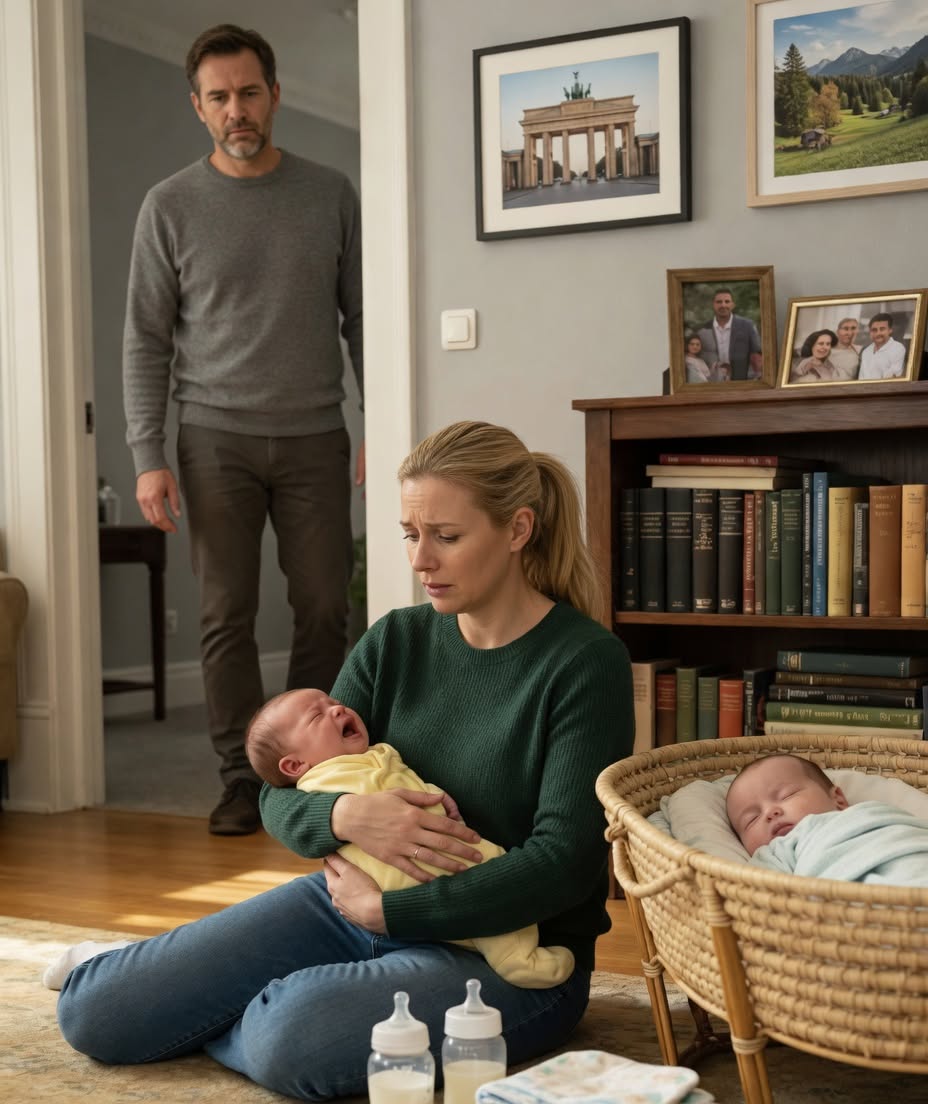
But that… wasn’t the shock. The camera captured a subtle, steady movement. Elena was rocking him gently while humming a melody—the very lullaby Seraphina had written for the twins before she died. It had never been released. No one else in the world should have known it. Then, the nursery door slowly opened. Beatrix stepped inside. She wasn’t there out of concern. She held a small silver dropper in her hand. She walked straight to Niklas’s crib—the healthy twin—and began dripping a clear liquid into his bottle. Elena stood up, still holding Lukas firmly in her arms.
Her voice echoed through the audio feed—soft, trembling, yet carrying an unmistakable tone of command. “Stop it, Beatrix,” Elena said. “I’ve already swapped the bottles. You’re giving him nothing but plain water now. That sedative you used to pump Lukas full of so he’d appear ‘sick’? I found the vial in your vanity yesterday.” I couldn’t move. The tablet shook in my hands. “You’re nothing but an employee,” Beatrix snapped at her on the screen, her face twisted with rage. “No one will believe you. Alistair thinks Lukas’s condition is genetic. As soon as he’s declared unfit, I get custody, the estate, everything—and you disappear back to where you came from.” “I’m not just an employee,” Elena countered, stepping into the light.
She reached into her apron and pulled out an old, worn locket. “I was the nursing student on duty the night Seraphina died. I was the last person she spoke to.” Her voice broke. “She told me you’d tampered with her IV. She knew you wanted the Thurn name. Before she passed away, she made me swear I’d find her sons if she didn’t make it. I spent two years changing my name and my appearance just to get into this house—to protect them from you.” Beatrix lunged at her. I didn’t wait to see what happened next. Seconds later, I was out of bed and running down the hallway, rage burning through my veins. I burst into the nursery just as Beatrix raised her hand to strike Elena. I didn’t scream. I simply grabbed her wrist and looked her in the eye. “The cameras record in HD, Beatrix,” I said icily. “And the police are already at the gate.”
The true end didn’t come when Beatrix was led away in handcuffs—though that did happen. It came an hour later, once the house had finally fallen silent. I sat on the floor of the children’s room, right where Elena had been sitting. For the first time in two years, I didn’t see my sons as problems to be solved or responsibilities to be managed, but as living parts of the woman I loved. “How did you know that song?” I asked Elena, my voice heavy with tears. She sat beside me, gently resting her hand on Lukas’s head. Lukas wasn’t crying; for the first time in his life, he was sleeping peacefully. “She sang it to them every night in the hospital,” Elena whispered. “She said that as long as they heard that melody, they would know their mother was still watching over them. I just… didn’t want the song to end.”
In that moment, I realized that despite all my wealth, I had been utterly poor. I had built walls of glass and surveillance, but I had forgotten to build a home rooted in love.
The Lessons Behind the Story:
Trust is not a transaction: You can buy the best security in the world, but you cannot buy the loyalty of a heart that truly cares.
Grief can blind you: Alistair was so focused on his own pain that he let a monster into his home and ignored the heroine standing right in front of him.
A mother’s love knows no bounds: Seraphina’s love for her children was so powerful that she reached out from beyond the grave to find a protector willing to sacrifice everything to keep a promise.
Character is revealed in the dark: What we do when we believe no one is watching is the only true measure of who we are.
Everything was finally resolved. I didn’t fire Elena. I appointed her head of the Seraphina Foundation, a non-profit organization we had built together to protect children from exploitation within families. And every