
PART 3
Luise escorted Elias and Leni up to Suite 904, carrying the flower vase.
Inside, Leni woke up and asked where they should put the flowers.
“By the window,” Elias said. “Where Mama can see them.”
Luise placed the roses on the table overlooking the Frankfurt skyline. One stem was bent, but it was still blooming.
Leni touched it gently. “This one looks tired.”
Luise smiled. “Sometimes tired flowers just need fresh water and time. Then they stand up straight again.”
Before Luise left, Elias stopped her.
“Thank you for not looking away.”
She lowered her gaze. “I know what it feels like when people look right through you. After my husband died, I took every job I could get to raise my sons. When I saw you tonight with your little girl, I couldn’t stay silent.”
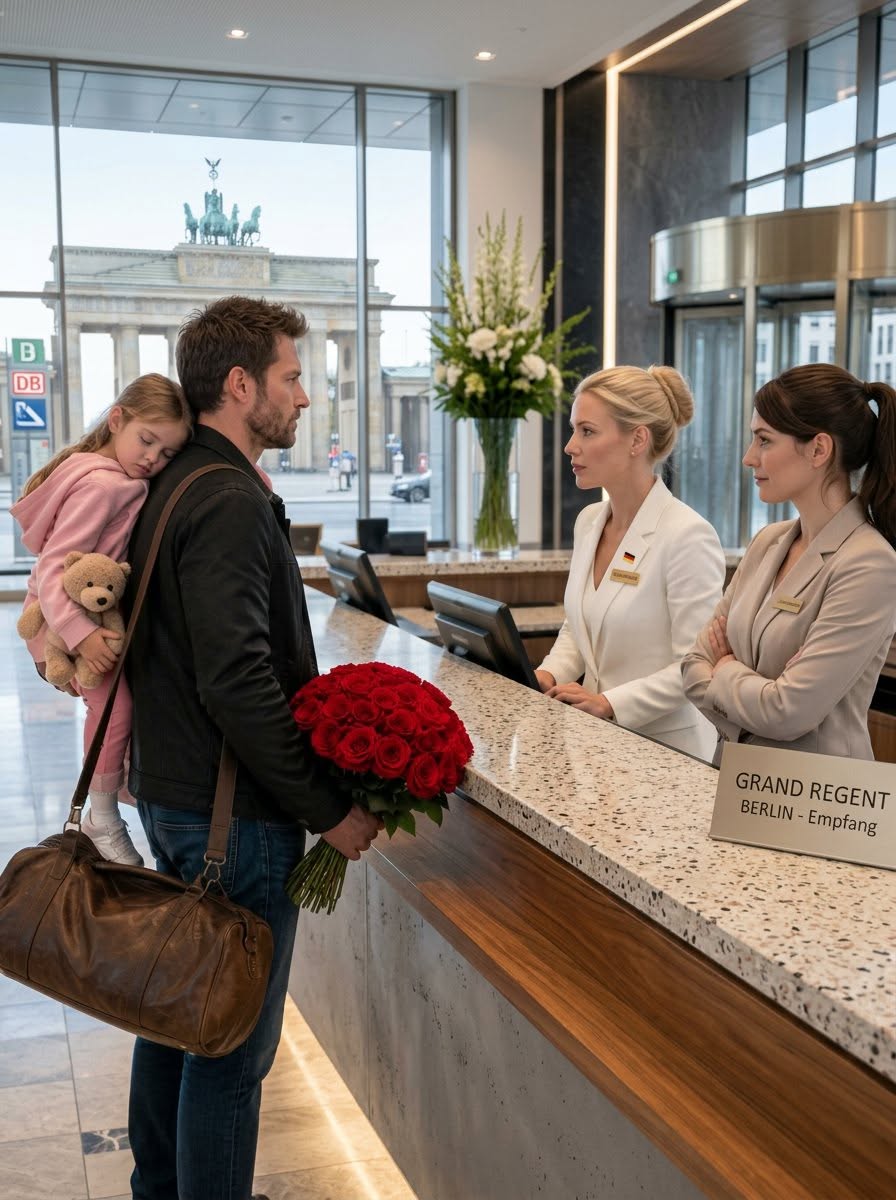
The next morning, Elias called an emergency meeting in the main lobby, right in front of the reception desk where it had all happened.
He placed Luise’s printed evidence on the marble counter.
“For months, this hotel ignored warning signs,” he said. “Guests were judged by their appearance. Employees were humiliated based on their rank. Complaints were buried. That culture ends today.”
Robert was later dismissed after a full audit revealed years of cover-ups. Patricia and Karla were fired after video footage and records proved that their behavior was systematic.
But Elias’s most important decision was not about firing people.
It was about promoting the right person.
He launched a new program for employee welfare and guest experience across all seven hotels.
Luise was to lead it.
At first, she declined. “Elias, I barely have a high school diploma.”
He said: “You understand hospitality better than people with expensive degrees. Hospitality is not a gold room key. It means making someone feel like they belong.”
A year later, Luise “Lu Lotte” Herrmann became Regional Director of Interpersonal Culture at the Weber Hotel Group.
On her desk stood a photograph of red roses in a crystal vase, one stem slightly bent, but in full bloom.
On the plaque beneath it read: “Thank you for seeing us when it would have been easier to look away.”
Years later, Leni asked Elias why he hadn’t yelled at the people who had insulted them.
Elias looked at the portrait of Sarah, which stood beside fresh red roses.
“Because dignity doesn’t need a scene to be powerful,” he said. “Sometimes it just takes one person who sees the truth and does the right thing.”
Leni smiled. “Like Luise.”
Elias nodded.
“Just like Luise.”