
Part 2
At the hotel, Klara slept for fourteen hours straight.
The doctor said that exhaustion, dehydration, stress, and dangerously low blood sugar had pushed her body beyond its limits. When he asked how long she had been deprived of the necessary rest, Klara buried her face in the pillow and wept silently.
That hurt more than any screaming ever could.
That night, I fed our son every two hours. Between bottles, I watched Klara’s breathing and reviewed every warning sign I had ignored.
My mother, who criticized Klara’s “weakness.” My mother, who insisted on moving in “temporarily” after the birth. My mother, who told relatives Klara was lazy. My mother, who smiled every time Klara apologized.
When morning came, my phone showed seventy-three missed calls. Then the first messages arrived.
You’ve embarrassed me. You’ve kidnapped my grandchild. Your wife is poisoning you against your own flesh and blood. Come home before I change the locks.
The last one almost made me laugh.
Around noon, my older brother Daniel called.
“Mom says Klara attacked her,” he said.
I stood at the hotel window, watching the traffic far below, moving like glittering blades. “Did she?”
Daniel hesitated. “Listen, I know Mom can be intense…”
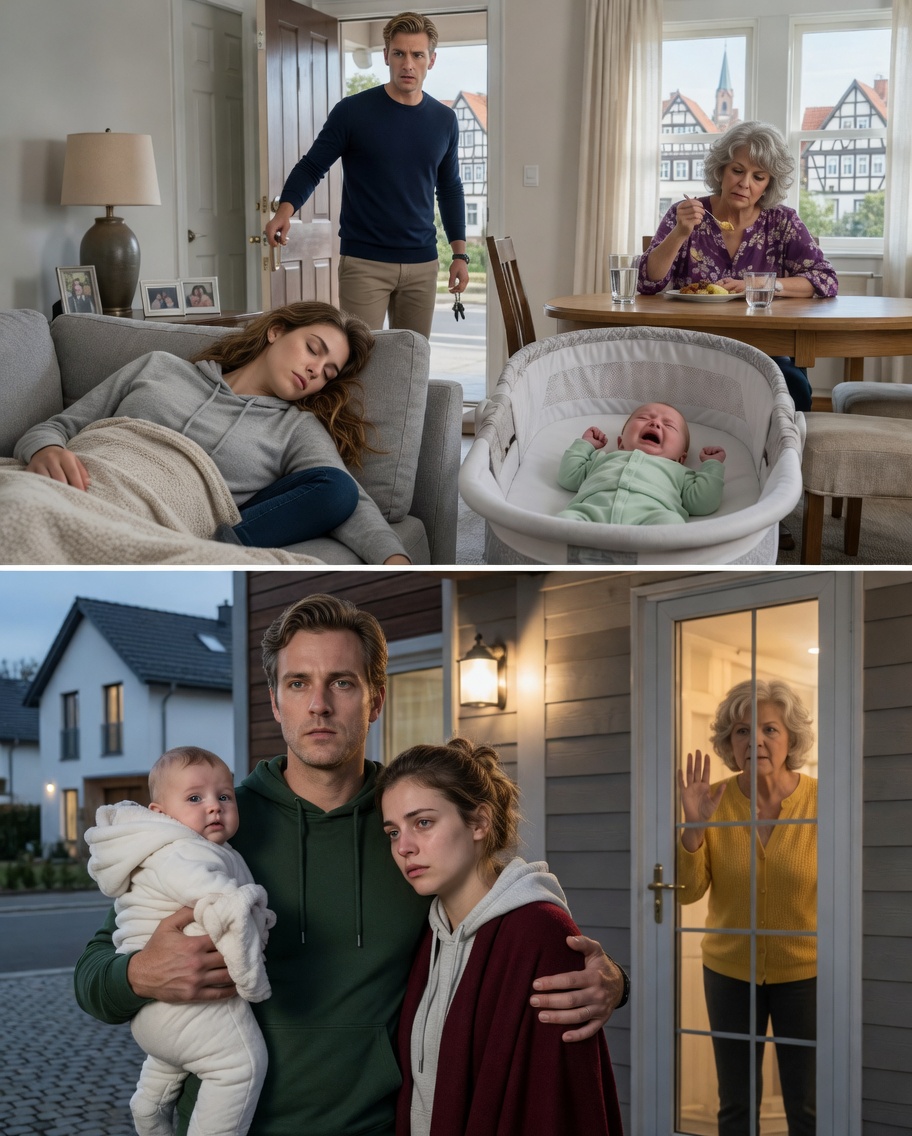
“Klara passed out while Mom was eating the food she’d forced her to prepare.”
Silence.
Then he spoke more quietly. “Mom said Klara was just faking it.”
I closed my eyes.
That was my mother’s greatest trick. She never needed the truth. She just had to be the first to speak, loud enough, until everyone else started to doubt themselves.
But she’d forgotten one thing.
I was no longer the terrified boy she cornered in kitchens. I was a contract lawyer. And I documented everything.
The house had indoor cameras because Klara had once worried the baby monitor might fail. My mother had mocked us for it and called us paranoid. She’d never bothered to ask where the cameras were.
The kitchen. The nursery. The living room. Everything was recording. Everything was automatically backed up to a cloud storage service under my name.
For the next two days, I silently gathered everything. Footage of my mother screaming while Klara stirred the soup with trembling hands. Footage of Klara begging to lie down while my mother snapped, “Not until you’ve cleaned the kitchen.” Footage of the screaming baby while my mother sat a meter away, scrolling through her phone.
And the final clip. Klara collapses. My mother eats. “Drama queen.”
I didn’t send anything yet. Not to Daniel. Not to relatives. Not to my mother.
Instead, I called my property management company and changed the building’s access code. Then I called the bank. Then our family lawyer. Then the private home health agency that my mother had once pressured me to cancel because “wives should raise their babies themselves.”
On the third day, Mother became brazen.
She posted online: “Deeply heartbroken. My son abandoned his mother for a manipulative woman who uses my grandchild as a weapon.”
Relatives flooded the comments. Poor thing. She always seemed fragile. A mother should never be treated like that.
Mother called me again that night, her voice smug and saccharine.
“Everyone knows what she is now,” she said. “Bring my grandson home, and maybe I’ll forgive her.”
Klara sat beside me, pale but awake. She held our son in both arms, as if he were the last warm being on the planet.
I put the call on speakerphone.
“My grandson,” the mother repeated. “My house. My family.”
I looked at Klara. Her eyes were moist, but determined.
“You’re right about one thing,” I said to my mother. “Everyone should know.”
Then I ended the call and uploaded the first video.