
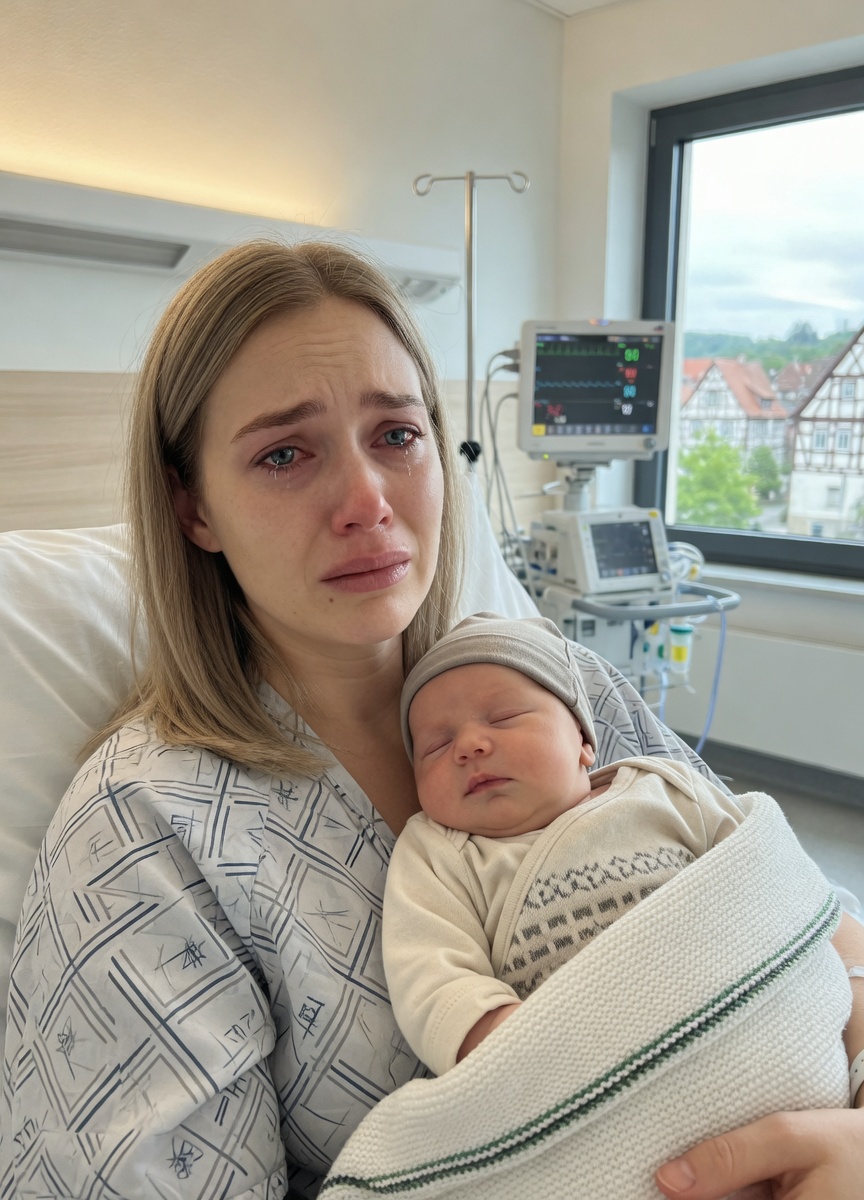
I barely registered her words. All I could focus on was the rise and fall of my baby’s chest. I memorized every eyelash, every tiny joint, afraid that even the memory might be taken from me. Within hours, the maternity ward was under internal lockdown. Nurses reviewed shift logs. Security scrutinized CCTV footage. The lab conducted a second round of DNA testing—new samples were taken from me and the baby. Dr. Peters explained each step carefully, her voice steady, as if holding me upright. The results remained the same. No maternal match. A detective introduced himself as Detective Weber and spoke plainly. “Until we prove otherwise, we are treating this as a missing infant investigation. This includes locating any baby that might have been switched. You did the right thing by calling.” Under mounting pressure, the hospital finally admitted a crucial detail: On the night I gave birth, there had been a brief overlap when two newborns were housed in the same preparation area during a shift change. A shortcut. A moment that should never have happened. And yet, it did. Early that evening, investigators identified another mother—Melanie—whose footprint records and the scan times from her wristband didn’t match. When she walked into the room, she looked as devastated as I felt. For a long time, neither of us spoke. We just stared at each other, two women trapped in the same wreckage. Finally, she whispered, “I kept telling myself I was just scared… but something felt wrong. Like my instincts were screaming.”
I nodded, tears flowing silently. I understood that feeling all too well. The commissioner offered no comfort or false hope. He promised effort, truth, and accountability. “If this was negligence, the hospital will be held responsible,” he said. “If it was intentional, we will find who did it.” Lukas arrived late that night, visibly irritated that the hospital had “completely blown out of proportion.” But the moment he saw the officers, his expression changed. For the first time, he looked frightened—not for me or the baby, but for himself and how this might backfire. That’s when I realized: The DNA test hadn’t just uncovered a medical emergency. It had exposed a person’s character. By morning, the maternity ward no longer felt like a hospital. It felt like a secured maximum-security prison after a break-in—IDs were constantly being checked, doors locked behind you, voices were quiet and cautious, as if the panic were just out of sight. Inspector Weber returned with two officers and a woman in a dark blue suit who introduced herself only as a member of the “risk management” team. She scanned the room before sitting down, as if looking for weak points. “We’re expanding the review window,” Weber said. “Not just the shift change—the entire 12 hours surrounding the delivery.” I looked at the baby—my baby—sleeping peacefully in the crib, oblivious to the chaos around it. The words escaped me like a sob. “So you still don’t know where my biological baby is.” “Not yet,” he admitted. “But we have some hot leads. For three infants, the wristband scans don’t match the timestamps of the footprints. That doesn’t usually happen by chance.” Melanie sat beside me, her eyes hollow, clutching a hospital blanket. She was no longer holding a baby. The infants had been moved to a secure nursery “for their safety,” which somehow felt like another loss—necessary, but cruel. A nurse I didn’t recognize came in for another cheek swab. Her name tag read S. MARSCH. She smiled too broadly. “Just routine,” she said, as if this were an ordinary day. As she leaned over the crib, her hand trembled—just slightly. Her eyes flickered to Weber, then to the door.
A shiver ran down my spine. After she left, I whispered, “Who was that? She wasn’t here yesterday.” Weber checked his notes. “She’s a locum from pediatrics. She was on duty the night you gave birth.” Melanie’s voice trembled. “I remember her. She made a comment about my baby crying—as if she knew him.” My throat tightened. “Can you investigate her?” Weber’s expression changed. “We already are.” An hour later, Lukas called. I almost didn’t answer. “What’s taking so long?” he snapped. “This is ridiculous. The hospital is embarrassing us.” Embarrassing us. “This isn’t about you,” I said quietly. He exhaled sharply. “If this gets out, people will think—” “Think what?” I interrupted. “That you accused me of infidelity and thus triggered an investigation that uncovered a baby switch?” Silence. Then, far too quickly: “Don’t talk to anyone without me.” In that moment, my fear found a new target. Lukas wasn’t worried about the babies. He was worried about his reputation. That afternoon, the hospital issued a statement blaming a “procedural deviation during a staff changeover.” The language was clinical and hollow—as if describing a typo instead of a catastrophe. Weber wasn’t convinced. He returned with a tablet. “Your husband checked in at 9:40 p.m. Did he leave the room?” “Yes,” I said, remembering him pacing. “He went to the self-service kiosks. He made a phone call.” “Did anyone else visit you?” I hesitated. “His mother. Donna. I was half asleep. She said she wanted to see the baby.” “Did she hold the baby alone?” I swallowed. “For a minute. Lukas was just outside.” Weber’s jaw tightened. He stepped into the hallway and made a phone call. When he returned, his tone was sharper. “We’ve reviewed the corridor’s security camera footage. At 2:17 a.m., a woman matching Donna’s description left your hallway with an infant wrapped in bundles. She returned minutes later without the child.” The room fell silent. Melanie gasped. “That means—” “We need to locate your mother-in-law immediately,” Weber said. “And your husband.” Lukas arrived an hour later, dressed in business attire, his eyes scanning the room as if calculating escape routes.
Donna followed him, clutching a crucifix, with the practiced expression of a woman ready to play the victim. “Oh, dear,” she said, reaching for me. “I was praying.” Weber stepped between us. “Madam, please wait outside.” Lukas raised a hand. “We won’t say anything without a lawyer.” “That’s your right,” Weber said calmly. “But we have good reason to ask questions.” “Questions about what?” Donna snapped. Weber showed her the video footage. “Why you were seen carrying an infant out of the delivery corridor at 2:17 a.m.” Her face hardened. “I was carrying a blanket.” “We also secured a hospital wristband from Nurse Marsh’s locker,” Weber added. “Do you know her?” Donna’s grip on the crucifix tightened. Melanie cried out, “Where’s my baby?” “Babies get mixed up sometimes,” Donna said coldly. “People should stop being so hysterical.” My fists clenched. “Because you planned it.” Lukas yelled, “Stop it—this is insane—” “Actually,” Weber said steadily, “it isn’t.” An officer came in with an evidence bag. Inside was a bracelet—neither mine nor Melanie’s. Weber turned to Lukas. “Your call records show repeated contact with Nurse Marsh before the delivery—and again after you requested the DNA test.” Lukas went ashen-faced. Donna hissed, “He was just protecting his family!” “From what?” Weber asked. “From the truth?” Then the radio crackled. “We’ve located Nurse Marsh. Parking garage. She has an infant with her.” My knees nearly buckled. Weber looked me in the eye. “We’re bringing the baby upstairs. Get ready for identification and immediate DNA confirmation.” Donna smiled thinly. “You’ll thank me,” she whispered. “Once you have the right baby.” And in that moment, everything became clear: This was no accident. It was a decision.