Then I said, “You can keep the flowers. You lost the bride.”
A sound moved through the crowd.
Half gasp.
Half sob.
My father stepped aside, not to let Caleb through, but to show him the exit.
Caleb stood there for one more second.
A man holding wedding flowers at a wedding that no longer belonged to him.
Then he turned and walked away.
This time, I did not watch until the end.
I turned back to Owen.
He looked at me with something I was afraid to name.
The officiant cleared her throat, crying.
“I’m not entirely sure what to do now.”
My mother laughed.
Then my father.
Then, somehow, everyone.
The tension cracked.
I wiped my face and looked at Owen.
“Do you still refuse to fake-marry me?”
“Yes.”
“Rude.”
“I’m consistent.”
“What exactly do you suggest?”
He glanced toward the guests.
Then back at me.
“I suggest you have the wedding you paid for.”
“With no wedding?”
“With a ceremony.”
“For what?”
He smiled.
“For the woman who stayed alive long enough to attend it.”
I stared at him.
Then I turned to the guests.
My voice was shaky, but loud enough.
“Everyone, thank you for coming to the strangest wedding in New Jersey.”
A ripple of laughter.
“I was supposed to marry someone else today. He left. Then I thought I was dying. Then I found out I might have more time than I was told. Then a man I hired to pretend became the first person who refused to lie to me.”
Owen looked down.
I continued.
“So no, I am not getting married today.”
My mother covered her mouth, smiling through tears.
“But I am still walking this aisle. I am still wearing this dress. My father still paid for the food, and I am absolutely eating the cake.”
A louder laugh.
“And if illness has taught me anything, it is this: love is not the person who promises forever when forever looks pretty. Love is the person who stays when forever becomes uncertain.”
I looked at my parents.
Then Owen.
“So today, I choose to stay.”
The officiant lifted her chin.
“In that case,” she said, voice trembling, “by the authority of absolutely no legal institution whatsoever, I now pronounce this day reclaimed.”
Everyone stood.
Applause broke over the garden.
Not polite applause.
Not wedding applause.
Survival applause.
My father hugged me so tightly I almost lost my breath.
My mother sobbed into my veil.
Owen stepped back, giving us the moment.
But my father reached for him too.
For one second, Owen looked startled.
Then my father pulled him into the hug.
“Thank you,” he said.
Owen’s eyes closed.
“You’re welcome, sir.”
The reception became the most beautiful disaster I had ever seen.
The seating chart was wrong because Caleb’s family left early.
Nobody cared.
My aunt got drunk and told everyone she had always thought Caleb had “weak ankles and weaker character.”
My mother danced with me barefoot.
My father gave a speech that lasted eighteen seconds because he cried after the first sentence.
He lifted his glass and said, “To my daughter, who taught us that canceled does not mean over.”
Then he sat down.
Perfect speech.
Owen danced with me after dinner.
The string lights glowed above the courtyard.
My dress brushed against his shoes.
I was tired by then.
Pain had started low in my abdomen, dull and mean.
He noticed.
“You need to sit.”
“I need to dance.”
“You can do both badly.”
“I hired you for emotional support, not commentary.”
“You didn’t hire me.”
“Because you’re stubborn.”
“Because you needed one person not taking from you.”
I looked up at him.
The music was slow.
Not romantic in the dramatic movie way.
Something older.
Gentler.
“You embarrassed me at the altar,” I said.
“Yes.”
“You exposed everything.”
“Yes.”
“You made me face Caleb.”
“No,” he said. “You did that.”
I swallowed.
“I’m scared, Owen.”
His hand tightened lightly at my waist.
“I know.”
“If treatment doesn’t work—”
“Then we deal with that day when it becomes today.”
“And if I lose my hair?”
“I’ll help you pick scarves.”
“If I get mean?”
“You already are.”
I laughed.
Then cried again.
He smiled faintly.
“If you get scared?”
“I am scared.”
“Then I’ll sit with you.”
The song ended.
Neither of us moved.
I whispered, “Why does this feel more real than my actual engagement?”
“Because nobody is selling you certainty.”
I rested my forehead against his chest.
“I don’t know what you are to me.”
His voice came quietly above me.
“That’s okay.”
For once, I believed it.
Treatment began the following week.
There is nothing cinematic about treatment.
No montage can capture the smell of antiseptic, the taste of metal, the humiliation of needing help to shower, the rage of watching hair come out in your hands, the boredom of infusion rooms, the terror before every scan.
Owen drove me to the first appointment.
Then the second.
Then the tenth.
He brought coffee that slowly improved.
He kept a notebook with medication names because my father panicked around medical terms and my mother cried whenever side effects were listed.
He learned when to joke and when to shut up.
That mattered.
People underestimate silence.
Good silence can hold a person together.
Bad silence abandons them.
Owen’s silence stayed in the room.
Caleb sent flowers after my first treatment.
I threw them away.
Then he sent a letter.
I did not open it.
Then he showed up at my parents’ house one afternoon while Owen was helping my father fix a loose cabinet door.
I was on the couch under a blanket, bald under a soft blue scarf, nauseous and furious at my own weakness.
My mother opened the door.
Her voice turned cold.
“She is resting.”
“I need to see her,” Caleb said.
Owen came into the hallway.
Caleb saw him and stiffened.
“You’re still here?”
Owen wiped his hands on a towel.
“Yes.”
“What, are you living here now?”
“No.”
“He’s helping,” my mother snapped.
Caleb looked past them and saw me.
His face changed.
Not love.
Shock.
Pity.
I saw myself through his eyes.
Thin.
Pale.
Sick.
Not the bride.
Not the girl in satin.
The version he had run from.
I pulled the blanket tighter.
He whispered, “Emily.”
I said, “Now you can leave again accurately.”
His face crumpled.
“I deserved that.”
“Yes.”
“I’m sorry.”
“I know.”
“I wrote you a letter.”
“I didn’t read it.”
He swallowed.
“I needed you to know I’m in therapy.”
“Good.”
“And I know I hurt you.”
“Yes.”
“And I know I don’t deserve another chance.”
“You’re right.”
Owen looked at me, silent.
Caleb took a breath.
“I’m not asking for one.”
That surprised me.
He reached into his coat and pulled out a small envelope.
My father moved forward like he might tackle him.
Caleb quickly held it out.
“It’s the refund from the honeymoon.”
I stared.
“What?”
“I canceled it after I left. I kept the refund. I told myself I’d give it back when things calmed down.”
My mother made a sound of disgust.
Caleb’s face reddened.
“I know. It was wrong. Everything was wrong.”
He placed the envelope on the entry table.
“It’s yours.”
No one spoke.
He looked at Owen.
Then at my parents.
Then back at me.
“I don’t expect forgiveness.”
I answered honestly.
“Good.”
He nodded, tears in his eyes.
Then he left.
This time, there was no grand speech.
No bouquet.
No applause.
Just a man finally returning something that was never his.
When the door closed, I looked at Owen.
“Did I do okay?”
His face softened.
“You did better than okay.”
“I wanted to scream.”
“You didn’t.”
“I wanted to.”
“You’re allowed.”
So I did.
Not at Caleb.
Not at anyone.
I screamed into a pillow until my throat hurt.
My mother cried.
My father stood in the kitchen with both hands on the counter.
Owen sat on the floor beside the couch and stayed there until I fell asleep.
Months passed.
Ugly months.
Holy months.
Months where I wanted to die just to stop feeling poisoned.
Months where Dr. Shah smiled for half a second at a scan and my whole family acted like we had won a war.
Months where I hated everybody for hoping too loudly.
Months where Owen learned to braid the tiny amount of hair I had left before it disappeared completely.
Months where I saw myself in the mirror and whispered, “Still here.”
At first, I said it like a challenge.
Then like a prayer.
Then like a fact.
Still here.
Still here.
Still here.
Owen never kissed me.
Not once.
That became unbearable around month five.
I had lost weight.
Lost hair.
Lost modesty.
Lost patience.
But somehow, I had not lost the part of me that noticed the way his eyes softened when I laughed.
One evening, after a scan that showed the treatment was working, we sat on my parents’ porch.
It was raining lightly.
He brought two mugs of tea.
I looked at him and said, “Are you ever going to admit you like me?”
He choked on his tea.
It was deeply satisfying.
“I’m sorry?”
“You heard me.”
He set the mug down.
“You are on a lot of medication.”
“Do not blame chemo for my excellent perception.”
He rubbed his face.
“Emily.”
“That’s a warning tone.”
“It’s a careful tone.”
“I hate careful.”
“No, you don’t. You hate cowardly. They’re not the same.”
That stopped me.
He was right.
I hated when he was right.
He leaned back.
“You are in the middle of treatment. You were abandoned. You are vulnerable. I was hired—”
“You refused payment.”
“Still. I entered your life under strange circumstances.”
“Strange is one word.”
“I don’t want to become another man who takes advantage of your fear.”
I stared at him.
Then looked away because tears came too fast.
“That is the most Owen answer imaginable.”
“I’m sorry.”
“No. You’re not.”
“No, I’m not.”
We sat in silence.
The rain tapped the porch roof.
Finally, I said, “What if I don’t want to be protected from every beautiful thing just because I might get hurt?”
His eyes closed.
I continued.
“What if I die anyway? Do I only get doctors and soup and responsible boundaries?”
His jaw tightened.
“No.”
“What if I live? Do we pretend this was only support?”
“No.”
“Then what are we doing?”
He looked at me.
For the first time since the altar, he looked scared.
Truly scared.
“I’m staying,” he said.
“That’s not an answer.”
“It’s the only one I trust.”
I moved closer.
He didn’t.
Not away.
Not toward.
Just still.
So I touched his face.
He inhaled sharply.
“I am not asking you to save me,” I whispered.
“I know.”
“I am not asking you to replace what Caleb broke.”
“I know.”
“I am not asking for forever.”
His eyes filled.
“Emily.”
“I am asking for tonight to be honest.”
That did it.
He kissed me like a man who had been holding back with both hands.
Careful at first.
Then not.
The rain kept falling.
My tea went cold.
My mother saw us through the window and immediately turned around so fast she hit the cabinet.
My father later pretended he had seen nothing.
He had seen everything.
Two years later, Dr. Shah said the word remission.
Not cured.
Doctors are cautious people.
They do not hand out forever.
But remission felt like sunlight after living underground.
My mother screamed.
My father cried.
Owen sat down in the exam room and covered his face.
I stared at Dr. Shah.
“Say it again.”
She smiled.
“Remission.”
I laughed.
Then I sobbed.
Then I asked, “Can I have pizza?”
Dr. Shah said, “Yes, Emily. You can have pizza.”
I looked at Owen.
He was still crying into his hands.
“Support person,” I said.
He looked up.
“Yes?”
“We need pizza.”
He laughed so hard Dr. Shah cried too.
Life after remission was strange.
People think survival is the end of the story.
It is not.
Survival is another country.
You enter with no map.
You are grateful and angry and tired and afraid to make plans because plans once betrayed you.
Your hair grows back different.
Your body carries scars.
Your calendar fills with follow-ups.
Every headache becomes a question.
Every pain becomes a courtroom.
But mornings came.
Then weeks.
Then seasons.
I moved into a small apartment near the park.
Not with Owen.
Not yet.
I needed to learn who I was when I was not Caleb’s fiancée, not my parents’ sick daughter, not Owen’s rescued woman, not the bride without a groom.
Just Emily.
I bought ugly yellow curtains because Caleb would have hated them.
I adopted a senior dog named Meatball because Owen said I should start with a plant and I disliked his tone.
Meatball hated everyone except my father.
My father was honored.
Owen and I dated slowly.
So slowly my mother asked if we were being supervised by the government.
We went to diners.
We walked in the park.
We argued about coffee.
We visited Lucy’s grave, where Owen introduced me as “the woman who proved me right and wrong at the same time.”
I placed white daisies by the stone.
“Thank you,” I whispered.
Owen stood beside me.
“For what?”
“For making your brother annoying enough to save my life.”
He laughed.
Then cried.
Three years after the wedding that wasn’t, Owen proposed.
Not in a restaurant.
Not at the venue.
Not under string lights.
In my apartment kitchen, while Meatball barked at thunder and I burned grilled cheese.
I turned around and he was on one knee.
I almost dropped the pan.
“No,” I said.
His face went white.
I quickly shouted, “I mean not while I’m holding flaming cheese.”
He looked at the pan.
“Oh.”
I put it down.
Smoke filled the kitchen.
Meatball barked louder.
Owen stayed on one knee, coughing.
“This is not how I pictured this.”
I opened a window.
“How did you picture it?”
“With less smoke.”
“Unrealistic.”
He laughed nervously.
Then held up a ring.
Not huge.
Not flashy.
Perfect.
“Emily Rose Whitaker,” he said, voice shaking, “I once refused to fake-marry you because you deserved honesty.”
My chest tightened.
“I still believe that.”
He swallowed.
“So honestly, I love you. Not because you survived. Not because you were sick. Not because I wanted to save someone after losing Lucy.”
His eyes shone.
“I love you because you are bossy, impossible, brave when you have to be and dramatic when coffee is bad. I love you because you reclaimed a wedding, a body, a future, and somehow my life too.”
I was crying.
Of course I was.
“I don’t know how many years any of us get,” he said. “But I know I want mine beside you.”
Meatball barked once, as if voting.
Owen looked annoyed.
“Please ignore him.”
I laughed through tears.
“Yes.”
Owen froze.
“Yes?”
“Yes.”
He stood too fast and nearly slipped on the kitchen rug.
I kissed him while the smoke alarm screamed.
It was perfect.
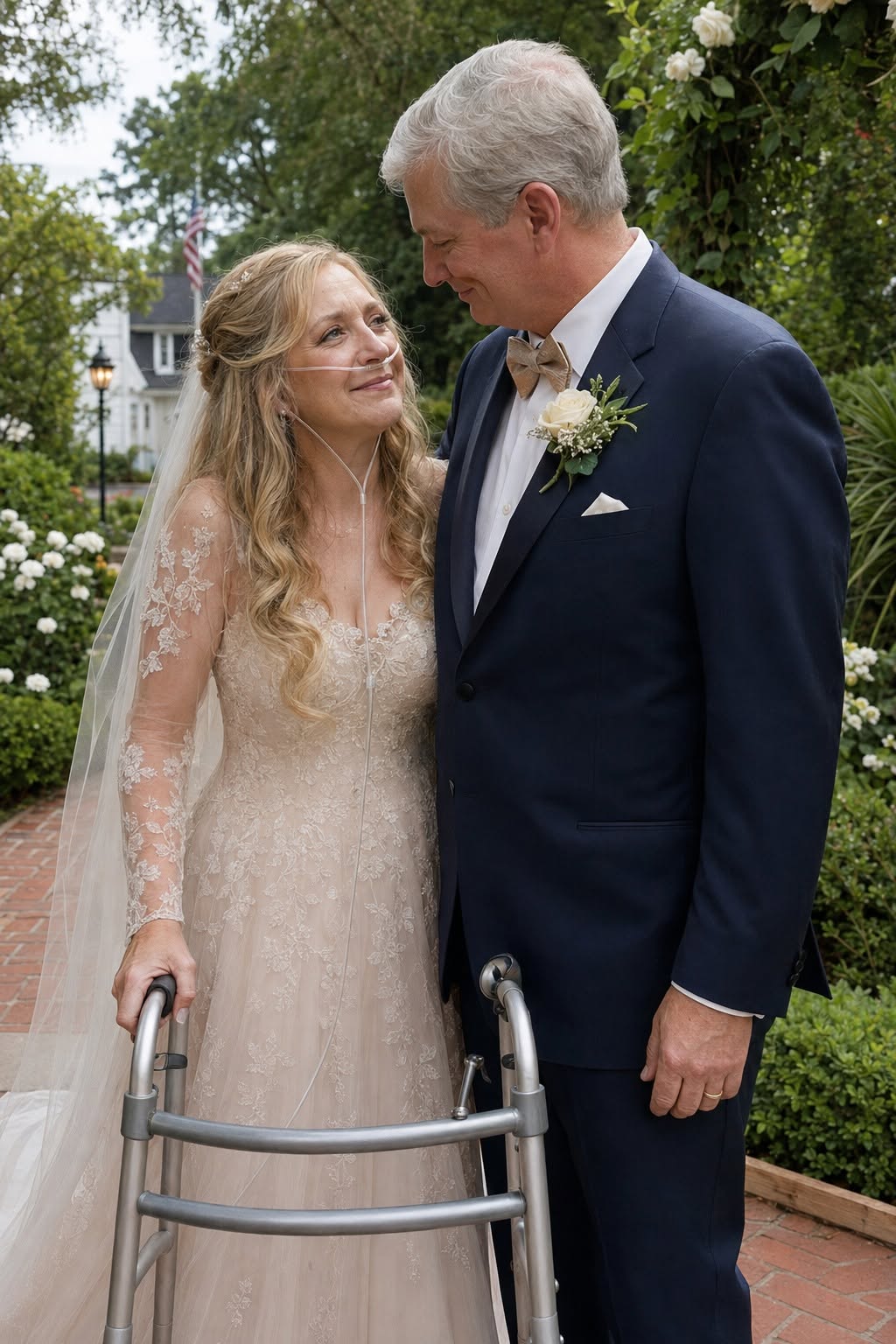
Our real wedding was small.
Forty people.
Backyard.
No rented actor.
No pity.
No Caleb.
My father walked me down the aisle again.
Older now.
Still crying.
My mother wore blue and kept touching my hair because it had grown back in soft dark curls.
Dr. Shah came.
So did Owen’s niece, who brought the plastic dinosaur and placed it beside the cake “for protection.”
When I reached Owen, he whispered, “You look like trouble.”
I whispered back, “You look expensive.”
“I rented the suit.”
“Of course you did.”
The officiant was the same woman from the first ceremony.
She smiled at us and said, “I have been waiting years to do this properly.”
Everyone laughed.
This time, when vows came, I had words ready.
“Owen,” I said, “the first time you stood beside me at an altar, you refused to lie.”
His eyes filled.
“I was furious.”
A ripple of laughter.
“Then grateful. Then terrified. Then in love.”
My voice shook.
“You met me when I thought my life was ending. But you did not treat me like an ending. You treated me like a person still allowed to choose, laugh, rage, hope, and eat cake.”
He wiped his eyes.
“You taught me that love is not the man who says forever when forever is easy. Love is the man who says, ‘I’m here today,’ and keeps saying it until today becomes years.”
My mother sobbed loudly.
My father handed her a tissue without looking away from me.
“So here is my vow. I will not waste the life I got back. I will not pretend fear is gone. I will not make survival pretty just to comfort other people. I will love you honestly, loudly, stubbornly, and with better coffee than you deserve.”
Owen laughed through tears.
“I deserve normal coffee.”
“You deserve consequences.”
Then his vows.
“Emily,” he said, “I once thought grief was a room you learned to live inside. Then you came in wearing a wedding dress and kicked out a wall.”
I cried immediately.
Unfair.
“You made me understand that staying is not passive. Staying is a choice. A discipline. A daily act of courage. I vow to stay when life is ordinary, when it is frightening, when scans are clean, when scans are not, when the dog hates me, when the grilled cheese burns, when you buy curtains that attack the human eye.”
“They’re cheerful,” I whispered.
“They’re criminal.”
Everyone laughed.
His voice softened.
“I vow not to worship your survival so much that I forget your humanity. I vow to love you when you are strong and when you are tired of being called strong. I vow to remember that forever is made of days, and every day with you is one I choose.”
The officiant finally said the words.
Real words.
Legal words.
Beautiful words.
“I now pronounce you husband and wife.”
Owen kissed me.
Not as an actor.
Not as a support person.
As my husband.
And this time, nobody reclaimed the day.
There was nothing left to reclaim.
It was already ours.
Ten years later, we renewed our vows at the original venue.
Not because we needed to.
Because my father insisted he had paid for 120 guests once and “deserved a normal party before he died.”
He did not die.
He danced badly for three hours and complained about the DJ.
My mother wore silver shoes and told everyone, “This is the wedding I ordered.”
Dr. Shah came again.
Owen’s niece, now in college, brought the same plastic dinosaur.
Meatball had passed years earlier, so we placed his collar near the guest book because my father said he was family and my mother said, “He bit three cousins,” and my father said, “Still family.”
Caleb sent a card.
I almost didn’t open it.
Owen said, “You don’t have to.”
“I know.”
I opened it anyway.
Inside was a short message.
Emily,
I heard about the vow renewal through an old friend. I won’t intrude. I only wanted to say congratulations.
You were right about me. I loved the easy version of life. Losing you forced me to face that. I am married now, with a daughter, and I hope I am teaching her to be braver than I was.
I am sorry for the pain I caused.
I’m glad you lived.
Caleb
I read it twice.
Then handed it to Owen.
He read it and nodded.
“How do you feel?”
I looked across the venue.
At my parents.
At Dr. Shah laughing with Owen’s niece.
At the flowers.
At the arch.
At the place where I had once stood with a hired stranger and a broken heart.
“I feel free,” I said.
Owen kissed my temple.
“That’s a good ending.”
I smiled.
“No.”
“No?”
I took his hand.
“It’s a good middle.”
He laughed.
That night, under string lights, my father gave another speech.
This one lasted a full minute.
A family record.
He lifted his glass.
“Years ago, I paid for a wedding I thought had been ruined. I watched my daughter walk toward a man who was not supposed to matter, on a day that was not supposed to make sense.”
His voice trembled.
“I thought I was watching the saddest day of her life.”
He looked at me.
“I was wrong.”
My mother took his hand.
“That day showed us who left. More importantly, it showed us who stayed.”
Owen squeezed my fingers.
My father raised his glass higher.
“To Emily and Owen. To second opinions. To strange beginnings. To support people who become family. And to the fact that my daughter still owes me for the open bar.”
Everyone laughed.
I stood and shouted, “Put it on my inheritance tab.”
He pointed at me.
“You’re not getting one. We spent it on flowers twice.”
The whole room erupted.
Later, Owen and I danced alone after most guests had gone.
The staff cleared tables around us.
My shoes were off.
My feet hurt.
My body was older, scarred, and alive.
Owen’s hair had gray at the temples now.
He looked better for it.
Annoyingly.
“Do you ever think about that first email?” I asked.
He smiled.
“All the time.”
“You were very bossy.”
“You were trying to hire a groom online.”
“I was vulnerable.”
“You were unhinged.”
“I had cancer.”
“That was not the unhinged part.”
I laughed and rested my head against his shoulder.
“Your condition saved my life.”
“No,” he said quietly. “You saved your life by agreeing.”
I thought about the girl I had been then.
The woman staring at a laptop in the dark.
The abandoned bride.
The terminal patient.
The daughter trying not to break her parents.
The desperate stranger asking an actor to stand beside her so she would not look unloved at the end of her life.
I wished I could go back and sit beside her.
Not to tell her everything would be easy.
It wouldn’t.
Not to promise she would live.
Nobody could promise that.
I would only take her hand and say:
He left.
You didn’t.
That is where your story begins again.
Owen’s voice brought me back.
“What are you thinking?”
I looked at the flowers.
The lights.
The man I had not meant to love.
“The wedding didn’t have to be canceled,” I said softly.
He smiled.
“You only needed another groom?”
I shook my head.
“No.”
I looked up at him.
“I only needed one person to tell me I wasn’t already gone.”
His eyes softened.
“You were never gone.”
I kissed him.
And for once, there was no diagnosis in the room.
No ghost of Caleb.
No borrowed groom.
No pity.
No countdown.
Only music.
Only breath.
Only my mother laughing somewhere behind us.
Only my father arguing with the bartender about whether leftover cake could be boxed.
Only Owen’s hand warm against my back.
Only the life I almost didn’t get, opening wider and wider until it no longer felt borrowed.
People love to say perfect endings are not real.
Maybe they are right.
Maybe real endings are always messy.
Maybe someone always has a scar.
A missing guest.
A bad scan in the past.
A letter you never read.
A fear that still wakes you at 3 a.m.
But perfection, I learned, is not the absence of pain.
It is the moment pain no longer gets the final word.
Caleb left.
Cancer came.
Hope arrived late.
Owen stayed.
My parents danced.
The flowers bloomed twice.
And I lived long enough to marry the man I hired to pretend.
Only he never pretended.
Not once.
THE END