
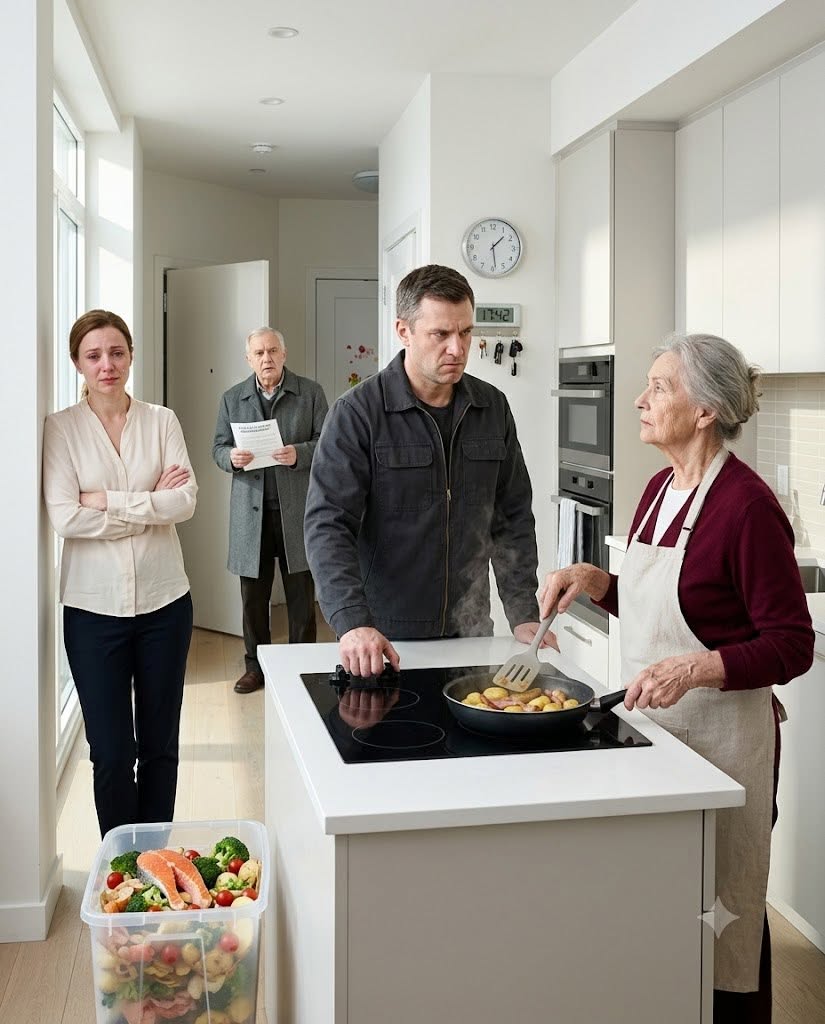
For Galina Petrovna, a household was only right when the air was thick with grease, meat was boiling in the pot, and someone stood at the stove with a flushed face.
She had raised Alexei on her own after his father left early on.
That was her most powerful weapon and her deepest wound.
She had worked night shifts, cooked soups, sewn on buttons, and taught a boy how to grow up without a father.
Alexei knew that.
Maria knew it, too.
That was why they had let Galina Petrovna get away with so much.
Too much.
The spare key had once been a sign of trust.
Maria had given it to her when Kirill developed severe bronchitis at the age of four and Galina Petrovna had offered to drop off medicine during the day.
Later, she would bring Anya back from kindergarten whenever Maria was stuck in traffic.
She had been there for birthdays, for nights spent nursing fevers, for a burst water pipe, and for the day Maria couldn’t speak because of tonsillitis.
A key for emergencies turned into a key for opinions.
Then it became a key for control.
At first, it was comments.
“A boy needs meat.”
“A girl shouldn’t look so pale.”
“Your place doesn’t smell like home.”
Maria gave friendly answers for a long time.
She explained that Kirill and Anja regularly visited the pediatrician.
She showed the recommendations from the practice, the vaccination record, the growth charts, and the note from the pediatrician’s office dated March 3rd, which stated that both children were developing appropriately for their age.
Galina Petrovna nodded then, as if accepting the paper.
But people like Galina Petrovna only accept paper when it serves their purposes.
If it doesn’t, they call it a modern invention.
Maria had bought the trout on the morning of that Wednesday.
She kept the receipt because she carefully documented household expenses.
It showed the time 5:48 p.m., followed by the supermarket’s name and the items: red trout, broccoli, cherry tomatoes, and a small pack of lemons.
At 6:21 p.m., she slid the baking sheet into the oven.
At 6:56 p.m., she took it out.
At 7:01 p.m., no one rang the doorbell.
The key simply turned in the lock.
Maria was standing in front of the oven, wearing oven mitts, when Galina Petrovna walked in.
Kirill was already sitting at the table, rolling a napkin into a trumpet shape.
Anya asked if she could have five tomatoes this time, because she was seven years old and seven-year-old girls deserved five tomatoes.
Maria was laughing just as Galina Petrovna entered the kitchen.
The scent of lemon, fish, and roasted vegetables hung warmly in the air.
It was the scent of an evening that could have remained peaceful.
Galina Petrovna did not greet the children with a hug.
She looked first at the baking sheet.
Then at Maria.
Then back at the baking sheet.
“What is that?” she asked.
Maria could tell from the tone alone that it wasn’t a real question.
“Dinner,” she said.
“You call that dinner?”
Kirill stopped rolling his napkin.
Anja gripped her fork with both hands.
Galina Petrovna stepped over to the stove, took the baking sheet as if it belonged to her, and set it on the counter.
Maria said, “Please put that back. It’s hot.”
Galina Petrovna took the silicone spatula from the jar next to the stove.
Later, Maria remembered that specific detail.
Not the first insult.
Not the volume of the voice.
The blue silicone spatula—the one Anja had picked out because it looked like a piece of the sky.
Using that spatula, Galina Petrovna pushed the trout into the trash.
First one piece.
Then the second.
Then the broccoli, tomatoes, and lemon slices—everything landing on top of potato peels and empty packaging.
The sound was soft and sickening.
No crashing, no shattering.
Just the dull thud of food being destroyed out of contempt.
“Normal people don’t eat tasteless filth like this,” Galina Petrovna told the children.
Anja whispered, “Mommy made it.”
“Exactly,” said Galina Petrovna.
Maria put down the oven mitts.
She could have screamed.
She could have snatched the spatula right out of Galina Petrovna’s hand.
Instead, she simply said, “You’re stopping now.”
Her voice was calm enough to make Galina Petrovna feel secure.
That was her mistake.
Some people mistake calmness for weakness.
In truth, calmness is sometimes the last fence before the abyss.
Galina Petrovna began her speech.
She explained to Kirill and Anya that growing bodies needed fat.
She said their mother was ruining their digestion with toxic waste.
She said only a grandmother knew how to feed children properly.
Kirill was the first to stand up.
“I don’t want to,” he said.
Anya slid off her chair and took his hand.
Maria walked toward them but didn’t touch them right away, because she could see they were both tense—like small animals that had heard a noise that was too loud.
“Go to your room,” she said quietly.
They went.
The door didn’t slam shut.
That made everything worse.
Meanwhile, Galina Petrovna opened drawers.
She found Maria’s frying pan, bacon fat, potatoes, and Maria’s light-colored apron.
She tied it around herself as if it were a uniform of conquest.
Then she began to fry.
At 7:09 p.m., Maria did not send Alexei a message.
She did not call him.
She waited.
Not because she needed help throwing a woman out of her kitchen.
But because she knew Alexei needed to see this scene with his own eyes.
A marriage survives many things.
But it dies a slow death when one partner only ever hears about the intrusions and is never forced to grasp them in real time.
When Alexei entered the apartment at 7:12 p.m., the smell of bacon fat had already crept through the hallway.
Maria stood in the doorway.
She spoke the sentence that set everything in motion.
“Your mother has been systematically scraping the entire dinner into the trash can, after explaining to Kirill and Anya that I’m ruining their digestion with toxic waste.”
Alexei stopped.
He took off his shoe and placed it on the shelf. This neat little action might have seemed odd had Maria not seen how white his fingers turned while doing it.
He didn’t ask if she was overreacting.
He didn’t ask if there had been a misunderstanding.
That was the first moment all evening that Maria breathed again.
Alexej went into the kitchen.
What he saw there wasn’t an argument about taste.
It was a crime scene—just without the police.
The baking sheet sat empty on the counter.
The silicone spatula lay greasy on the edge of the sink.
The clear trash bag revealed everything Galina Petrovna had wanted to destroy: red trout, broccoli, cherry tomatoes, lemon wedges, and potato peels—jumbled together like evidence in a poor hiding place.
The pan was sizzling on the stove.
Galina Petrovna moved around it with the confidence of a woman who believed motherhood was a lifelong warrant issued against her son’s boundaries.
“Turn off the stove,” Alexej said.
She didn’t.
So he did.
The click of the knob was quiet.
In that kitchen, it sounded like a verdict.
Galina Petrovna’s indignation was directed first at the potatoes.
Not at Maria.
Not at the children.
Not at the trash.
At the potatoes.
“They’re soaking up all the grease now,” she said.