David’s phone vibrated again before he could ask Bishop what he had found, and the message on the screen forced him to reconsider who had been protecting the three young men from the beginning.
The name was the detective standing twenty feet away from Nora’s hospital room.
David read it twice.
Not because he was surprised that someone had been compromised.
Because he had already seen the man’s hands shake when he said the name Holbrook.
Bishop called immediately.
“Do not confront him,” he said.
David watched through the narrow glass panel as the detective spoke quietly with a nurse at the far end of the corridor.
“I wasn’t planning to.”
That was the old instinct talking.
Nineteen years earlier, Commander David Vance had been trained to enter a problem fast, identify the threat, isolate it, and take control before anyone else understood what was happening.
David Miller had learned something harder.
Sometimes the strongest move was waiting long enough for someone to expose himself.
“What do you have?” David asked.
“Enough to know he received several calls before he came to the hospital,” Bishop said. “I’m still verifying who made them. We stay with records we can authenticate. Nothing else.”
David understood the warning.
Vanguard had once operated in places where ordinary rules barely existed.
This was different.
This was his daughter.
If he wanted the truth to survive, it had to survive daylight too.
“No shortcuts,” David said.
Bishop paused.
“Understood.”
David ended the call and returned to Nora.
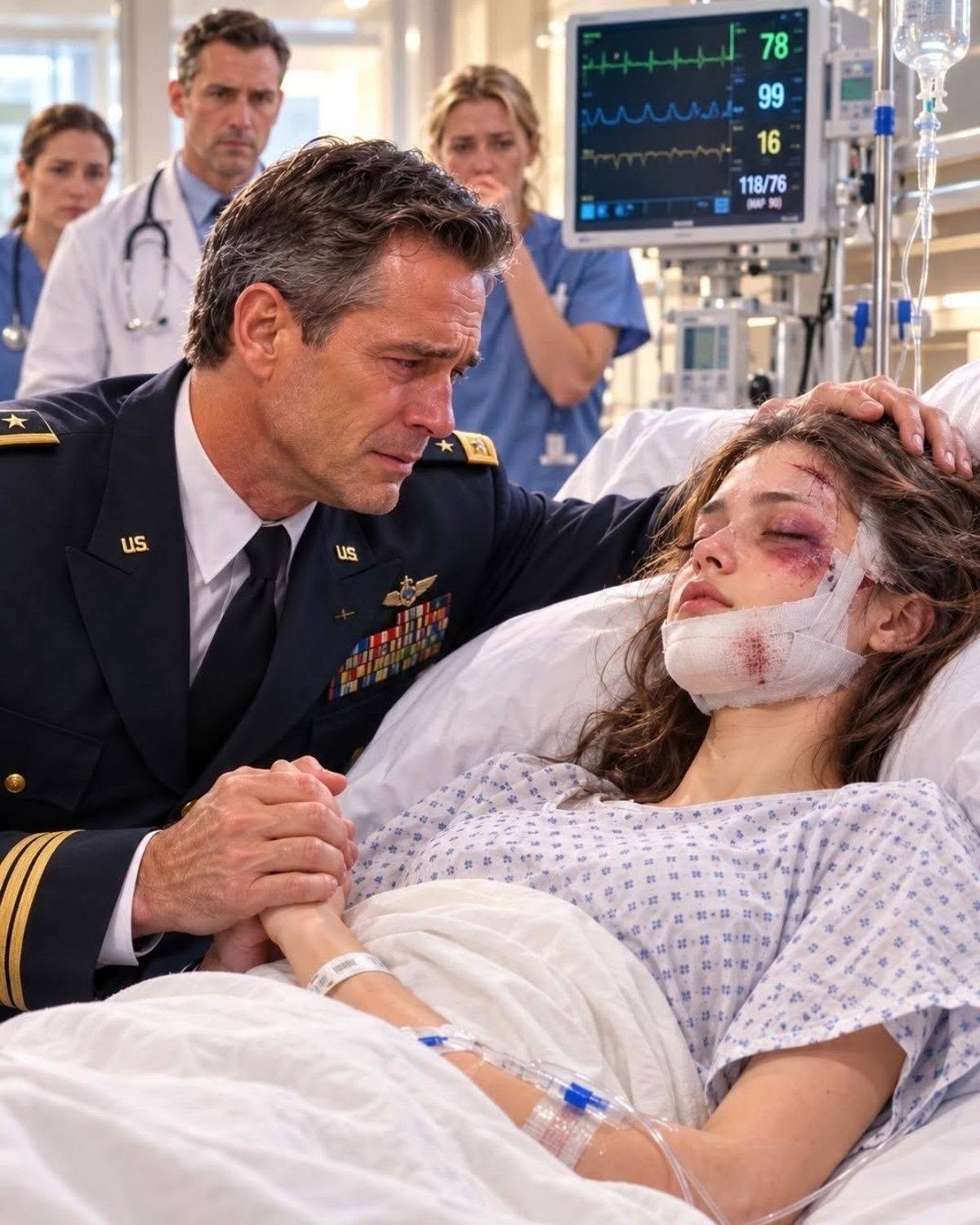
She was awake now.
Her face was swollen around the jaw, both eyes bruised, the hospital blanket pulled high across her chest. The wires made speech impossible, so a nurse had placed a small dry-erase board beside her bed.
David sat down.
Nora reached for the marker.
Her hand trembled.
She wrote four words.
THEY KNEW THE CAMERAS.
David felt something inside him tighten.
He kept his voice level.
“Who knew?”
Nora closed her eyes for a moment, then wrote again.
CHAD SAID NOBODY WOULD SEE.
That mattered.
Not because it proved who disabled anything.
It proved the failure had been expected.
David took a picture of the board only after asking Nora with a nod and receiving one back. Then he handed the board to the nurse so the statement could be documented properly.
The old David would have treated the message as intelligence.
The father understood it was also his daughter’s testimony.
There was a difference.
At 1:16 a.m., Bishop sent the first verified timeline.
Campus cameras covering the path Nora had taken stopped recording shortly before the attack.
Several emergency call stations in the same area reported service interruptions within the same window.
And one maintenance request connected to that system had been entered earlier that evening.
David stared at the timestamp.
“Who submitted it?” he asked when Bishop called again.
“That’s where it gets interesting,” Bishop said. “The request appears legitimate at first glance. But the account used to submit it had been accessed from a device that doesn’t match the employee’s normal login history.”
“Can you prove who used it?”
“Not yet.”
David leaned back.
“Then we don’t say we can.”
Bishop gave a quiet laugh with no humor in it.
“You really did become somebody else.”
David looked at Nora.
“Yes.”
He meant it.
For years he had wondered whether leaving Vanguard had made him softer.
Now he understood what had actually changed.
He no longer needed to win every room.
He needed to protect one person without destroying the truth around her.
By dawn, the three family names were no longer just names scribbled on a torn piece of paper.
They had patterns attached to them.
Chad Kensington had a history of school complaints that seemed to resolve quietly before formal discipline.
Brantley Sterling had been mentioned in two prior incidents involving intimidation, though neither had moved far enough to produce a public finding.
Wyatt Holbrook had the most carefully managed record of all.
Clean on paper.
Almost unnaturally clean.
Bishop was careful with the distinction.
“None of this proves what happened to Nora,” he said. “But it tells us where pressure may have been applied before.”
David appreciated that.
He did not need rumors.
He needed a chain that would hold.
The first real break came from something almost embarrassingly ordinary.
A parking record.
One of the three families had insisted through an attorney that their son had left campus earlier that evening.
A routine garage entry showed otherwise.
The vehicle associated with him had exited much later.
Then a second record surfaced.
A food-delivery driver had entered the same campus area during the window when the official camera system was supposedly useless.
His own dash camera had continued recording.
The footage did not show the attack.
It did something nearly as important.
It showed a dark SUV entering a restricted service lane shortly before the incident and leaving less than half an hour later.
The license plate was readable.
It was registered to a company connected to the Kensington family.
David listened without speaking.
Bishop continued.
“There’s more. The driver gave the clip to investigators after he heard there had been an assault nearby. He says somebody from campus security initially told him it probably wasn’t relevant.”
David’s eyes moved toward the hallway.
The detective was gone.
“Who received the clip?” David asked.
“We’re confirming that now.”
For the first time since the hospital called, David felt the shape of the cover-up becoming visible.
Not one giant conspiracy.
That would have been easier to recognize.
It looked more like a collection of small decisions.
A call made to the right person.
A report softened.
A camera problem treated as routine.
A witness told not to worry about what he saw.
Each piece small enough to defend by itself.
Together, they formed a wall.
Money had not erased the truth.
It had taught people to look away from it one piece at a time.
At 8:03 a.m., the detective returned.
He looked worse than before.
His tie was loose. His eyes were red. He stood at the doorway instead of entering Nora’s room.
“Commander Miller, can I speak with you?”
David stepped into the corridor.
The detective glanced toward the nurses’ station.
“Privately.”
“No.”
The answer came so quickly that the detective blinked.
David folded his arms.
“You can speak here.”
The man swallowed.
“I may have been too pessimistic last night.”
David said nothing.
“There are additional leads.”
“Such as?”
“A vehicle. Potential digital records. We’re working through them.”
David watched him carefully.
The detective knew about the vehicle now.
That meant the clip had moved beyond wherever it had originally stalled.
“Good,” David said.
The man looked almost disappointed by the lack of confrontation.
Then he lowered his voice.
“These families have resources. I want you to understand that cases like this can become difficult very quickly.”
David looked directly at him.
“They already have.”
The detective shifted his weight.
“I’m trying to help your daughter.”
“Then help her.”
Nothing more.
No threat.
No mention of Vanguard.
No warning about what David knew.
The detective left several minutes later.
Bishop called almost immediately.
“He’s scared,” Bishop said.
“Of me?”
“No. Of them.”
That changed something.
David had spent the night imagining corruption as loyalty purchased with money.
Bishop’s findings suggested a messier truth.
The detective had financial trouble.
Nothing glamorous.
Debt.
A sick parent.
A house payment that had slipped behind.
Months earlier, a consulting company tied indirectly to one of the Sterling family’s business partners had arranged paid security work for him while he was off duty.
The work itself was legal.
The relationship was not proof of a crime.
But it created leverage.
Then came the phone records.
On the night Nora was attacked, that same intermediary called the detective twice before the detective reached the hospital.
David closed his eyes.
Not a mastermind.
A pressured man making terrible choices.
That did not excuse anything.
But it told David where the next fracture line might appear.
“Does Bishop have enough to report this through proper channels?” Nora wrote later that morning after David explained only what she needed to know.
He smiled despite himself.
She remembered the name.
“Yes.”
She wrote another question.
ARE YOU GOING AFTER THEM?
David looked at the board for a long moment.
Then he took the marker.
NO.
Nora frowned.
He added another line.
I’M GOING AFTER THE TRUTH.
Her eyes softened.
She reached for his hand.
That answer became the line David refused to cross.
Bishop wanted Vanguard activated only in the sense that mattered now: old contacts who could locate records, preserve public information, identify conflicts, and make sure legitimate evidence reached people who could not easily bury it.
No intimidation.
No breaking into systems.
No anonymous threats.
No private punishment.
If the three young men had believed they were protected by influence, David intended to remove the protection without becoming another man who believed power placed him above the rules.
By the second day, pressure started producing mistakes.
The Kensington family issued a statement through counsel insisting Chad had been targeted by false accusations.
The statement claimed he had no contact with Nora that night.
Hours later, a recovered campus access record showed his student credential had been used near the same building Nora left shortly before the attack.
That alone did not prove he used it.
Then Chad made the mistake himself.
According to an investigator’s documented interview, he tried to explain why he had been in that area before he had been told that anyone knew his credential had appeared there.
The contradiction mattered more than any dramatic confession could have.
Brantley Sterling’s problem was different.
His family tried to distance him from Chad and Wyatt.
But phone-location records obtained through the investigation placed the three devices in the same general area during the critical window.
Again, not perfect proof.
But the separate stories were beginning to collapse against each other.
Wyatt Holbrook held out longest.
His father’s defense company employed layers of attorneys and public-relations professionals accustomed to controlling narratives.
But corporate power could not change one small fact.
Wyatt had sent Nora messages earlier that week.
Nora had kept them.
Most were ordinary.
One was not.
David sat beside her as investigators reviewed the exchange with her permission.