I helped Mariana toward my old car while Rodrigo stood behind us insisting that taking his wife away would destroy the family.
At that point, the word family sounded almost meaningless.
Twenty minutes later, Mariana was sitting inside a small restaurant in town with a bowl of chicken soup in front of her.
No photo description available.
She ate too quickly.
That was the first thing I noticed.
Not like someone enjoying a favorite meal.
Like someone afraid the food might disappear if she slowed down.
I watched her finish several spoonfuls before asking the question I had been avoiding.
“When was the last time you ate a full meal?”
Mariana stopped.
The spoon stayed halfway between the bowl and her mouth.
Her eyes dropped.
“Almost two weeks ago.”
I felt my fingers tighten around the edge of the table.
Almost two weeks.
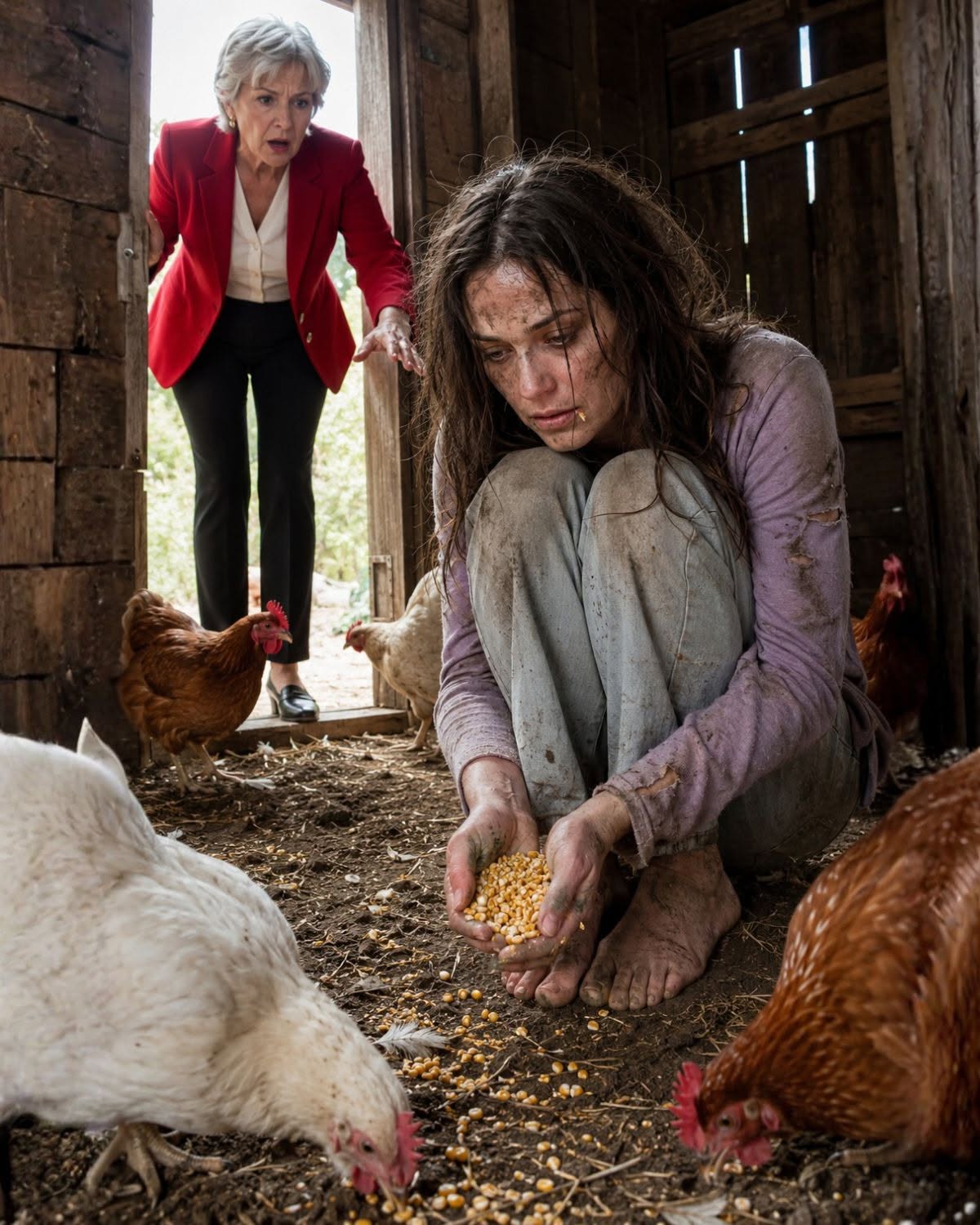
I thought about the dry kernels of corn in her hand.
The damp feed.
The dirt.
The feathers sticking to her clothes.
Then I thought about Rodrigo saying:
“She brought it on herself.”
My son.
My only son.
Eight years earlier, when I left for Spain, I still believed I understood the man he had become.
I knew we had grown apart.
That was undeniable.
After my husband died, I could no longer stay on the ranch without feeling as though every wall carried his absence.
An opportunity came for me to go abroad.
I took it.
At first, Rodrigo and I called often.
Then less.
Work.
Distance.
Resentment.
All the ordinary excuses families use when years pass faster than anyone expects.
Still, I never imagined returning to find his wife sitting on the floor of a chicken coop eating livestock feed.
The ranch itself should have warned me.
When the taxi first stopped at the gate, I thought perhaps Rodrigo had simply stopped caring about the property.
Paint peeled from the walls.
The garden had dried out.
Pens that had once held animals stood empty.
There were no workers.
The place felt abandoned even though my son lived there.
I walked in with my suitcase and expected to call his name.
Then I heard the kick against the coop door.
“I told you to finish before dark.”
His tone was not angry in the wild way people sometimes become angry.
That would almost have been easier to understand.
He sounded routine.
“If you don’t, you stay in there all night.”
Then a woman answered from inside.
Weak.
“I’m almost done, Rodrigo.”
I knew that voice only faintly.
Mariana had been young when I last saw her.
She was still studying nursing.
She talked constantly then.
About classes.
About hospitals.
About her mother in Monterrey.
About things she wanted to do after graduation.
She had energy.
Hope.
She and Rodrigo were newly married, and although I worried they were rushing, she seemed to love him.
The woman inside the coop barely sounded like the same person.
When Rodrigo saw me, his first reaction was surprise.
Then performance.
“Mom…what are you doing here?”
That smile.
I keep remembering it.
Not joy.
Management.
He wanted time to understand what I had seen.
I asked who was inside.
He told me Mariana was cleaning.
“She always leaves everything half-finished.”
As though that explained a locked coop.
I moved toward the door.
He blocked me.
“Don’t make a scene.”
Eight years away from my son disappeared in that sentence.
Because I had heard his father say things like that before.
Not in the same situation.
Never this.
But I recognized the instinct.
Control the appearance first.
Deal with the harm later.
I moved around him.
When the bolt opened, the smell reached me before the full picture did.
Damp feed.