
The surgery was scheduled for a Tuesday.
For some reason, that felt fitting.
Tuesdays are ordinary. Nothing about them suggests that your entire understanding of your life might suddenly change.
But I had learned that the moments that divide your life into before and after rarely arrive with warning.
My name is Catherine Marsh. I was fifty-four years old, and I had been married to my husband, David, for thirty-one years.
We met when I was twenty-three and he was twenty-six at a work event neither of us wanted to attend.
We were both standing near the food table, silently waiting for enough time to pass that leaving wouldn’t seem rude.
David glanced at me.
“How much longer do you think we have to stay?”
I looked at the clock.
“Forty minutes. After that, we’re free.”
We lasted exactly forty minutes.
Then we left together, found a diner three blocks away, and talked until the employees started wiping tables around us in the very obvious hope that we would finally go home.
We had been together ever since.
To understand what happened next, you need to understand David.
He wasn’t a dramatic man.
He didn’t talk endlessly about his feelings.
He showed love through actions.
He remembered when something in the house needed fixing.
He noticed when my car sounded strange.
He brought home the coffee I liked without being asked.
If he said he would be somewhere, he was there.
David had worked as a residential contractor for almost thirty years, and reliability seemed built into him.
He believed that if you built something, you built it properly because somebody else had to live with what you left behind.
That was how he approached houses.
And, I thought, our marriage.
We never had children.
We had tried when we were younger, but it simply hadn’t happened.
By our late thirties, we had stopped thinking of our life as incomplete and started accepting that it was simply going to look different from what we had once imagined.
And it was a good life.
At least, I had always believed it was.
Then came my surgery.
It was for a complicated hernia.
Nothing life-threatening, but serious enough that I would need a lengthy hospital stay and several weeks of limited activity afterward.
David was there when they took me in.
He was there when I woke up.
The expression on his face when he realized I was conscious and talking told me he had been far more frightened than he had admitted.
He stayed several hours that first day.
Then he went home.
He returned Saturday.
Then Tuesday.
At least, those were the days I remembered him visiting.
So when one of the nurses came into my room on Thursday, noticed the yellow flowers beside my bed, and smiled, I didn’t think much of it.
“You have such a devoted husband,” she said.
I smiled.
“He’s a good man.”
“He certainly is. He’s here every day.”
I looked at her.
“Every day?”
She nodded casually.
“Tall gentleman? Gray hair? Usually wearing a blue jacket?”
My smile disappeared.
That description fit David perfectly.
Tall.
Gray hair.
Navy jacket.
But he had not visited me every day.
Or at least, he had not visited me.
I considered correcting her.
Then something stopped me.
Instead, I said nothing.
After she left, I stared at the yellow flowers for a long time.
That afternoon, I called David.
We spoke normally.
He told me he would come see me again in three days.
I didn’t mention what the nurse had said.
Thirty-one years of marriage had taught me that sometimes it was better to understand what you were dealing with before confronting it.
Maybe the nurse was confused.
Maybe she had mistaken another man for David.
Or maybe something was happening that I didn’t yet understand.
The following morning, my doctor told me I was strong enough to walk farther down the hallway.
So I put on my robe, slipped my feet into hospital slippers, gripped my walker, and slowly made my way toward the elevators.
I had almost reached the curve in the corridor when the elevator doors opened.
And David stepped out.
He was holding flowers.
For half a second, I felt relieved.
There he was.
My husband.
He had surprised me.
I opened my mouth to call his name.
Then he turned.
And walked away from my room.
I stopped.
David didn’t hesitate.
He didn’t look confused.
He moved with the confidence of someone who knew exactly where he was going.
My first instinct was to believe there had to be an innocent explanation.
Maybe he was visiting a client.
A friend.
Someone from work.
Perhaps he had simply planned to see them before coming to me.
But then I remembered the nurse.
He comes every day.
I followed him.
Slowly.
Painfully.
Pushing the walker ahead of me while he disappeared farther down the corridor.
At the end of the hallway, he turned.
Then he walked through a set of doors.
I stopped when I saw the sign.
MATERNITY.
My stomach tightened.
There were dozens of reasonable explanations.
A client had given birth.
A friend’s daughter had a baby.
PlanFamily Trips
A distant relative I had forgotten about was there.
My mind offered each possibility rapidly.
My body believed none of them.
I pushed through the doors.
David was already halfway down the maternity corridor.
I followed him.
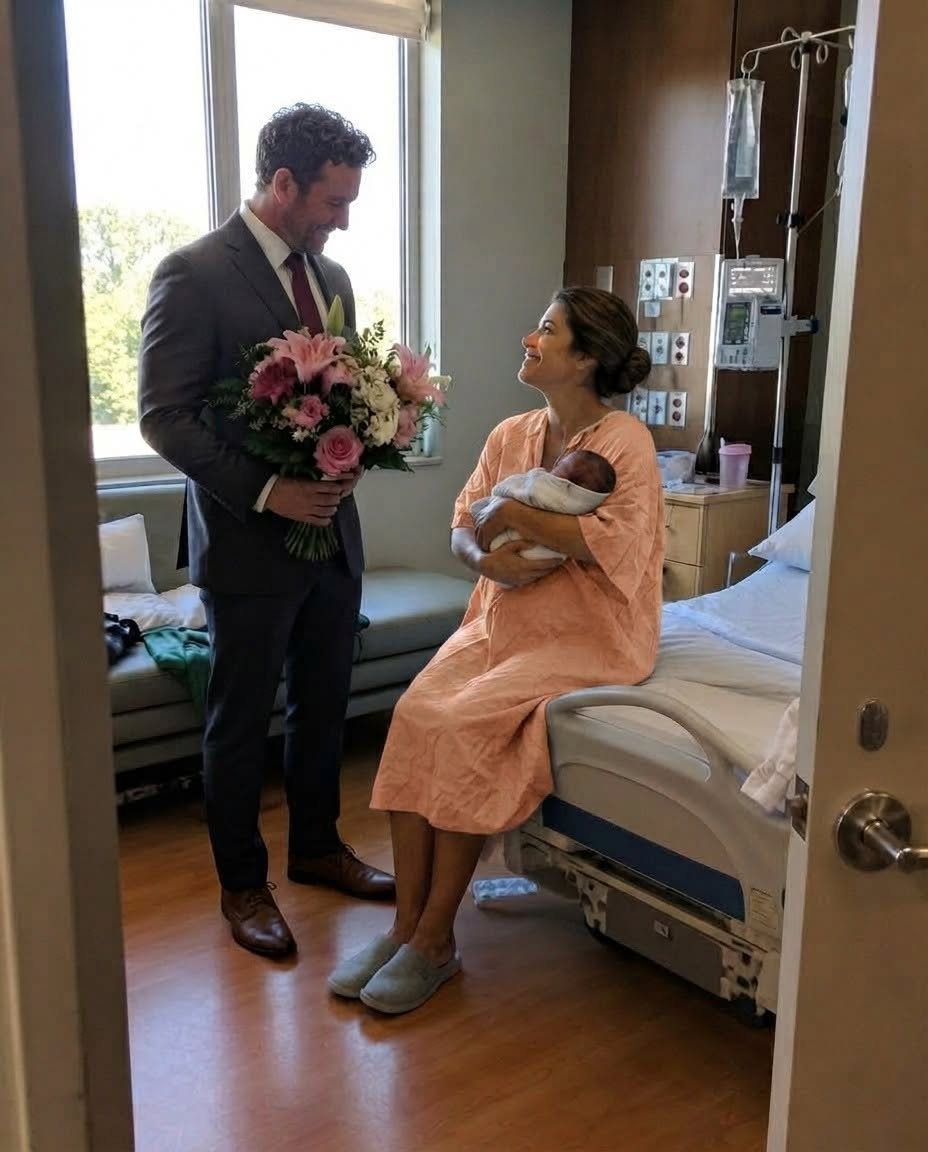
He stopped outside one room.
Then he opened the door and stepped inside.
I waited several seconds.
Then I walked toward it.
My hand was shaking when I pushed the door open.
Inside was a young woman sitting upright in the hospital bed.
She was holding a newborn baby.