
PART 2
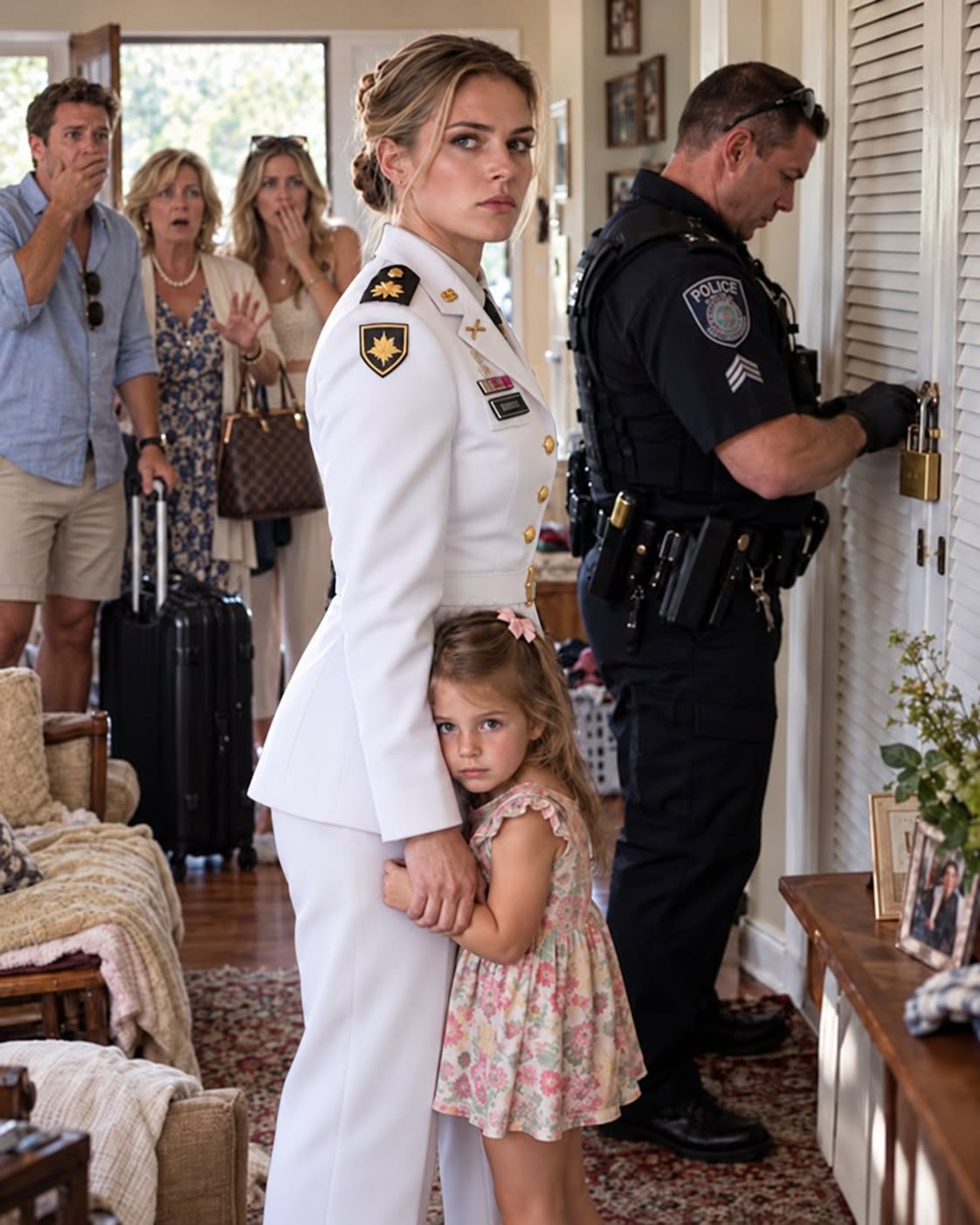
Officer Bell didn’t cut the lock immediately.
That was the first thing I remembered clearly afterward.
Not Derek’s voice still crackling through my phone. Not the brass padlock hanging between the white closet handles. Not even the terrible thought that had flashed through my mind when Lily pointed toward the hallway.
I remembered Officer Marcus Bell lowering the bolt cutters and looking at me.
“Major Nolan,” he said quietly, “before we open anything, I want to make sure we do this correctly.”
Behind him, one of the paramedics was helping Lily into a little blue sweatshirt they kept in the ambulance for children. Evelyn Price had found Lily’s favorite stuffed rabbit under the sofa and was carefully cleaning cereal dust from one ear.
The ordinary gentleness of those small actions steadied me.
“What does correctly mean?” I asked.
“This is your home, and you’ve given us permission to search it. But your husband specifically warned us about a locked area. I’d rather document everything before we touch it.”
My phone was still on speaker.
Derek heard every word.
“Hannah,” he said, much quieter now. “Please.”
I looked at the phone.
“Tell me what’s inside.”
He didn’t answer.
Officer Bell took several photographs of the lock.
The silence stretched.
Finally Derek said, “Paperwork.”
“What paperwork?”
“It’s complicated.”
I almost laughed, but there was nothing funny in me.
Three weeks earlier than expected, I had stepped off a military transport feeling as if I had been given stolen time. I had imagined Lily racing toward me in the airport. Derek standing behind her with that crooked smile I had loved since college.
Instead, my daughter had been alone.
Our savings were almost gone.
And my husband was begging me not to open a closet in my own house because something inside was “complicated.”
Officer Bell looked toward the paramedics.
One of them approached.
“Major Nolan, your daughter is stable. She’s dehydrated and she needs food and rest, but her vitals are good. We’d like to take her to the pediatric emergency department for evaluation.”
I was at Lily’s side before she finished.
“Can I go with her?”
“Of course.”
Officer Bell nodded toward the closet.
“This can wait.”
Derek interrupted.
“No. Hannah, listen to me. Just leave it alone until I get back.”
That decided it.
Not because I wanted revenge.
Not because I wanted to expose him.
Because three days earlier, Derek had apparently decided I didn’t need to know who was caring for our daughter.
Months earlier, he had apparently decided I didn’t need to know what was happening to our money.
And now he had decided I didn’t need to know what was happening inside our home.
I had spent fifteen years working in intelligence.
I knew what secrecy did when it became a habit.
It stopped being about protecting information.
Eventually, it became about controlling reality.
“Document it,” I told Officer Bell. “Then open it.”
Derek inhaled sharply.
“Hannah—”
I ended the call.
Officer Bell cut the lock.
The doors opened.
And for several seconds, nobody spoke.
There was no weapon.
No dangerous equipment.
No hidden person.
There were shelves.
Boxes.
Folders.
A folding table had been squeezed into the narrow closet space, creating a makeshift desk. On it sat an old laptop, a printer, several envelopes, a calculator, and a thick three-ring binder.
The walls were covered with sticky notes.
Dates.
Amounts.
Names.
At first glance, it looked less like something sinister than the office of a person who had become overwhelmed and tried to hide the evidence of being overwhelmed.
Officer Bell put on gloves.
I stepped closer.
One yellow note read:
Mortgage — call before 15th.
Another:
Patricia — $4,800 still owed.
Another:
Hannah home November. Fix before then.
My stomach tightened.
“What is all this?”
Officer Bell opened the binder.
The first section was labeled HOUSE.
The second said DEBTS.
The third said PATRICIA.
The fourth said PLAN.
Officer Bell stopped.
“Do you recognize this?”
He showed me a document.
It was a mortgage statement.
My mortgage statement.
Except I hadn’t seen one in months because Derek had told me he had switched everything to electronic billing.
Three payments were behind.
I stared at the page.
“That can’t be right.”
Officer Bell said nothing.
I checked the next document.
Credit card statement.
Then another.
And another.
Derek had opened two cards during my deployment.
Both nearly maxed out.
There were overdue utilities, a personal loan, notices from a collections agency, and several letters from Derek’s former employer.
I picked up one.
My eyes went straight to the date.
Four months earlier.
Dear Mr. Nolan,
This letter confirms the termination of your employment effective—
I stopped reading.
Derek had lost his job four months ago.
He had never told me.
I lowered myself onto the hallway floor.
For months, our video calls had happened at carefully chosen times.
He had complained about meetings.
He had talked about projects.
Once, he had even laughed about his supervisor making everyone come into the office on a Saturday.
None of it had been true.
Evelyn appeared behind me.
“Hannah?”
“I’m fine.”
It was automatic.
I had said those words in dust storms, briefings, hospital waiting rooms and funerals.
Evelyn didn’t argue.
She simply sat beside me.
Officer Bell continued examining the documents.
There was no drama in his movements.
That helped.
Facts were easier when they arrived quietly.
Derek had lost his job.
He had hidden it.
He had fallen behind on bills.
He had borrowed money.
Then, somehow, he had spent thousands on a cruise.
I found the folder marked PATRICIA.
Inside were medical invoices.
For a moment I felt guilty for looking.
Then I saw Derek’s handwriting across one of them.
Paid $3,200 from emergency. Don’t tell H until settled.
The invoice was from the previous year.
Patricia had undergone surgery while I had been stationed temporarily in Germany. Derek had told me insurance covered almost everything.
Apparently, it hadn’t.
There were more bills.
Physical therapy.
Specialists.
Prescriptions.
One page contained a spreadsheet.
Derek had been sending his mother money almost every month.
Sometimes a few hundred dollars.
Sometimes more than a thousand.
Without telling me.
I closed my eyes.
Patricia and I had never been close.
She wasn’t cruel. She wasn’t the theatrical nightmare mother-in-law people joked about.
She was simply a woman who loved her son with such concentration that everyone else sometimes became background.
When Lily was born, Patricia had spent two weeks in our house folding blankets, washing bottles and telling me that Derek had been the easiest baby in Virginia.
When I returned to active duty, she told me she admired my career.
Then she added, “I just hope Lily never feels second to it.”
I had carried that sentence for four years.
Now I wondered what sentences she had been carrying.
Officer Bell found something else.
“Major?”
It was a real estate folder.
Inside was an appraisal request for our house.
A preliminary loan application.
And a handwritten estimate of what we might receive if the house were sold.
At the bottom Derek had written:
Enough to clear everything and start over.
Under that:
Florida? Mom thinks Jacksonville.
My throat tightened.
“Was he planning to sell the house?”
“I can’t tell from this alone.”
“He can’t sell it without me.”
“No.”
Officer Bell carefully turned several pages.
Then he paused.
There was a photocopy of my military power of attorney.
I recognized it immediately.
I had signed a limited document before deployment allowing Derek to handle insurance issues, repairs, certain school matters and routine household transactions while I was overseas.
There were handwritten notes beside it.
Ask lender if POA sufficient.
My skin went cold.
Officer Bell met my eyes.
“This is something you’ll want an attorney to review.”
“Did he use it?”
“We don’t know.”
I stood.
The paramedic called softly from the living room.
“Mom?”
Lily was waiting for me.
That single word reorganized the entire world.
I left the closet.
Nothing in those folders mattered more than the person sitting under Evelyn’s knitted blanket.
I carried Lily to the ambulance myself.
She wrapped both arms around my neck.
“Are you staying home now?”
I pressed my cheek against her hair.
“For a while, yes.”
“For all the breakfasts?”
The question nearly undid me.
“For every breakfast I can.”
She considered that.
Then she whispered, “Can we have pancakes?”
I smiled for the first time since entering the house.
“We can absolutely have pancakes.”
The pediatrician kept Lily for observation until late afternoon.
She was tired, hungry and confused, but medically stable.
Once she realized nobody was going to leave her alone, her four-year-old priorities returned with reassuring speed.
She wanted orange juice.
She wanted her rabbit.
She wanted to know whether the hospital television had cartoons.
And then she wanted pancakes again.
A hospital social worker named Grace Holloway sat with me while Lily colored at a small table.
Grace had silver-framed glasses and the calm manner of someone who had learned not to fill every silence.
“We’ll make a safety plan before you leave,” she said.
“I’m not leaving her.”
“I know.”
“I mean ever.”
Grace smiled gently.
“You probably mean that literally right now.”
I looked at Lily.
“Yes.”
“You don’t need to decide the rest of your life today.”
That sentence irritated me at first.
Then it relieved me.
I was accustomed to decisions.
Assess.
Prioritize.
Act.
But marriage wasn’t an operation.
Motherhood wasn’t a checklist.
And whatever came next would last longer than one terrible afternoon.
Grace helped arrange follow-up care and documented that Lily would remain with me. Officer Bell called to say his report had been filed and that additional questions would follow.
Then he added something unexpected.
“Your mother-in-law contacted the department.”
I straightened.
“Patricia?”
“She says she’s returning early.”
“From the cruise?”
“Yes.”
I almost said something bitter.
Instead I asked, “Did she explain why my daughter was alone?”
“No. She asked to speak with you.”
“I’m not ready.”
“That’s your choice.”
For once, choice felt like an unfamiliar luxury.
Evelyn drove us home from the hospital because my car had been sitting at the base.
I expected Lily to be frightened of the house.
She wasn’t.
Children, I learned that evening, can sometimes separate a place from what happened inside it better than adults can.
She walked into the living room, looked around and said, “It smells weird.”
“It does.”
“Can we fix it?”
“Yes.”
That became our task.
Not the marriage.
Not Derek.
Not the debts.
The house.
Evelyn opened windows while I filled garbage bags. Officer Bell had said the closet needed to remain undisturbed until investigators finished documenting the financial materials, so I stayed away from the hallway.
Lily sat safely at the kitchen table making what she called a restaurant menu.
Pancakes.
Strawberries.
Macaroni.
“Is broccoli on the menu?” I asked.
“No.”
“Carrots?”
She frowned.
“This restaurant is closed.”
Evelyn laughed.
It was the first normal sound the house had made all day.
By seven, Lily had eaten half a pancake, six strawberries and three bites of scrambled egg.
At seven-thirty, she fell asleep on the sofa before I could get her upstairs.
I carried her to bed.
Her room looked untouched.
Purple curtains.
Glow-in-the-dark stars.
A family photograph on the dresser taken the week before I deployed.
Derek stood behind us with one arm around my shoulders.
He looked happy.
That was the hardest part.
Not every good memory had been false.
People wanted betrayal to simplify the past.
It didn’t.
Derek had held my hand through eighteen hours of labor.
He had danced with Lily through the kitchen when she was a baby because it was the only way she would stop crying.
He had mailed me ridiculous care packages overseas filled with gummy bears, crossword puzzles and handwritten notes.
He had also lied to me.
He had also left our daughter without appropriate care.
Both sets of facts existed.
Love did not cancel failure.
Failure did not erase every moment of love.
I sat beside Lily until her breathing became deep and even.
Then I went downstairs.
Evelyn was washing dishes.
“You don’t have to do that.”
“I know.”
“You have your own house.”
“I know that too.”
I leaned against the counter.
“Did you know Derek lost his job?”
She dried her hands.
“No.”
“Did anything seem different?”
She hesitated.
“His car was home more.”
“When?”
“Last few months.”
I closed my eyes.
“I should have noticed.”
“You were on another continent.”
“I talked to him every day.”
“And he chose what you saw.”
There was no judgment in her voice.
That made the truth easier to accept.
Evelyn sat across from me.
“There is one thing.”
“What?”
“A woman came here twice.”
I felt something tighten inside me.
Evelyn immediately raised a hand.
“Not like that.”
I waited.
“She was older. Maybe late sixties. Gray hair. She carried folders. The second time, Derek walked outside with her and they argued.”
“Argued about what?”
“I couldn’t hear much.”
“Anything?”
Evelyn thought.
“He said, ‘I can’t tell Hannah until I know.’”
The refrigerator hummed between us.
“Know what?”
“I don’t know.”
The answer came the next morning.
Not from Derek.
From Jenna.
Derek’s younger sister called at 6:42 a.m.
I almost ignored it.
Then I remembered she was on the cruise.
I stepped onto the back porch so Lily wouldn’t hear.
“Hello?”
Jenna sounded exhausted.
“Hannah.”
“Where are you?”
“Nassau. Technically.”
I waited.
“We’re getting off the ship.”
“Why?”
“Because Mom is losing her mind.”
I nearly said she had chosen an inconvenient time to discover concern.
Instead I asked, “Where is Derek?”
There was a pause.
“In the cabin.”
“Why are you calling me?”
“Because I found out fifteen minutes ago that Lily was actually alone.”
My grip tightened around the phone.
“You didn’t know?”
“No. Hannah, I swear. Derek told us a college student from your neighborhood was staying at the house.”
“There is no college student.”
“I know that now.”
“He told Evelyn there was a babysitter upstairs.”
Jenna was silent.
Then she whispered, “Oh, Derek.”
Not angrily.
Sadly.
That reaction unsettled me more.
“What is happening with him?”
“I don’t know everything.”
“What do you know?”
“He lost his job.”
“I found that out.”
“Mom knew.”
That hurt in a surprisingly precise place.
“Since when?”
“Almost from the beginning.”
“And neither of you thought I should know?”
“I didn’t know until a month ago.”
I pressed two fingers against my forehead.
“Why the cruise?”
Jenna exhaled.
“It was supposed to be Mom’s seventieth birthday trip. We planned it more than a year ago.”
“With my money.”
“I thought Derek had his portion covered.”
“He didn’t.”
“I’m sorry.”
I looked through the kitchen window.
Lily was still sleeping.
“Tell me about the woman who came to my house.”
Silence.
“Hannah, I really think Derek needs to explain that.”
“I’m not asking Derek.”
Another pause.
Then Jenna said, “Her name is Margaret Vale.”
“Who is she?”
“She worked with Dad.”
Derek’s father had died eight years earlier.
Robert Nolan had been a quiet man who repaired marine engines and collected old coins. He had never earned much, but he had been careful with what he had.
“What does Derek’s father have to do with my house?”
“I’m not sure.”
“Jenna.”
“I’m telling you the truth. Margaret contacted Mom six months ago because she found records from Dad’s old business. Something about property.”
“What property?”
“I don’t know.”
I thought of the locked closet.
The spreadsheets.
The real estate folder.
Enough to clear everything and start over.
“What did Derek think he was going to find?”
“I don’t know.”
Then Jenna said something that stayed with me.
“But I think he convinced himself it would fix everything.”
Patricia arrived in Virginia the following night.
She didn’t come to the house.
That surprised me.
She sent a message instead.
I am at Jenna’s apartment. I will not come near Lily unless you invite me. I am deeply sorry. When you are ready, I owe you the truth.
I read it three times.
Then set the phone down.
I wasn’t ready.
Over the next two days, my world narrowed to manageable things.
Groceries.
Laundry.
Appointments.
Making sure Lily ate.
Listening when she talked.
Not pressing when she didn’t.
My commanding officer extended my leave immediately after I explained the situation. A family advocacy liaison helped me navigate resources without making me feel like a case file.
Officer Bell returned with a financial crimes investigator named Denise Mercer.
They had reviewed the materials.
The good news was that Derek had not sold the house.
He had not successfully refinanced it either.
The limited power of attorney did not authorize the transaction he had apparently been considering.
The bad news was everything else.
He had been trying to consolidate debts without telling me.
He had repeatedly moved money between accounts.
And almost three weeks before the cruise, a deposit of $27,400 had appeared in an account I hadn’t known existed.
I stared at the number.
“Twenty-seven thousand dollars?”
Mercer nodded.
“Most of it was transferred out within eight days.”
“Where?”
“Some went toward delinquent bills. Some went to his mother’s medical debt. Some funded the cruise charges. There are several withdrawals we’re still identifying.”
“Where did the deposit come from?”
“That’s the interesting part.”
She slid a photocopy across the kitchen table.
The issuing institution was a small regional bank.
The memo line contained two words.
Nolan Marine.
Derek’s father’s old company.
I looked up.
“I thought that business closed years ago.”
“So did everyone, apparently.”
That afternoon, I called Patricia.
She answered before the second ring.
“Hannah.”
“I need you to come over.”
“I’ll be there.”
“Without Derek.”
A pause.
“Yes.”
Patricia arrived twenty minutes later wearing the same navy sweater I remembered from Christmas two years earlier.
She looked smaller somehow.
Not physically.
Certain people spend years carrying themselves as though certainty were posture.
Patricia had lost hers.
She stopped inside the doorway.
“Where is Lily?”
“Napping.”
“Is she all right?”
“She will be.”
Patricia closed her eyes.
“Thank God.”
I motioned toward the dining table.
We sat.
For several seconds neither of us spoke.
Finally she said, “I failed you.”
I expected excuses.
Instead she continued.
“I knew Derek had lost his job.”
“How long?”
“Four months.”
“Why didn’t you tell me?”
“He begged me not to.”
“That isn’t an answer.”
“No.”
She folded her hands.
“He was ashamed.”
“So you helped him hide it.”
“Yes.”
Her willingness to admit it took some of the fight out of me.
“Did you know about the debts?”
“Some.”
“The mortgage?”
“No.”
“The credit cards?”
“No.”
“The money he took from our account?”
Patricia’s face changed.
“I knew he used money for the cruise. I did not know where it came from.”
“You accepted thousands of dollars for your medical bills.”
She looked down.
“I believed it came from Robert.”
I frowned.
“Robert has been dead eight years.”
“I know.”
She reached into her handbag.
What she placed on the table was an envelope yellowed at the edges.
Robert Nolan’s handwriting was across the front.
Patricia — if Margaret ever finds the rest, tell the children together.
A strange stillness filled the room.
“What does that mean?”
Patricia looked toward the hallway.
“There was money missing when Robert closed his business.”
“Missing?”
“Not stolen.”
She shook her head.
“At least, we never believed so. Robert had a partner named Samuel Vale. Margaret is Samuel’s widow.”
The woman Evelyn had seen.
“They owned a small parcel near the marina,” Patricia continued. “Nothing special then. An old warehouse and some land. When the business failed, there was confusion over whether the property had been transferred or included in bankruptcy. Robert believed it was gone.”
“And it wasn’t?”
“Apparently not.”
She pushed the envelope toward me.
“Margaret discovered last winter that Robert and Samuel still had an interest in it through an old holding company.”
I stared at her.
“How much?”
“We didn’t know.”
“But Derek did.”
“Not at first.”
Patricia swallowed.
“Margaret contacted him because he was handling Robert’s remaining estate records. Derek became convinced there might be enough money to solve his problems.”
Everything began connecting.
The secret meetings.
The folders.
The notes.
The sudden deposit.
“How much was the property worth?”
“More than it used to be.”
“How much, Patricia?”
Her answer was barely audible.
“Potentially several hundred thousand dollars.”
I leaned back.
There it was.
The hope that had become permission.
Derek had lost his job.
He had hidden it.
Bills mounted.
Then an old family asset appeared like a door opening in a locked room.
He had started spending money before the future became real.
“What was the twenty-seven thousand?”
“An advance from a buyer while ownership was being reviewed.”
“And Derek spent it.”
Patricia nodded.
“Some of it.”
“Why lock the closet?”
“Because everything was in there. Robert’s records. The property documents. The debts. Derek didn’t want you discovering any of it before he could present you with a solved problem.”
I thought of Derek’s words.
If you open that lock, you’re going to destroy everything.
“He thought secrecy was protecting us.”
Patricia’s eyes filled.
“He thought if he could fix everything before you came home, the lies would disappear.”
“They don’t.”
“No.”
She looked older when she said it.
“Lies never disappear just because the problem does.”
From upstairs came the soft thump of Lily climbing out of bed.
Patricia immediately stood.
“I should go.”
Then a little voice called, “Mama?”
“I’m here!”
Lily appeared at the top of the stairs rubbing her eyes.
She saw Patricia.
“Grandma?”
Patricia froze.
Lily came down slowly.
I watched Patricia carefully.
She didn’t rush toward her.
She waited.
Lily reached the bottom step.
“Did you bring the shell?”
Patricia covered her mouth.
On previous trips, she always brought Lily a seashell.
“I did,” she whispered.
“Can I see it?”
Patricia looked at me.
I nodded.
She knelt and took a small pink shell from her purse.
Lily held it to her ear.
“The ocean is in there.”
Patricia smiled through tears.
“It always sounds that way.”
Lily studied her grandmother.
Then she said, with the devastating simplicity of a child, “Daddy made a bad plan.”
Patricia’s face crumpled.
“Yes, sweetheart.”
“He needs better plans.”
“Yes.”
Lily handed her the shell.
“You can help him.”
Patricia looked at me.
I didn’t rescue her from the meaning of it.
She had spent years helping Derek avoid discomfort.
Now she had another choice.
“You’re right,” she told Lily. “But helping somebody doesn’t always mean fixing things for them.”
I watched her say it.
Maybe she was speaking to herself.
Derek returned to Virginia the next morning.
I didn’t meet him.
Not yet.
Through attorneys and investigators, arrangements were made for him to stay elsewhere while everything was sorted out.
He asked to see Lily.
I said not immediately.
Then I spent hours wondering whether I was protecting her or punishing him.
Grace helped me see the distinction.
“Ask yourself what Lily needs,” she said.
“Stability.”
“Yes.”
“And eventually her father.”
“Possibly. In a safe, structured way.”
That word mattered.
Eventually.
Not never.
Not tomorrow.
Eventually.
Derek sent no dramatic messages.
No accusations.
No demands.
Just one text.
I will follow whatever process you believe is safest for Lily. I am sorry. I know that is not enough.
I didn’t reply.
Three days later, Officer Bell called.
They had finished cataloguing the closet.
“Your husband’s attorney will receive the appropriate documents,” he said. “But there’s something personal that belongs to you.”
“What?”
“An envelope.”
“From Derek?”
“No.”
My heart shifted strangely.
“From who?”
“It appears to have been written by Robert Nolan.”
I drove to the station after Lily’s preschool evaluation.
Officer Bell handed me a plain white envelope sealed with old tape.
Across the front, in Robert’s uneven handwriting, were the words:
For Hannah, if the marina property ever comes back to us.
I stared at my name.
Robert had died two years before Lily was born.
Three years before Derek and I bought our house.
“Why would he write to me?”
“I don’t know.”
I opened the envelope.
Inside was a single folded letter.
I read the first line.
Then the second.
And suddenly the mystery of Derek’s hidden room changed again.
Robert hadn’t written about money.
He had written about his son.
Hannah,
If you are reading this, then Derek has probably convinced himself that money can repair something he was too frightened to face honestly. He has always been like me in that way.
I stopped.
Officer Bell quietly moved away, giving me privacy.
I kept reading.
Robert described the collapse of Nolan Marine.
How he had hidden financial trouble from Patricia for nearly a year.
How he had borrowed money hoping one good contract would rescue the company.
How every secret had created another secret.
Then came the paragraph that made me sit down.
Derek was twenty-two when he found out. He paid one of my overdue accounts with nearly everything he had saved for graduate school. I let him. I told myself I would repay him. Instead, I taught my son that loving your family means quietly carrying problems until you can no longer stand.
My eyes burned.
There was one final paragraph.
If the property has value someday, it belongs equally to Derek and Jenna. But if Derek tries to use it to make himself look whole, tell him this from me: being whole is not the same as appearing unbroken. Tell the truth before you spend the money. Tell the truth before you lose the people you’re trying to protect.
At the bottom Robert had signed:
Dad.
I sat in that police station holding a dead man’s confession.
For the first time, I saw Derek not simply as the person who had deceived me, but as the son of someone who had taught him—without intending to—that fear could be disguised as responsibility.
It did not excuse what he had done.
It did not make Lily’s three days alone disappear.
Understanding was not absolution.
But understanding changed the question.
Until then, I had been asking:
How could Derek do this to us?
Robert’s letter suggested another question.
How long had Derek believed this was what love looked like?
When I returned home, Patricia’s car was parked outside.
She was helping Evelyn plant flowers with Lily near the front porch.
Lily saw me and came running.
“Mama! Grandma says these come back every year.”
“Some flowers do.”
“Even after winter?”
“Even after winter.”
She considered that with great seriousness.
Then she returned to the garden.
Patricia stood.
“Everything okay?”
I looked at Robert’s letter in my hand.
“No.”
Then I looked at Lily pressing soil around a small purple flower.
“But I think I finally understand what the closet was really hiding.”
Patricia’s eyes moved to the envelope.
I nodded.
“Your husband knew.”
Her face went pale.
“Knew what?”
“That Derek would do exactly what he did.”
A long silence passed between us.
Then Patricia whispered, “There’s something else you need to know.”
I almost smiled from exhaustion.
“Of course there is.”
She didn’t.
Her expression remained solemn.
“Margaret called this morning.”
“The property?”
Patricia nodded.
“The ownership review is finished.”
“And?”
She looked toward Lily.
Then back at me.
“Robert was wrong about one thing.”
“What?”
“The property doesn’t belong equally to Derek and Jenna.”
I waited.
Patricia’s next words changed the direction of all our lives.
“It was transferred years ago into a family trust.”
“What family trust?”
“One Robert never told me existed.”
“For Derek and Jenna?”
Patricia shook her head.
“No.”
Her eyes rested on me.
“The beneficiary named in the trust is Lily.”
-END OF PART 2 – CLICK THE “NEXT PART” SECTION AT THE BOTTOM OF THE PAGE TO CONTINUE READING