The Ledger of Blood and Bone
Chapter 1: The Architecture of Arrogance
Family dinners are culturally advertised as sanctuaries of warmth, spaces where the bruised armor of the day is unbuckled, and blood ties weave a safety net of unconditional support. For the Vance family, however, the dining table was never a place of nourishment. It was a gladiatorial arena. It was an altar where power was aggressively performed and weakness was ruthlessly penalized.
My name is Elena. I am twenty-six years old, and for the vast majority of my existence, I was the designated casualty in that arena.
As my tires crunched over the pristine, imported gravel of the Vance Estate driveway, a familiar, cold dread began to coil tightly in the pit of my stomach. The mansion loomed ahead, a sprawling limestone monstrosity that my father, Arthur Vance, had constructed as a monument to his own ego. It was an architectural bully, all severe lines and imposing columns, surrounded by manicured hedges that looked sharp enough to draw blood.
I parked my modest, reliable sedan near the back of the circular driveway, deliberately keeping it out of the sightline of the grand portico. For years, I had been the family’s ghost, the daughter who quietly moved out at eighteen, funded her own education through crippling shifts at a fluorescent-lit diner, and disappeared into the relentless machinery of the financial sector.
They assumed I was struggling. They assumed my absence was a byproduct of shame.
In reality, I had spent the last eight years clawing my way up the brutal ladder of Vanguard Equity, a premier corporate restructuring and debt acquisition firm. I lived in spreadsheets, breathed risk analysis, and understood the fatal anatomy of failing empires. I had built an entire kingdom of independence in the shadows, far away from their mocking eyes.
I cut the engine, the sudden silence of the car amplifying the heavy thudding of my pulse. I checked my reflection in the rearview mirror. My tailored, charcoal-gray suit was immaculate, devoid of wrinkles, a piece of corporate armor. I took a slow, measured breath, forcing the frantic rhythm of my heart to slow.
I hadn’t returned to this limestone fortress to seek forgiveness. I certainly hadn’t come to beg, which was undoubtedly the narrative they had constructed for the evening. I was here to execute a professional obligation, one that happened to be intrinsically, violently tied to the rapidly deteriorating foundation of my father’s legacy.
Keep it clinical, I reminded myself, smoothing my lapels. Numbers do not possess emotions. Debt does not feel pity.
As I stepped out into the biting autumn air, my eyes caught a glimpse of a sleek, black Mercedes idling near the service entrance. I recognized the license plate immediately. It belonged to Adrian Graves, the Vance family’s long-suffering corporate attorney. The sight of his vehicle sent a sharp, electric thrill down my spine.
They thought they had summoned the prodigal, pathetic daughter for a ritualistic humiliation. They had no idea they had actually invited their executioner. And as I walked toward the heavy oak doors, I let them savor their final few minutes of absolute, blissful ignorance.
Chapter 2: The Theatre of Cruelty
The interior of the estate smelled exactly as I remembered: an oppressive blend of lemon polish, expensive beeswax candles, and the metallic tang of old, unearned money. I handed my coat to a silent housekeeper and navigated the marble hallway toward the formal dining room.
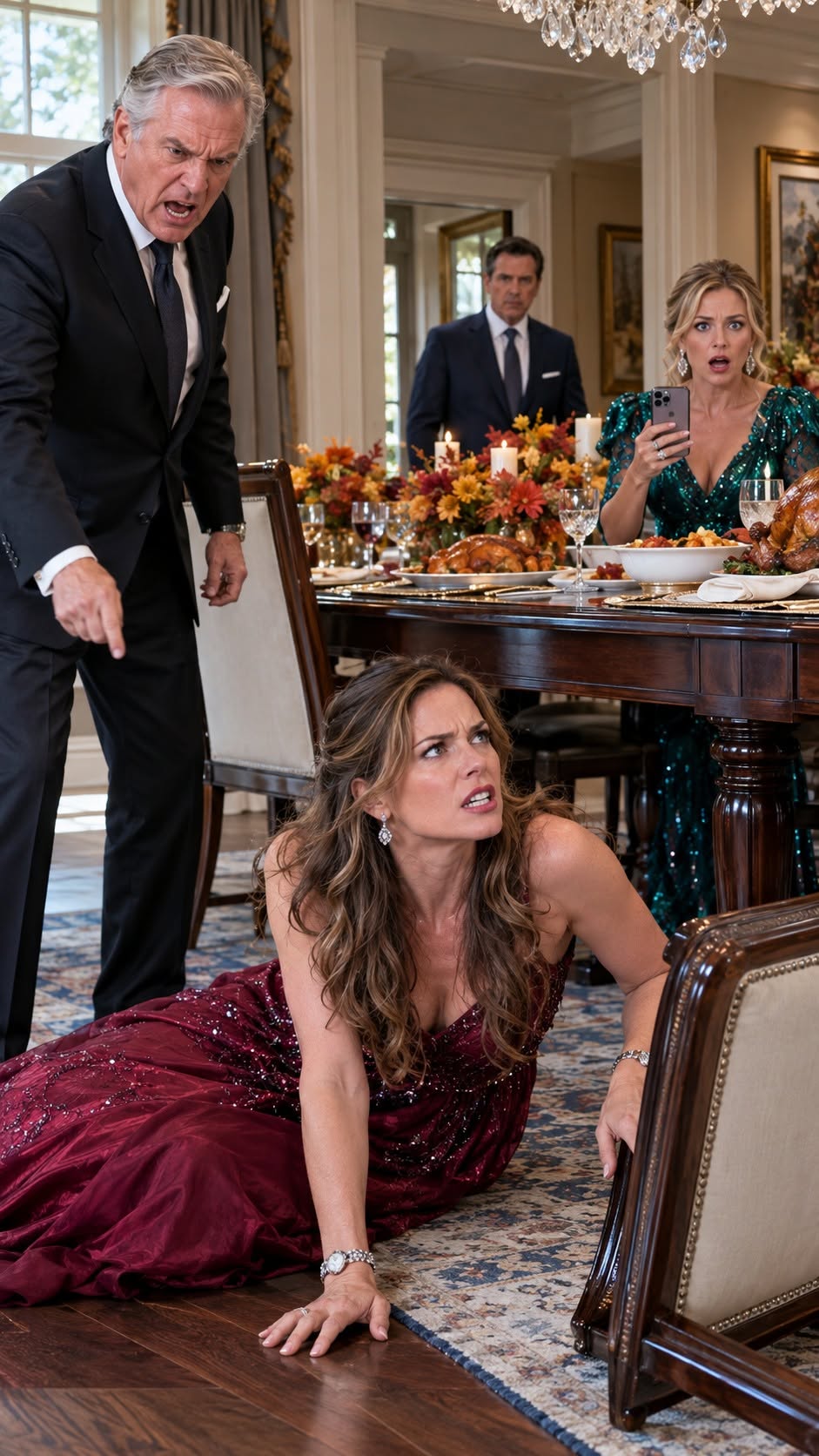
The heavy mahogany doors were already open. The scene inside was staged with theatrical precision. Crystal chandeliers cast a warm, fractured light over a table vast enough to seat twenty, yet only set for three. At the head of the table sat Arthur, nursing a glass of dark red wine, his posture rigid and imperious. To his right lounged my older sister, Layla, draped in designer silk, her phone already resting near her polished silverware like a loaded weapon.
I stepped into the room, my heels clicking sharply against the hardwood floor. The ambient hum of their conversation died instantly.
“Elena,” my father said. He didn’t rise. He didn’t smile. He merely acknowledged my physical presence as one might acknowledge a stain on a rug.
“Arthur. Layla,” I replied, keeping my voice utterly devoid of inflection. I walked toward the single empty chair situated at the far end of the table, miles away from their concentrated orbit of power.
As I reached the chair and began to bend my knees to sit, the atmosphere violently shifted. My father’s hand shot out. With a sudden, vicious jerk, he pulled the heavy wooden chair out from under me.
The wood scraped violently against the floor, a jarring, ugly sound that echoed off the vaulted ceiling. My muscles contracted instinctively, saving me from falling backward, but I stumbled awkwardly, my hands gripping the edge of the table to steady myself.
The silence that followed was suffocating. Then, a soft, cruel giggle drifted from Layla’s direction. She was already lifting her phone, the red recording light blinking like a malevolent eye.
My father stood up, towering over his end of the table. His eyes were flat, cold chips of flint. His voice, when he spoke, was sharper than broken glass.
“I don’t share a table with useless people,” he announced.
The words hung in the air, toxic and heavy. It was a phrase he had utilized when I was a teenager, a weapon designed to shrink me into submission. He expected me to flush with embarrassment. He expected tears. He expected me to gather my things and flee, providing Layla with excellent footage for her private group chats.
A younger, more fragile version of myself would have shattered. But the woman standing in that dining room had stared down hostile boards of directors and dismantled multi-million dollar conglomerates without blinking.
I slowly straightened my spine. I brushed a speck of invisible dust from my jacket sleeve, taking my time, letting the silence stretch until it became uncomfortable for them.
I raised my chin and met my father’s icy stare dead on. My voice, when it broke the quiet, was eerily calm, possessing the quiet danger of a receding tide before a tsunami.
“You just made a very expensive mistake,” I said.
My father scoffed, a short, barking sound of dismissal. He waved a hand in the air, gesturing for the hovering server to refill his wine. He was performing his power, retreating into the delusion of his untouchable mansion, entirely unaware that the structural beams were already snapping.