I accepted money to pose as an elderly lady’s son because I was desperately trying to keep my own mother alive. But then, the woman I was deceiving began holding my hand as if I truly belonged to her, and after she passed away, the nursing home informed me that she had left a final request intended solely for me.
The dashboard clock read 11:47 PM as I pulled my delivery van up to the curb in front of my mother’s apartment building. The rain blurred the streetlights into long, yellow streaks. I sat there for a few more seconds, running the numbers in my head—subtracting the cost of medication from the rent—and arriving at the same result: the math just never added up.
I grabbed the grocery bag and the small paper bag from the pharmacy, then climbed the three flights of stairs.
Mother opened the door before I could even knock, just as she always did. “You shouldn’t be out so late, my dear.” “I’m fine, Mom. I brought your blood pressure pills and the soup you like so much.”
She cupped my face in both hands. Her palms felt warm—the same warmth I had known all my life. “You look tired, Jona.”
“I’m fine, Mom.” I wasn’t fine.
The next morning, I squeezed a coffee shop delivery in between my shifts. A man sat down in the chair opposite me without asking. He looked wealthy. “You’re Jona, right? A friend of mine mentioned you. He said you could use some extra income.” “Who is your friend?” “Doesn’t matter. What matters is that I have a problem, and I think you can solve it.” I should have gotten up and left. Instead, I took another sip of coffee. “My mother lives in a care home,” the man said. “Her name is Rosa. She has dementia. On her good days, she tells anyone within earshot that her son never comes to visit.” “Then why don’t you visit her?” For a brief moment, his gaze drifted to the window. “I can’t see her like that,” he replied. “Business commitments. Relatives asking questions. Family friends. It’s starting to become a problem.” He slid a folded stack of banknotes halfway across the table. “Five hundred euros a week. Weekend visits. Call her ‘Mama.’ Pretend to be Tobias. That’s my name. She won’t notice the difference, Jona. She doesn’t know who’s standing in front of her anymore.” I stared at the money. “That’s not right, Mr…” “Being ‘right’ doesn’t pay your mother’s bills.” The sentence hit exactly where he’d aimed it. “How do you know about my mother?” “I asked around. You’re reliable, Jona. Decent guy. About the right age. You look the part.” I should have refused. I almost did. “Just on weekends?” I asked instead. “Just on weekends. Bring her flowers if you want. Sit there for an hour. Smile. Leave.” My hand moved before my conscience could stop it. I pulled the money toward me and felt its weight in my palm like a small, heavy stone. “When do I start?” He almost smiled. For a second, he looked like a man relieved to shift his burden onto someone else’s shoulders. “Saturday. And Jona: don’t form any attachments.” I nodded, already realizing I had agreed to become someone I wasn’t.
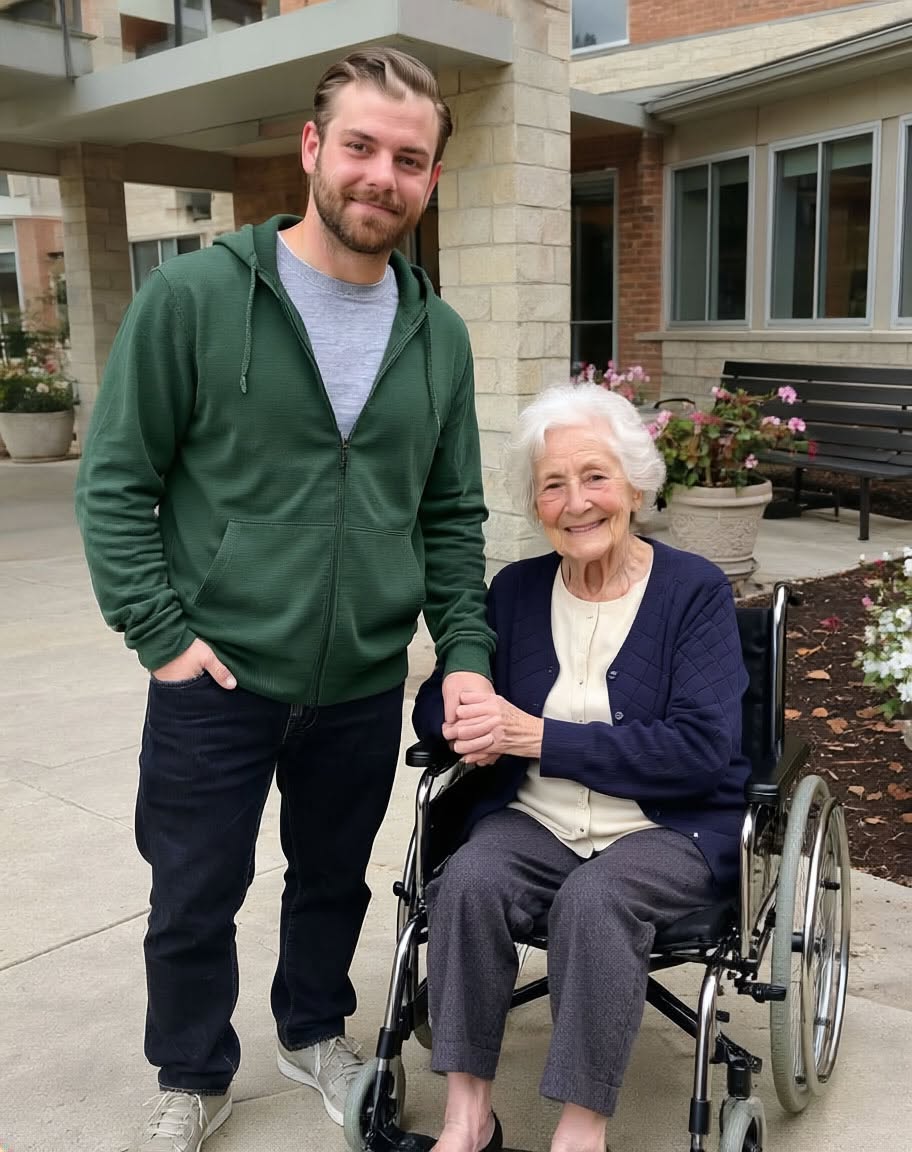
The nursing home corridor smelled of disinfectant and faded roses. My hands were clammy as I repeated the name Tobias—the one he had drilled into me over the phone the night before. Room 214. I knocked once, opened the door, and stepped inside. Rosa was sitting by the window, a thin blanket folded over her knees. She slowly lifted her head and squinted against the afternoon sun. “Mama,” I said, the word feeling unfamiliar on my tongue. “It’s me. Tobias.” For a long time, she simply studied my face. Then her expression softened, and she raised a trembling hand toward me. “There you are,” she whispered. I walked across the room and took her hands. I had expected to feel clever and detached. Instead, a hot wave of shame rose in my throat. “Sit down, sit down,” Rosa said, patting the chair beside her. “Have you eaten? You look tired.” “I’m fine, Mama.” “Are you getting enough sleep, Tobi? You always used to push yourself too hard.” No one had asked me those questions in years. Not after my father left. Not after my mother fell ill.
I stayed for an hour, mostly letting her talk. Rosa spoke of a garden I had never set foot in and a dog I had never owned, and I nodded as if those memories were my own. When I stood up to leave, she squeezed my hand tighter. “Come back soon.” “I will, Mama.” As I turned toward the door, I glanced back and saw tears shimmering in her eyes. She quickly turned away and wiped them with the edge of her blanket.
For my second visit, I brought tulips. For the third visit, I brought a small box of caramel chocolates—the kind the caregiver had told me Rosa liked. I arrived for my fourth visit on a Wednesday, even though Tobias hadn’t paid for that day. In the hallway, I ran into Margarete, a petite woman with sharp eyes and a cardigan that was far too big for her frame. She watched as I walked past her door with flowers in my hand. “You visit her often,” she said. “She’s my mother.” Margarete tilted her head. “She’s the most loyal soul here. You’re lucky.” The way she said it made me look away.
Tobias called that Friday. His voice was tense. “You don’t need to go over during the week, Jona. It’s just a job. Keep it simple.” “She gets lonely.” “She has dementia. She forgets the moment you leave.” I gripped the phone tighter. “Maybe. But she remembers while I’m there.” He hung up.
Weeks turned into months. I started skipping lunch to drive across town. I read the newspaper to Rosa. I massaged her hands when her knuckles ached. One afternoon, she leaned closer, breathing softly, and her eyes were clearer than I had ever seen them. “You’re a good person, my son,” she said. I almost broke down right then. “Mom, I…” “Shh.” She patted my cheek. “I know what I know.” I didn’t understand it at the time. I told myself it was just the dementia—just random words spoken in passing.
That night, I drove home thinking about my own mother and how rarely I sat beside her the way I sat beside Rosa. I vowed to do better. To call more often. To stay longer.
Two days later, my phone rang while I was loading boxes onto the truck. It was the manager of the care home. “Jona. Rosa passed away in her sleep last night.” I set the box down on the wet asphalt. “And she left something for you.”
Three days after the funeral, I sat in the office of the home’s director, Dr. Heike, staring at a sealed envelope lying on her desk. I had prepared myself for grief, not for documents. “She knew you weren’t her son,” Dr. Heike said gently. I looked up. “What?” “Right from the very first visit, Jona. She told me after a week. She asked me to keep her secret.” With trembling fingers, I opened the envelope. Rosa’s handwriting sprawled across the page—sweeping in places, shaky in others, yet resolute. “My dear boy, who is not my boy. My memory failed me, but my eyes never did. I knew your face wasn’t his. I let you stay because you stayed. That was enough. The key opens what I’ve saved. Use half of it for my friends here. They have so little.” I pressed my thumb against the paper. A small brass key slid into my palm. “She left it to you on purpose,” Dr. Heike said. “Not by accident.” Dr. Heike explained that the nursing home’s executor had to notify Tobias as the next of kin, since Rosa had left behind a safe-deposit box and a written bequest. At the time, I gave it little thought.