After my husband’s funeral, I returned home in a black dress that still held the day’s warmth and the lingering scent of lilies. I pushed open the front door, expecting that hollow silence that follows a loss—that heavy, unreal quiet where grief is finally allowed to settle.
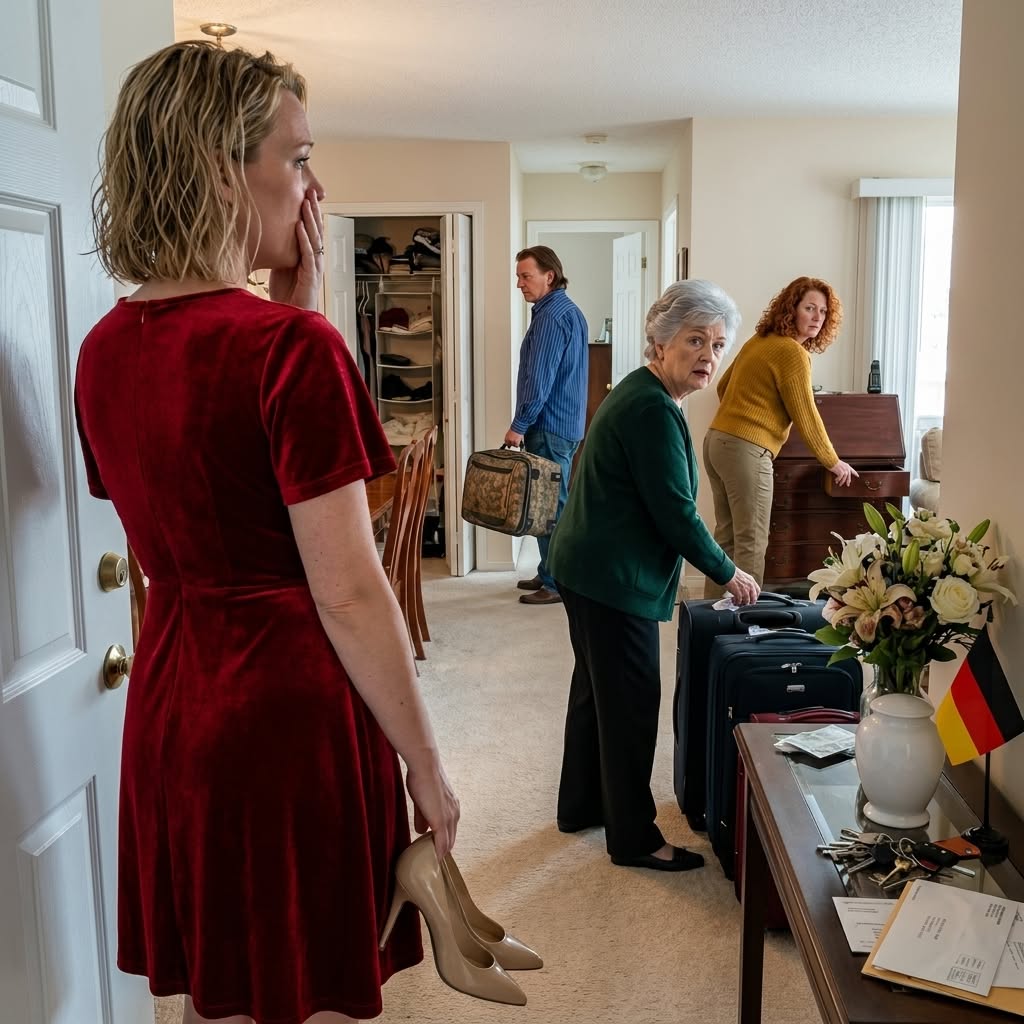
Instead, I stepped into my living room and saw my mother-in-law orchestrating the scene as eight relatives stuffed Lukas’s belongings into suitcases.
For a moment, I honestly thought I had walked into the wrong apartment. Closet doors stood wide open. Hangers scraped against the wood. A suitcase sat on the sofa where Lukas used to read in the evenings. Two of his cousins stood in the hallway, stacking boxes.
On the dining table, next to the bowl where we kept our keys, lay a handwritten list in Margarete Helmer’s sharp, slanted script: Clothing, electronics, documents. And right by the entrance—untouched yet completely disregarded—stood Lukas’s temporary urn, sitting beside the funeral flowers. The sight struck me to the core. Not because it made me cry, but because it showed me how quickly some people move from mourning to looting.
Margarete turned at the sound of the door. She didn’t flinch. She didn’t look ashamed. She simply lifted her chin, just as she always did when she believed she was the only adult in the room.
“You’re back,” she said.
I stood in the doorway, my heels in one hand, my head light from hunger, my whole body too exhausted to feel real. “What are you doing in my home?” I asked.
Margarete ignored the question. She tapped the dining table once with two fingers and said very clearly, “This house belongs to us now. Everything of Lukas’s, too. You have to leave.”
I let my gaze slowly sweep across the room. Frieda was rummaging through drawers. Dominik was zipping up one of Lukas’s travel bags. A younger cousin was carrying framed photos as if they were leftover wedding decorations. No one looked away. No one paused. It was as if I had been buried right along with him.
“Who let you in?” I asked.
Margarete reached into her handbag and held up a brass key. “I’m his mother. I’ve always had one.”
That key hit me harder than anything else. Lukas had asked for it back months ago. He’d told me he suspected she still had a copy, but he wanted peace, not another fight. Now she stood there, using that old access as if it were a right of ownership.
Frieda yanked open Lukas’s desk drawer. Papers shifted. Something inside me tightened. “Don’t touch that,” I said.
She turned around, her expression marked by a kind of cruel satisfaction. “And who are you now?” she asked. “A widow. That’s all.”
There are words that wound. And there are words that clarify. This one clarified everything. I laughed. It burst out of me before I could stop it. Not quietly, not sheepishly, not uncertainly. It was the laugh of a woman who had just realized that the people standing before her had walked straight into a trap set by the one man they had underestimated their entire lives.
Every head turned. Margarete’s expression hardened. “Have you lost your mind?”
I wiped beneath one eye and met her gaze directly for the first time that day. “No,” I said. “You all made the same mistake with Lukas that you’ve been making for thirty-eight years. You assumed he was weak because he was quiet. That he was broke because he was private. Because he didn’t put his life on display to win your approval, you thought he hadn’t built one at all.”
Dominik straightened up beside his suitcase. He was Lukas’s paternal cousin—a man who was constantly borrowing money and always carried with him a strange mix of entitlement and heavy cologne. “There is no will,” he said. “We’ve already checked.”
“Of course you have,” I replied. “And of course, you didn’t find one.”
What none of them knew was that six days earlier—under the sterile hospital lights and amidst the steady hiss of the oxygen—Lukas had predicted this almost word for word. If they come before the flowers wilt, he had whispered, laugh first. Elena will handle the rest.
He had looked pale back then. So pale, as if something fragile and final were glowing beneath his skin. The monitors blinked steadily. Rain streaked down the hospital window in thin, silver lines. He squeezed my hand with the last of his strength and made me repeat his instructions. Call Elena. Don’t argue. Don’t let her take anything. And laugh first.
At the time, I thought the morphine was making him prone to melodrama. Lukas wasn’t a dramatic man. That was one of the reasons I loved him. But then he stated it more clearly: “They won’t come as family, Anneliese. They’ll come as tax collectors.”
He was right. To understand just how right he was, you have to understand who Lukas really was. To his family, Lukas Helmer was the difficult son. The one who kept to himself. The one who moved away. The one who was slow to answer messages, skipped family outings, and never showed up with an open checkbook for every manufactured crisis.
To strangers, he seemed ordinary in a highly trustworthy way. Mid-thirties. Thoughtful eyes. A quiet voice. He alternated between the same two watches. He favored linen shirts, old books, and restaurants quiet enough for reflection. He could disappear into a crowd if he wanted to.
Margarete mistook this for insignificance. She had spent his entire childhood confusing silence with submissiveness. Her world was built on hierarchy, self-presentation, and debt. There was always a cousin who needed saving, an aunt who required support, a family history demanding that someone else pay for its conclusion.
Lukas had been useful because he was capable. He paid bills on time. He read the fine print. He resolved problems without making a scene. Then he met me, and something inside him ceased to be available.
We met in Heidelberg, years before our move to Regensburg, when I was working on a translation for an archival project and he was advising a law firm on cases involving the recovery of historical assets. That is how he described it at first: consulting. A quiet word. Proper. Forgetful. Only later did I understand what this work really meant.
Lukas had a knack for following paper trails. Not the kind of brilliance people make speeches about, but the startlingly practical kind that exposes liars. He could sniff out shell companies, buried trust assets, fabricated transfers, hidden ownership structures, changes in beneficiaries, and forged estate documents. He could look at a stack of dry paperwork and hear the outline of a theft within it.
He had acquired this skill the hard way—first as a legal assistant, then at banks, then working for private clients whose estates had been picked apart by greedy relatives and opportunistic partners. Over time, he began accepting equity stakes instead of fees. Then a silent partnership in a debt-collection agency. Then another in a title-research firm. He used his middle name, Konrad, for most of these ventures—partly for discretion, partly because he already knew what his family did when they caught the scent of money.
By the time I married him, Lukas had done something his relatives would never have believed possible—because believing would have required respect. He had built wealth. Not flashy wealth. Not “yachts-in-the-harbor” wealth. Not social-media wealth. The kind that lies behind clean structures and careful planning. The kind held in trusts and LLCs—accounts that don’t beg to be admired. The kind born of patience and an understanding of how other people hide things. Once, while we were strolling through Regensburg’s Old Town beneath old balconies overgrown with ferns, he said to me: “If you spend enough years tracking down greed, you either become greedy yourself or you become reticent.” He chose reticence.
We lived comfortably, but without excess. For a time, we rented; later, we bought our apartment through a holding company that eventually became part of a trust structure—one I barely noticed, because I trusted him and because he hated it when money dominated a room. We traveled whenever we wanted. We ate wherever we pleased. We collected books, not status symbols. He paid off debts early. He quietly donated to heritage preservation projects and scholarships. He never mentioned a specific figure to his mother.