
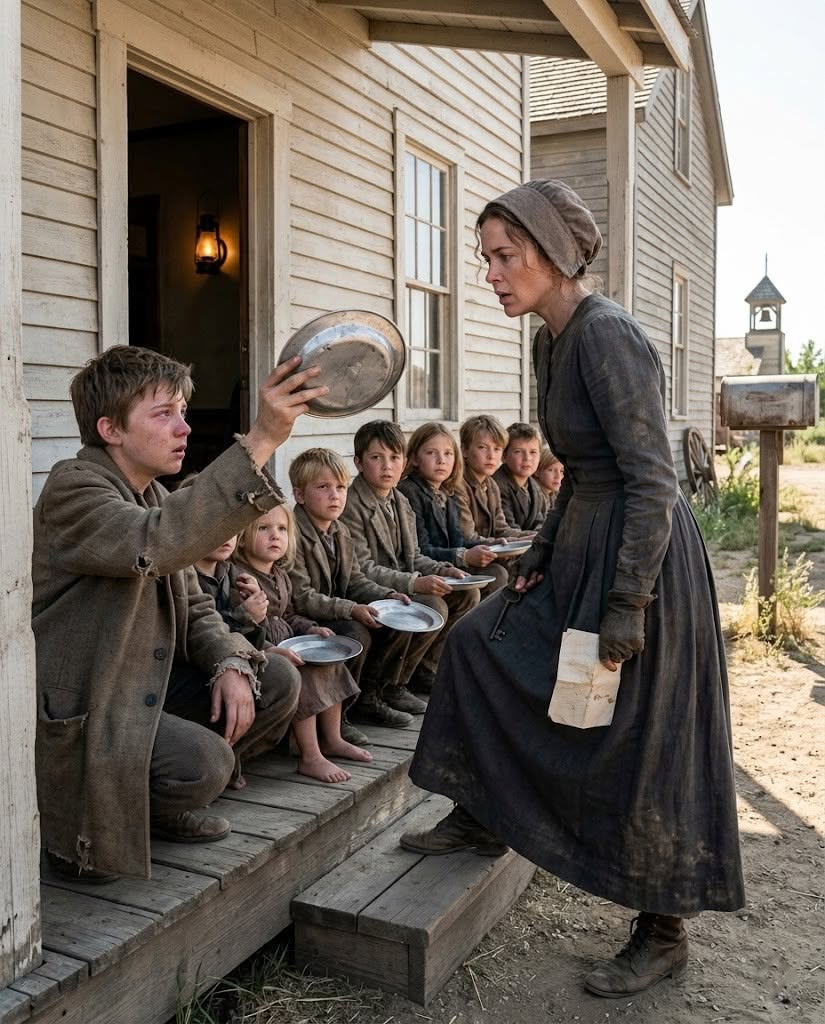
The iron key felt heavier than any house key had a right to feel.
Clara turned it over in her gloved fingers while the wagon groaned beneath her, each turn of the wheel dragging a complaint out of the old axle.
The flats stretched pale and cracked beneath the afternoon sun.
Dust sat in her mouth and clung to the roof of her tongue.
By the time she saw the Sangre Hills rise in the distance, she had not swallowed properly since Redemption Creek, forty miles behind her.
That was where the stagecoach agent had leaned one elbow against the counter, wiped his thumb on his vest, and handed her the folded letter.
“One child, ma’am,” he had said.
He had not said it with sympathy.
He had said it the way a man reads a shipping label.
“Boy. Maybe seven.”
Clara had tucked the letter into her bodice and asked only the questions that mattered.
Was the house standing?
Was there a stove?
Was there any known sickness?
Had anyone sent wages ahead?
The agent had shrugged at the last one.
“Key’s in the packet.”
So Clara had taken the packet.
She had taken the iron key.
She had taken the road.
One child was what she had agreed to.
One child was what she had prepared herself to handle.
Clara had been a contract household mother for seven years, though she never cared for the title.
It sounded too clean.
Too proper.
As if mothering could be hired by the month, folded into a ledger, and ended neatly with a signature.
The work itself was less tidy.
Sometimes it meant cooking for a child who hid bread under the mattress because hunger had stayed longer in him than food ever had.
Sometimes it meant teaching a girl how to sleep without her shoes on because she had learned to run first and rest second.
Sometimes it meant washing a fevered forehead all night and being thanked in the morning by a man who had not bothered to learn where the clean sheets were kept.
Before that work, Clara had taught school in a town that eventually dried up and blew east with the dust.
Before that, she had been a farmer’s daughter in Ohio.
Ohio had given her strong hands, a straight back, and the particular quiet that people mistook for coldness.
It was not coldness.
It was management.
A person only had so much of herself to spend.
Clara had learned early that spending it loudly did not make it last longer.
In seven years, she had gone to nine placements.
Three times, she had stayed after the contract ended because leaving would have done more harm than remaining.
Two times, she had left earlier than planned.
She never discussed those two.
She had learned the difference between a house that was poor and a house that was cruel.
She had learned the difference between neglect born from grief and neglect sharpened into habit.
She had learned to make that judgment quickly.
A slow decision could become a child’s whole winter.
That was the kind of thing people who wrote contracts never understood.
Paper has patience.
Children do not.
The wagon dipped hard into a rut, and the iron key knocked against her knuckles.
Clara looked down at it.
It was plain, dark, and cold from the shadow of her palm.
A key meant a door.
A door meant a room.
A room meant work.
She could make work out of almost anything if the bones of the place were sound.
A stove could be blacked and coaxed back to use.
A flour sack could become dish towels.
A torn blanket could be cut and hemmed into smaller ones.
A frightened child could be given routine before he was asked for trust.
One child.
She held on to that number as the wagon creaked toward Caldera Flats.
The town did not rise into view so much as gather out of the dust.
First came the livery, its roof sagging in the middle like a tired back.
Then a row of low buildings with sun-peeled signs and windows dulled by grit.
Then the church.
The church was missing its bell.
The empty tower stood above the street with an awkward silence, and the bell itself sat in a patch of weeds near the steps.
Someone had meant to rehang it.
Clara could see that much from the road.
Someone had dragged it there, perhaps with a team, perhaps with hope, and then stopped.
That was how towns showed themselves to her.
Not in what they built.
In what they failed to finish.
Caldera Flats had three streets, if one was generous.
A woman in a faded shawl paused outside the dry goods store and watched Clara pass.
A boy near the livery pump stopped working the handle.
Two men under the awning of what might once have been a saloon looked at the wagon and then looked away at the same time.
Clara noticed that.
She noticed most things.
The house stood at the edge of the last street, where the land fell toward a dry creek bed.
It was two stories, clapboard, gray with weather and neglect.
The porch leaned a little to one side.
The upstairs curtains hung unevenly.
One shutter beat softly against the siding whenever the wind found it.
Clara pulled the wagon to a stop and set the brake.
For a moment, she sat with both hands on the reins and let the place speak.
No dog barked.