
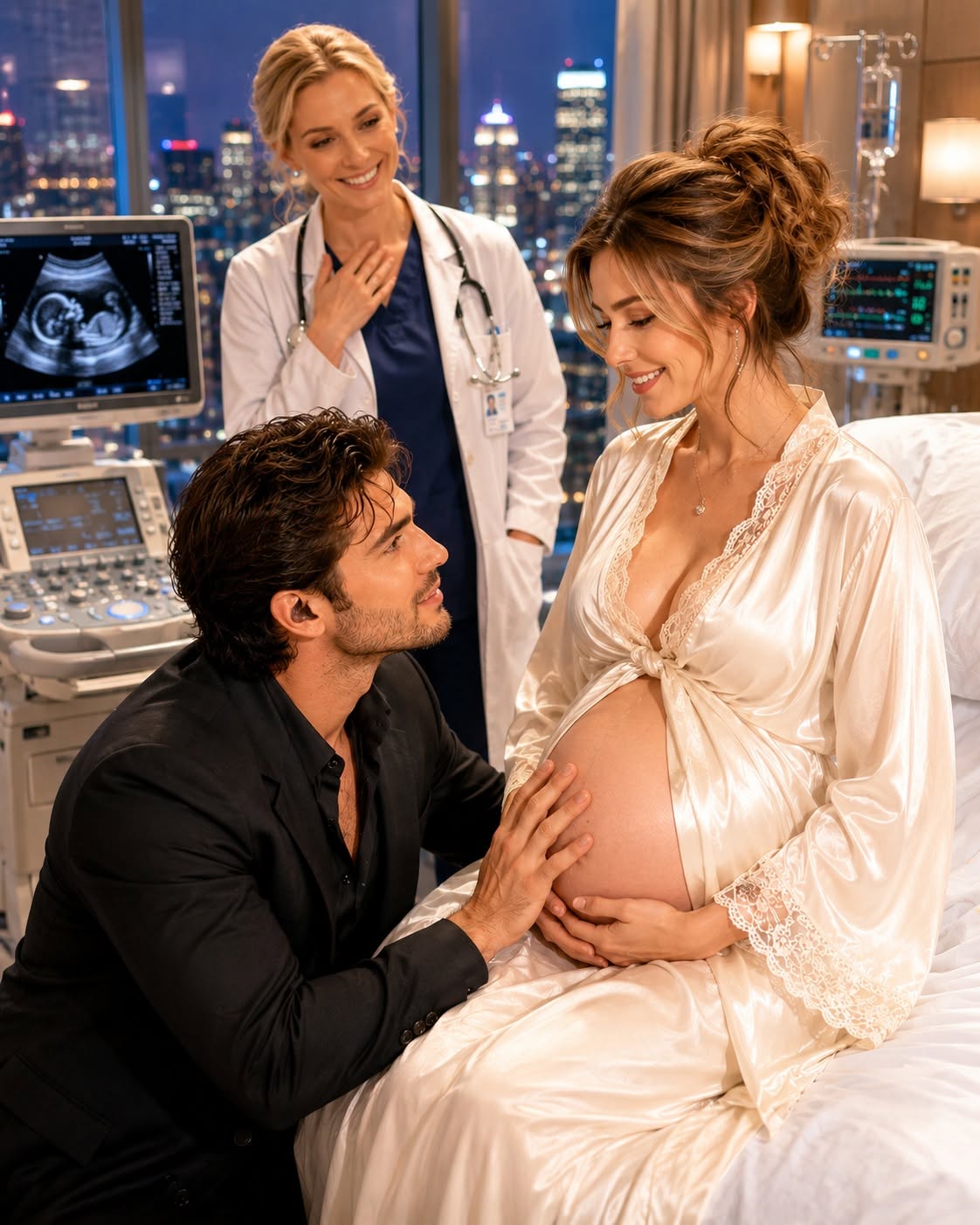
Dr. Rebecca Sloan did not press the emergency button.
Not immediately.
Her fingers hovered over it, trembling just enough for me to notice, and in the quiet of the exam room, that tiny hesitation felt louder than an alarm.
Adrian noticed too.
His hand, which had been resting gently on the edge of the examination bed, curled into a fist. Not in anger. Not the way I remembered from the rare moments when someone had crossed a line in his world and he had decided, silently and completely, that the line would never be crossed again.
This was different.
This was fear.
“Doctor,” he said, his voice low and controlled, “what is it?”
Dr. Sloan looked from the ultrasound screen to me, then to Adrian, then back to the screen again. The warm gel on my stomach suddenly felt cold.
“Rebecca,” I whispered. “What’s wrong?”
She took a breath, the kind people take when they know the next sentence will divide someone’s life into before and after.
“I need you both to stay calm.”
Adrian’s eyes sharpened. “That is not an answer.”
“No,” I said quickly, reaching toward him without thinking.
His gaze flicked to my hand. I pulled it back as if I had touched fire.
Dr. Sloan adjusted the wand again, pressing lightly beneath my ribs. On the monitor, our daughter shifted in that shadowy black-and-white world I had come to know over the past months. Her profile appeared and disappeared. A tiny hand floated near her face. Her heart flickered like a desperate little star.
“She has a strong heartbeat,” Dr. Sloan said. “That’s good.”
I waited.
There was always a “but” after words like that.
The doctor’s brows drew together. “But I’m seeing signs that concern me. There appears to be an abnormality with the placenta, and I’m also seeing some fluid accumulation that I don’t like.”
The room tilted.
I heard the words, but they scattered before they could settle into meaning.
Placenta.
Fluid.
Concern.
Strong heartbeat.
Adrian moved closer to me. “What does that mean?”
“It means,” Dr. Sloan said carefully, “that we need a more detailed scan immediately. Possibly at Northwestern. They have a maternal-fetal medicine team on call.”
“Is she in danger?” I asked.
Dr. Sloan’s expression softened, and that frightened me more than if she had looked clinical and detached.
“You both could be,” she said. “I don’t want to jump ahead until we know exactly what we’re dealing with, but at thirty-four weeks, we have to be careful. There are conditions that can become serious very quickly.”
My hand went instinctively to my stomach.
Our daughter kicked, once, hard, as if objecting to the entire conversation.
I almost laughed.
Instead, I started to cry.
Not loudly. Not dramatically. Tears just spilled out of me without permission, hot and humiliating.
For six months, I had managed everything alone. Rent. Appointments. Back pain. Sleepless nights. The strange loneliness of building a nursery in a small apartment where no one knew my real name. I had learned to be steady because there had been no one there to catch me if I fell apart.
Now, with Adrian standing beside me, impossibly close and impossibly dangerous to my heart, I fell apart in the one place I had sworn I would remain composed.
Adrian’s hand hovered near my shoulder.
He did not touch me.
That restraint hurt almost as much as the fear.
“Rebecca,” I managed, “do we have time?”
“We have time to move carefully,” she said. “Not time to ignore it.”
Adrian turned toward the door. “Call Northwestern. Tell them we’re coming.”
Dr. Sloan gave him a look. “I was going to do that.”
His jaw tightened, and for one old, familiar second, I saw the man everyone else saw—the man who believed the world was a set of locked doors and his name was a key.
Then he looked at me.
And somehow, he softened.
“Please,” he said to the doctor.
That one word hung in the room like something rare.
Dr. Sloan nodded. “I’ll make the call.”
She stepped out, leaving the ultrasound image frozen on the screen. Our daughter’s face remained there in silver shadows, turned slightly away, as if she already had secrets of her own.
The silence after the door closed was unbearable.
Adrian stood beside the bed, his eyes fixed on the monitor.
“I should have known,” he said.
“You couldn’t have.”
“I should have.”
“You divorced me before I knew.”
He looked at me then, and the rawness in his expression took the breath from my lungs.
“I divorced you because I thought it would keep you safe.”
My heart struck painfully against my ribs.
There it was.
The sentence I had wanted for months and dreaded just as long.
“No,” I said. “You don’t get to do that.”
“Do what?”
“Turn abandonment into protection.”
He flinched, almost imperceptibly.
“I know what it looked like.”
“You know what it felt like?” My voice cracked. “I woke up one morning with my husband gone, half my closet empty, and divorce papers delivered by a man who wouldn’t meet my eyes. You didn’t call. You didn’t write. You didn’t explain. You just erased me.”
His face paled.
“I read those papers so many times,” I continued, unable to stop now. “I thought there must be something hidden between the lines. Some sign. Some mistake. There wasn’t. Just your signature. Cold. Perfect. Final.”
Adrian lowered his gaze.
“My father’s enemies had found out about you,” he said. “Not rumors. Proof. Pictures of you leaving the house. Your favorite café. The church where you lit candles for your mother. They knew your routines.”
My breath caught despite myself.
“I wanted to move you out of Chicago,” he said. “You refused the first time I brought it up.”
“I refused because you wouldn’t tell me why.”
“I was trying not to scare you.”
“You scared me anyway.”
“I know.”
Those two words landed quietly.
Not as an excuse.
As admission.
For a moment, the hospital sounds beyond the door faded—the distant ring of a phone, the muted squeak of wheels, someone laughing softly down the hall. All that remained was the impossible sight of Adrian Moretti standing in a small clinic exam room with his shoulders bowed under regret.
“I thought if I made the separation public and convincing,” he said, “they would lose interest. I thought they would believe you no longer mattered to me.”
I wiped my cheek with the back of my hand. “And did they?”
His silence answered first.
Then he said, “For a while.”
My stomach tightened, and not from the baby.
“What does that mean?”
Before Adrian could answer, the door opened.
Dr. Sloan returned, followed by the nurse from the waiting room. The nurse held a folder against her chest and looked far too pale.
“I spoke with the hospital,” Dr. Sloan said. “They’re expecting you. I’d like you to go now.”
“Ambulance?” Adrian asked.
Dr. Sloan hesitated. “That would be safest.”
“No ambulance,” I said immediately.
Both of them looked at me.
I struggled to sit up. “I’m not being wheeled out of here in front of everyone.”
“Elena—” Adrian began.
“No.” My voice came out sharper than I intended. I gripped the edge of the exam table. “I have spent six months trying not to be seen. I’m not walking into a public scene now.”
Dr. Sloan’s expression grew firm. “This is not about pride.”
“It’s not pride.” I swallowed hard. “It’s fear.”
Adrian’s face changed.
He understood fear when it wore another name.
He turned to Dr. Sloan. “Can she travel by car if we go directly?”
“With no delays,” the doctor said. “And if anything changes—pain, bleeding, dizziness—you call emergency services immediately.”
Adrian nodded once. “Done.”
I gave him a look. “You’re not in charge.”
“No,” he said. “You are.”
The words were simple.
I did not trust them.
But I needed them.
The next ten minutes unfolded in pieces.
The nurse helped me clean the gel from my stomach and lower my sweater. Dr. Sloan handed me a sealed envelope of records and a printed referral. Adrian stepped outside to speak quietly to his security chief, Luca, whose face I remembered from our marriage as a permanent study in watchfulness. Luca glanced through the narrow window once, saw me looking, and immediately turned away.
That small courtesy nearly broke me again.
I had thought every person in Adrian’s world existed to serve Adrian.
I had forgotten that some of them had known me too.
When I stepped into the hallway, Adrian was waiting.
Not too close.
Not too far.
“May I carry that?” he asked, nodding to the envelope in my hand.
I almost refused out of habit.
Instead, I handed it to him.
His fingers brushed mine.
Neither of us spoke.
The waiting room had changed in the short time we were gone. Or maybe I had. The faded painting of Lake Michigan looked lonelier now. An elderly man flipped through an old magazine. A young mother bounced a toddler on her knee. Two teenagers whispered by the vending machine.
No one knew that my entire life had just tilted beneath fluorescent lights.
As we reached the exit, the toddler pointed at Adrian.
“Big man,” he said.
Despite everything, I laughed.
Adrian looked startled, then almost smiled.
“Accurate,” Luca murmured from behind us.
Adrian shot him a look.
The look did nothing.
Luca opened the door.
Cold Chicago air swept in, carrying the smell of wet pavement and exhaust. The sky was low and gray, the kind of winter sky that made every building look like it was holding its breath.
A black SUV waited at the curb.
Of course it did.
I stopped.
Adrian noticed immediately. “What?”
“I’m not getting into one of your cars like nothing happened.”
His expression remained calm, but I saw the worry moving behind his eyes. “Elena, we need to get you to the hospital.”
“I know that.”
“Then tell me what you need.”
The question disarmed me.
What did I need?
For six months, I had needed not to miss him. Not to reach for my phone at night. Not to imagine him sitting alone in that enormous house with no music playing because I had been the one who filled silence. I had needed the baby to be healthy. I had needed to believe leaving him had been the only choice.
Now I needed all of that and a ride to Northwestern.
“I sit by the door,” I said.
“Of course.”
“And Luca drives. Not you.”
Adrian nodded. “Of course.”
“And you don’t call anyone about me.”
He hesitated.
There.
There was the man I knew.
“Adrian.”
His jaw worked. “There are people who should be informed if—”
“No.” I stepped closer, lowering my voice. “This is my body. My daughter. My medical appointment. If you cannot accept that, I’ll walk to the hospital.”
“You can barely stand.”
“Try me.”
For a moment, the old battle between us returned—not shouting, never that, but the clash of two people who had loved each other and both believed love meant knowing best.
Then Adrian exhaled.
“I won’t call anyone.”
I studied him.
He held my gaze.
“All right,” I said.
He helped me into the back seat without touching more than my elbow. The gesture was careful, almost formal, and somehow more intimate than the nights we had once moved through our home like we belonged to each other.
Adrian climbed in on the other side, leaving space between us.
Luca pulled into traffic.
Chicago slid past the tinted windows in streaks of stone and glass. The clinic disappeared behind us. The small life I had built under a false calm disappeared with it.
For several minutes, no one spoke.
Then Adrian said, “What is her name?”
I looked down at my belly.
I had imagined telling him in anger, in a courtroom, in some distant future when our daughter asked questions I could no longer avoid.
Not like this.
“Sofia,” I said.
His eyes closed briefly.
“My grandmother’s name.”
“I know.”
When he opened his eyes, there was something in them I could not bear.
“You remembered.”
“I remembered everything.”
The words slipped out before I could stop them.
Adrian looked away first.
Outside, traffic slowed. A bus hissed beside us. Somewhere ahead, a horn blared.
“Sofia Moretti,” he said quietly.
“Sofia Bennett,” I corrected.
He turned back to me.
I braced for argument.
None came.
“Elena Bennett,” he said. “Your mother’s name.”
I nodded. “It felt safer.”
Pain crossed his face, but he accepted that too.
“Bennett suits her,” he said.
My throat tightened.
I hated that he could still surprise me with grace.
A dull ache spread low across my back. I shifted, trying to breathe through it.
Adrian noticed. “Pain?”
“Normal.”
“Elena.”
“I said normal.”
Luca’s eyes lifted to the rearview mirror.
I glared at him. “Don’t you start too.”
His eyes dropped back to the road. “Wouldn’t dream of it, Mrs. Moretti.”
The title struck the car like a match.
Adrian went still.
I looked out the window. “It’s Bennett.”
A pause.
“Yes, ma’am,” Luca said softly.
Adrian did not correct him.
That silence said too much.
At the hospital, everything happened faster than I was ready for.
A nurse met us near a side entrance. Not the emergency entrance, I realized. Adrian had arranged that without making a phone call in front of me. I should have been angry.
I was too tired.
The maternal-fetal medicine floor was warmer than the clinic, brighter too, with polished floors and windows overlooking a city blurred by clouds. Machines beeped behind half-closed doors. Nurses moved with the calm urgency of people who knew panic was contagious and refused to spread it.
A woman in navy scrubs introduced herself as Dr. Priya Nair.
She had intelligent eyes and a voice that made even frightening words sound manageable.
“We’re going to take very good care of you,” she said, shaking my hand first, then Adrian’s. “Dr. Sloan sent over preliminary findings. We’ll repeat the scan, run labs, and monitor the baby.”
“Sofia,” Adrian said quietly.
Dr. Nair smiled. “We’ll monitor Sofia.”
That nearly undid me.
They settled me into a room with a reclining bed and a view of Lake Shore Drive. A nurse strapped monitors around my belly. Soon the room filled with the galloping rhythm of Sofia’s heartbeat.
Fast.
Steady.
Alive.
I stared at the small paper strip printing beside the machine.
Adrian stared at it too.
For once, neither of us knew how to read the thing that mattered most.
Dr. Nair conducted the scan with focused silence. Unlike Dr. Sloan, she explained as she went, pointing out blood flow, measurements, the position of the placenta, the baby’s fluid levels.
Adrian stood near the wall with his arms folded, as if he could hold himself in place by force.
“You can come closer,” Dr. Nair said without looking up. “I don’t bite.”
Luca, standing just outside the door, made a sound suspiciously close to a cough.
Adrian stepped forward.
The monitor shifted. Sofia’s face appeared again, softer this time, one fist tucked beneath her chin.
“She looks like you,” Adrian said.
“She looks like a potato.”
He glanced at me.
I shrugged. “A beautiful potato.”
Dr. Nair laughed, and the tension in the room loosened by a thread.
Then she grew quiet again.
I watched her measure a shadowed area twice.
“What is it?” I asked.
Dr. Nair set the wand down and wiped her hands.
“I’m seeing evidence of a condition called placental insufficiency, and possible early signs of fetal anemia. That means Sofia may not be getting everything she needs as efficiently as she should.”
Adrian’s voice was careful. “Can that be treated?”
“Yes,” she said. “Depending on severity. At thirty-four weeks, delivery may be the safest treatment if the risk of staying pregnant becomes greater than the risk of birth. But I don’t want to decide that based only on one scan.”
My breath grew shallow. “Delivery? Today?”
“Possibly not today,” Dr. Nair said. “Possibly soon. We need labs and monitoring before making that call.”
Adrian moved closer to the bed. “And Elena?”
Dr. Nair looked at me. “Your blood pressure is higher than I like. We’ll watch that closely.”
“I’ve been stressed.”
“I imagine so.” Her tone was kind but direct. “Stress can contribute, but we don’t dismiss numbers just because life is complicated.”
Life is complicated.
That was one way to describe being pregnant with the child of a man half the city feared.
After Dr. Nair left, a nurse drew my blood. Another brought water and crackers I couldn’t eat. Luca stationed himself near the hallway with the discretion of a man who had spent years pretending not to overhear life-changing conversations.
Adrian remained by the window.
The gray afternoon pressed against the glass. Beyond him, cars moved along the drive like dark beads on a string.
“You should sit,” I said.
He turned.
“You look like you’re waiting for sentencing.”
“I am.”
I looked down at the monitor straps around my belly. “Don’t do that.”
“Do what?”
“Make this about your punishment.”
His expression tightened.
I sighed. “I’m scared too, Adrian. I don’t have room to manage your guilt.”
He crossed the room slowly and sat in the chair beside my bed.
“You’re right.”
Those words again.
He had become dangerously fond of them.
I studied him. He looked thinner than he had the last time I saw him. Still broad-shouldered, still immaculate in a dark overcoat and charcoal suit, but there were shadows beneath his eyes. A faint line near his mouth that hadn’t been there before. He looked less like a king and more like a man who had slept badly in a house with too many locked rooms.
“Have you been sick?” I asked.
Surprise flickered across his face. “No.”
“You look awful.”
The corner of his mouth moved. “I missed your tenderness.”
“I was never tender when you deserved honesty.”
“No,” he said. “You weren’t.”
That almost smile faded.
“I looked for you,” he admitted.
I turned my head sharply. “What?”
“After the divorce. After the threat passed. I went to your apartment. You were gone.”
“You told me to leave that apartment in the settlement.”
“I thought you’d use the house in Oak Park.”
“I sold it.”
“I know.”
“Then you didn’t look very well.”
His gaze dropped. “I looked too late.”
The honesty sat between us, heavy and useless.
“Why?” I asked. “Why too late?”
Adrian leaned forward, elbows on his knees. For a long moment, he said nothing.
Then he reached into the inner pocket of his coat and withdrew something small.
A photograph.
He held it like it weighed more than paper.
“I received this two weeks after the divorce was finalized.”
He handed it to me.
The photo showed me stepping out of the café near our old townhouse. It had been taken months before the divorce. I wore a blue dress and sunglasses, one hand lifted to block the sun. Someone had circled my face in red ink.
A chill moved through me.
On the back, written in neat black letters, were three words.
Still your weakness.
My fingers went numb.
“They sent more,” Adrian said. “Places you went. People you spoke to. One of them showed you outside Dr. Sloan’s clinic.”
I looked up, horrified. “When?”
“Before you knew you were pregnant.”
My mind raced backward.
I had gone to Dr. Sloan once before the pregnancy. A routine appointment. Nothing special.
Someone had followed me then.
Someone had known.
“You never told me.”
“I thought telling you would put more fear into your life.”
I gave a humorless laugh. “So you chose grief instead?”
His eyes closed briefly. “Yes.”
I stared at the photo until the edges blurred.
“Who sent it?”
“I don’t know.”
I looked at him.
Adrian Moretti, who knew which alderman took money from which developer, who could identify a crooked accountant from the way he avoided eye contact, who could find a missing shipment in a city of millions, was telling me he did not know.
That frightened me more than the photograph.
“You always know,” I whispered.
“This time, I didn’t.”
The fetal monitor crackled softly. Sofia’s heartbeat galloped on, stubborn and bright.
“Is that why you came to the clinic today?” I asked.
Adrian hesitated.
The answer was yes.
I felt it before he said a word.
“Elena—”
I pushed the photograph back at him. “You didn’t just walk in by accident.”
“No.”
The ache in my chest sharpened into something colder. “You followed me?”
“No,” he said quickly. “Not you.”
“Then who?”
He looked toward the door, where Luca’s silhouette stood beyond the frosted glass.
“A man connected to the photographs.”
My mouth went dry.
“He was seen near the clinic this morning. Luca’s people called it in. I came because I thought…” He stopped.
“You thought I was in danger.”
“Yes.”
“And instead you found me pregnant.”
His throat moved. “Yes.”
I leaned back against the pillow, suddenly exhausted.
The room felt too small for all the secrets we had carried into it.
“You promised no one knew where I was.”
“I did not know until today.”
“But someone did.”
He did not deny it.
The door opened before I could ask more. Dr. Nair returned with a tablet in her hand and a seriousness that made both of us straighten.
“Your labs are back,” she said.
Adrian rose.
I grabbed the sheet covering my knees.
Dr. Nair glanced at him. “You may stay if Elena wants you here.”
It was such a small thing, that she asked me. Yet it steadied me.
I looked at Adrian.
He waited.
No assumption. No command.
“You can stay,” I said.
His face softened.
Dr. Nair pulled a chair closer. “Your blood pressure and labs suggest we may be seeing the beginning of preeclampsia. Not severe at this moment, but concerning combined with what we’re seeing on ultrasound.”
The word landed hard.
I knew it. Every pregnant woman knew it, even if we pretended not to. The dangerous word whispered in waiting rooms and late-night search histories.
“What happens now?” I asked.
“We admit you for observation,” Dr. Nair said. “Steroid shots to help Sofia’s lungs in case we need to deliver early. Continuous monitoring. Repeat scans. If your condition worsens or Sofia shows distress, we deliver.”
Adrian’s face had gone still. “What are her odds?”
“Good,” Dr. Nair said firmly. “She’s thirty-four weeks. That’s reassuring. But good does not mean casual. We take this seriously.”
“And Elena?”
“We take her seriously too.”
Adrian’s jaw tightened again, and for once, I did not resent it.
Because I was beginning to shake.
Dr. Nair noticed. “You’re not alone in this.”
The words were meant kindly.
They were also the one thing I had been trying not to believe.
After she left, nurses moved around me with practiced efficiency. An IV was placed in my arm. Forms appeared. Questions came. Allergies. Pain. Emergency contact.
I froze at that one.
Emergency contact.
For six months, I had written no one.
No spouse.
No family.
No one.
The nurse waited, pen poised.
Adrian looked at the floor.
I remembered my mother’s hands, flour-dusted and warm. My father’s quiet singing in the kitchen. Both gone years before I married Adrian. I remembered how alone I had felt when the divorce papers arrived, how I had sat on the bathroom floor with a positive pregnancy test in my hand and whispered, “What do I do now?” to an apartment that gave no answer.
“Elena?” the nurse asked gently.
I swallowed.
“Adrian Moretti,” I said.
His head lifted.
The nurse wrote it down.
“Relationship?”
The pause lasted less than a second.
But I felt every piece of our broken history inside it.
“Her father,” I said, touching my stomach.
The nurse nodded without comment.
Adrian turned toward the window.
I saw him wipe one hand across his mouth, hiding whatever expression he did not want me to see.
By evening, I had been moved to a private room on the maternity floor. Not luxurious, but quiet. The walls were pale blue, the bed too narrow, the blankets too thin. A small bassinet stood folded in one corner like a promise no one was ready to make.
Adrian sent Luca to retrieve a bag from my apartment.